
Struggling to motivate your kids to revise without it ending in tears and grumpy faces? 😊 Learning while having fun becomes child’s play when you set up an educational treasure hunt, a playful method that turns every riddle into a real win for their memory. Discover our tips for creating coded messages and exciting challenges that will boost their logic while strengthening team spirit.
- Run a successful educational treasure hunt by setting the right goals
- 3 adventure themes to captivate little explorers
- Create riddles suited to each child’s level
- Organise the logistics without losing your head
- Keep up engagement and peer collaboration
- Turn finding the treasure into a learning moment
🎯 Run a successful educational treasure hunt by setting the right goals
Once the scene is set, it’s time to look at the heart of the matter: why and how to turn a simple game into a true learning tool.
📚 Choose the school topics to weave in
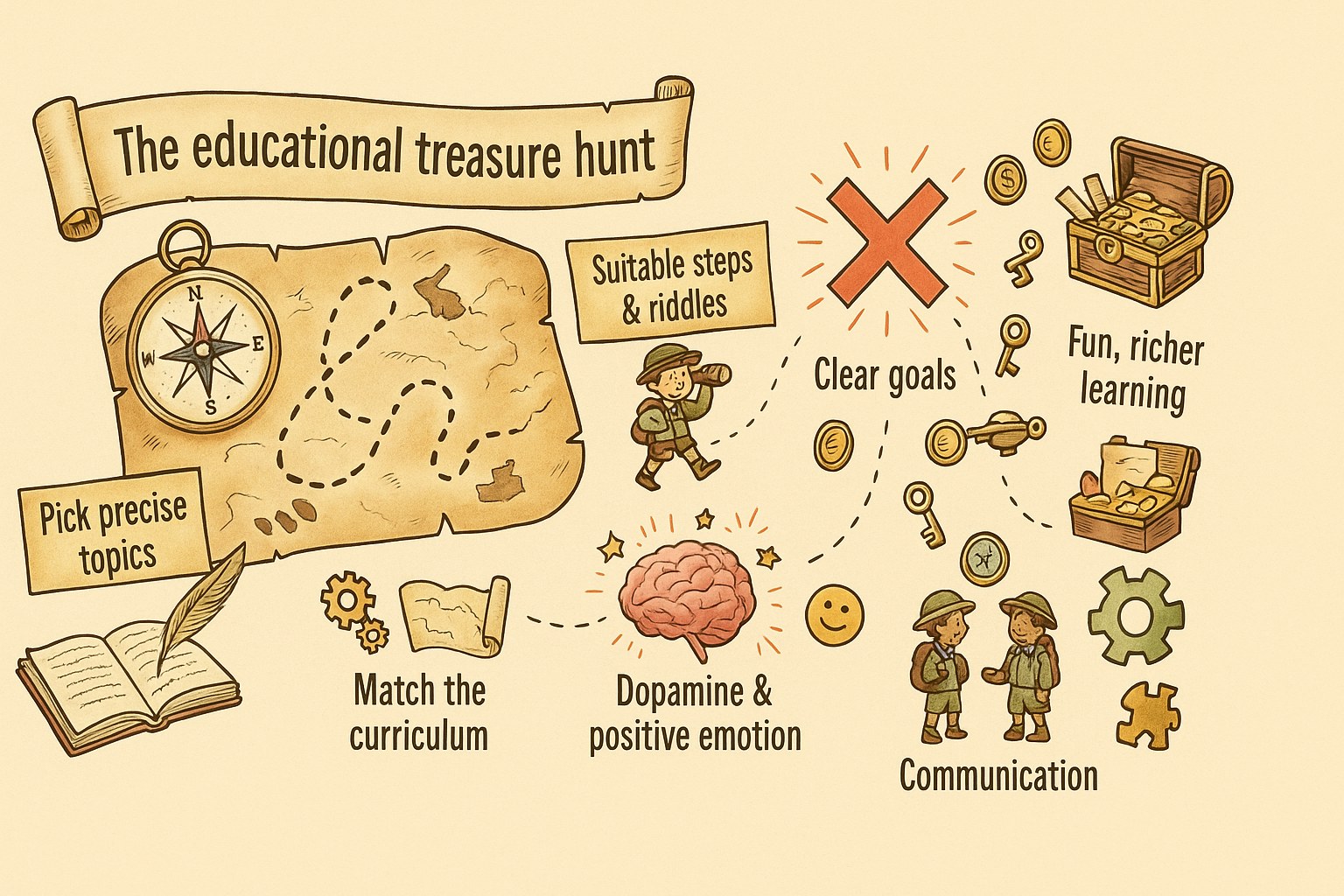
Let’s first target one precise topic to revise. Mental maths or reading instructions both work really well. Let’s avoid overloading the activity.
Next, let’s line the challenges up with the child’s current school curriculum. This reinforces what they’ve seen in class. The game becomes a natural extension of school. Let’s pick one single main theme.
It helps to clearly define your learning goals so you can keep a clear guiding line. Clear aims help the child progress without confusion. That’s the key to success.
🧠 Use neuroscience to boost memory
Fun releases dopamine in the brain. This molecule greatly helps long-term memorisation. The child learns without even realising it. It’s magic and effective.
The positive emotion tied to finding a clue anchors the information. Curiosity acts as a powerful engine for the brain. Every riddle solved confirms a skill. It’s a virtuous circle.
Cognitive engagement multiplies when the child is the driver of their own quest for knowledge through play.
🎲 Build cross-cutting skills through play
Logic and critical thinking are called on constantly. Children have to analyse complex clues. They learn to sort out the useful information to move forward. Organising an educational treasure hunt calls for exactly this rigour.
Spoken communication becomes an essential tool for the team. You have to explain your point of view to others. This strengthens independence and decision-making. Roles rotate naturally among the players.
- Data analysis
- Active collaboration
- Solving complex problems
🗺️ 3 adventure themes to captivate little explorers
Once the goals are set, you need to wrap it all up in a storytelling world that makes them want to push themselves.
🏴☠️ The call of the open sea with pirates
Turn the living room into a stormy ocean. Use maps aged with coffee for immersion. Geography then becomes child’s play.
Teach them to handle a compass to find their way. Slip real sea names into the story. The cardinal points will hold no more secrets. It’s an educational sea quest.
| Theme | Key props | School subject |
|---|---|---|
| Pirates | Compass, map | Geography |
| Detectives | Magnifier, notebook | Logic |
| Time travellers | Dates, costumes | History |
🔍 A mysterious case at the detective office
Create a fictional crime scene with tape. Children love playing experts. Deduction is the star skill here.
Provide magnifying glasses and fingerprint records. Sharp observation lets them dig out the hidden clues. Every detail counts to solve the final riddle. It’s an excellent patience exercise.
To understand how to organise an educational treasure hunt, look into the motivation factors in educational games that truly boost children’s involvement.
⏰ A trip through time to revise history
Travel from Prehistory to the Renaissance. Meet historical figures. The clues are artefacts from the past.
Use key dates as padlock codes. Compare ways of life to spark reflection. History becomes concrete and tangible. It’s far better than a textbook.
- Antiquity (hieroglyphs)
- Middle Ages (coats of arms)
- Modern times (inventions)
🧩 Create riddles suited to each child’s level
The scene is set, but the engine of the game stays the riddle; it has to be just hard enough to stimulate without discouraging.
🧒 Tips for little ones who can’t read yet
For the tiny tots, forget long texts. Replace written clues with close-up photos or clear drawings. The picture speaks for itself for the youngest.
Offer fun physical challenges like hopping on one foot. Hide objects of specific colours, like a red ball, to bring back. This works on gross motor skills with no reading at all. It’s simple and effective.
The visual riddle lets you include the youngest in the group dynamic without creating reading-related frustration.
🔐 Coded messages and rebuses for older kids
Introduce the famous Caesar cipher to encrypt your secret messages. Children love playing with these shifted alphabets, just like Julius Caesar did. It’s an excellent pure-logic exercise for them.
Use rebuses or classic riddles to spice up the adventure. Jigsaw puzzles to piece together can also point to the next spot. Wordplay boosts vocabulary as the complexity gradually rises. It’s genuinely fun.
- The visual rebus
- The word-meaning riddle
- The mirror message
📈 Ramp up the difficulty as the quest goes on
Start with very easy steps to build the players’ confidence. The difficulty should then climb like a little mountain. This keeps a constant dramatic tension throughout the activity.
Adjust the clues in real time if you see they’re stuck. If the group is blocked, give a discreet little nudge. Plan bonus steps for the fastest ones. Everyone has to finish.
A gradual difficulty guarantees an optimal flow of engagement, avoiding boredom for the strongest and discouragement for the weakest.
📋 Organise the logistics without losing your head
Behind the magic of the adventure hides a rigorous organisation to keep the party from turning into a flop.
🏡 Mark out the space, indoors and outdoors
Adapt your hiding spots to the space available. In a flat, use everyday furniture. In the garden, go for discreet natural features like a tree hollow.
Always plan a plan B in case of rain. The weather is sometimes fickle. A quick retreat indoors saves the activity. Clearly mark the allowed play boundaries so no one wanders off.
The safety of the space is your top priority. Check every nook before the start.
⏱️ Manage the group’s time and safety
A length of forty-five minutes is often ideal for 6 to 9 year olds. Beyond that, tiredness catches up with the youngest. Keep a brisk but smooth pace to keep the excitement intact.
Watch the group discreetly. Make sure no one drifts off alone during the quest. Handle the transitions between steps calmly. The fun must stay safe at every moment.
A visible timer can add some spice. Don’t stress the players out too much.
✂️ Design home-made props on a budget
Recycle egg boxes or cardboard tubes. Paper aged with coffee makes excellent scrolls for your educational treasure hunt. It’s cheap and very creative.
Use simple digital tools like QR codes. They hide videos or mysterious sounds. Make your own props out of next to nothing. Imagination beats budget hands down.
Home-made adds a touch of authenticity. Children love handmade objects.
🤝 Keep up engagement and peer collaboration
The materials are ready, but you still have to manage the human side so the group works like a real team.
👀 Techniques to keep children focused
Mix things up to revive interest regularly. Alternate between calm thinking and pure action. A child who moves is a child who pays attention.
Plan playful breaks between two tough riddles. The brain needs to breathe to stay sharp. Switch narrator to liven up the story. Boredom is your worst enemy.
To organise an educational treasure hunt that captivates, try these levers:
- Change of pace
- Physical challenges
- In-between rewards
🤗 Encourage mutual help over competition
Hand out specific roles to each player. One carries the map, another the magnifying glass. Everyone feels useful and involved.
Put individual strengths at the service of the group. Sharing the clues found should be automatic. The victory is shared or it isn’t one. Encourage constant kindness.
Every little win strengthens the group. In fact, that’s the secret to avoiding sulks and bonding the little adventurers.
Collaboration turns a simple fun activity into a life lesson on the power of the group.
💎 Turn finding the treasure into a learning moment
The chest is finally in sight, but the adventure doesn’t stop when it opens; that’s where the learning crystallises.
🎁 Go for a symbolic or tasty reward
Favour personalised certificates over plastic toys. A themed snack rounds off the adventure beautifully. It’s the moment to celebrate the success.
Avoid overly pricey material gifts. Use symbolic objects found in nature. A “magic stone” sometimes has more value. The experience lived stays the real treasure.
Here are a few ideas to mark the occasion:
- Explorer certificates
- Pirate snack
- Chocolate medals
💬 Run a gentle teaching debrief
Go back over what they learned without making it obvious. Ask them how they solved that particular sum. Putting it into words helps fix the knowledge.
Talk about the different solutions the group found. Value everyone’s efforts, even the smallest. This sharing moment wraps up the learning experience. It’s a positive recap.
As people often say in the world of children’s activities:
The debrief is the final step that turns passing fun into knowledge that lasts and is truly understood.
By blending logic riddles, collaboration and immersive themes, you turn revision into a memorable adventure. Set your learning goals right now to boost your little explorers’ motivation thanks to neuroscience. A successful educational treasure hunt promises smiles and knowledge that sticks for good.
❓ FAQ
💎 Why is a treasure hunt such a great learning tool?
A treasure hunt turns learning into an immersive adventure. As they play, the child’s brain releases dopamine, which boosts motivation and helps memorise information long-term with no apparent effort.
It’s a method that calls on both logic and positive emotions. By solving riddles, the child becomes the driver of their own knowledge, which strengthens their confidence and their ability to retain concrete school topics.
🗺️ Which themes are best suited to an educational activity?
The choice of theme depends on the interests of your little explorers and the subjects you want to cover. Pirates are perfect for geography, while a detective case sparks logic and sharp observation.
To revise history, a trip through time from Prehistory to the Renaissance works wonderfully. The idea is to tie the scenario to real elements, like historical figures or natural phenomena, to learn while having fun.
🖼️ How do I create riddles if the children can’t read yet?
No need to read to join the adventure! You can replace texts with photos of spots around the house, drawings or visual rebuses. The picture-based approach is very effective for the youngest.
You can also add physical challenges, like bringing back an object of a precise colour or hopping on one foot. This lets you include everyone in the quest without creating frustration tied to decoding instructions.
🌟 Which skills do children develop during the game?
Beyond pure knowledge, this game develops essential cross-cutting skills like critical thinking and problem-solving. Children learn to sort information and to cooperate towards a common goal.
Communication is also at the heart of the activity. You have to listen to others, share your discoveries and make decisions as a team. It’s a real life lesson on the power of the group and mutual help.
📋 How do I organise the logistics well to avoid stress?
The key to calm organisation lies in preparation. Clearly mark out the play area and always plan an indoor plan B in case of fickle weather. A length of 45 minutes is often ideal to keep attention.
For materials, bet on recycling with cardboard tubes or coffee-aged paper. Imagination often beats a big budget, and home-made props add a touch of authenticity that children love.
🏆 Which reward should I pick to wrap up the adventure in style?
The treasure doesn’t need to be costly to be memorable. A personalised explorer certificate or a themed snack shared together are much-loved symbolic rewards that value the effort put in.
The experience lived stays the finest of gifts. By ending with a gentle little debrief, you help the children put into words what they learned, turning this fun moment into knowledge that lasts.
