
Explaining earthquakes to children feels hard when you’re a little afraid yourself that the ground might give way. 🌍 This article unpacks the mystery of tectonic plates in simple words to turn that fear into a fascinating geology lesson. You’ll discover how our planet moves like a giant jigsaw and learn the right reflexes to reassure your little explorers with complete calm.
- Why does the earth shake under our feet?
- The words to understand earth tremors
- How do we measure the strength of an earthquake?
- From giant waves to small aftershocks
- The right reflexes to stay safe
- Supporting children and having fun with science
🌍 Why does the earth shake under our feet?
Have you ever felt that strange sensation where the ground, usually so solid, suddenly starts to vibrate like a drum? This striking event has its origin far below our shoes.
🧩 The Earth looks like a giant jigsaw
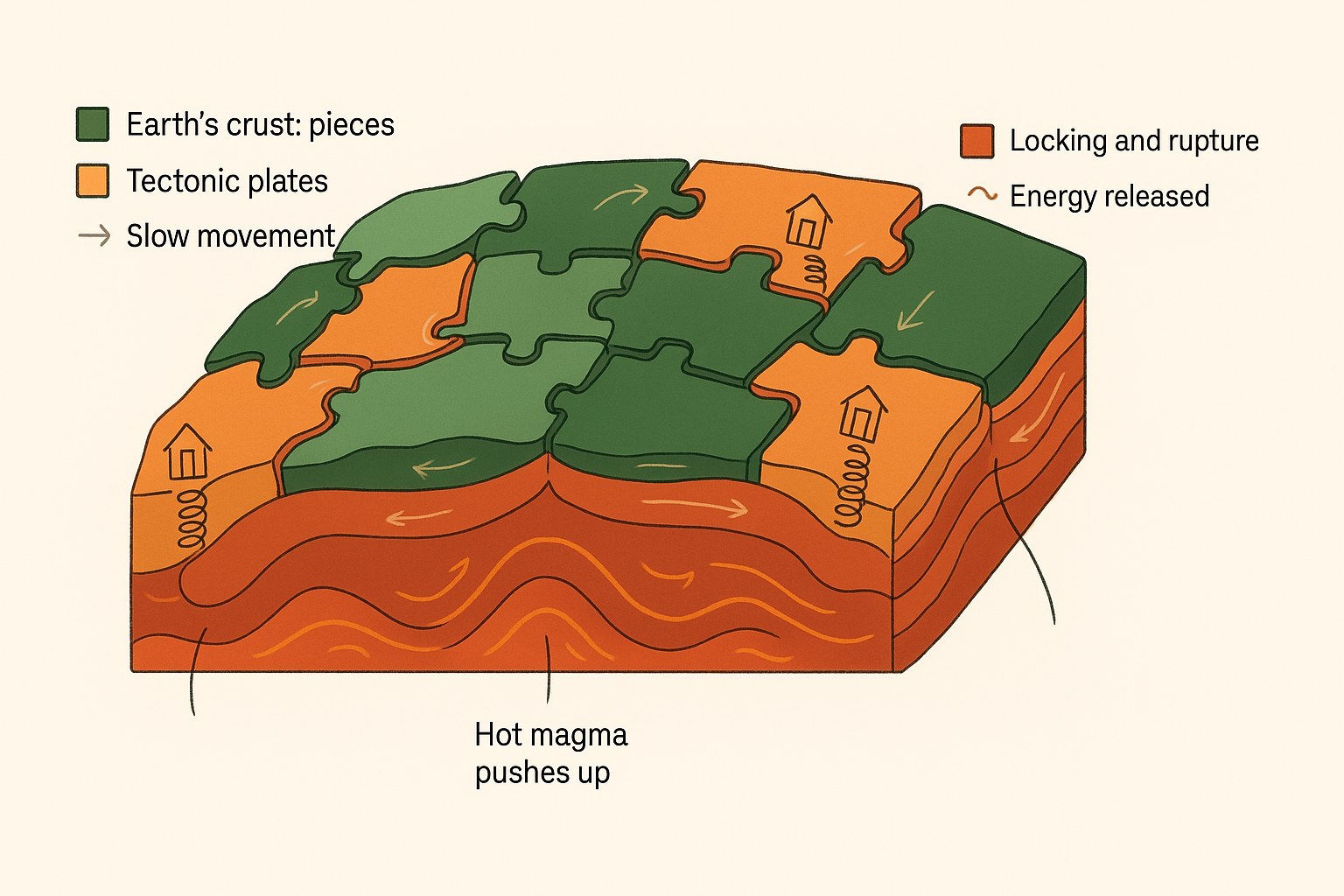
Our planet’s surface isn’t a single block. It looks more like a broken eggshell split into several pieces. This outer layer is called the Earth’s crust.
We call these pieces tectonic plates. They fit together perfectly, like the pieces of a planetary jigsaw. These plates float on a layer of hotter, more pliable rock just below.
So the Earth is completely broken up. It’s exactly this fragmented structure that allows geological movement.
🪨 Plates that move ever so slowly
These plates move only a few centimetres a year. To picture that speed, just imagine your fingernails growing. It’s an extremely slow journey.
The scorching magma, hidden beneath the lithosphere, acts like an engine. This heat pushes the jigsaw pieces and forces them to drift very slowly over the asthenosphere.
This constant movement stays completely imperceptible. Day to day, no one feels the earth move despite this endless underground activity.
⚠️ When the jigsaw pieces get stuck
Sometimes, two plates rub against each other. They end up locking together. At that moment, colossal energy starts to build up in the rock.
Then comes the moment of sudden rupture. The rock gives way under the enormous pressure. All the stored energy releases in one sharp burst, creating a crack called a fault.
This violent shock causes the tremor. The earth finally shakes under the force that’s been let loose.
📖 The words to understand earth tremors
Once we understand that tectonic plates shift under our feet, it helps to name precisely what happens during a rupture.
🎯 The focus and the epicentre without getting muddled
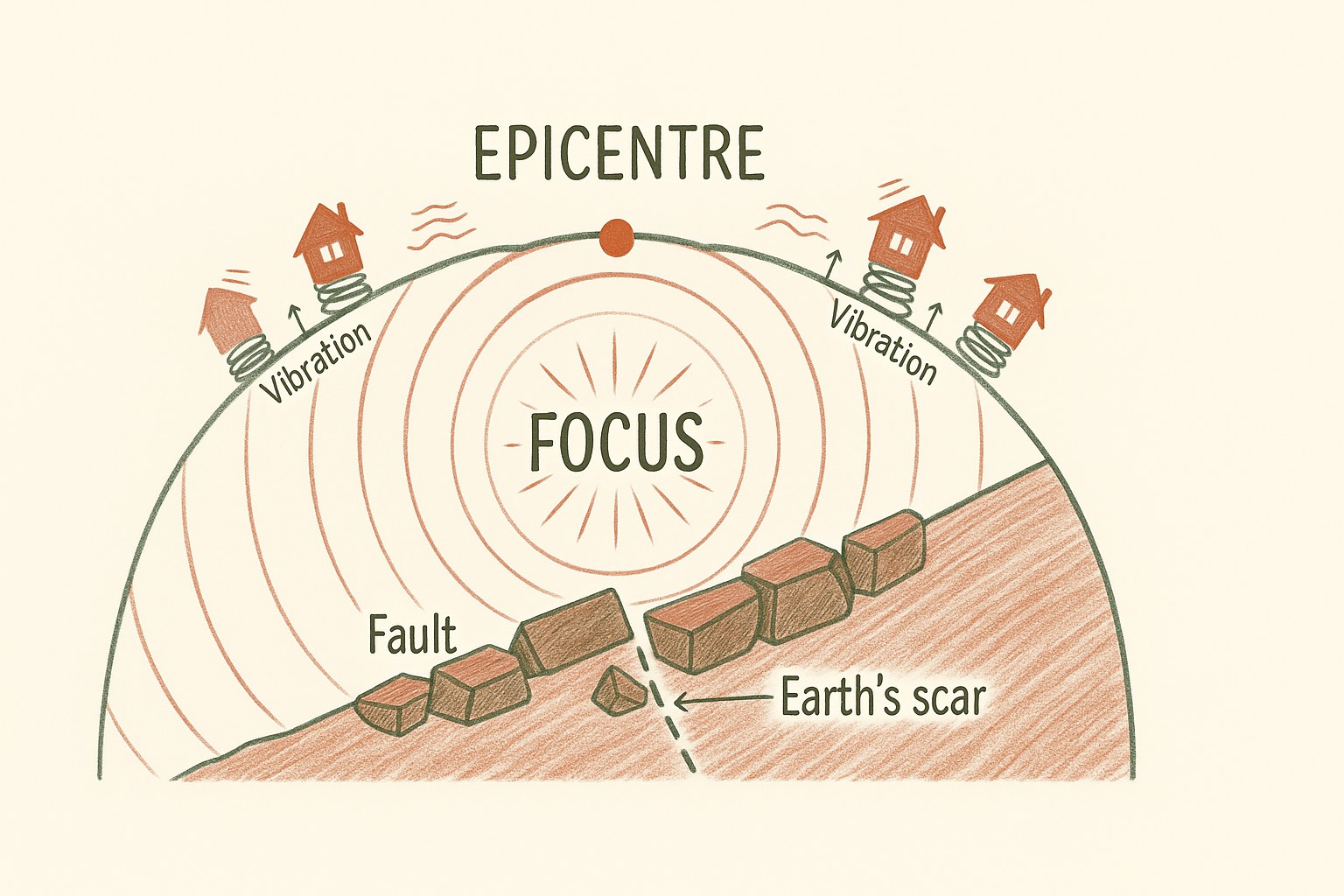
The focus is the starting point deep down. That’s where the rock breaks first. It happens far below our feet.
The epicentre sits just above, at the surface. It’s the spot where the vibrations are strongest. People there feel the most shaking.
You can think of it this way:
The focus is the hidden heart of the earthquake, while the epicentre is its visible face.
🩹 The fault, or the Earth’s scar
The fault is a big crack in the ground. It marks the boundary between two blocks of rock. These blocks have moved against each other.
These breaks are often found at the edges of plates. Some famous faults are visible to the naked eye. You can see them right there in the landscape.
It’s a real scar on the Earth. It bears witness to past tensions. It also shows our planet’s present tensions.
〰️ Seismic waves travel everywhere
Picture ripples in water. When you throw a stone into a pond, the wave spreads out. Earthquakes, tectonic plates and vibrations work the same way.
The energy travels through the different layers of the ground. The waves make the rocks vibrate. Then they make buildings shake and everything around us.
These waves are invisible. And yet, we feel them pass.
📏 How do we measure the strength of an earthquake?
To really understand a danger like earthquakes and tectonic plates, you first have to learn to measure it very precisely.
📈 The seismograph that draws the tremors
The seismograph is scientists’ main tool for watching the Earth. This device has a special stylus. It traces lines on a roll of paper that turns non-stop.
The stylus stays still thanks to inertia while the ground moves. The drawing it produces is called a seismogram. It shows the exact size of the tremors recorded by the machine.
Here are the three key things to remember:
- The seismologist who analyses.
- The seismograph that records the vibrations.
- The seismogram, which is the written result.
🔢 The Richter scale and the magnitude numbers
The Richter scale lets us rank the power of a tremor. Each number stands for a force ten times greater than the one before. It’s a universal tool used by all the world’s experts.
We can use simple comparisons. Level 3 is like a big lorry going past. But level 7 can destroy whole cities very quickly.
The magnitude shows the total energy released. It’s the earthquake’s power score.
👁️ Why some earthquakes are invisible
Here’s a reassuring thought: the Earth shakes all the time. Thousands of micro-earthquakes happen every day. No one notices them because they’re tiny.
Only the high numbers on the scale are truly worrying. Most tremors stay too weak. They don’t even shift the furniture in the house.
| Magnitude | Feeling | Risk |
|---|---|---|
| Under 3 | Not felt | None |
| 3 to 5 | Light vibration | Very low |
| 5 to 7 | Possible damage | Moderate |
| Over 7 | Major earthquake | High |
🌊 From giant waves to small aftershocks
After understanding how tectonic plates collide, it helps to look at what happens just after the tremor.
🌊 When the sea stirs and creates a tsunami
When an earthquake strikes under the ocean, the seabed moves suddenly. This movement shifts a colossal amount of water. A huge column of seawater rises up.
The tsunami wave is born and travels very fast out at sea. It stays low and quiet in the open water. Yet it grows enormously as it reaches the sandy coasts. It then becomes a wall of water.
So a tsunami is a sea-borne earthquake. It’s an impressive chain reaction.
🔁 Aftershocks, or the Earth’s little reminders
Aftershocks are secondary tremors. They come after the main earthquake. We feel them a few minutes or even several days later.
The Earth simply needs to settle. The blocks of rock crack a little more. They’re looking for their final place after the great initial rupture of the plates.
These aftershocks are often weaker. Even so, they’re closely watched by local authorities.
📜 Historical examples to picture it better
The San Francisco earthquake of 1906 is famous. A huge fault literally tore the landscape apart in California. The city suffered enormous damage from the tremors.
Japan is also a country very used to vibrations. People there have learnt to live with this force. They build solid buildings to protect everyone.
History teaches us that the Earth is alive, and that its strength sometimes outdoes all human structures.
🛡️ The right reflexes to stay safe
Moving from scientific theory to real practice lets you know exactly how to react if the ground starts to move under your feet.
🏠 Protecting yourself at home or at school
The top piece of advice is to shelter immediately under a sturdy table. You must protect your head and neck with your arms from the very first tremors. You stay put.
Some areas are dangerous and must be avoided. Stay away from windows that can shatter. Also avoid big furniture or heavy shelves. Don’t try to run outside during the tremor.
Here are the three moves to remember:
- Drop
- Cover
- Hold on
🚶 What to do if you’re outside
If you’re outdoors, get quickly to an open space. You need to stay away from buildings, where roof tiles or bits of facade could fall. That’s the golden rule for staying safe.
Remember not to stand under power lines. Poles can topple under the force of the earthquake. Trees are also areas to avoid first, because branches can break.
Calm is your best ally. Once in a safe spot, you must wait for the vibrations to fully stop. Don’t rush back inside until everything has settled.
🏗️ Solid houses that dance with the ground
Engineers now use earthquake-resistant construction. These are buildings designed to absorb the shocks without collapsing on the people inside. It’s a bit like giving superpowers to the walls of our houses.
The secret often lies in flexible foundations. Some buildings sit on huge springs or rubber shock absorbers. They literally dance with the ground instead of resisting and breaking.
This modern architecture saves lives every day. It makes cities sitting on faults much safer for families. Earthquakes, tectonic plates and safety go hand in hand.
🔬 Supporting children and having fun with science
Tackling earthquakes calls for a mix of gentleness and concrete facts. Here’s a fun, teaching-friendly approach to take the drama out with the youngest ones.
💬 Explaining the unpredictability without scaring them
Science can’t predict the exact time of an earthquake. We know the planet’s risk zones well. But the precise moment it triggers stays a mystery for researchers.
So it helps to prepare calmly. Knowing what’s happening under our feet is reassuring. It means we can avoid panicking when the tremors actually come.
Knowledge is the best shield against the unknown. Let’s stay honest but always very reassuring with them.
🧪 Experiments to do in the living room
You can use biscuits placed on top of cream. The biscuits stand for the Earth’s plates. The cream mimics the magma that makes them slide very slowly every day.
Take a sponge to show how rocks deform. You press hard on the sides until it twists. The rock builds up energy this way before breaking suddenly.
These little games make earthquakes and tectonic plates very concrete. They turn fear into curiosity.
🤗 Easing anxiety after the news
You should let your child express their fears freely. The images on television can be striking at times. Talking through the emotions they feel helps a lot to release the built-up stress.
Reminding them of the safety measures you learnt together gives back a sense of control. We explain that rescue teams are organised to help everyone. This soothes worries linked to the unexpected.
The Earth is powerful, that’s true. But we are well prepared.
Understanding that our Earth moves like a giant jigsaw helps us tame its tremors. By knowing the tectonic plates and the right safety reflexes, you turn worry into thrilling scientific curiosity. Stay ready and calm: knowledge is your best protection for the future. ✨
🎬 Watch the video
❓ FAQ
🧩 What exactly is a tectonic plate, for a child?
Imagine the Earth is covered in a giant shell, a bit like a hard-boiled egg with a cracked casing. These big chunks of rock are called tectonic plates. They aren’t welded together but fit like the pieces of an enormous planetary jigsaw covering the whole surface.
These plates float on very hot magma and move all the time, but really very slowly. They shift only a few centimetres a year, roughly the speed at which your fingernails grow. That’s why we don’t feel anything day to day!
📍 What’s the difference between the focus and the epicentre?
The focus is the hidden starting point, deep inside the Earth. It’s the exact spot where the rock finally breaks and releases all its energy. It’s a bit like the starting point of a crack when you bend a wooden stick until it snaps.
The epicentre is the point right above it, but this time at the surface of the ground. That’s where the tremors are usually strongest and most striking for us. To keep it simple: the focus is the heart of the earthquake under our feet, and the epicentre is its address at the surface.
📈 How does a seismograph work to measure earthquakes?
The seismograph is scientists’ favourite tool for drawing the ground’s vibrations. It has a suspended weight that stays nice and still while the rest of the device moves with the Earth. A small stylus then traces lines on a roll of paper that turns without stopping.
The drawing it produces is called a seismogram. The bigger and more zigzagged the lines, the stronger the tremor was! Today, modern versions use electricity to be even more precise, but the principle stays the same: turning an invisible tremor into a very real drawing.
📊 What is the Richter scale we hear about on the weather?
It’s a kind of universal graded ruler that gives a power score to the earthquake, which we call the magnitude. Every number counts a lot: a level-4 earthquake is ten times stronger than a level 3! The small numbers mean vibrations we barely feel, like a big lorry going down the street.
But as soon as we go past number 7, we’re talking about a major earthquake that can do a lot of damage. It’s a really handy tool that lets experts all over the world understand each other instantly when they analyse the strength of a tremor.
🌊 Why can an earthquake cause a tsunami?
A tsunami happens when the earthquake decides to strike under the ocean. The sudden movement of the plates on the seabed lifts a huge column of seawater all at once. This creates a wave that travels very fast, a bit like ripples when you throw a pebble into a pond.
Out at sea, the wave is almost invisible because it isn’t very high. But as it reaches the coasts, where the water is shallower, it suddenly grows into a giant wave. That’s why a tsunami is often called a “sea-borne earthquake”.
🆘 What should you do if you feel the ground move at home?
The number-one reflex is to protect your head and neck! The best thing is to slip quickly under a sturdy table and hold on to it. You also need to move away from windows that could shatter and from big furniture, like bookcases, that might topple over.
If you’re outside, look for a nice open spot, away from buildings, trees and power poles. The most important thing is to stay calm and wait for all the vibrations to stop completely before moving. Take a deep breath, follow the instructions, and everything will be fine!
