
Does your child dream of touching the stars but you have no idea where to start to support such a sky-high ambition? Discovering how to become an astronaut turns this distant wish into a concrete path mixing science, sport and perseverance. 🚀 This article explains the selection stages used by space agencies and reveals the secrets of the rigorous training that prepares future little explorers to reach for the Moon.
- How to become an astronaut as a kid
- The school subjects to focus on
- A sharp mind in a healthy body
- What life in weightlessness is really like
- A job open to every kind of person
- Training while having fun at home
👨🚀 How to become an astronaut as a kid
Let’s start by exploring what this dream job really means so we can understand the mission waiting for future explorers.
🔬 Working for science up there
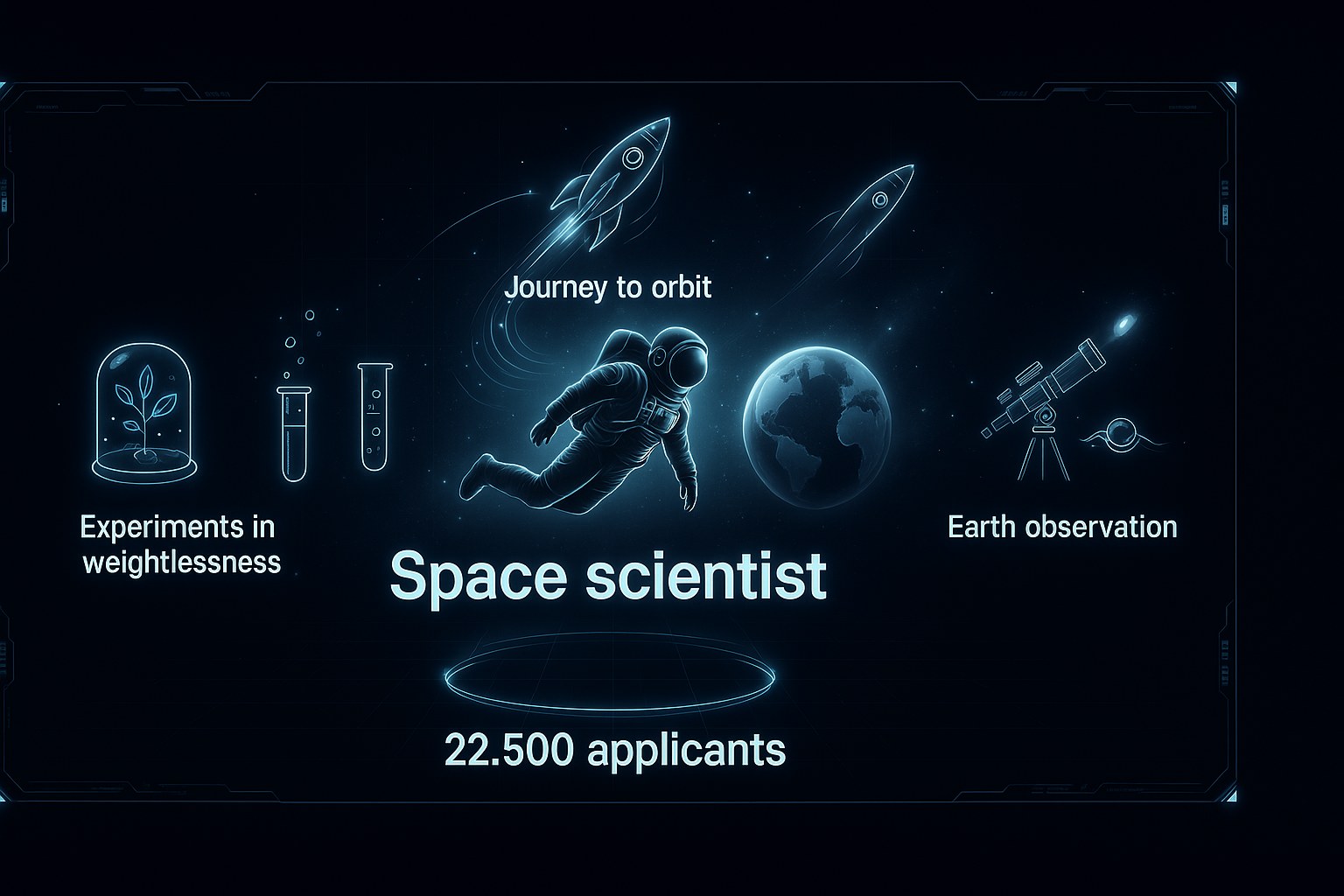
An astronaut is above all a passionate scientist. They carry out experiments that are impossible to do on Earth. That’s because gravity changes everything down here.
In orbit, they study how plants grow or how the human body works. It is a giant laboratory that floats. Every little action truly counts for science. They even monitor their sleep with sensors.
The goal is always to help humanity. That is how we uncover the secrets of the universe.
🔑 A very exclusive club
Very few people have seen the Earth from up there. Spots are rare and the selection is tough. So you have to be patient.
For the European Space Agency, the selection numbers are dizzying. Out of 22,500 candidates, only a chosen few earn their ticket to the stars.
It is indeed an exceptional job. But every child still has a chance by working hard.
🔭 Don’t mix it up with an astronomer
You have to tell apart the one who travels from the one who observes. The astronomer stays calmly on the ground with their telescope. Their job is to analyse the light from the stars.
The astronaut, on the other hand, climbs into the rocket. They handle the equipment and live in the station. These are two jobs that complete each other to explore the infinite.
One looks at the sky while the other lives in it. Both love mathematics.
📚 The school subjects to focus on
To reach these heights, it all begins at school with a few key subjects to master.
🔢 Maths and science without fear
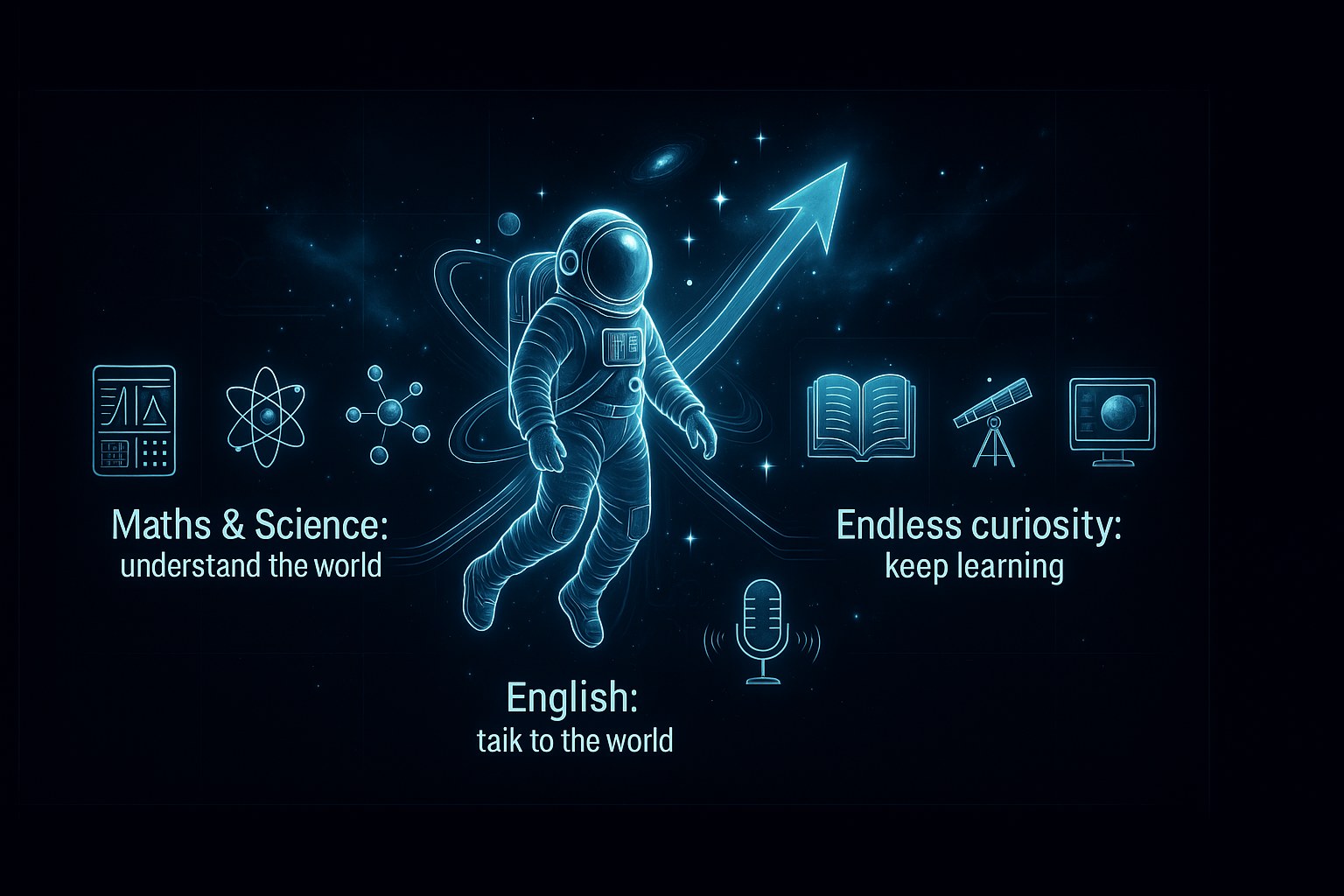
You don’t need to be an absolute genius to succeed. Maths is used to work out flight paths. Physics explains why you float up there. Chemistry helps you understand the air you breathe.
Above all, you have to enjoy understanding how the world works. Science is a set of magical tools for explorers. It lets you solve complex problems.
Be curious in class. Ask questions about everything around you.
🇬🇧 English to chat with the whole world
Space is an international adventure. Astronauts come from every country in the world. They have to understand each other to work safely.
English is the official language. It is essential for talking with colleagues.
Speaking several languages is a huge advantage. It lets you make friends everywhere on the planet.
🔍 Keeping your curiosity wide awake
School isn’t everything. You should read books about the stars at home. Watch documentaries and learn on your own.
Here are a few ideas to feed your passion every day:
- Subscribe to science magazines
- Visit space museums
- Use a sky-mapping app
A future astronaut never stops learning. The thirst for knowledge is their most powerful engine for success.
💪 A sharp mind in a healthy body
But knowledge isn’t enough; your body and mind also have to be ready for the great journey.
🏃 Moving your body regularly
Sport is a must to stay in shape. In weightlessness, muscles go all soft. You need to be strong before heading up there.
Choose an activity you really enjoy. Whether it’s judo, swimming or football. What matters is moving every week.
A healthy lifestyle is essential. Eating well and sleeping well prepare your body for future missions.
🤝 Becoming a teamwork pro
You never go to space alone. Success depends on the help shared between members of the group. You have to know how to listen to others and help them. A good teammate is worth more than a lone genius.
Learn to share your ideas calmly. Mutual respect is the foundation of any space mission.
The strength of the crew lies in its ability to turn every individual into a solid link in an unbreakable chain.
🧘 Learning to stay calm everywhere
Space can be impressive or stressful. You have to know how to breathe and keep your cool. Managing your emotions is something you can learn right now.
If a problem comes up, don’t panic. Think through a solution step by step. That is what we call mental resilience.
Strategy games help a lot with this. They teach you to stay focused despite the pressure of time.
🌌 What life in weightlessness is really like
Once the training is over, daily life among the stars looks like a very real science-fiction adventure.
🛰️ Life on board the station
Eating becomes a funny challenge. The food floats away if you don’t strap it down. People often use straws to drink their juice.
To sleep, you slip into a sleeping bag fixed to the wall. Without it, you would drift all over the cabin. Washing is done with damp wipes. There is no normal shower up there.
It is a strange but fascinating life. Every everyday action is a little discovery.
🏋️ Training in specialised centres
Before leaving, astronauts train in huge swimming pools. This simulates the feeling of floating in the void. They wear very heavy suits.
They follow rigorous initial training to get ready. They also learn to survive in the jungle or the cold.
Flight simulators are essential too. They let you pilot the spacecraft like in a video game.
🛠️ The different technical specialities
Not everyone is a pilot. Some are doctors or engineers. Each member has a precise role for the mission.
| Job | Main mission | Quality needed |
|---|---|---|
| Pilot | Flying the spacecraft | Precision |
| Mission specialist | Scientific experiments | Curiosity |
| Flight engineer | Technical maintenance | Ingenuity |
| Commander | Team management | Leadership |
You can choose the path that excites you the most. Space needs every kind of talent.
🌟 A job open to every kind of person
Modern space adventure aims to be more inclusive, proving that the stars belong to everyone.
👩🚀 More balance in the missions
Women take up a bigger and bigger place. They command stations and carry out spacewalks. Gender no longer limits dreams.
Agencies look for varied profiles to grow stronger. Cultural diversity is an incredible strength for the crew. We learn a lot from each other’s differences. That is how humanity moves towards Mars.
Girls or boys, go for it without hesitation. The future of space is waiting for you all.
🌍 Space for everyone
Disability is no longer an unbreakable barrier. Programmes are studying how to adapt spacecraft for everyone. Motivation is the most important criterion.
Thanks to a space agency, the first parastronaut joined the official ranks. He shows that anything is possible.
Courage and willpower open the doors of the rockets. Don’t let anyone tell you it’s impossible.
🛤️ Original life paths
There isn’t just one set route. Some were soldiers, others researchers or even teachers. Each journey brings a unique experience to the group.
The road to the stars is not a straight line, but a mosaic of courageous earthly experiences.
The important thing is to stay true to your passions. Your own story will be your best strength in the selection.
🏠 Training while having fun at home
While waiting to apply, you can already turn your bedroom into a real control centre.
🚀 Simulating a mission in your bedroom
Invent role-playing games with your friends. Imagine that your bed is a space module. Handle pretend breakdowns and find solutions.
Look out for hands-on “astronaut for a day” activities offered by space agencies. They are a great chance to test your abilities. The idea is really brilliant.
Do balance or concentration exercises. Try building scale models with precision and calm. That helps a lot for later on.
🔭 Using space discovery tools
Download apps to spot the Space Station. Look at the stars with a sky map. Learn to recognise the main constellations.
- A stargazing app for astronomy
- A space agency website for images
- Space videos made for children
The internet is full of free and exciting resources. Make the most of them to feed your imagination every day. It is an incredible opportunity.
🎯 Setting yourself step-by-step challenges
Don’t aim for the Moon straight away. Start by acing your next science test. Learn ten new English words every week. These little victories build your future success. Patience is an astronaut’s virtue.
Perseverance is the key to every great project. If you fail, start again with a smile. That is how you become a true hero. You are always learning.
Your dream is within reach. Keep your eyes fixed on the sky.
Becoming an astronaut takes curiosity, a strong team spirit and a passion for science. Encourage your little explorers to practise English and sport starting today to prepare for their future liftoff. The sky is just waiting for their talents to reveal its next secrets!
❓ FAQ
🤔 What is the difference between an astronaut and an astronomer?
It is a question many children ask! To put it simply, an astronaut is a traveller who climbs into a rocket to go and work directly in space. They are an explorer of the sky.
The astronomer, on the other hand, keeps their feet firmly on Earth. They are a scientist who uses big telescopes to observe the stars and understand how the universe works, without ever leaving our planet.
👶 What is the ideal age to start a career as an astronaut?
You don’t become an astronaut right after school. Space agencies look for people who already have solid experience. The ideal age to apply is generally between 27 and 37.
However, the door stays open for quite a while! It is perfectly possible to try your luck up to the age of 50, as long as you are in top physical shape and have a great scientific background.
🎓 What studies do you need to go into space?
There is no “rocket-piloting school” after high school. The secret is to become an expert in a scientific field. You need to aim for at least a master’s level, such as a master’s in science or an engineering degree.
The most sought-after profiles are specialists in physics, chemistry, biology or mathematics. Some astronauts are even doctors. What matters is being a passionate and curious researcher.
👩🚀 Can girls become astronauts too?
Of course, and thank goodness! Even though women historically made up only 10% of space travellers, things are changing. Today, space agencies strongly encourage girls to go for it.
Whether it’s commanding the station or doing spacewalks in a suit, gender doesn’t matter. What counts is courage, intelligence and the ability to work as a team.
🗣️ Which languages do you need to learn to talk with other astronauts?
In space, communication is the key to safety. The language you absolutely must master is English. It is the official language on board the International Space Station.
Depending on the missions and partners, learning Russian can also be a big advantage. The more languages you speak, the easier it is to make friends with teammates from all over the world.
🌌 Is it hard on the body to live without gravity?
Living in weightlessness is an incredible adventure, but it is a real challenge for your health. Without gravity, muscles and bones work less and can grow weaker. You can also notice a drop in vision or reaction time.
That is why astronauts do a lot of exercise up there. Once back on Earth, it sometimes takes several months of rehabilitation to get back all their strength and usual reflexes.
