
Does the dream of seeing our children walk one day on another planet still feel distant and out of reach? 🚀 This article explains how space exploration, from the Moon to Mars, is turning that old dream into a real, concrete plan thanks to the Artemis programme. You will discover how astronauts are learning to tame the lunar soil to prepare, with surgical precision, the great technological leap toward the red planet.
- The Moon as a dress rehearsal before Mars
- The Artemis programme timeline in 2026
- Using local resources for autonomy
- Protecting the health of future explorers
- The technologies to reach the red planet
- Organising this new space era
🌙 The Moon as a dress rehearsal before Mars
If Mars remains the ultimate goal, the Moon is the vital training ground where every forgivable mistake gets us ready for the leap into the Martian unknown.
🤔 Why not aim straight for Mars?
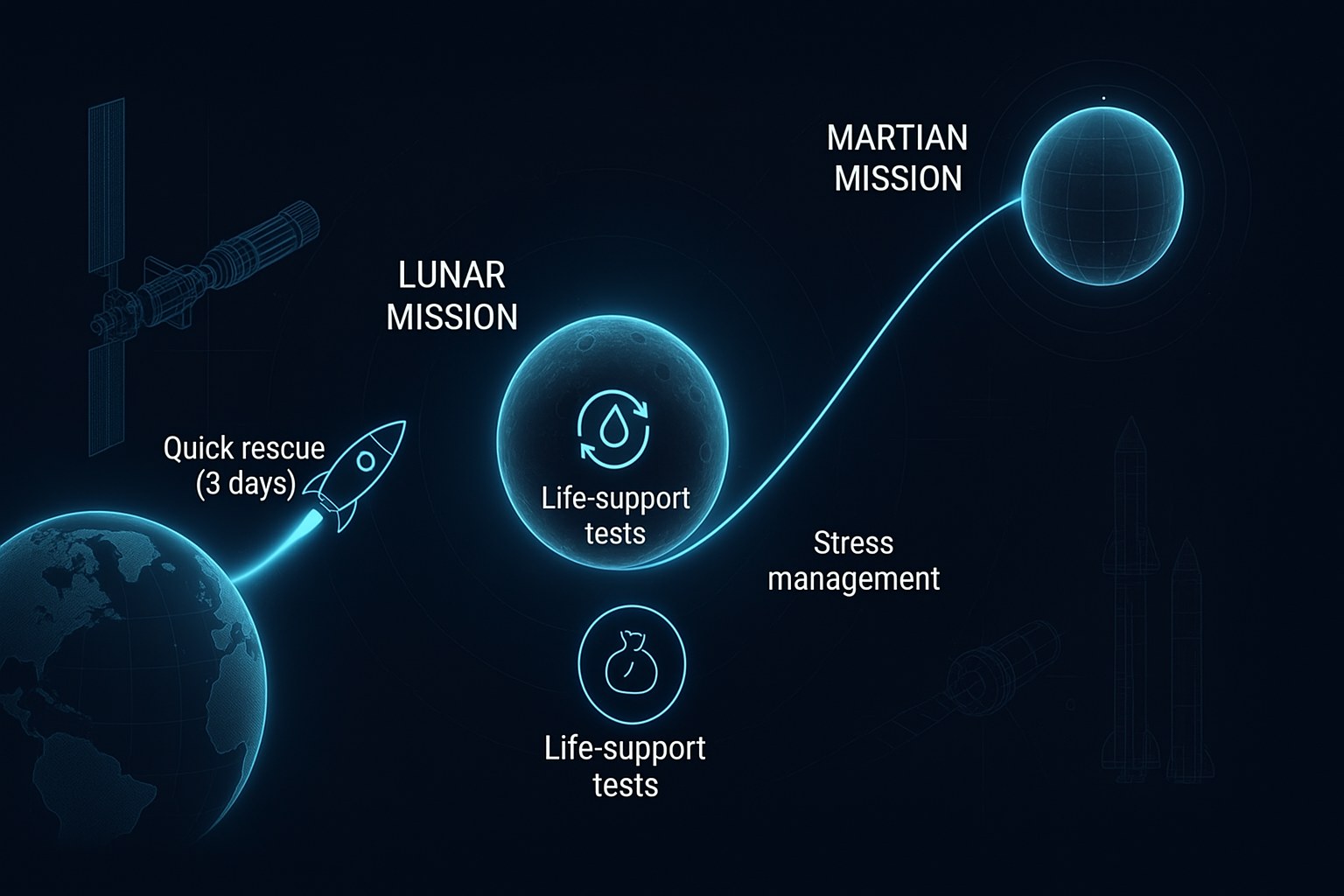
The Moon is close enough for a quick rescue in just three days. On Mars, a crew would be on its own for months. That kind of safety changes everything.
Testing technologies in lunar orbit costs far less. Launch windows toward Mars only open every two years. The Moon is available all the time for our trials. That is a huge logistical advantage.
You do not launch a two-year mission without a safety net. The Moon acts as a stepping stone for exploring the Solar System, like a tough, unforgiving test bench.
🫁 Validating life-support systems
Recycling air and water is a matter of pure survival. The systems must work without a single major breakdown. A test in the harsh lunar environment will finally validate our current technologies.
Remote maintenance is a huge technical challenge. Astronauts will have to repair complex machines themselves. Total autonomy starts with complete mastery of these survival tools.
With no immediate help, reliability becomes the only measure of success. Every part must be tested in a vacuum.
🛡️ Reducing risk through closeness
An emergency return from the Moon takes less than a week. That is enough time to stabilise a critical situation. This margin for manoeuvre simply does not exist for a Martian journey.
Real-time communication makes guidance from Earth easier. Engineers can step in on the onboard systems. This direct support builds the operational experience of our teams.
Learning to handle stress close to home is the smart choice. Deep space forgives no hesitation, mental or technical.
The Moon is seen as an essential outpost for space exploration, serving as a stepping stone to explore the Solar System thanks to how close it is.
📅 The Artemis programme timeline in 2026
Now that we understand why our satellite matters so much, let us see how the Artemis programme makes this return real with precise dates and infrastructure.
👨🚀 The next steps for crewed missions
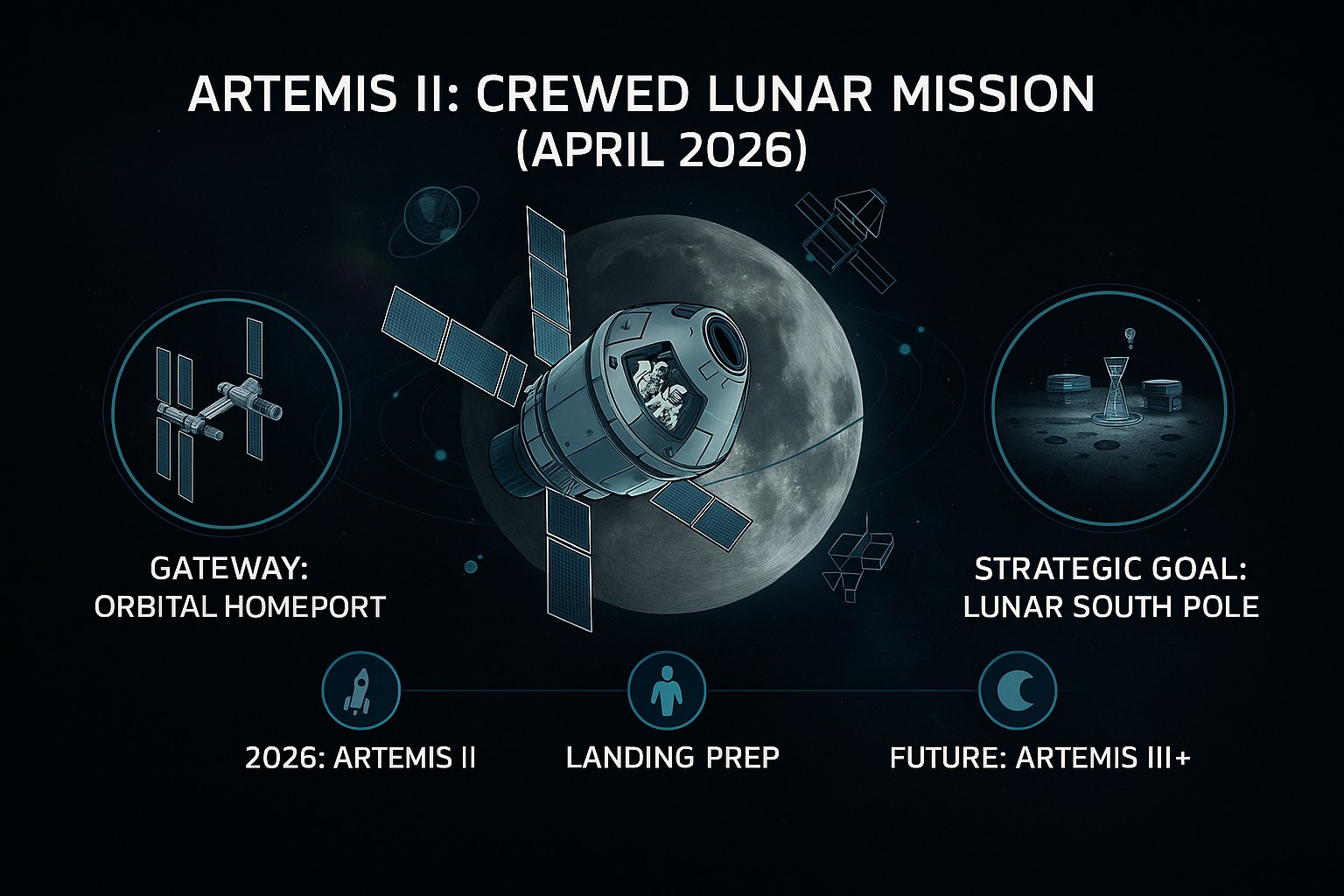
Artemis II will be the first crewed flight around the Moon. Four astronauts will test the Orion spacecraft in real conditions. It is the essential prelude before setting foot on the surface.
Artemis III will aim for the lunar surface around 2027. The chosen crew will have to show they can explore the terrain. Each mission pushes back the limits of our lasting presence up there.
The schedule is speeding up to secure future landings. The space agency keeps multiplying safety tests for its crews through its Artemis programme.
🛰️ The Gateway station as a home port
The Gateway will serve as a relay for missions toward Mars. This orbital station will be assembled in a modular way. It will host cutting-edge scientific research laboratories.
The communication and habitation modules will be crucial. Major aerospace partners are taking an active part in this international build. Astronauts will stay there before going down to the Moon. It is a true gateway to the deep, unknown space.
This permanent structure ensures a continuous human presence. It stabilises our logistics far from low Earth orbit.
📍 The strategic goal of the lunar South Pole
The South Pole offers peaks of eternal light. It is an almost endless source of solar energy for our bases. The shadowed craters also hide major scientific secrets.
This zone is strategic for access to icy resources. The permanent darkness there preserves essential volatile elements. Understanding this geology is a priority for future human settlements.
Yet the thermal challenges there are fearsome. Surviving in these extreme conditions will validate our future Martian habitats and space exploration, from the Moon to Mars.
🛠️ Using local resources for autonomy
A lasting settlement cannot happen without using what the soil offers us, turning the Moon into a real space service station.
❄️ Extracting frozen water for fuel
Lunar ice can be turned into liquid hydrogen. This fuel will power the engines of future spacecraft. The extracted oxygen will also serve for immediate chemical propulsion.
Mining these resources reduces the mass launched from Earth. Local refuelling could save billions of dollars per mission. Engineers confirm the value of this idea. It is the key to autonomy.
Without this water, distant exploration stays a costly dream. The Moon becomes our first reservoir of extraterrestrial energy.
🏗️ Building habitats with regolith
3D printing will use lunar dust as its main material. Regolith offers natural protection against solar radiation. It also insulates habitats from violent temperature swings.
Micrometeorites will not be able to pierce these thick structures. Building on site avoids shipping tonnes of concrete. This technique revolutionises how we imagine lasting space settlement.
The strength of the lunar soil is an architectural asset. Our future builder robots are already preparing the ground for us.
💨 Producing oxygen on site
Chemical processes extract oxygen straight from the lunar soil. This guarantees full breathing autonomy for permanent bases. We can no longer depend on regular deliveries from Earth.
These technologies recall the MOXIE experiment tested on Mars. The Moon serves as a laboratory to perfect these vital systems. The success of these tests is essential for human survival.
Breathing on another world is finally becoming real. The space industry is now focused on this chemical independence.
- Lower transport costs
- Greater crew safety
- The possibility of expanding bases without outside resupply
👨🚀 Protecting the health of future explorers
Beyond the technology, the human being remains the most fragile link of the journey, needing medical and psychological care like never before.
☢️ Facing radiation and temperatures
The lack of a magnetic field exposes bodies to radiation. Habitable modules must have shielding made of lead or regolith. It is an essential physical barrier against cosmic rays.
The temperature swings between day and night are brutal. They go from 120 degrees down to minus 170 degrees. The regulation systems must be perfectly precise. Any thermal failure would instantly put the crew’s lives at risk.
Surviving these contrasts demands cutting-edge engineering. The Moon is a stress test for our bodies.
🌌 Managing the effects of long weightlessness
Microgravity eats away at the bone density of astronauts. Muscles waste away without intense daily exercise. Two hours of sport a day are the strict minimum required.
Vision problems appear during long stays. The pressure of fluids in the skull changes the retina. Doctors are still looking for ways to counter this worrying effect.
The human body is not made to float forever. Each lunar mission teaches us more about our biological limits.
| Physiological risk | Effect on the body | Preventive solution |
|---|---|---|
| Muscle atrophy | Loss of strength and mass | Intense exercise |
| Bone loss | Weakening of the skeleton | Calcium supplements |
| Vision problems | Changes to the retina | Eye monitoring |
| Radiation | Cell damage | Passive shielding |
🧠 Preserving the crews’ mental balance
Isolation in a confined space weighs on morale. Astronauts must handle inner tensions with no escape possible. Group cohesion then becomes a survival skill.
Keeping a link with families reduces stress. Yet the delayed communications on Mars will make this support harder. Total psychological autonomy is the ultimate goal of this training.
The silence of space is a challenge for the mind. Mental preparation begins long before the launch from Earth.
🚀 The technologies to reach the red planet
Once health and resources are secured, there is still the space gulf to cross thanks to engines and electronic brains of a brand-new kind.
⚛️ Speeding up trips with nuclear propulsion
Nuclear thermal power could cut travel time in half. That limits the astronauts’ exposure to dangerous radiation. The SR-1 Freedom project will test this technology from 2028.
The safety of fission reactors is an absolute priority. These engines offer far more thrust than the classic chemical ones. Engineers are working on ultra-safe launch protocols. It is the only realistic way to reach Mars quickly and safely.
Travelling faster means surviving better in space. Space nuclear power is no longer just a futuristic option.
🤖 Artificial intelligence for autonomous navigation
AI will fly the spacecraft without waiting for orders from Earth. The communication delay makes manual piloting impossible in an emergency. The algorithms must decide in just a few milliseconds.
Smart management of resources optimises every watt of energy. The systems spot breakdowns before they turn critical. This preventive maintenance ensures the durability of long-duration missions.
Trusting our lives to a machine is an ethical leap. Yet it is the absolute condition of the journey.
🤖 Scout robots and the Rosalind Franklin mission
The European rover Rosalind Franklin will search for traces of life. Planned for 2028, it will prepare the future human landing sites. Its drill will be able to probe the Martian soil deeply.
Drones will map the areas that are hard for humans to reach. These scout robots make the terrain safe before our arrival. Automation is the armed wing of our future planetary exploration.
Each piece of data gathered reduces the uncertainty for the first settlers. Robotics leads the way toward the red planet, just like the MMX mission.
🌌 Organising this new space era
Finally, this adventure is not only about science, but also about big money, diplomacy and international law.
💰 The private sector’s impact on budgets
Reusable launchers make the price per kilo sent crash down. Private companies are driving fast, fierce innovation. The commercial model is slowly replacing public subsidies.
Competition between private players speeds up launch schedules. National agencies now buy ready-made transport services. This public-private synergy is the financial engine of today’s exploration.
Space is becoming a full-fledged economic market. Costs are no longer an impossible barrier.
🤝 Pooling efforts between nations
More than sixty nations have already signed the Artemis Accords. This cooperation lets countries share the cost of common infrastructure. No one can conquer Mars while staying alone in their corner.
Partner space agencies exchange their worldwide scientific data. Several agencies contribute essential modules to the Gateway. This technical solidarity strengthens the safety of every astronaut.
Unity is strength in the void of space. Diplomacy is now being written beyond our atmosphere.
⚖️ Defining a legal framework for resources
Space mining raises fundamental ethical questions. Who owns the minerals dug up on a distant world? International agreements try to define fair space ownership.
Protecting historic sites like Tranquility Base is crucial. We cannot let chaos rule on the Moon. Strict rules must govern the peaceful use of these new resources. It is a legal challenge as complex as the journey itself.
The Artemis Accords provide a set of principles to govern the civil and peaceful exploration and use of space.
Without law, space would become a new Wild West. Regulation ensures lasting and shared use.
Setting up a lunar base and using regolith mark the start of a lasting autonomy. These technologies finally validate our leap toward the red planet thanks to nuclear propulsion. The future of space exploration is being written now, to offer a new horizon to humanity.
❓ FAQ
📅 What is the planned schedule for the next Artemis missions?
The timeline for our return to the stars is becoming clearer. The Artemis II mission, which will be the very first crewed flight of this programme, is currently planned for April 2026. This ten-day journey will carry four astronauts on a historic flyby around the Moon, the farthest distance in more than fifty years.
As for Artemis III, the mission meant to mark the return of humans to the lunar surface, no precise launch date has been announced yet. We know that preparations are coming along well, especially for the landing system, but technical challenges sometimes call for a little patience and flexibility.
🛰️ What exactly is the Gateway station and who takes part in this project?
The Gateway will be the very first space station to orbit the Moon. Picture it as a little home port or an essential relay for testing technologies before heading off to Mars. It is a modular project that will host living quarters (like the Lunar I-Hab module) and high-tech propulsion systems.
It is a wonderful team adventure. The lead space agency works with Europe (ESA), Canada (CSA), Japan (JAXA) and the United Arab Emirates. Each partner adds its own piece, like the Canadarm3 robotic arm or resupply modules, to let astronauts from all over the world stay and work there.
📍 Why is the Moon’s South Pole such a strategic zone?
The South Pole is a bit like the Moon’s “treasure” spot. Scientists are very interested in it because its craters, always in shadow, hide water ice. This resource is precious: it could be turned into drinking water, oxygen or even rocket fuel. It is the key to staying there a long time without bringing everything from Earth.
On top of this ice, some peaks enjoy almost permanent sunshine. That is ideal for setting up solar panels and having continuous energy. It is also a perfect training ground for learning to build lasting bases before aiming at the red planet.
⚛️ How will nuclear propulsion help our journeys to Mars?
It is a small technological revolution in the making. The plan is to use nuclear propulsion to dramatically cut travel time to Mars. Travelling faster also protects the astronauts’ health by limiting their exposure to deep-space radiation.
A full-scale test is in fact planned with the SR-1 Freedom mission in late 2028. This demonstrator will test a fission reactor to prove that we can propel our ships more efficiently. It is a big step toward making crewed missions to the red planet finally realistic and safe.
🤖 What role do robots like Rosalind Franklin play in exploration?
Robots are our best scouts. The European rover Rosalind Franklin, with a launch planned for 2028, will have the mission of searching for traces of past life on Mars. Thanks to its drill, able to probe the soil deeply, it will help us better understand the history of this fascinating planet.
Other little helpers, like helicopter drones inspired by the famous Ingenuity, will also be part of the team. They map the difficult areas and make the terrain safe. Every piece of data they gather is one less thing to guess for the future human explorers who will walk on Martian soil.
