
It’s hard to answer our children’s endless questions about the world’s biggest dinosaurs 🦕 when even the experts can’t decide between two fossils. This article compares titans like Patagotitan and Argentinosaurus to finally crown the true king of the heavyweights. You’ll uncover paleontologists’ secrets and dizzying length records that will turn your bedtime stories into real adventures.
- How Do You Measure the Biggest Dinosaur From a Few Bones?
- Patagotitan mayorum, the Current Heavyweight Champion
- 3 Facts About Argentinosaurus, the Former Title Holder
- Bruhathkayosaurus, the Mystery of the Giant Estimates
- Supersaurus, the Absolute Record for Length
- Australotitan, the New Wonder From Australia
- Why Are the Carnivores Less Imposing?
- Other Records From the Seas and Skies
- A Summary of the Size and Weight Records
📏 How Do You Measure the Biggest Dinosaur From a Few Bones?
After daydreaming in front of the huge museum skeletons, you can’t help wondering how experts go from a single thigh bone to a colossus weighing dozens of tonnes.
🔬 The Paleontologists’ Estimation Methods
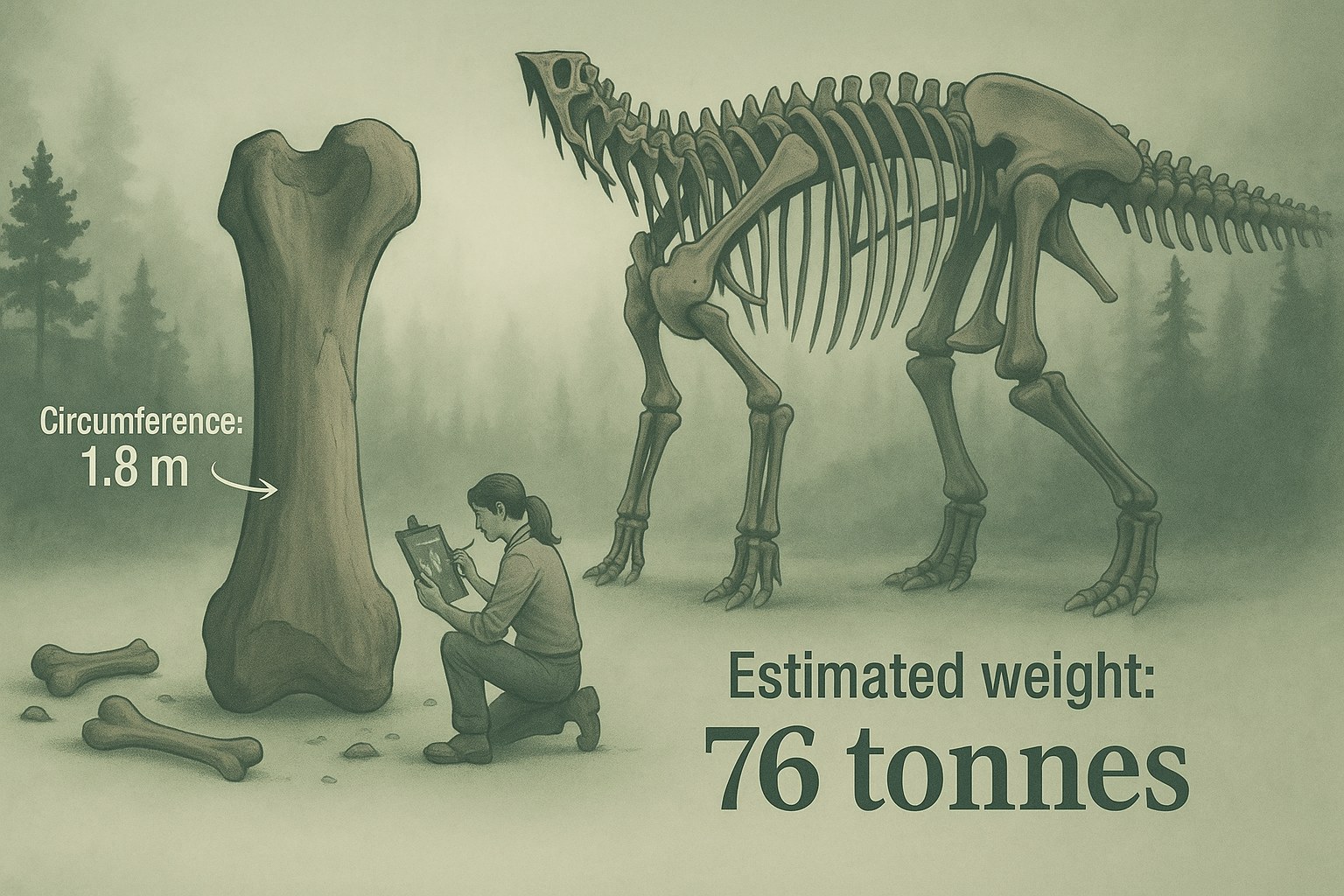
Weight is often worked out from the circumference of the femur. This sturdy bone shows the load the animal carried. It’s a reliable clue for scientists.
Experts also use 3D models for incomplete skeletons. Software fills the gaps by comparison with other species. This technique has become really very precise today.
Yet there is a margin of error with fragmentary fossils. A single bone varies with the age of the specimen. So these estimates remain simple working hypotheses.
⚖️ The Debates Over Weight Revisions
The ranking of the giants changes often over the years. New technologies refine the first mass calculations. Sometimes the estimated weight suddenly drops by half.
New discoveries also upset old established certainties. A more complete specimen can overturn decades of theories. That’s how science moves forward through successive corrections.
Telling apart closely related species remains a tricky exercise for everyone. The variations between individuals seriously complicate classification. One giant can hide another very similar one.
🏆 Patagotitan mayorum, the Current Heavyweight Champion
Even if the calculation methods are debated, one name keeps coming up to claim the throne of sheer excess: Patagotitan.
📏 Off-the-Chart Dimensions for a Titan
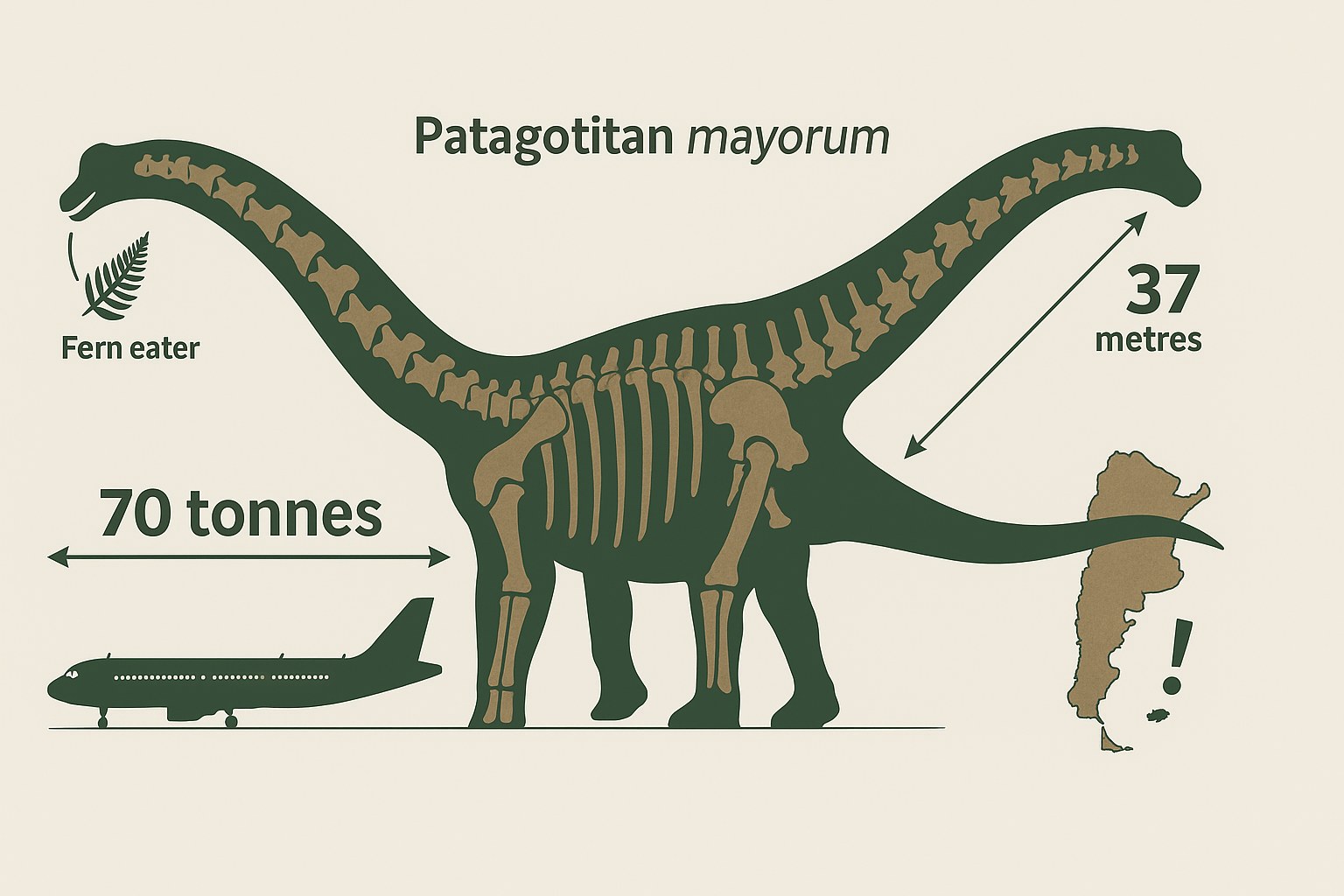
This colossus reached dizzying heights. It measured between 25 and 37 metres long. Its weight was around 70 tonnes. It weighed as much as seven African elephants put together.
Picture an Airbus A320 in your back garden. That’s the real scale of this monster. Its stature is beyond comprehension for a land animal. You feel tiny standing next to it.
This giant was discovered in Patagonia, in the province of Chubut. A farm worker found the first fossils in 2008. Argentina really does hide incredible treasures under its soil.
🦴 The Constraints of a Gigantic Body
To keep up such a metabolism, it had to eat non-stop. The amount of ferns it swallowed is unimaginable. It needed hundreds of kilos of plants every single day.
Its limbs were true cathedral pillars. Its bone density was adapted to this constant pressure. Its bones had to support a mass of 70 tonnes. It’s a feat of nature.
They had air sacs like birds. This helped lighten their overall structure. This efficient breathing system helped these titanosaurs avoid collapsing. In short, a fascinating piece of biological engineering.
🥇 3 Facts About Argentinosaurus, the Former Title Holder
But before Patagotitan took all the spotlight, another Argentine dominated the world rankings from the 1990s on.
🏆 A Heavyweight Hard to Dethrone
Estimates of its weight often reach 80 tonnes, making it a true titan. Some experts even think it remains the heaviest of all. The figures vary between scientific papers, sometimes swinging from 60 to 100 tonnes depending on the calculation models used.
Its back vertebrae are truly imposing in size, beyond imagination. A single piece measured over one metre fifty tall and more than one metre twenty wide. That’s an absolutely colossal and rare piece of anatomy, including a special joint complex called the hyposphene-hypantrum. It’s hard to imagine the force needed to support such a bony structure every day.
It remains a worldwide benchmark despite fairly partial fossil remains. Its incomplete skeleton, made of a few ribs and a 1.55-metre fibula, still fuels every paleontologist’s dreams. It perfectly symbolises the golden age of the giants and the quest to identify the world’s biggest dinosaurs.
🌿 Its Role in the Cretaceous Ecosystem
It lived on specific floodplains in the province of Neuquén. It dwelt in a warm, humid world around 95 million years ago. The vegetation there was dense, very rich and able to feed such appetites.
As for its predators, Mapusaurus could attack in groups in the hope of bringing it down. Despite its size, it was a fierce struggle for survival, especially for the more vulnerable young. The environment stayed fairly hostile overall for these massive herbivores, which had to migrate constantly to find new pastures.
Its presence directly shaped the growth of the surrounding plants. Its passage lastingly changed the local forest landscape by creating gaps of light. It uprooted whole trees to feed on conifers and used gastroliths to grind these tough fibres in its stomach.
❓ Bruhathkayosaurus, the Mystery of the Giant Estimates
Far from the Argentine certainties, there is a candidate whose very existence now seems wrapped in a veil of mystery.
🤔 Lost Fossils and Lingering Doubts
The story begins in India in the 1980s. Researchers discover massive bones in the Kutch basin. Sadly, these precious fossils have since been lost or destroyed.
This physical disappearance makes current measurements impossible. Scientists therefore stay very cautious about this data. Without tangible proof, the notes from the time can no longer be verified.
Yet optimistic estimates suggest a length of over 34 metres. Some experts imagine a colossal weight of 100 tonnes. All of this remains, for now, purely theoretical.
📚 The Giant’s Place in the Classification
This colossus probably belonged to the titanosaur group. Its overall shape seems to match these massive creatures. The few remaining clues point to this precise family.
Its supposed dimensions could have dethroned Argentinosaurus in total volume. But the lack of concrete fossils blocks any official validation. So the title of biggest dinosaur remains disputed.
Paleontologists keep hoping to make new discoveries in India. The ground could still hide priceless specimens. Science is patiently waiting for irrefutable proof.
📐 Supersaurus, the Absolute Record for Length
If weight often defines power, pure length offers a just-as-impressive spectacle with Supersaurus.
🦒 A Neck and Tail Without End
Its total length is estimated by experts at between 39 and 42 metres. Picture three buses lined up end to end in your garden. Its silhouette was truly incredibly stretched out and majestic. We’re talking here about one of the world’s biggest dinosaurs in terms of linear dimensions.
Its skeleton had a very light structure for its size. Unlike the massive titanosaurs, it stayed slender and graceful in its proportions. Its bones also contained many air pockets, a feature called pneumaticity. This helped to reduce its total weight while keeping the strength it needed.
Its silhouette is radically different from the other giants of the era. Where some look like tanks, it looks more like a ribbon. Its evolutionary strategy clearly favoured lateral and vertical reach. It wasn’t chasing raw mass, but the longest reach to get to its food.
🦴 The Reliability of the Jimbo Specimen
The skeleton found in Wyoming is a precious scientific source. This specimen, nicknamed Jimbo, remains a centrepiece for today’s paleontologists. It offers an overall view of its body thanks to an exceptional state of preservation. It’s the most complete sauropod ever found in that region.
This fossil made it possible to reassess its real size with precision. The old measurements were often underestimated for lack of available bones. Jimbo really changed the scientific picture by providing reliable bone-growth data. The study of its ribs even revealed it was a fast-growing adult.
Such a long neck offered clear survival advantages. It let the animal graze a wide area without moving much. It was a vital energy saving to keep up such a stature. By staying still, it could eat huge amounts of plants without wasting calories.
🇦🇺 Australotitan, the New Wonder From Australia
America and Asia don’t have a monopoly on giant size, as this major discovery in Oceania proves.
🌏 A Major Discovery for Oceania
The Eromanga basin is finally revealing its buried secrets. The arid lands of Queensland hide impressive prehistoric treasures. It’s a new paleontological playground for enthusiasts.
This titan nicknamed Cooper impresses with its sheer span. It’s estimated that Australotitan measured between 25 and 30 metres long. Its fossilised bones testify to a simply extraordinary build.
This fossil changes the picture for local research. It finally puts Australia on the map of the world’s giants. It’s a real source of national pride for the country’s researchers.
🦕 Comparison With Its South American Cousins
Scientists analyse the shape similarities with the titanosaurs of Argentina. The bone structures look strangely alike despite the geographic distance. You can clearly see a close family link between these specimens. This physical resemblance is truly striking.
The existence of ancient land bridges explains this closeness. The continents were once linked through Antarctica. This justifies the surprising geographic spread of the world’s biggest dinosaurs.
This colossus belongs to the Late Cretaceous. It reigned over these lands 90 million years ago.
🦖 Why Are the Carnivores Less Imposing?
Faced with these mountains of herbivore muscle, you might wonder why the predators never reached such proportions.
📏 The Size Limit of the Big Predators
The famous T-Rex weighs about nine tonnes for the biggest specimens. Next to the eighty-tonne sauropods, it seems almost lightweight. It’s a feather compared to the titans.
Running after prey takes wild amounts of energy every day. A body that’s too heavy would quickly become a major handicap for hunting effectively. Physics imposes its own speed limits.
Theropods had a very active metabolism for reptiles. They burned their calories far faster than the peaceful giants. So their physiology naturally held back their maximum growth.
⚖️ The Balance Between Prey and Predator
Becoming a giant was the best natural armour for survival. This impressive size discouraged most direct attacks. No lone predator could bring down such a colossus.
To take on a titan, you had to be cunning and organised. Pack hunting was probably the only viable option. It was a matter of strategy rather than brute force.
We see here a truly fascinating biological arms race. Some grew bigger to survive the endless attacks. Others adapted to stay effective killers. The world’s biggest dinosaurs thus set the rules of evolution.
🌊 Other Records From the Seas and Skies
If dry land was home to monsters, the oceans and the sky had their own champions too.
🦈 Mosasaurus and the Marine Giants
Mosasaurus impresses with its extraordinary build. This reptile could reach seventeen metres long. It stood out as the ultimate predator of the dark depths.
Water effectively supports the weight of massive bodies. This greatly eases spectacular growth in an aquatic environment. Yet these creatures stayed less imposing than the land sauropods.
Be careful not to mix them up. They are not dinosaurs. They are marine reptiles, distant cousins of the lizards.
🦅 Quetzalcoatlus and the Wingspan of the Skies
This pterosaur had an absolutely record-breaking wingspan. Its outstretched wings reached twelve metres across. That’s about the size of a small light aircraft.
Its body showed fascinating adaptations for flight. Its bones were hollow to gain lightness. Its structure was a real masterpiece of natural engineering.
Once on the ground, its height matched that of a giraffe. Standing up, it looked the biggest mammals in the eye. A terrifying sight for its potential prey.
📊 A Summary of the Size and Weight Records
To see more clearly through this jungle of numbers, a little recap is in order to fix the ideas.
Comparing these colossi helps us picture their excess. The scientific data, drawn from often partial skeletons, paints a dizzying portrait of these giants. Between massive herbivores and predators, the scales vary threefold.
| Species | Estimated length | Estimated weight | Diet |
|---|---|---|---|
| Patagotitan | 37 metres | 70 tonnes | Herbivore |
| Argentinosaurus | 35 metres | 80 tonnes | Herbivore |
| Supersaurus | 33-42 metres | 36 tonnes | Herbivore |
| Australotitan | 25-30 metres | Unknown | Herbivore |
| T-Rex | 12 metres | 8 tonnes | Carnivore |
| Quetzalcoatlus | 11 metres | 250 kg | Carnivore |
📌 The Key Points to Remember
Looking at the world’s biggest dinosaurs, we understand that nature pushed the limits of the possible. Here’s the essential to remember:
- Patagotitan currently leads the ranking for overall body mass.
- Supersaurus holds the length record thanks to its enormous neck.
- The carnivores stay smaller because their energy needs limit their growth.
It’s incredible to imagine such beings moving across our earth. Suddenly you feel very small next to these records, don’t you?
Between the airplane-sized Patagotitan and the all-length Supersaurus, these giants are fascinating. Measuring these colossi remains a thrilling technical challenge for the experts. Plan your next museum outing soon to admire these records of nature as a family!
❓ FAQ
🦕 What is the biggest dinosaur that ever lived on Earth?
The title currently goes to Patagotitan mayorum. This colossus discovered in Argentina could reach 37 metres long and weigh around 70 tonnes, the weight of seven African elephants!
🔬 How do scientists estimate a dinosaur’s weight from just a few bones?
Paleontologists mainly use the circumference of the femur, because this bone bears most of the load. They also rely on 3D models to fill in the missing parts of the skeleton by comparison with close species.
📰 Why do dinosaurs’ dimensions often change from one article to the next?
It’s quite simply because science keeps progressing. The discovery of a new bone fragment or the use of more precise reconstruction software make it possible to refine the calculations, which can vary the weight or size estimates over the years.
🏋️ Is Argentinosaurus still considered the heaviest?
It remains a very serious contender for the podium with an estimated weight close to 80 tonnes. Although its remains are fragmentary, the size of its vertebrae — over 1.50 metres — keeps fascinating experts the world over.
📏 Which dinosaur holds the record for the greatest length?
The pure length record belongs to Supersaurus. Thanks to its endless neck and tail, it could stretch over 39 to 42 metres, the equivalent of three buses lined up end to end.
🇦🇺 Are there any giant dinosaurs discovered recently in Australia?
Yes, Australotitan cooperensis, nicknamed “Cooper”, is the new star of Oceania. Discovered in Queensland, this giant measured between 25 and 30 metres long, proving that giant size wasn’t reserved for South America.
🦖 Why are carnivorous dinosaurs like the T-Rex smaller than the herbivores?
It’s a question of energy! Running to hunt takes a huge amount of calories. A predator that’s too heavy wouldn’t be agile enough, while the giant herbivores used their massive size as natural armour against attacks.
🦈 Was Mosasaurus bigger than the largest land dinosaurs?
Even though Mosasaurus was a fearsome 17-metre marine predator, it stayed far less massive than the land sauropods. What’s more, scientists remind us that it’s a marine reptile and not a dinosaur in the strict sense.
