
Are your children asking questions about those shiny dots up there, and do you feel a little lost about how to guide them? ✨ This article explains how to recognise the constellations simply, turning your family evenings into real celestial treasure hunts. You’ll discover handy tips for spotting the Big Dipper or Orion and for sharing the legends that make little astronomers’ eyes light up.
- What is a constellation exactly?
- Why did ancient people look at the sky?
- Famous shapes that are easy to spot
- Learning to look beyond appearances
- Tips for a successful night of stargazing
- Creative activities to become a little astronomer
✨ What is a constellation exactly?
Looking at the night sky is a bit like reading a big picture book whose pages are scattered with dots of light.
✏️ Invisible drawings in the night sky
Constellations are completely imaginary shapes. You have fun joining up the bright dots. This lets you create familiar characters or objects.
It’s a bit like a giant join-the-dots game. Humans invented these patterns to find their way. The vastness of empty space then feels less daunting.
These drawings don’t physically exist out in space. They’re simply visual landmarks. Our brain and our imagination do all the work.
🔢 The official number of star groups
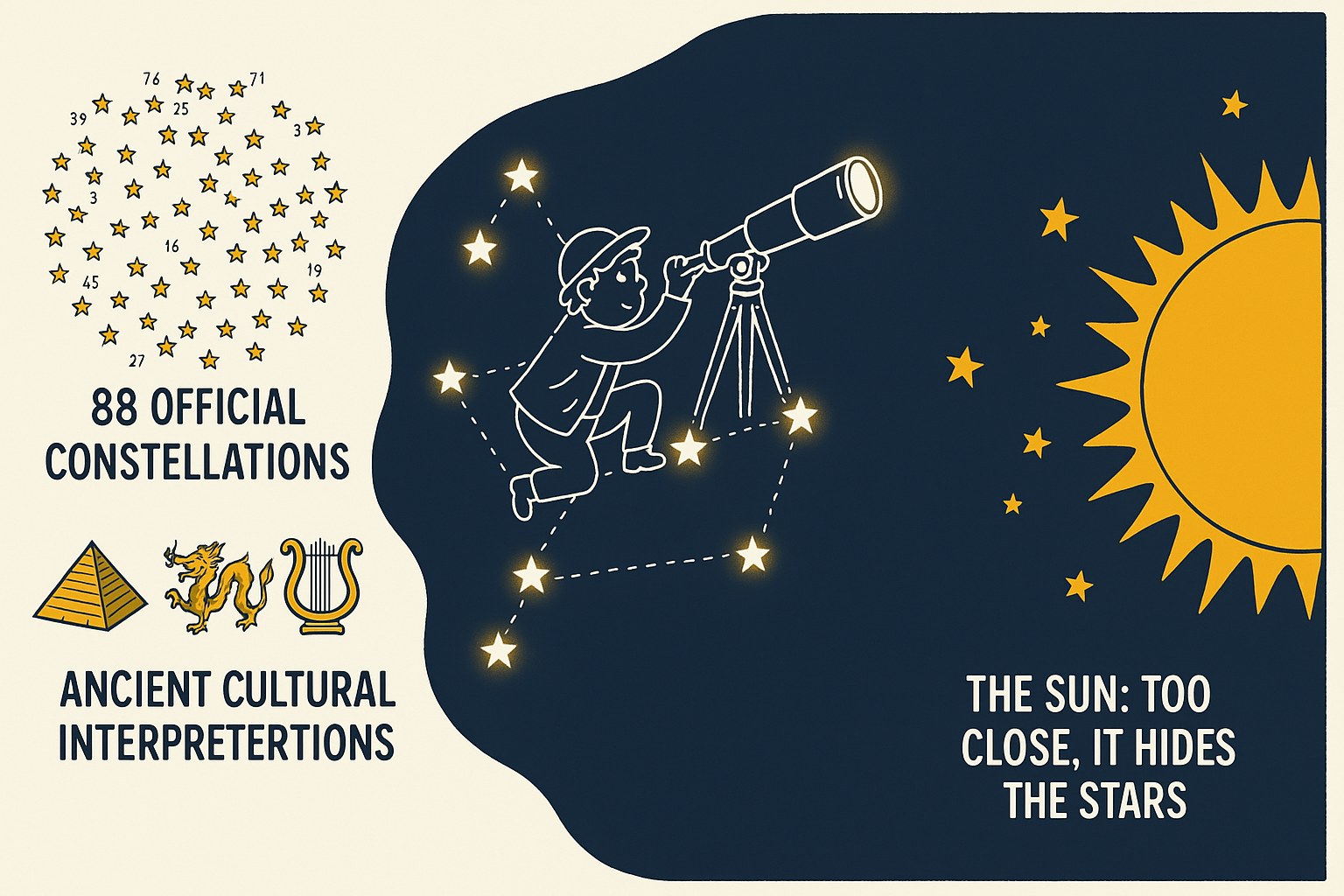
There are exactly 88 officially recognised constellations today. Astronomers use them to map the sky. Each group has a precise name. Modern science has set strict boundaries.
Yet every ancient culture saw different shapes. The Greeks, the Chinese and the Egyptians imagined their own stories. Their tales didn’t always look alike.
The sky is a true worldwide cultural heritage. These famous names often come down to us from antiquity. They’re tied to fascinating old myths.
☀️ The Sun is still our closest star
The Sun is actually a very ordinary star. It looks like all the bright dots of the night. Its only real difference is how close it is.
Its light is so intense that it hides the other stars by day. It’s like a torch switched on at midday. You can no longer see the little candles around it.
But the constellations are always up there. They’re simply waiting for the Sun to set. Then they reappear, and recognising them becomes a game.
📜 Why did ancient people look at the sky?
Watching the stars wasn’t just a night-time pastime for our ancestors. It was a practical tool, a compass and an open-air calendar. Understanding the constellations begins with this journey back in time.
🧭 Finding your way on land and at sea
The stars served as a giant natural compass. Travellers followed precise points so they wouldn’t get lost. It was vital in the desert or the forest. The constellations were a reliable guide.
Sailors found their way without GPS. They watched how high the stars rose above the sea horizon to steer their ships.
“For centuries, the vault of the sky was the only road map for explorers braving unknown oceans.”
📖 Telling stories and legends
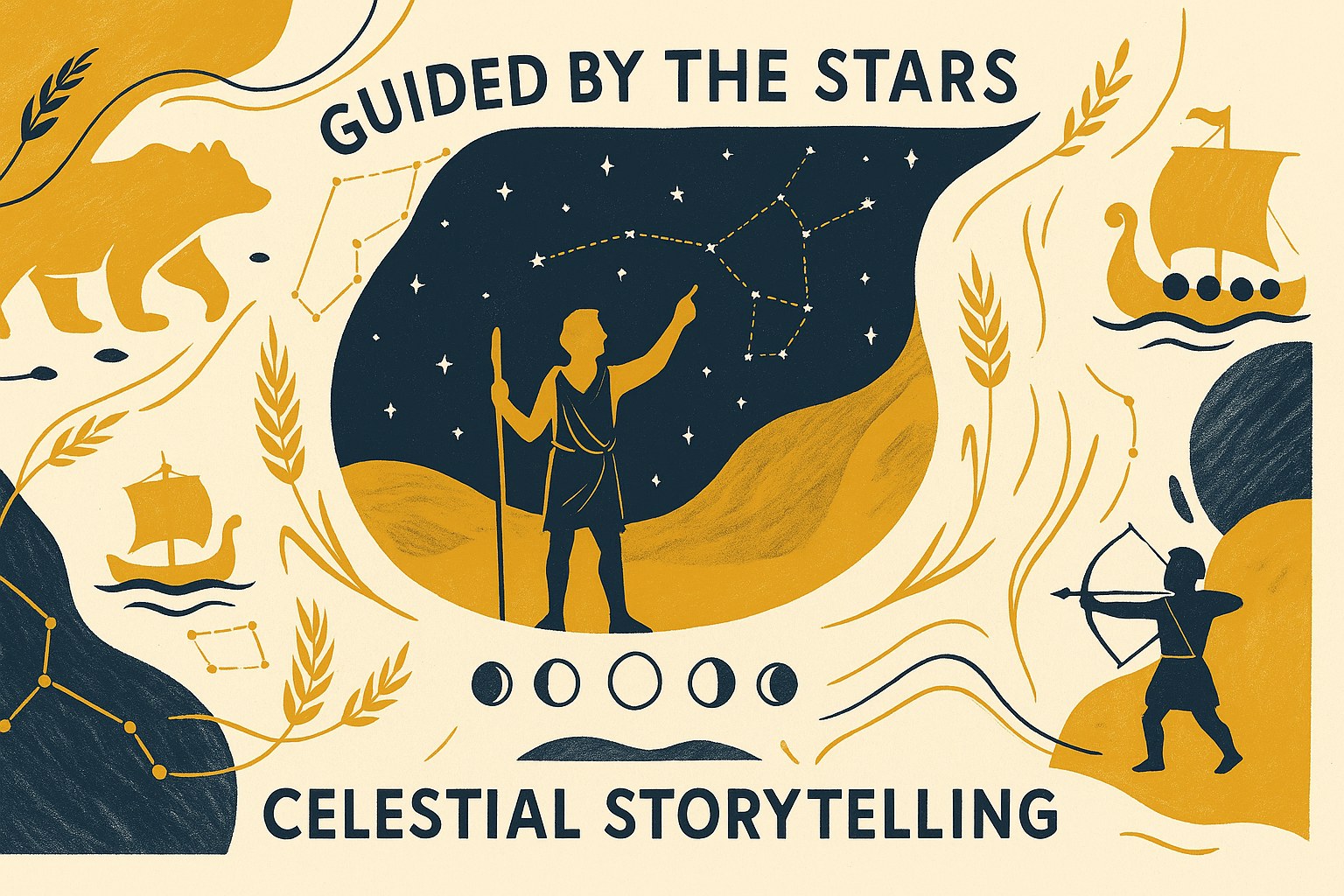
The sky was a huge picture book. Ancient people projected their heroes and monsters onto it. It was a way to pass on oral culture.
Mythology helped them remember the positions. Linking a star to a character made learning much easier. In this way children learned the geography of the sky.
These tales gave meaning to the night-time chaos. Each glimmer finally had its own identity and a legend.
🍂 Following the rhythm of the seasons
There’s a link between when the shapes appear and the harvests. When certain stars rose, it was time to sow the grain. The sky served as a farming calendar.
A change of position signalled the coming cold. Farmers watched the constellations to get ready for winter. It was a very precise cosmic clock.
Reading time this way was a matter of life and death. Without it, the survival of whole communities was at risk.
⭐ Famous shapes that are easy to spot
Now that we know what they’re for, let’s see how to track down the best-known ones.
🐻 The Big Dipper and its saucepan shape
Look for seven very bright stars in the sky. They draw a giant saucepan or a cart. It’s the easiest shape to identify. From our latitudes, it stays visible without ever dipping below the horizon.
Use this shape to find other groups. By extending the right-hand edge of the saucepan, you reach its neighbours. It’s really the essential starting point for any night of stargazing, for young and old alike.
- Seven main stars
- Shape of a ladle or saucepan
- Visible all year round
- Points the way to the Pole Star
⭐ The Little Dipper and the famous Pole Star
Find the Pole Star right at the tip of the tail. It shines less brightly than people often imagine. Yet its role stays vital for explorers. It seems to stay completely still while the sky turns.
It acts as a natural compass pointing north. All the other stars seem to swing around it through the night. It marks the exact axis of rotation of our planet Earth in space.
“The Pole Star is the still pivot of the sky, the eternal beacon that points north to lost travellers.”
🏹 Orion the hunter and his bright belt
Admire the perfect line of the three central stars. This is called Orion’s belt. It’s a magnificent landmark, especially on winter nights. The hunter then towers majestically over the southern horizon.
Look too at the neighbouring constellations, such as the Great Dog. The star Sirius, the brightest in the sky, follows Orion very closely. It’s a rich celestial show, very easy to follow for learning to recognise the constellations.
The hunter’s shoulders and feet are marked by colourful stars. Betelgeuse shows a clearly visible reddish tint. Opposite it, Rigel shines an intense, very pure blue.
👁️ Learning to look beyond appearances
Don’t always trust what your eyes think they see, because space plays with our perspectives.
🔗 Why the stars aren’t linked to each other
The stars in a constellation seem to be neighbours. Yet dizzying distances really separate them. This closeness is just an optical illusion. In fact, light-years of depth break these drawings apart.
If we moved to another galaxy, everything would change. The famous saucepan would look like nothing at all. These shapes depend only on our position. It’s an Earthly point of view.
| Celestial object | Relative distance | Twinkling | Apparent movement |
|---|---|---|---|
| Star | Very far away | Yes | Fixed |
| Planet | Close | No | Slow |
| Shooting star | Atmosphere | Quick | Flash |
🪐 Telling a star apart from a planet
Twinkling is a brilliant trick. Stars flicker because of the air. Their light travels through atmospheric turbulence. Planets give off a steady glow. Watch out for that still detail.
Venus is a perfect example of this trap. It’s often called the evening star. But it’s a very bright planet. It often shines first.
Planets travel across the sky. They follow a line called the ecliptic. They move among the scenery. The stars, on the other hand, stay fixed relative to each other.
💫 Shooting stars aren’t constellations
Don’t mix up meteors and constellations. A shooting star is a speck of dust. It bursts into flame when it touches our atmosphere. The streak of light is very brief. It’s a quick encounter.
This debris often comes from comets. It has nothing to do with suns. Constellations last for millions of years. The dust vanishes in an instant.
Here’s what to remember:
- Lasts a few seconds
- Straight-line path
- Atmospheric event
- No connection with the constellations
🌙 Tips for a successful night of stargazing
To move from theory to practice, here’s how to get ready for your first outing under the stars.
📍 Choosing the right time and place
You need to get away from the city lights. Light pollution wipes out the faint stars. Look for an open field or a dark hill. The sky there will be far more spectacular and rich.
The sky changes with the seasons. You don’t see the same shapes in summer as in winter. The Earth orbits the Sun.
🌕 The Moon’s impact on visibility
The full Moon is very bright. It acts like a natural street lamp in the night. The most discreet constellations then become invisible. It’s beautiful, but a nuisance for precise astronomy.
Go for the new-moon periods. The sky is then a deep black. It’s the ideal time to see the Milky Way.
📱 Using sky-map apps
There are digital tools using augmented reality. You just point your phone at the sky. The screen then shows the names of the constellations in real time. It’s magical for beginners and children.
These interactive maps make identification much easier. You can even travel through time to see tomorrow’s sky. With apps like Stellarium or Star Guide, recognising the constellations becomes child’s play.
🔭 Creative activities to become a little astronomer
Finally, if the clouds turn up, you can always bring the stars indoors with these workshops.
🔦 Making a homemade constellation projector
Get some cardboard tubes and thick paper ready. Use a torch and a needle. Poke little holes following the pattern of the Big Dipper. It’s a very rewarding craft activity for children.
- A tin can or cardboard
- A torch
- A needle or point
- Constellation templates to print
✏️ Joining the dots to create your own drawing
Suggest inventing brand-new original shapes. Look at the stars and imagine a dragon or a robot. Give them funny names and make up a legend. Imagination has no limits in the endless universe.
Encourage your child to draw their own sky map. It’s a great way to make the night sky their own. Each dot then becomes a unique adventure.
💻 A first taste of coding with star patterns
Introduce some simple visual coding tools. You can program a little robot to draw Orion. It’s a modern way to link science and technology. Children love seeing their lines appear.
Explain how to automate the line drawn between the stars. You set X and Y coordinates for each star. It’s a really exciting logic exercise.
Telling these mythical shapes apart turns every night-time outing into a magical treasure hunt. Between the steady glow of the planets and the twinkling of the 88 official constellations, the sky offers a free and endless show. Get your sky maps out quickly to admire Orion before the seasons hide it away!
❓ FAQ
✨ What exactly is a constellation in the sky?
A constellation is a group of stars that form an imaginary drawing in the night. It’s a bit like a giant join-the-dots game where you use bright dots to invent characters, animals or objects.
In reality, these stars are very far apart in space. These shapes only exist in our imagination, to help us find our way more easily in the vastness of the night sky.
🔢 How many official constellations are there today?
There are exactly 88 constellations officially recognised by astronomers. This number lets them map the whole sky precisely, as if it were the pieces of a great celestial puzzle.
Each group has a precise name and well-defined boundaries. While the Greeks or the Egyptians once saw different shapes, modern science has settled this list so that everyone uses the same landmarks.
📜 Why did ancient people invent names for the stars?
Our ancestors used the sky as a natural compass and a calendar. It let them find their way at sea or in the desert without GPS, and also know when to sow or harvest the crops from the position of the stars.
It was also a wonderful way to tell legends. By projecting their heroes and monsters among the stars, they created a huge picture book to pass on their culture and their stories to children.
🪐 How can you easily tell a star from a planet?
The trick is to look at whether the light twinkles. Stars flicker because their light is disturbed by the air of our atmosphere. Planets, being closer to us, give off a steady, calm and far more stable glow.
You can also watch their movement. Planets move slowly from one night to the next compared with the constellations, whereas the stars always keep the same position relative to each other.
💫 Is a shooting star part of a constellation?
Not at all, even if the name is misleading! A shooting star is in fact a tiny grain of space dust that burns up very fast as it enters our atmosphere. It’s a brief event that lasts only a few seconds.
By contrast, constellations are made of distant suns that stay in place for millions of years. Shooting stars are fleeting travellers, while the constellations are the fixed scenery.
📅 When is the best time to watch the constellations?
The sky changes with the seasons because the Earth orbits the Sun. For example, the constellation of Orion is the queen of winter nights, while other shapes are only visible in summer.
For a successful viewing, go for new-moon nights. Without the light of the lunar “street lamp”, the sky is far darker and the faint little stars finally become visible, to the great delight of your eyes.
