
Explaining the International Space Station to your children can feel like a real brain-teaser, since the numbers are enough to make anyone dizzy. This article breaks down this giant laboratory the size of a football field to turn a complex machine into an adventure kids can actually understand. 🚀 You will discover the secrets of water recycling and how famous astronauts manage the amazing feat of sleeping standing up without ever falling.
- A giant house that circles the Earth
- Eating, sleeping and washing upside down
- Recycling and sport to stay healthy
- The role of robots and science experiments
- Getting ready, from liftoff to landing
- Games and tips to watch the sky
🛰️ A giant house that circles the Earth
Look up at the stars. Somewhere up there, an extraordinary object is flying over our heads without us even noticing, a witness to an incredible human achievement.
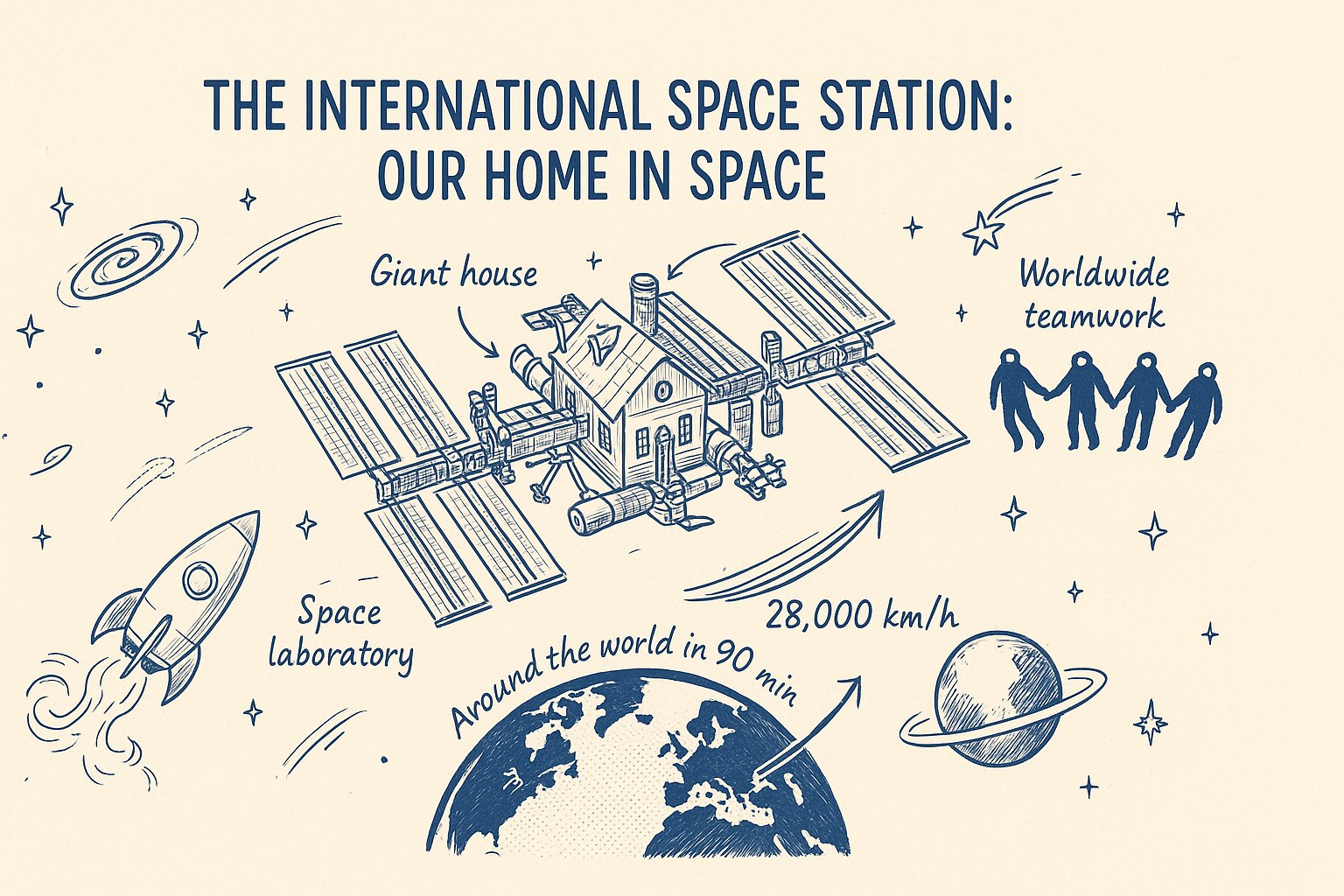
🔬 A laboratory flying over our heads
The International Space Station, explained for kids, is first of all a huge scientific playground. This one-of-a-kind laboratory sits way up high, far above the clouds.
It is about the size of a large football field. It races along at an incredible 28,000 km/h. In fact, it travels all the way around the globe in just 90 minutes.
It is an amazing sight. You can sometimes spot it shining very brightly in the dark night sky.
🧱 A build worthy of a brick set
The adventure began in 1998. The first pieces were sent up there by rockets. It was a real giant puzzle in the sky.
The modules fit together exactly like toy bricks. Each piece has a precise job. The assembly took many, many years.
The major work was finished around 2017. The station is now complete and fully working for the astronauts.
🌍 Several countries working hand in hand
Agencies like NASA and ESA work closely together. No one could pull off such a feat alone. This project unites nations from all over the world.
The station symbolically belongs to all of humanity. Children can even take part in space-themed drawing contests run by space agencies.
Helping each other is the golden rule. Up there, peace and science come first.
🙃 Eating, sleeping and washing upside down
Now that we have seen the structure of the station, let’s look at how people actually live there, because without gravity, even the simplest actions become real challenges.
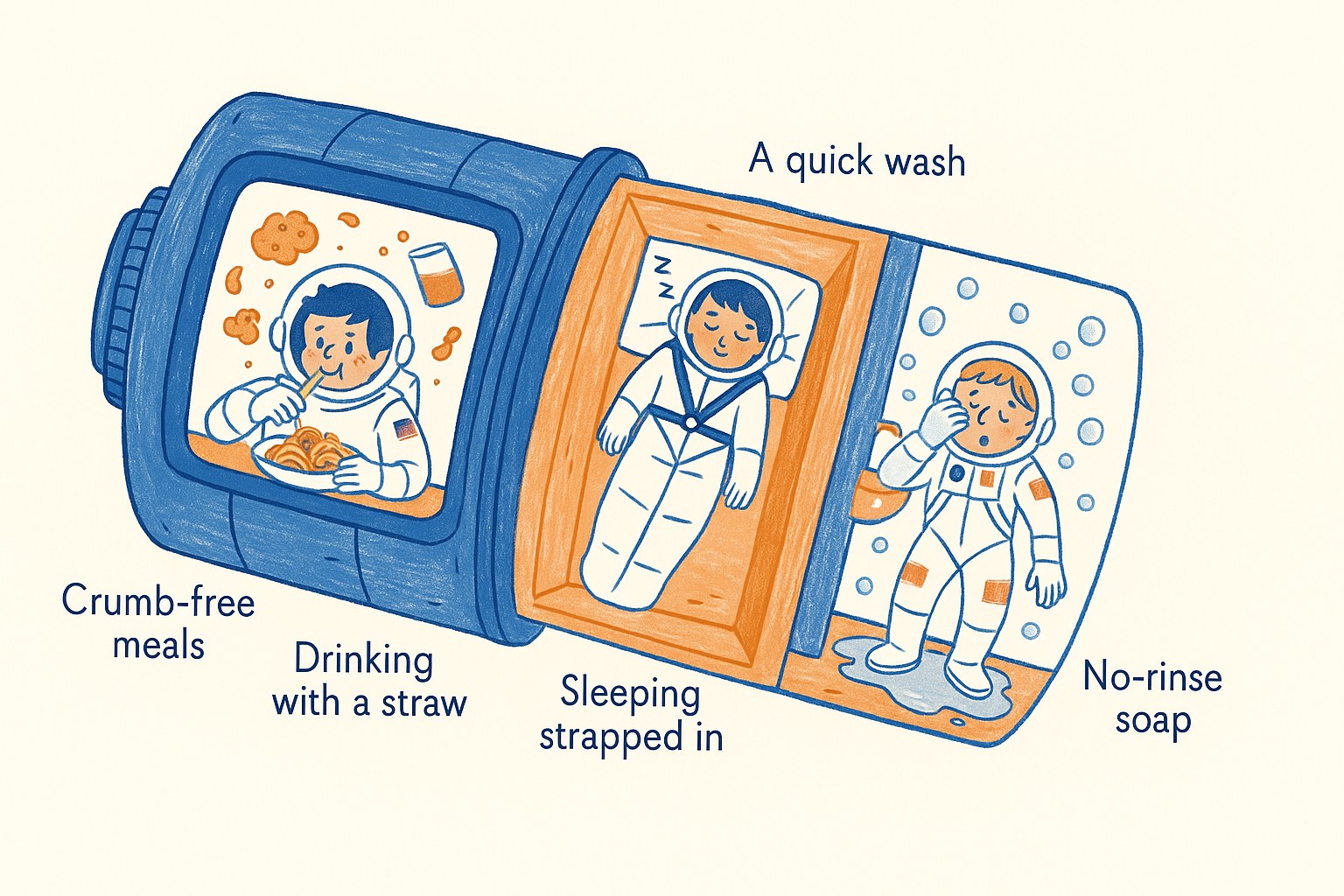
🥤 Crumb-free meals and magic straws
Space menus favour dishes with plenty of thick sauce. This sticky texture helps the food stay nicely on the plate. It is an essential trick so nothing gets lost.
The salt and pepper come in liquid form. As a powder, those grains would float and clog the astronauts’ noses. To drink, they always use straws fitted with a little safety clip.
Nothing must fly away. A single tiny crumb can become a real technical danger for the machines.
😴 Sleeping standing up in a bag fixed to the wall
You absolutely have to strap yourself in to go to sleep. Without that precaution, you might drift off and bump into everything. The sleeping bag is therefore fixed to the walls.
The individual cabins look like tiny vertical cupboards. There is no soft mattress and no pillow. The body simply floats freely.
It is very different from our cosy bed. And yet, the astronauts sleep very well in the complete quiet.
🧼 A quick wash with no shower or bathtub
The International Space Station, explained for kids, shows that there is no running water. Astronauts use damp washcloths to stay clean.
Washing your hair calls for a bubble of water and a special no-rinse shampoo. You massage your scalp, then wipe everything off with a towel. It is a very funny technique.
The toilets suck everything in. It is the only effective way to stay clean without gravity.
♻️ Recycling and sport to stay healthy
To survive in this enclosed environment, you have to be clever with your resources and take care of your body every single day.
💧 Turning pee into drinking water
The water recycling system is a true technical marvel. In space, nothing is ever wasted. Every drop becomes a precious resource that is reused again and again.
Even urine goes through a full treatment. It comes out transformed into perfectly pure water. The machines do an incredible job filtering out every impurity.
“On board the station, today’s coffee often becomes tomorrow’s coffee thanks to recycling.”
💨 Making fresh air to breathe
Oxygen is produced directly from water using a clever closed-loop system. It is a bit like magic chemistry. The molecules are split apart to create breathable air.
The carbon dioxide also has to be filtered out all the time. Humans naturally breathe out this gas. Removing it is vital to keep the astronauts alive.
Sensors keep watch on the air. Safety always comes first.
🏋️ Two hours of exercise to keep your muscles
Without gravity, muscles shrink very quickly. The bones also grow weaker and more fragile. Exercise then becomes a real medicine for the body.
The treadmill uses special straps. The astronauts buckle in so they don’t float away while working out. They do two hours of exercise every day to stay in shape.
The training is intense. You have to stay strong.
🤖 The role of robots and science experiments
The station is not just a home, it is above all a huge laboratory where robots and humans work together to prepare for the future.
🧪 Why run tests so far from Earth?
Studying the human body in weightlessness is fascinating. We understand better how our organs work. It is useful for medicine.
Scientists also create tougher materials. In space, mixtures form differently. These discoveries are then used back on our planet.
Science moves forward thanks to the ISS. Every test brings an answer.
🦾 Robotic arms and helper robots
Take the big robotic arm, a giant tool. It grabs the spacecraft as they arrive. It is an incredibly precise iron hand.
- The Canadarm2 robotic arm
- The small spherical helper robots
- The robots for risky outings
The robots do the dangerous jobs. They protect the astronauts from outside risks.
🥗 Growing salads among the stars
Picture growing plants without any soil. The roots float in a nourishing liquid. The salads grow towards the light.
There is even a 3D printer to make tools. If a part breaks, it can be repaired on the spot. This is essential for independence.
It all helps prepare the journey to Mars. These experiments are rehearsals.
🚀 Getting ready, from liftoff to landing
Becoming an astronaut doesn’t happen by chance, it is a long road that takes courage and a lot of personal hard work.
🦸 A superhero’s training before departure
Future astronauts climb into a giant centrifuge. This machine spins very fast to simulate the acceleration of liftoff. There, they learn to handle enormous speed. It is a very intense physical challenge for the body.
They also have to learn several foreign languages. Russian and English are compulsory for everyone. Communication is vital for the mission to succeed.
Studying science is essential. You have to be a serious student.
🚀 The steps from liftoff to coming back to Earth
The rocket releases a phenomenal amount of power. It tears through the air to leave the Earth’s atmosphere. The journey then lasts only a few hours.
| Stage | Duration | Feeling |
|---|---|---|
| Liftoff | 8 minutes | Strong acceleration |
| Journey to the ISS | 6 hours | Arrival in orbit |
| Stay | 6 months | Total weightlessness |
| Return to Earth | 3 hours | Controlled fall |
The return happens in a small capsule. It lands in the ocean or on the steppe.
👶 How old do you have to be to fly to the stars?
Let’s be clear: there is no magic age to go. Above all, you need to have finished higher education successfully. Passion is the main engine.
Look at role models who worked hard to meet this challenge. Their journeys inspire thousands of children every day.
Believe in your scientific dreams. Space may be waiting for you tomorrow.
🔭 Games and tips to watch the sky
To wrap up this adventure, here is how to take part in space exploration from your own garden or kitchen.
🌙 How can you spot the ISS in the night sky?
The station looks like a very bright dot. It moves fast but makes no sound. You really can’t miss it.
There are apps that tell you when it passes over. These tools warn you before each visible pass.
Look carefully towards the horizon. It is a magical moment to share.
🥄 Fun experiments to try in your kitchen
Simulate weightlessness by dropping an object. During the fall, it weighs nothing at all. It is a very simple experiment.
Build a mini-rocket using vinegar. The gas will launch your creation. Watch out for splashes in the kitchen.
Try some hands-on craft activities. They let you build wonderful models.
📖 A little glossary to talk like a pro
The orbit is the station’s path. Weightlessness is the absence of weight. A module is one room of the house.
The rocket is the taxi, the station is the hotel. That is the main difference between the two. Learn the names of the constellations too.
Space begins right where the sky turns black and dreams take flight.
This giant laboratory, the fruit of worldwide teamwork, proves that the impossible can become real. By watching the International Space Station with the right tools, you are already preparing the future explorers who will aim for Mars. The sky is just waiting for your discoveries. Space begins right where dreams take flight.
❓ FAQ
🛰️ What exactly is the International Space Station?
The ISS is a huge laboratory that orbits all the way around our planet. Picture a giant house, as big as a football field, floating way up there in the sky so scientists can carry out incredible experiments.
It is the largest object ever built by humans in space. It weighs about 400 tonnes and serves as a permanent home for six people who live and work there to prepare for future journeys to other planets.
💨 How fast does the ISS travel above our heads?
The station races along at about 27,700 km/h! It is so fast that it makes a full lap of the Earth in just 90 minutes. The astronauts are lucky enough to see 16 sunrises and sunsets every day.
This speed is essential for it to stay in orbit at about 400 kilometres up. If it slowed down too much, it would fall towards the Earth because of gravity. Luckily, its engines regularly correct its path.
🧼 How do astronauts wash without a shower?
In space, water doesn’t flow, it floats in little bubbles! To stay clean, astronauts use damp washcloths and pouches of water. They also use a special soap that doesn’t need rinsing.
It is a bit like a cat’s wash. For their hair, they use a no-rinse shampoo and have to be very careful that the droplets don’t float off everywhere in the cabin. A real pro’s routine!
😴 Do astronauts sleep in normal beds?
Not at all, because without gravity, they would float away in their sleep! They sleep in sleeping bags fixed vertically to the walls of small individual cabins. It is a bit like sleeping standing up inside a cupboard.
They have to strap themselves in well so they don’t drift off and bump into the station’s instruments. Even though there is no mattress or pillow, the body floats gently inside the bag, which is apparently very restful.
🏋️ Why do astronauts have to do so much exercise?
In weightlessness, the body no longer works to stand up or move around. Without exercise, muscles shrink and bones become fragile. That is why they do two hours of compulsory exercise every day.
They use special machines, like a treadmill where they are held in by straps. It is their natural “medicine” to stay in great shape and be able to walk normally again when they return to Earth.
👀 Can you see the space station from your garden?
Yes, it is absolutely possible and it is even magical! It looks like a very bright dot, like a star that moves quickly and steadily, without blinking and without making any sound.
There are apps and websites that show exactly the time and direction of its passes. It is a great activity to share with the children on a lovely summer evening.
