
Does that unbearable tickle in your nose always strike at the worst moment? Understanding why we sneeze helps you see this reflex as a precious defence mechanism built to blast out irritants and protect your airways. Here you’ll discover how this express clean-up prevents infections, and why blocking that burst of pressure can be risky for your ears. 🤧
- Why sneezing is a vital protective reflex
- The common causes of repeated sneezing
- Telling an allergy from a passing viral infection
- The curious phenomenon of sneezing in the sun
- The dangers of deliberately holding in a sneeze
- Hygiene measures and tips to calm your nose
🤧 Why sneezing is a vital protective reflex
Once you’ve felt that familiar tickle, it’s fascinating to learn that this isn’t just a small nuisance, but a real biological suit of armour.
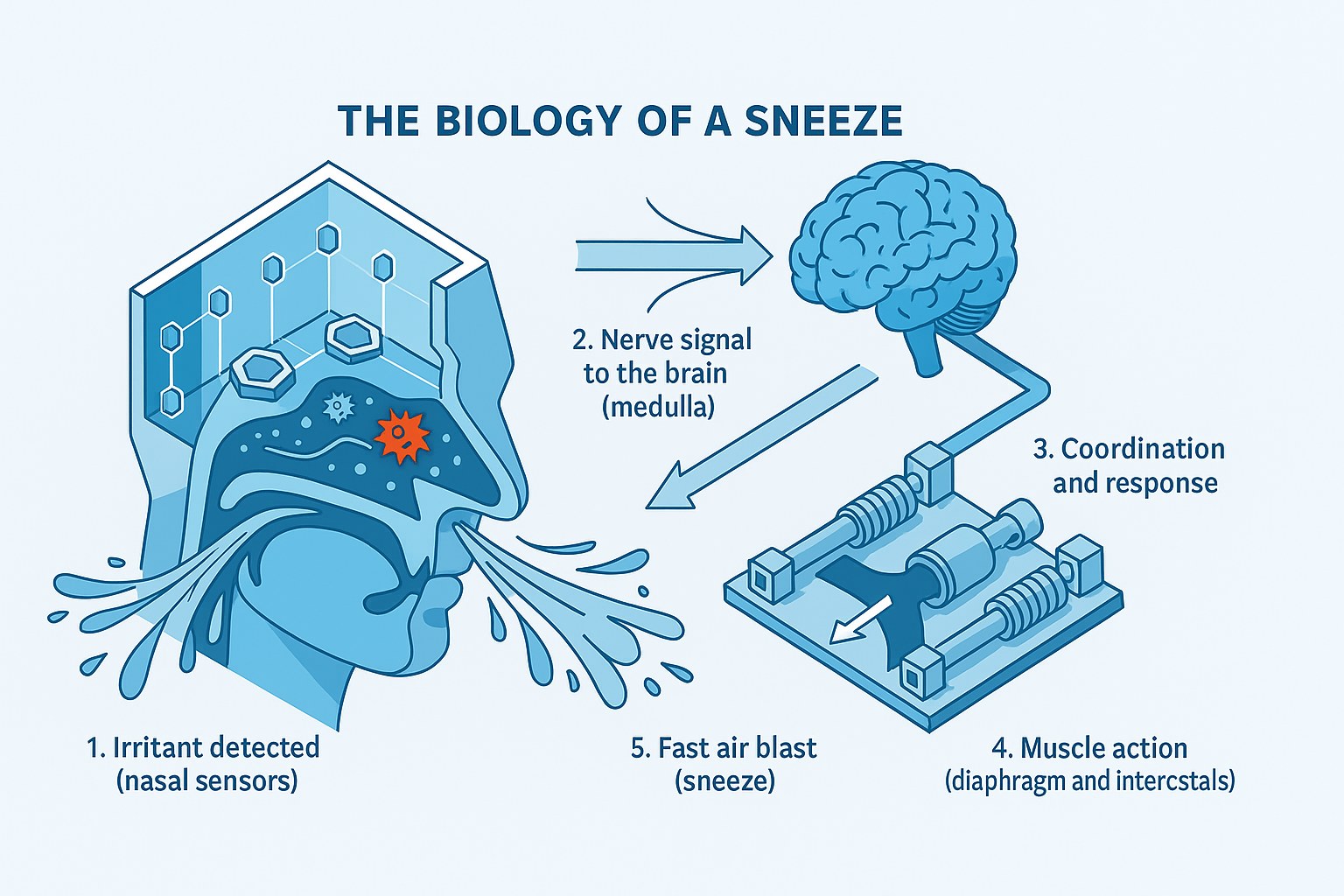
👃 The nasal lining as a sentinel
The nasal lining has ultra-sensitive receptors. These sensors act like watchful guards. They detect the slightest intrusion of unwanted particles.
These sentinels react fast to dust or germs. The body immediately tries to blast out these intruders. It’s a frontline defence mechanism. The survival of our airways depends directly on it.
This reflex pushes thousands of infectious droplets out of the nose. It’s an essential protective barrier. Why do we sneeze? Quite simply, to stay healthy.
⚡ The nerve signal’s journey to the brain
The trigeminal nerve plays a crucial role here. This nerve carries the sensory alert at lightning speed. The message travels straight up to the brainstem.
The sneeze centre then switches on in the medulla. This area processes the information and prepares the response. It’s an involuntary command, impossible to stop. The brain then coordinates the whole body.
This neurological process is completely automatic. Once the signal is confirmed, the reflex becomes unavoidable. The body gets ready for a burst of internal pressure.
💨 The muscle teamwork that blasts out the air
Several muscles spring into action, like the diaphragm and the intercostals. These muscles contract sharply to squeeze the air. The ribcage works like a piston.
The eyes close involuntarily during the process. It’s a protective reflex linked to the cranial nerves. You technically cannot keep your eyes open. This timing is an anatomical feat.
The air is finally driven out through the nose and mouth. The power of the final blast is impressive. Relief follows straight away after this intense physical release.
🌬️ The common causes of repeated sneezing
The mechanism is clear, but the triggers vary enormously, from your immediate surroundings to your habits.
🌼 How environmental allergens affect the nose
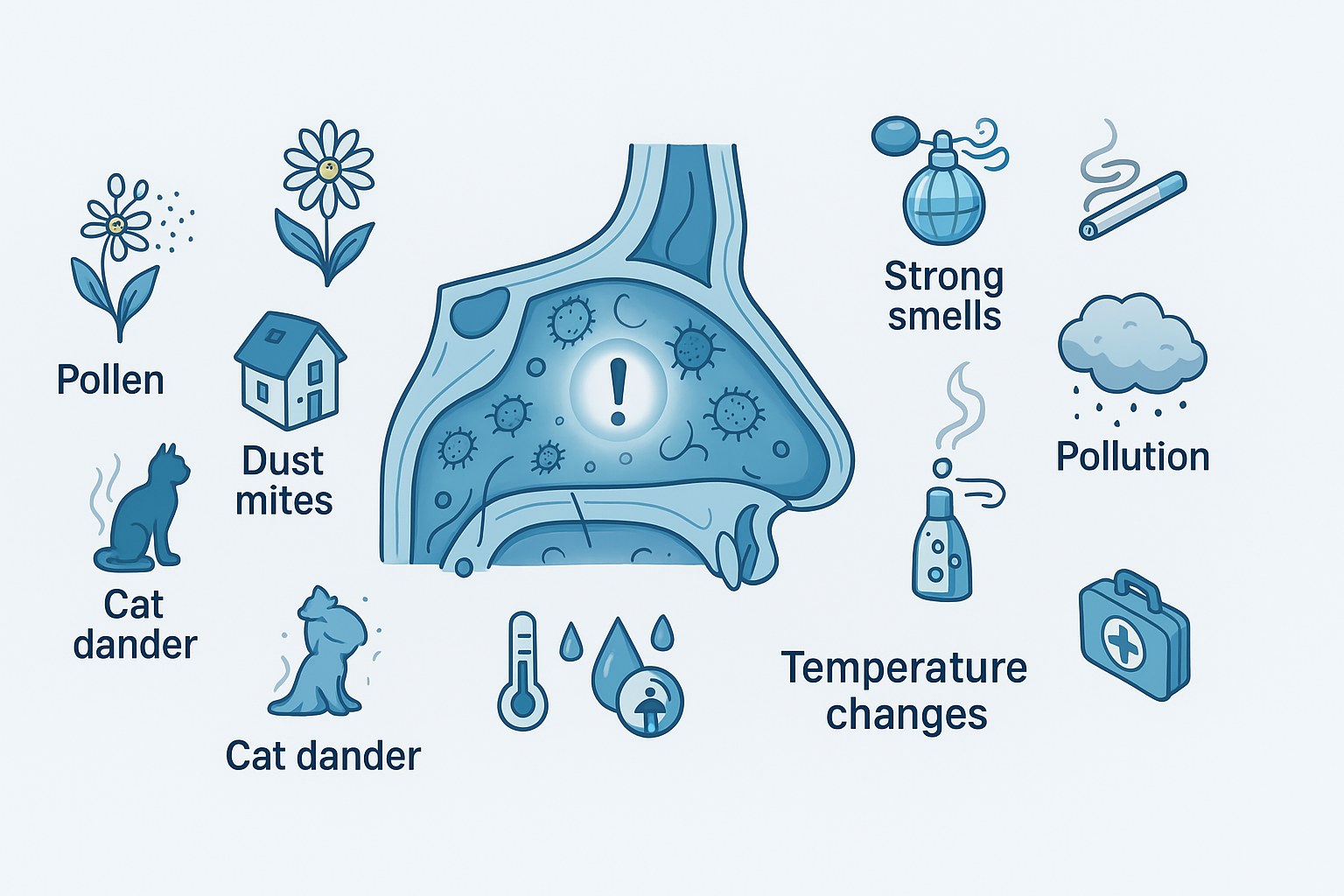
The nose quickly spots pollen, dust mites or animal hair. The immune system sees these as threats. They set off an immediate inflammatory reaction.
The body then releases histamine during allergic contact. This molecule causes itching and a string of sneezes. It’s the typical signature of allergic rhinitis. The nose runs and the eyes often get irritated.
Here are the most common culprits:
- Grass pollen
- Cat dander
- Dust mite droppings
Repeated bouts often point to an untreated allergy. A medical diagnosis then becomes necessary.
🏭 Everyday irritants and air pollution
Strong perfumes and tobacco smoke have a direct effect. These particles aren’t allergens but chemical irritants. They attack the fragile linings directly.
Sensitivity to cleaning chemicals is also common. Bleach or solvent fumes are fierce. They trigger an instant rejection reaction. It’s better to air the room well while cleaning.
Sometimes the irritation comes from our plates. We know, for example, that the piperine in pepper irritates sensory neurons, which is why we sneeze while cooking. It’s a very effective defence reflex.
🌡️ The influence of changes in temperature and humidity
The nasal blood vessels react sharply to sudden cold. Going from a heated indoor space to icy outdoor air surprises the nose. The vessels widen or shrink abruptly.
This is what we call vasomotor rhinitis. It’s a non-allergic reaction to changes in the environment. Too much humidity can also be a trigger. The nose is simply reacting to a physical change.
| Factor | Type of reaction | Main symptom |
|---|---|---|
| Dry cold | Vasomotor | Blocked nose |
| High humidity | Inflammation | Clear runny nose |
| Urban pollution | Nerve irritation | Tingling |
| Perfumes | Nerve irritation | Bursts of sneezes |
In short, our nasal linings are real weather sensors. They flag every sudden change in the surrounding air. A little gentleness and well-humidified air often help to ease these bouts.
🤒 Telling an allergy from a passing viral infection
Yet when the nose goes wild, we often hesitate: is it spring pollen or just a cold caught at the office?
🤒 The telltale signs of a cold and the flu
Fever and aches often signal an infection. These markers prove that the body is actively fighting a virus. The whole organism then rallies to heal quickly.
Take a good look at the colour of your nasal mucus. Thick, yellowish or greenish mucus usually points to a viral infection. At first the fluid stays clear, then it changes texture. It’s a classic natural clean-up.
A cold normally lasts about a week. If your symptoms drag on beyond that, the cause is surely elsewhere. Tiredness also feels more intense here.
🌸 The lingering symptoms of allergic rhinitis
The absence of fever is the big clue for allergic reactions. It’s the main test for telling the difference. You may sneeze again and again, but your body temperature stays steady.
These bouts often come back with the seasons or the environment. They last as long as you stay in contact with the allergen. Relief only comes by removing the source or with treatment.
An allergy can be spotted by its cyclical repetition and the complete absence of fever, unlike classic viral infections.
💧 The importance of hydration for the nasal linings
Drinking water really helps to thin the nasal mucus. Good hydration lets the nose clean itself. The tiny hair-like cilia work better in a nicely moist setting.
Use saline solutions for an effective nasal rinse. This move physically flushes out dust, pollen or viruses. It’s simple and incredibly useful, ideally morning and evening.
Indoor air that’s too dry ends up irritating your nasal walls. Keeping a water bottle within reach is the best prevention. Your nose will greatly appreciate this little comfort regained.
☀️ The curious phenomenon of sneezing in the sun
Beyond illness, there’s a far more surprising trigger, made purely of light, that affects one in four of us.
☀️ Understanding the photic sneeze reflex
This genetic trait affects part of the world’s population. It’s also called ACHOO syndrome. It’s a fairly common inherited quirk in humans.
The brain mixes up light information and tickling sensations. In fact, there’s a confusion between optical and nasal signals. Bright light then becomes an irritant.
This strange reflex, triggered by sudden exposure to bright light, affects about 25% of the world’s population.
👁️ The role of the optic nerve and the trigeminal nerve
These two nerve pathways sit strikingly close together. They run very near one another inside the skull. An electrical interference sometimes happens between them.
The intense signal from the optic nerve spills over onto the trigeminal. The latter then thinks it’s getting a nasal alert. The sneeze is triggered by mistake because of this over-stimulation.
Still, this phenomenon stays completely harmless to your health. It can be a bother for drivers coming out of a tunnel. Wearing sunglasses often reduces this risk.
🔁 Why we often sneeze several times in a row
Several tries are often needed to clear out an intruder. Sometimes the first blast isn’t enough. So the body insists, to guarantee that the linings are clean.
If the particle stays stuck, the cycle starts again straight away. It’s an automatic feedback loop. Relief only comes once the passage is completely clear.
- incomplete expulsion
- leftover irritation
- heightened sensitivity
Three sneezes are generally the norm observed. It’s the classic rhythm for an effective clean-up.
⚠️ The dangers of deliberately holding in a sneeze
Faced with this looming explosion, it’s tempting to hold it all in to stay discreet, but that’s a risky mistake.
👂 The pressure on the ears and eardrums
Holding back that sudden blast risks damage to the inner ear. Blocking the air forces the pressure inside the skull. This can damage the fragile structures of your hearing.
The pressurised air then rushes violently into the Eustachian tube. This force can literally crack an eardrum. It’s an intense, sudden pain. It’s better to let the air escape freely.
Social discretion is never worth a physical injury. The ear is a precious and delicate organ. Don’t gamble with your hearing for the sake of mere convenience.
🩸 The risks to blood vessels and sinuses
Blocking the expulsion sometimes causes tiny capillary ruptures. Blood pressure shoots up across the whole face. Small vessels can then burst in your eyes.
In extreme cases, air slips in where it shouldn’t, causing a pneumothorax. It’s an uncommon but very real medical emergency. Never take this risk needlessly.
It’s better to let nature do its thing. The body knows exactly what it’s doing when it blasts out this air. Respect this fundamental physiological need for your health.
🚀 The truth about the speed of the expelled air
We need to bust the myths about the real speed of this reflex. People often say 160 km/h, but that’s hugely exaggerated. Science suggests more like 50 km/h.
This blast is still more powerful than an ordinary cough. This force is enough to send droplets several metres. That’s why hygiene stays crucial every day.
Even at 50 km/h, the internal impact stays strong. The pressure must escape without any obstacle. Your body handles this energy with great precision.
🧼 Hygiene measures and tips to calm your nose
So, how can you manage these bouts day to day while protecting those around you and your own nasal comfort?
🤝 Barrier gestures against the spread of viruses
Sneezing into the crook of your elbow is an essential reflex to protect others. It’s the most effective barrier in daily life. Above all, it stops you contaminating your own hands.
Always use disposable tissues for your nose. A cloth handkerchief is a real, rather grim, germ nest. Throw the tissue quickly into a closed bin after use. Wash your hands straight away.
- Sneeze into your elbow
- Single-use tissue
- Frequent hand-washing
These simple little reflexes genuinely save lives. They effectively slow the spread of nasty winter epidemics.
🌿 Natural tricks to ease a sudden urge
Firm pressure under the nose can sometimes stop the process dead. Pressing on the philtrum helps divert the nerve signal. It’s a rather surprising little distraction trick.
Remember to air your rooms for at least ten minutes a day. Refreshing the air helps flush out lingering pollutants and allergens. Your nose will then be far less bothered by irritants.
Setting up a humidifier is a great idea if the air is dry. It stops your linings from drying out over winter. A well-hydrated lining always stays less reactive and more comfortable.
👨⚕️ When to see an allergist or an ENT specialist
Spot the signs of chronic bouts that become suspicious. If these sneezes disturb your sleep, it’s time to act. Medical advice will finally help pinpoint the real cause.
Nasal polyps can also play a role in blockage. These small growths get in the way of breathing and create constant irritation. An ENT specialist will easily detect them to offer you treatment.
| Symptom | Specialist to see | Goal |
|---|---|---|
| Seasonal bouts | Allergist | Skin tests |
| Permanently blocked nose | ENT specialist | Endoscopy |
| Loss of smell | ENT specialist | Precise diagnosis |
This reflex protects your lungs by blasting out intruders, thanks to the trigeminal nerve and the medulla. To soothe your nose, air it often and keep your linings hydrated, without ever blocking this vital expulsion. Keep your natural filters in top shape to breathe easy every day! 🌬️
❓ FAQ
🔁 Why do I sneeze several times in a row?
It’s simply because your body is a perfectionist! Sometimes a single sneeze isn’t enough to fully blast out the intruder (dust, pollen or cat hair) tickling your nasal lining. The reflex then repeats until the passage is perfectly clear and clean.
It can also be leftover irritation that keeps the alert signal switched on. Usually, a little burst of three sneezes is the norm for an effective clean-up of your airways. It’s a defence mechanism that’s a bit noisy, but very efficient!
🚫 Is it dangerous to hold in a sneeze?
Yes, it’s best not to play shy with your sneezes. By blocking that sudden blast, you create very strong internal pressure that looks for another way out. This force can be redirected towards your ears and sinuses, risking damage to your eardrums.
In some cases, this pressure can even cause tiny ruptures of small blood vessels in the eyes or, more rarely, lung complications. Discretion isn’t worth an injury, so let nature express itself freely!
☀️ Why does the sun make me sneeze the moment I step outside?
You’re not alone — this affects about a quarter of the population! It’s called the photic sneeze reflex, or ACHOO syndrome. It’s a little neurological “short circuit”: the intense light signal picked up by your optic nerve spills over onto the trigeminal nerve, which handles the nose’s sensitivity.
Your brain gets its wires a little crossed and reads the bright light as a nasal irritation. This trait is often inherited, so if you sneeze in the sun, there’s a good chance your children will too. A decent pair of sunglasses is usually enough to calm this reflex.
🤔 How can I tell whether my sneezing hides a cold or an allergy?
The first clue to watch is fever: an allergy never causes one, unlike a viral infection such as the flu or a heavy cold. If your sneezing comes with aches and marked tiredness, the culprit is probably a virus passing through.
Also watch the length and colour of your mucus. A cold lasts about a week with secretions that thicken, while an allergy lingers as long as you’re exposed to pollen or dust mites. An allergy is mainly recognised by its cyclical side and the complete absence of fever.
🤫 Are there tricks to calm an urge to sneeze at the wrong moment?
If you feel a sneeze coming during a solemn moment, you can try pressing firmly on your philtrum, that little area just under your nose. This pressure creates a nerve distraction that can sometimes stop the signal sent to the brain dead in its tracks.
In the long run, be sure to keep your linings well hydrated by drinking water and using saline solutions to clean your nose. Less dry indoor air, thanks to a humidifier or ten minutes of daily airing, will also help your nose be far less reactive to everyday little irritants.
