
Have you ever wondered how your inner engine delivers oxygen to your billions of cells without ever stopping for a coffee break? ❤️ This article explains exactly how the heart works and how blood flows around your body — a muscle barely bigger than a fist and a half that pumps 8,000 litres of life-giving liquid every single day. You’ll discover the secret of its electrical automatism and the role of its four valves, the little flaps whose closing makes the famous beat that keeps time with your busy life.
- How the heart works and its four chambers
- The heart valves and the secret of the beat
- Short loop: the pulmonary circulation
- Long loop: delivery around the whole body
- How does the heart decide to beat on its own?
- Feeding and looking after the heart machine
❤️ How the heart works and its four chambers
Now that the scene is set, let’s look at how this machine is built, because its structure explains all its talent.
🏛️ The atria, the welcome halls
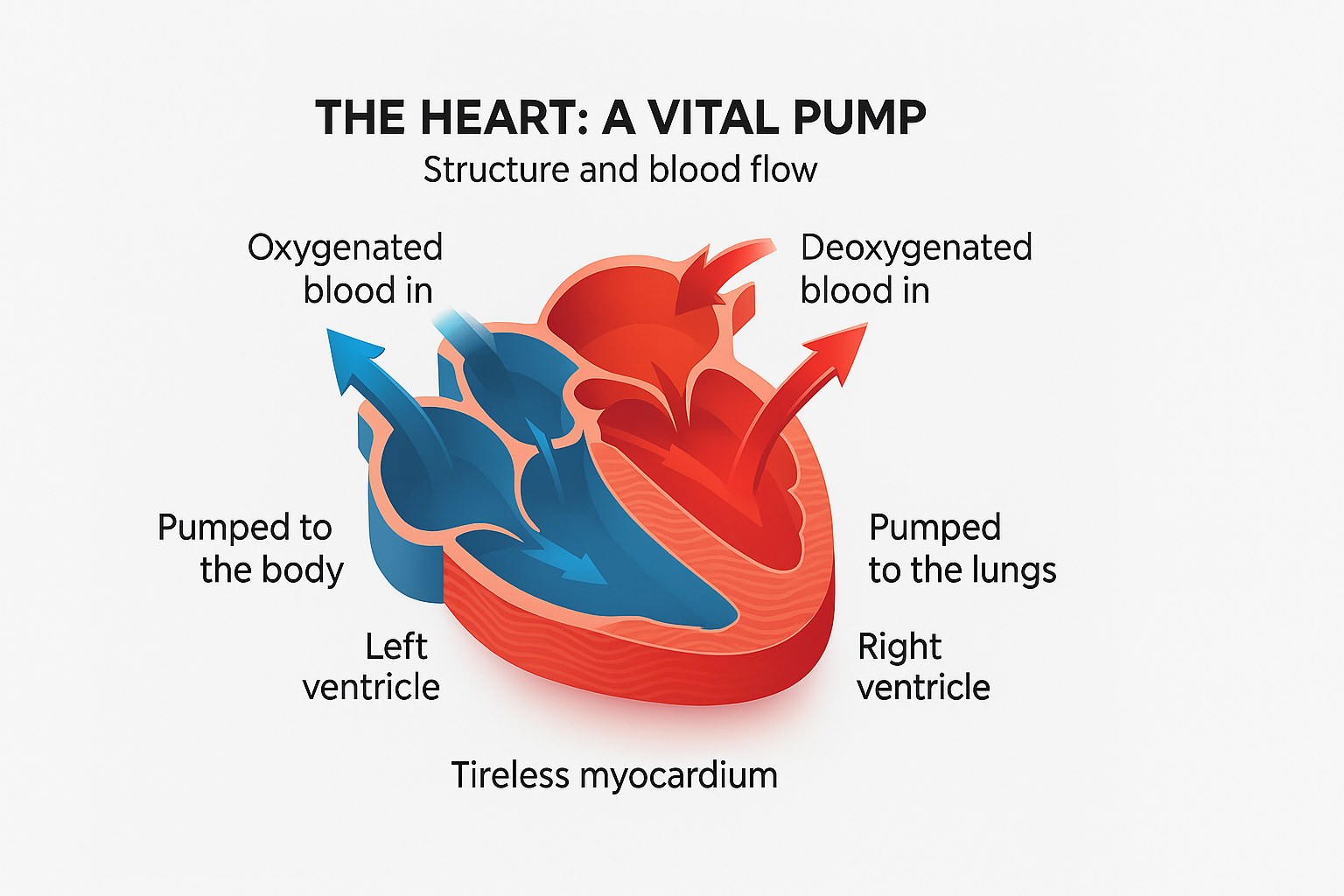
The heart has two atria that act as arrival areas. The right one receives the tired blood coming back from the body, while the left one welcomes the fresh blood from the lungs. It’s the entry point for every drop.
The walls of these chambers are very thin. They don’t need brute force. Their job is simply to pass the blood down to the floor below.
These chambers stay fairly passive. They act as a transition lock.
- Right atrium: receives deoxygenated blood through the vena cava
- Left atrium: receives oxygenated blood through the pulmonary veins
- Thin walls suited to low pressure
🚀 The ventricles, the engines of expulsion
Now for the serious business: the ventricles. These are the real muscles of the system. They push the blood out of the heart with impressive force at every contraction.
The left ventricle is a workhorse. It has to send blood all the way to your toes. Its walls are therefore much thicker and stronger.
The right ventricle is more modest. It only aims for the lungs, right next door.
💪 The myocardium, a muscle that never sleeps
The myocardium is a tissue unlike any other. It’s a striated muscle that works without your help. It never gets tired, unlike your biceps.
Its size is surprising. Make a fist: that’s roughly the size of your engine. It’s compact and efficient at keeping your cells alive.
Its automatism is its strength. It contracts in a steady rhythm without ever asking for a break.
🚪 The heart valves and the secret of the beat
For this pumping movement to be of any use, it needs a direction. That’s where the valves come in.
🚪 A system of one-way flaps
Picture swinging doors that only open one way. That’s exactly the role of the valves. They stop the blood from turning back when the heart contracts. Without them, the liquid would stagnate or keep flowing backwards.
The mechanics are purely physical. The pressure of the blood pushes the valve open to pass through. Then, as soon as the pressure drops, the flaps close tightly to block the way.
It’s a perfect seal. The flow stays one-way and constant.
📍 Where the four main valves sit
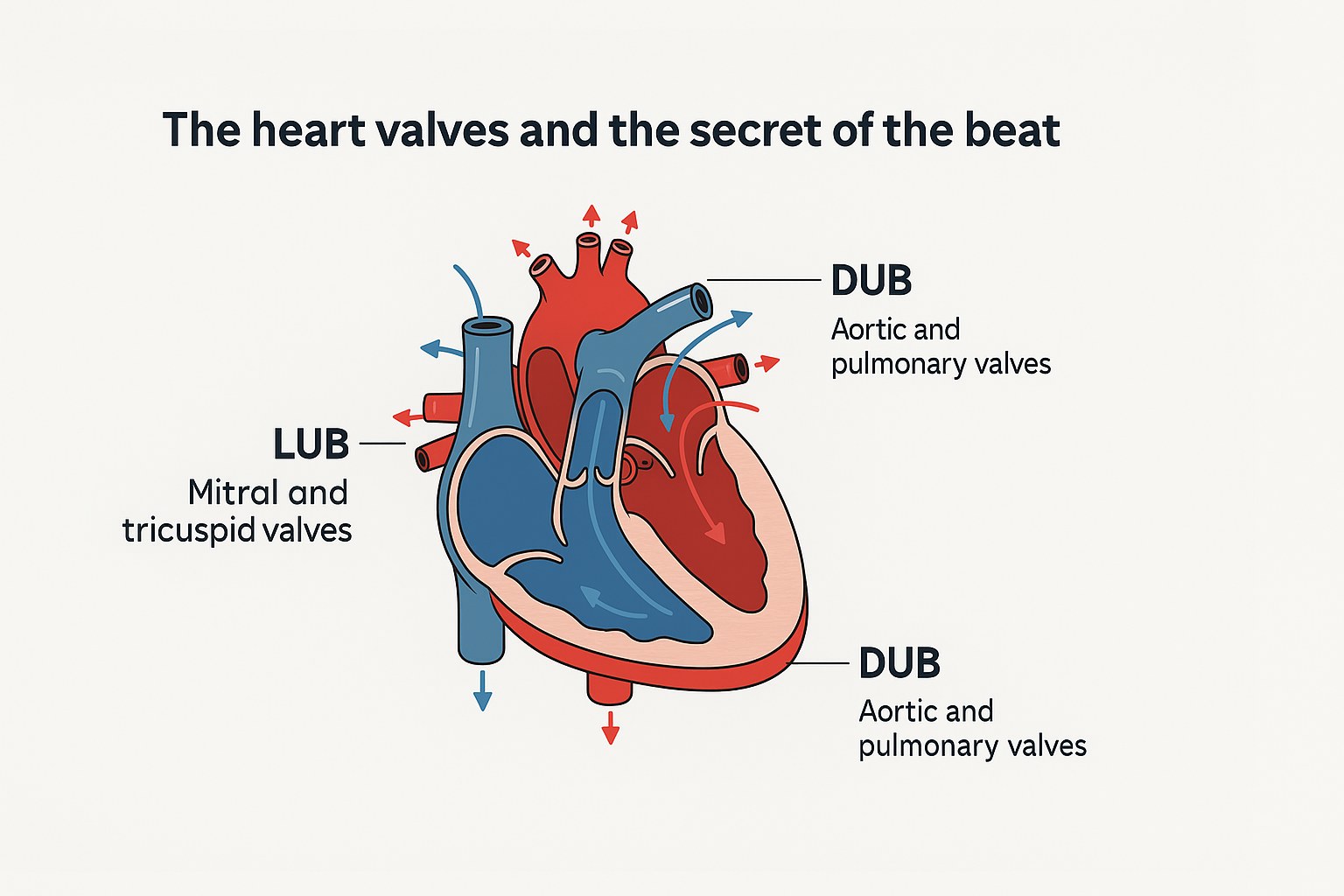
There are four guardians of the temple. First come the atrioventricular valves, like the mitral and the tricuspid. They separate the top from the bottom. Then come the outlet valves.
The aortic and pulmonary valves handle the ejection towards the arteries. They open at the same moment as the ventricles push. It’s a perfectly synchronised dance, and without it the whole delivery system would struggle and run out of breath.
Every beat calls on these four flaps. They’re tough and put to work constantly.
🔊 Where the sound of the heart comes from
That famous “lub-dub” isn’t the muscle thumping. It’s the sound of doors slamming shut. Each sound matches the sharp closing of a pair of heart valves.
The first sound marks the closing between atria and ventricles. The second, crisper one signals the closing of the outlets towards the arteries. It’s a mechanical music that reassures you the seal is holding.
The beat you hear is the echo of precision machinery, where each flap closes to guide life along.
🫁 Short loop: the pulmonary circulation
Now that the pump is ready, let’s follow the blood’s first journey: the one that refreshes it.
💙 Blue blood setting off for the lungs
The blood comes back from the body, worn out. It has given all its oxygen to the organs. We call it “blue” by convention, because it’s loaded with carbon dioxide and waste.
The pulmonary artery then takes over. It’s the only artery in the body that carries oxygen-poor blood. It leads it straight to the lungs for a refresh. It’s a short trip, but a vital one for what comes next.
The right ventricle gives the first push. The journey to the air sacs begins.
💨 The gas exchange that tops up the tank
Once in the lungs, the blood meets the air you breathe. This is where the magic happens. The carbon dioxide is pushed out to be breathed away quickly.
In exchange, the red blood cells grab brand-new oxygen molecules. The blood instantly changes colour. It turns a bright, vivid red. This chemical change is the very heart of cellular breathing. Without this energy top-up, nothing works.
The barrier between the air and the blood is tiny. The exchange is almost instant.
❤️ Red blood coming back to the heart
Once fully loaded, the blood wastes no time. It takes the pulmonary veins. These channels bring it straight back to the left atrium, the gateway to the big loop.
This return marks the end of the short loop. The blood is now ready to take on the rest of the body. It just waits for the signal to move into the left ventricle.
- Getting rid of CO2
- Picking up O2
- Return to the left heart
🩸 Long loop: delivery around the whole body
The blood is refreshed, so it’s time to send it where life is buzzing: to our organs.
🛣️ The aorta, the body’s main motorway
The aorta is the queen of the arteries. It leaves the left ventricle under huge pressure. It’s the main trunk from which all the branches that feed your body set off. Its wall is elastic to absorb the shock of each powerful beat.
It then branches into smaller and smaller arteries. It serves the brain, the arms, then heads down to the abdomen and the legs. It’s a flawless delivery network.
Without that aortic pressure, the blood would never reach the far ends. The pump has to stay strong.
📦 Delivering oxygen to the vital organs
At the end of the road, the arteries become capillaries. They’re so thin that only one red blood cell passes at a time. This is where the delivery happens.
The brain, the muscles and the liver collect the oxygen and the nutrients. In exchange, they hand their waste over to the blood. It’s a constant swap that keeps every cell alive and doing its daily biological job.
| Loop | Main role | Type of blood | Destination |
|---|---|---|---|
| Pulmonary loop | Re-oxygenation | Deoxygenated blood | Lungs |
| Systemic loop | Delivery | Oxygenated blood | Whole body |
🔄 The return trip through the veins
The blood now heads back to the heart. It travels through the veins, where the pressure is much lower. To climb up from the legs, it uses small one-way valves.
The upper and lower vena cava collect all this flow. They join up to pour the blood into the right atrium. The loop is complete. The cycle can start again, endlessly.
This venous return is essential. It stops the blood from pooling in the lower limbs. So how does the heart work? The circulation of blood is a marvel of precision.
⚡ How does the heart decide to beat on its own?
We know where the blood goes, but who gives the starting signal? It’s a matter of electricity.
🔋 The sinus node, a natural electric battery
The heart has its own conductor. The sinus node, in the right atrium, generates spontaneous electrical impulses. It doesn’t wait for an order from the brain to switch on.
This is what we call cardiac automatism. Even cut off from the rest of the body, a heart can keep beating for a few moments. This natural battery sets the rhythm of your life, day and night, without you ever needing to think about it.
It’s a fascinating independence. The electrical signal is born all by itself.
⚡ How the signal spreads through the ventricles
The spark has to travel everywhere. It crosses the atria, then heads down to the ventricles through the bundle of His. This internal wiring network makes sure the muscle contracts from top to bottom, like squeezing a tube of toothpaste.
The timing has to be perfect. If the chambers contracted any old way, the blood wouldn’t move forward. It’s this electrical precision that makes every beat effective.
The heart’s electricity is the invisible thread that keeps the pace of our existence.
🏃 The rhythm speeding up during sport
When you run, your muscles cry out for fuel. They need more oxygen. The heart senses this need and speeds up the pace. The sinus node sends signals closer together.
It’s a fine, responsive control. As soon as the effort stops, the rhythm gradually comes back down. The nervous system adjusts the speed of the battery to save the heart muscle’s energy.
Sport also strengthens the heart. A well-trained heart beats more slowly at rest.
🛠️ Feeding and looking after the heart machine
Finally, let’s not forget that the firefighter needs water too. The heart has to feed itself.
⛽ The coronary arteries, the muscle’s fuel
The blood passing through the chambers doesn’t feed the muscle. The myocardium has its own private network: the coronary arteries. They wrap around the heart like a crown.
These pipes are vital but fragile. If they get blocked, part of the muscle dies from lack of oxygen. That’s a heart attack. Looking after these channels keeps your engine in good shape.
They bring the fuel the heart needs. Without them, the pump stops dead.
📊 Keeping an eye on your resting heart rate
Your pulse says a lot about your health. At rest, a healthy adult runs between 60 and 100 beats per minute. Stress, lack of sleep or caffeine can push these numbers up.
Learning to take your pulse is a simple thing. Two fingers on the wrist is enough. It’s a handy habit for spotting something unusual or simply getting to know yourself better.
Steadiness is the watchword. A stable rhythm is a sign of calm.
💪 Simple habits for good health
Taking care of your heart isn’t rocket science. A brisk daily walk and a colourful plate already work wonders. The heart loves movement and hates sitting still.
Stress is also a silent enemy. Learning to breathe calmly helps the rhythm settle. It’s a worthwhile investment in your future. Your heart will thank you for it.
- Move for 30 minutes a day
- Go easy on salt and fat
- Sleep enough to recover
This fist-sized muscle keeps up a vital dance between lung oxygenation and body delivery, thanks to its four protective valves. Listen to your beats: they confirm that your heart pump is working tirelessly. Start a brisk daily walk today to look after this amazing engine for the long term.
❓ FAQ
🔄 How does the heart manage to move blood around the whole body?
The heart acts like an ultra-efficient pump. By contracting steadily, it pushes the blood into two quite separate loops. The right side sends the blood to the lungs to top up on oxygen, while the left side, more muscular, drives it forcefully into the aorta to feed absolutely every cell in your body, from your hair to your toes.
This huge job moves about 8,000 litres of blood every day. It’s an endless cycle in which the heart muscle, the myocardium, keeps up a steady delivery of oxygen and nutrients, while picking up waste such as carbon dioxide.
🔢 What are the four chambers that make up our heart?
Our inner engine is split into two parts, right and left, each with two chambers. At the top are the atria, which act as welcome halls for the incoming blood. At the bottom, the ventricles play the role of propulsion engines to push the blood out of the heart.
The right atrium receives the tired blood from the body, while the left atrium welcomes the fresh blood coming from the lungs. The ventricles then take over to send this precious liquid to its final destination, whether that’s the lungs or the rest of the body.
🚪 What exactly are the heart valves for?
The valves are real little one-way flaps. Their mission is simple but vital: they force the blood to flow in one single direction. They open to let the flow through, then close tightly to stop the blood from going backwards.
There are four of them in total, placed strategically between the atria and the ventricles, as well as at the exit of the ventricles. It’s actually the sound of their sharp closing that we hear during the famous “lub-dub” of our heartbeats.
⚡ How can the heart beat on its own?
It’s the magic of cardiac automatism! The heart has its own natural electric battery, called the sinus node. Sitting in the right atrium, this little command centre spontaneously generates electrical impulses that trigger the muscle’s contraction, without our brain needing to step in.
This electrical signal then travels through an internal wiring network, the nodal tissue, to perfectly coordinate the movement of the chambers. That’s what lets the heart keep the rhythm, even when we sleep or aren’t thinking about anything.
🩸 How is the heart muscle itself supplied with blood?
Even though litres of blood pass through its chambers, the heart can’t feed on it directly. It has its own private delivery network: the coronary arteries. These vessels set off from the aorta and wrap around the heart like a little crown to bring it the oxygen it needs to work.
So it’s essential to look after these little arteries. A healthy lifestyle, with a bit of exercise and a balanced diet, helps keep these channels nicely clear so that our engine never runs out of fuel.
🫁 What exactly is the path of the blood during the pulmonary loop?
The pulmonary loop is a short but essential journey for refreshing the blood. The deoxygenated blood arrives in the right atrium, passes into the right ventricle, then is pushed out to the lungs through the pulmonary artery.
Once in the lungs, the blood gets rid of the carbon dioxide and tops up on oxygen. It then changes colour to a bright red before coming back to settle in the left atrium, ready for the big journey to the rest of the body.
