
Do you ever wake up feeling like you’ve just lived through an exhausting adventure, when really you were tucked up under your duvet? 😴 Understanding why we dream at night helps us realise that this nighttime cinema is actually a vital natural therapy session that sorts your emotions and locks in your memories. This article reveals how your brain uses REM sleep to boost your creativity and protect your mental balance, thanks to a fascinating piece of biological organisation.
- Why our brain switches on at night
- The biological functions of our dreams
- What happens in your head while you sleep
- Dreams versus other nighttime phenomena
- Factors that influence how intense dreams are
- Understanding your own dreaming habits
🧠 Why our brain switches on at night
Once you’ve closed your eyes, a real biological factory starts up to orchestrate your rest.
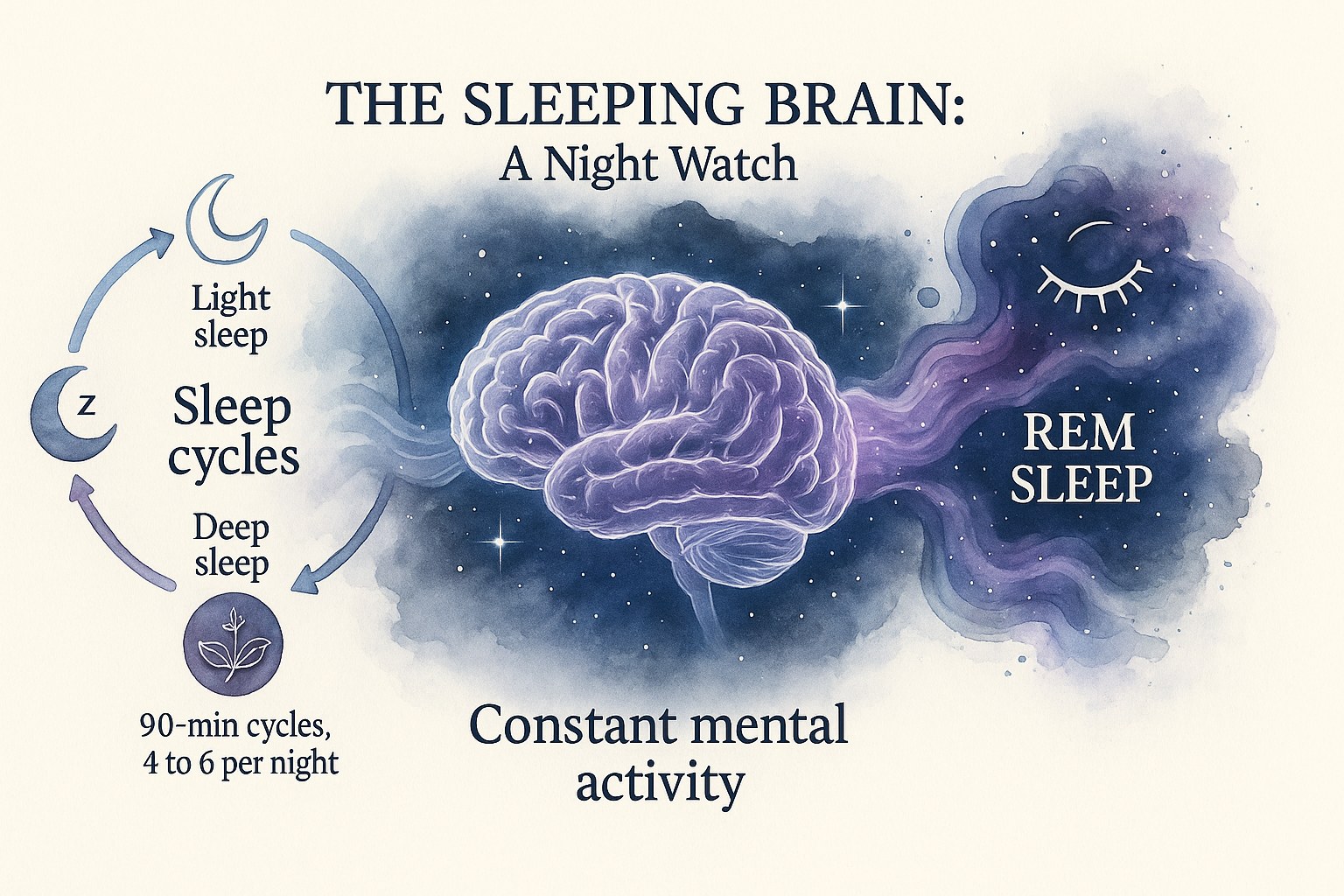
🔄 How sleep cycles work
Sleep isn’t one solid block. It switches between phases of light sleep and deep sleep. Each stage plays a precise role in physical recovery. It’s a well-rehearsed ballet.
A full cycle lasts about 90 minutes. These sequences repeat four to six times a night. The body follows this rhythm to fully recharge. It’s a piece of precision machinery.
You shouldn’t break these cycles suddenly. Waking up in the middle of deep sleep leaves a foggy feeling. You then feel very tired.
The transition then moves towards the most restless phase. Mental activity ramps up clearly. The brain begins its nighttime show.
💤 The place of REM sleep
REM sleep, the rapid-eye-movement phase, is fascinating. It’s the moment when the eyes move quickly. The brain is then working at full power.
Brain activity is almost as intense as in broad daylight. It’s the favourite ground for the most complex dream scenarios. Our emotions are processed strongly here. We build whole worlds.
Muscle atonia causes a temporary paralysis of the body. It stops us acting out our dreams. This keeps us from hurting ourselves by accident during the night. The body stays nice and still.
This protection is a fascinating safety mechanism. Without it, our nights would be far more eventful. It’s an essential natural safeguard for us.
🧠 A normal, constant mental activity
Everyone dreams, even those who never remember it. Why do we dream at night? It’s a universal biological function. No one really escapes it.
We produce several dream sequences every night, with no notable exceptions. It’s an automatic, regular process. The brain never stops working for us.
- The average number of dreams is several sequences per night.
- Dream activity takes up about 20 to 25% of total sleep time.
- Animals dream too, which proves the biological nature of the phenomenon.
Dreaming is the sign of a healthy brain. It’s an essential nighttime workout. It helps to keep our mental balance.
💭 The biological functions of our dreams
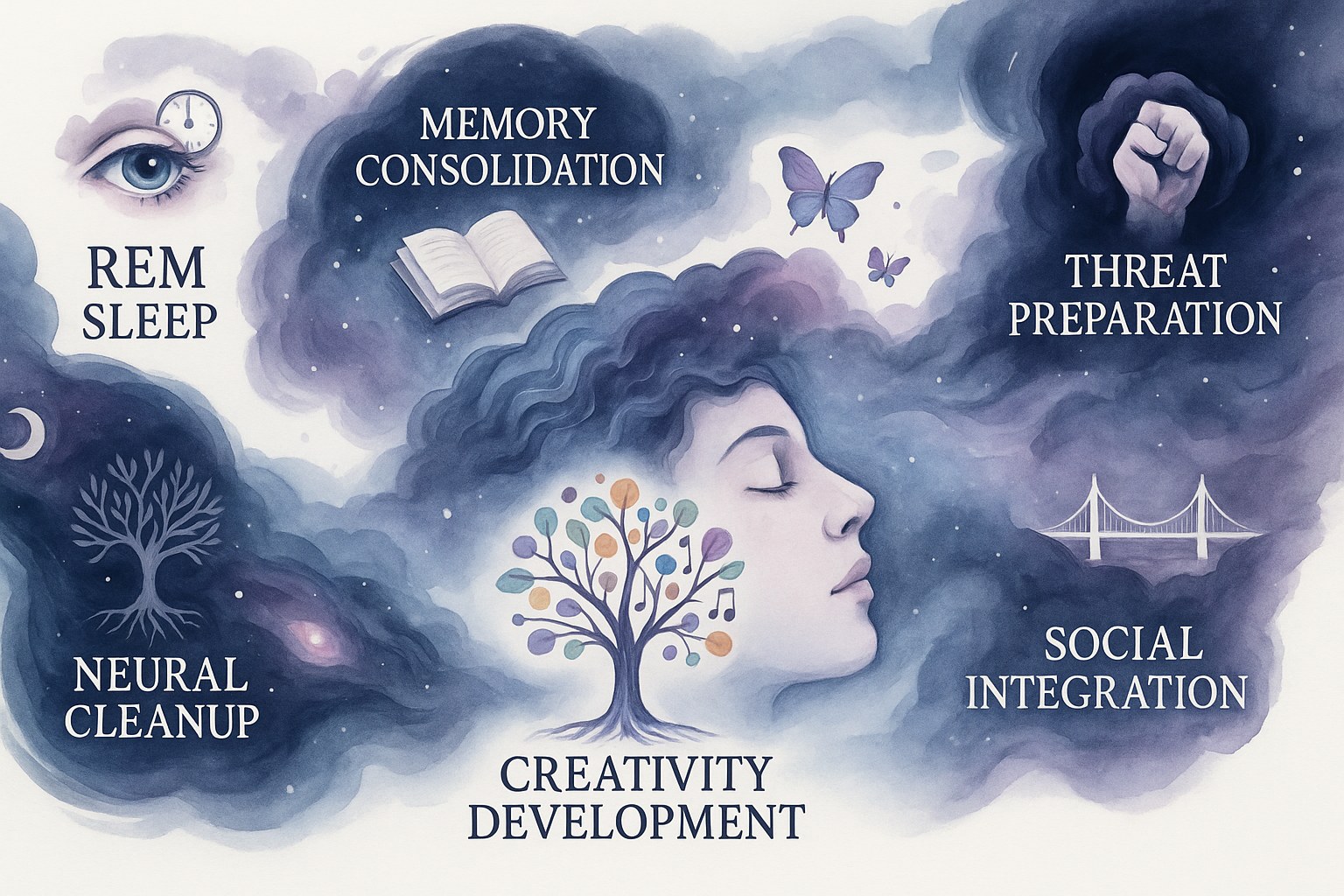
But beyond the neural buzz, why does our mind put us through these nighttime films? Why do we dream at night? Science suggests that these scenarios, sometimes strange, carry out vital missions.
📚 Locking in memory and learning
At night, the brain sorts the data it has gathered. It decides what’s useful. The useless details end up in the bin. This nighttime clean-up is essential for memorising.
The important memories are then stored for the long term. The dream acts like a dress rehearsal. We replay the skills we’ve recently learned. This strengthens the traces in our mind.
Students who dream about their lessons do better. It’s a completely unconscious revision. The brain works while we sleep.
This process also clears out the clutter. We free up space this way. We’re ready for the next day’s learning.
💞 Regulating emotions to feel better
The dream is a real natural therapy. It helps us digest tension. The little everyday upsets are transformed this way.
The emotional intensity of memories fades at night. The brain detaches the emotional charge. We often wake up calmer.
Dreaming is a mechanism of emotional regulation that helps us face the challenges of the real world with greater calm.
This nighttime work protects our mental balance. It’s a shield against anxiety. Without it, stress would quickly become unmanageable.
🎨 Developing creativity without limits
The mind makes very unusual connections between ideas. The logical barriers crumble during rest. Awareness gives way to imagination.
The brain finds solutions to complex problems. Original ideas pop up effortlessly. Great discoveries are born from nighttime insights.
| Type of thought | Awake state | Dream state |
|---|---|---|
| Logic | Linear | Chaotic |
| Connecting ideas | Strong | Unlimited |
| Inhibition | Present | Absent |
| Creativity | Structured | Spontaneous |
The dream is our secret laboratory. It explores brand-new paths. This boosts our endless capacity for innovation.
😴 What happens in your head while you sleep
To understand these strange tales, we need to look under the bonnet of our skull.
🧠 The role of the amygdala and the hippocampus
The amygdala plays a major role in handling strong emotions. It fires up intensely during the night. This lets us process our nighttime fears and angers.
The hippocampus then steps in for spatial navigation and memories. It supplies the precise backdrop of our dream adventures. This structure is essential for replaying our lived experiences.
The teamwork between these two zones creates truly vivid tales. Emotions then blend with familiar or imaginary places. The brain mixes all of this to form a story.
This intense activity explains why our dreams feel so real. We live them physically. The limbic system works at full power while we sleep.
👤 Keeping our personal identity
The theory of nighttime neural reprogramming is fascinating. The brain checks and updates our basic neural circuits. It’s a necessary technical service for our balance. Why do we dream at night? To stay ourselves.
Dreams keep the coherence of our deep self. They weave a strong link between our past and our present. This mental continuity is essential so we don’t lose ourselves.
This function protects our personality through hard times. We stay the same despite outside changes. It’s an invisible force that acts quietly every night.
This process is vital for mental health. Identity steadies itself in the calm of the night. We wake up with a stronger sense of unity.
🔌 The shutdown of the prefrontal cortex
The illogical side of dreams comes from the resting of the prefrontal cortex. It’s the seat of reason and everyday judgement. Without it, logic gently fades away.
We accept the wildest scenarios without batting an eye. The inner critic is fully switched off during REM sleep. Nothing seems odd to us in the moment.
This lack of filter allows total freedom of the mind. We can fly or talk to animals without being surprised. The constraints of the real world no longer exist at all.
This letting-go is a real breath of fresh air for the mind. Logic will take back control on waking. Let’s enjoy this magical break with no limits at all.
🌙 Dreams versus other nighttime phenomena
Not everything that pops up in the dark is necessarily a classic dream.
👻 Telling a nightmare from a dream
A nightmare is often a failure of emotional digestion. The brain gets muddled during sleep. It then generates an anxiety too strong to be handled calmly.
The sudden wake-up comes in the face of an intense fear. It’s an immediate survival reaction. We’re simply trying to escape a threat sensed by our mind.
Around 82% of dreams are thought to be violent or negative in nature, possibly serving to simulate threats so we’re better prepared.
Occasional nightmares are completely normal. They shouldn’t be a worry. They’re a full part of our natural psychological defence system.
✨ Spotting hypnagogic hallucinations
As we fall asleep, visual or sound sensations sometimes appear. We think we hear a familiar voice. We glimpse strange shapes in the dim light of the bedroom.
We need to tell this apart from classic dream activity. These phenomena happen during the transition into rest. Sleep hasn’t really set in yet in the brain.
These hallucinations are harmless and very common. Many people experience them with no illness at all. So there’s no reason to be alarmed by these perceptions.
Extreme tiredness often makes these particular episodes stronger. The brain then hesitates between waking and sleep. Why do we dream at night? That’s a whole different machinery.
📈 How dreams change with age
Children’s dream activity is far more intense than that of adults. The youngest dream a lot. They spend a large part of their night in REM sleep.
This phase naturally shrinks over the course of life. The time given to dreams gradually reduces. Ageing thus reshapes the deep structure of our usual nights.
- Dreams in babies
- The overflowing imagination of teenagers
- The settling down in adulthood
Our nights simply reflect our current stage of development. The brain adapts brilliantly at every age. Each period of life has its own nighttime signature.
⚡ Factors that influence how intense dreams are
Your daytime lifestyle often dictates the quality of your nighttime adventures.
😰 The influence of stress and sleep hygiene
Eating dinner too late upsets your body clock. Difficult digestion raises your body temperature. Your dreams then become more muddled and your sleep less deep.
Anxiety often causes micro-awakenings during the night. We then remember our dreams more easily. This gives the impression of a particularly tiring, restless night.
The stress lived in the day invites itself into your nights. Daily worries directly influence the content of dreams. The brain processes these tensions while you sleep.
Avoid coffee or tea after four in the afternoon. These stimulants break up nighttime rest. Your brain will thank you for this regained calm.
📱 The effect of screens on melatonin
The blue light of smartphones blocks the release of melatonin. Yet this hormone tells the brain it’s time to fall asleep. It’s a major disruptor for your natural circadian rhythm.
Using screens just before bed stirs up the mind. This visual excitement prevents calm rest. The REM sleep phases are often changed or disrupted by it.
Put your electronic devices down an hour before closing your eyes. Choose a paper book to soothe your thoughts instead. This helps a gentle transition into sleep.
Getting back total darkness in the bedroom remains essential. It’s the must-have condition for quality sleep. Your mind can then drift off peacefully.
🌙 Building an effective evening routine
Setting regular times steadies your biological cycles. Regularity is the key to a high-performing rhythm. The body loves these cues to trigger tiredness naturally.
Practising meditation or gentle stretches prepares the ground. These relaxing activities calm the nervous system. Why we dream at night then becomes a more peaceful experience.
Here are a few simple habits for your evenings:
- Go to bed at a fixed time every day.
- Keep a cool temperature, ideally 19°C.
- Practise gratitude before falling asleep.
Sleep is prepared from the moment you wake, through good habits. It’s a whole way of living. Take care of your days to protect your nights.
🔮 Understanding your own dreaming habits
In the end, how do we tame this inner theatre that lives in us every night?
🤷 Why we often forget our dreams
Micro-awakenings play a major role in nighttime memory. Without a brief return to awareness, the image fades. The memory then evaporates instantly the moment we open our eyes.
The brain also clears out the data judged useless for survival. This natural selection keeps our cognitive capacities from overloading. It’s an efficient clean-up mechanism for our hippocampus.
The tale we tell is often a mental reconstruction after the fact. Science actually shows a close link between real life and dreams. Our days feed our nights.
Why do we dream at night? To fix these memories, jot them down quickly on waking. Just thinking about them helps you keep them for the long term. A small notebook is often enough.
🪄 The basics for trying lucid dreaming
Lucid dreaming is about becoming aware of your state in the middle of the night. You realise you’re asleep while staying inside the dream. It’s a fascinating experience, within reach of many sleepers.
This practice brings real benefits for self-confidence. It lets you face your fears in a safe setting. You become the lead actor in your own nighttime adventures.
Simple techniques exist, like regular reality checks. Looking at your hand several times a day is a good start. It eventually becomes a rewarding habit.
It’s a training that takes patience. Results come with regularity. You have to persevere to succeed.
🩺 The signs that call for medical advice
Sometimes dreams become too overwhelming in everyday life. If tiredness lingers despite long nights, there may be a problem. Rest no longer plays its protective role.
Certain symptoms, like violent night terrors, should ring alarm bells. Waking up in a sweat every time is also an important sign. These signs shouldn’t be ignored.
A visit to a sleep specialist is then advised. A professional diagnosis can radically change quality of life. You shouldn’t be left alone with your worries.
Sleep must stay a moment of recovery for the body. If that’s no longer the case, seek help without delay. Your mental well-being depends on it every day.
Understanding why we dream at night helps us better look after our emotional balance and our memory. By caring for your evening routine, you give your brain this essential creative laboratory. Adopt these habits from tonight to turn your nights into real well-being allies. Sleep well: your mind is working for you!
❓ FAQ
🧠 Why does our brain stay so active when we sleep?
Even though our body is at rest, our brain certainly isn’t slacking off! During the REM sleep phase, its activity is as intense as when we’re awake. It’s a key moment when it sorts memories, clears the day’s tensions and reorganises our thoughts so we’re ready to go the next day.
This neural buzz notably helps to lock in what we’ve learned. It’s a bit as if your brain did its spring cleaning every night, keeping only the essentials and throwing out the useless information.
💭 Does everyone dream every night?
Yes, absolutely! Everyone dreams, even people who feel they never remember it. We produce several dream sequences across our 4 to 6 nightly sleep cycles. It’s a universal biological function, the sign of a brain in great shape.
If you forget your dreams, it’s often because you don’t wake up during or just after a REM phase. The brain sometimes prefers to erase this data so as not to flood our memory with imaginary scenarios.
❤️ What are our dreams really for, healthwise?
Dreams act like a real natural therapy. They help us “digest” strong emotions or the little stresses of daily life. By reliving certain situations as metaphors, the emotional impact softens, which lets us wake up with a calmer mind.
On top of this emotional regulation, dreams boost our creativity. Freed from the barriers of logic, the mind makes surprising connections between ideas that can help us find original solutions to our problems once we’re awake.
😨 What’s the difference between a classic dream and a nightmare?
A nightmare is often the sign of a small “failure” in processing our emotions. When an anxiety is too sharp, the brain can’t digest it calmly, which causes a painful dream and a sudden wake-up. It’s a defence mechanism that pulls us out of a situation felt as threatening.
You should know that a large part of our dreams contains negative or stressful elements. This may actually serve as training to teach us to better handle the challenges and dangers of the real world, while staying snug under the duvet.
📝 How can we better remember our dreams on waking?
The secret often lies in the transition between sleep and waking. To fix the images, it’s advised to stay still for a few moments as you open your eyes and think back to the last scenes you saw. Noting your impressions in a notebook is also an excellent habit.
Simply paying attention to your inner world encourages the brain to memorise these tales. The more you train your mind to give importance to your dreams, the more your memories will become clear and frequent.
📱 Why do screens disturb our nights and our dreams?
The blue light of our smartphones and tablets is a bit of a rascal: it blocks the production of melatonin, the hormone that tells our body it’s time to sleep. This delays falling asleep and fragments our sleep cycles, making our dreams more muddled or restless.
To get back peaceful nights and quality dreams, the ideal is to put screens down at least an hour before bed. Choosing a good paper book helps calm mental activity and prepare the ground for truly restorative rest.
