
Do your children stump you with questions about the fearsome marine dinosaurs, even though these giants technically weren’t dinosaurs at all? 🌊 It’s easy to get lost between the dolphin-like ichthyosaurs and the famous Mosasaurus, but this guide clears it all up. You’ll discover the secrets of these reptiles that appeared in the Triassic, their tricks for breathing at sea and the reasons for their sudden disappearance 66 million years ago.
- The reptiles we mistake for marine dinosaurs
- The 4 major clans that ruled the deep
- Natural tricks for living underwater
- A size comparison with our animals today
- How researchers make the bones talk
- Why these masters of the world vanished
🦕 The reptiles we mistake for marine dinosaurs
We often hear about “marine dinosaurs”, but it’s a misuse of words that makes palaeontologists jump; let’s see why these giants of the seas form a family of their own.
🌊 The difference in hips between land and sea
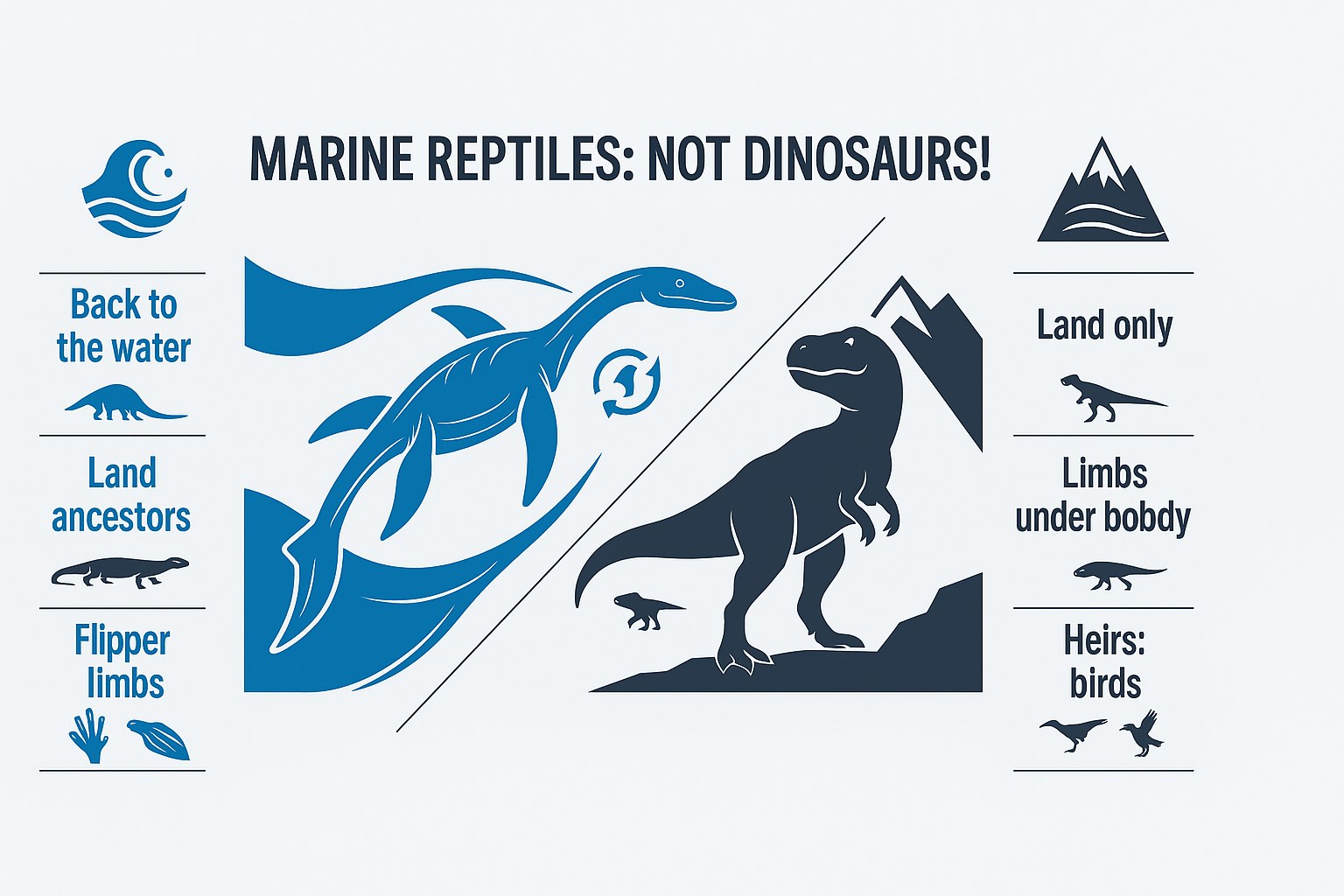
Dinosaurs have limbs placed directly under the body for walking. Marine reptiles show a very different, sideways anatomy. Their limbs are positioned on the sides.
There is no direct kinship between these groups. By scientific definition, dinosaurs are land animals only. Marine reptiles belong to separate evolutionary lines. It’s a common classification mistake.
In reality, dinosaurs were land animals. This anatomical difference changes everything.
🔄 The return to the water of former land animals
Evolution sped up during the Triassic. Some land reptiles chose to go back and live in the oceans. They set off in search of new, plentiful sources of food.
Their body shape then went through major changes. Their legs turned into efficient swimming paddles. The body gradually grew longer to cut through the sea currents better.
These creatures are the descendants of land ancestors. They colonised the oceans successfully.
🐦 Birds as the only rightful heirs
Birds are the only descendants of the dinosaurs. They survived the great Cretaceous extinction. Today they carry the genetic heritage of the theropods.
The marine reptiles weren’t so lucky. The mosasaurs and plesiosaurs disappeared completely. They left no modern successor in our seas.
Seabirds are dinosaurs adapted to water. They are completely different from the old, extinct marine reptiles.
🌊 The 4 major clans that ruled the deep
To really understand this sunken world, we need to take a closer look at the four great families that laid down the law beneath the surface.
🐬 The ichthyosaurs and their dolphin look
Their streamlined shape is surprisingly modern. They look strangely like our dolphins today. It’s a fine example of convergent evolution, which proves that nature often finds the same solutions.
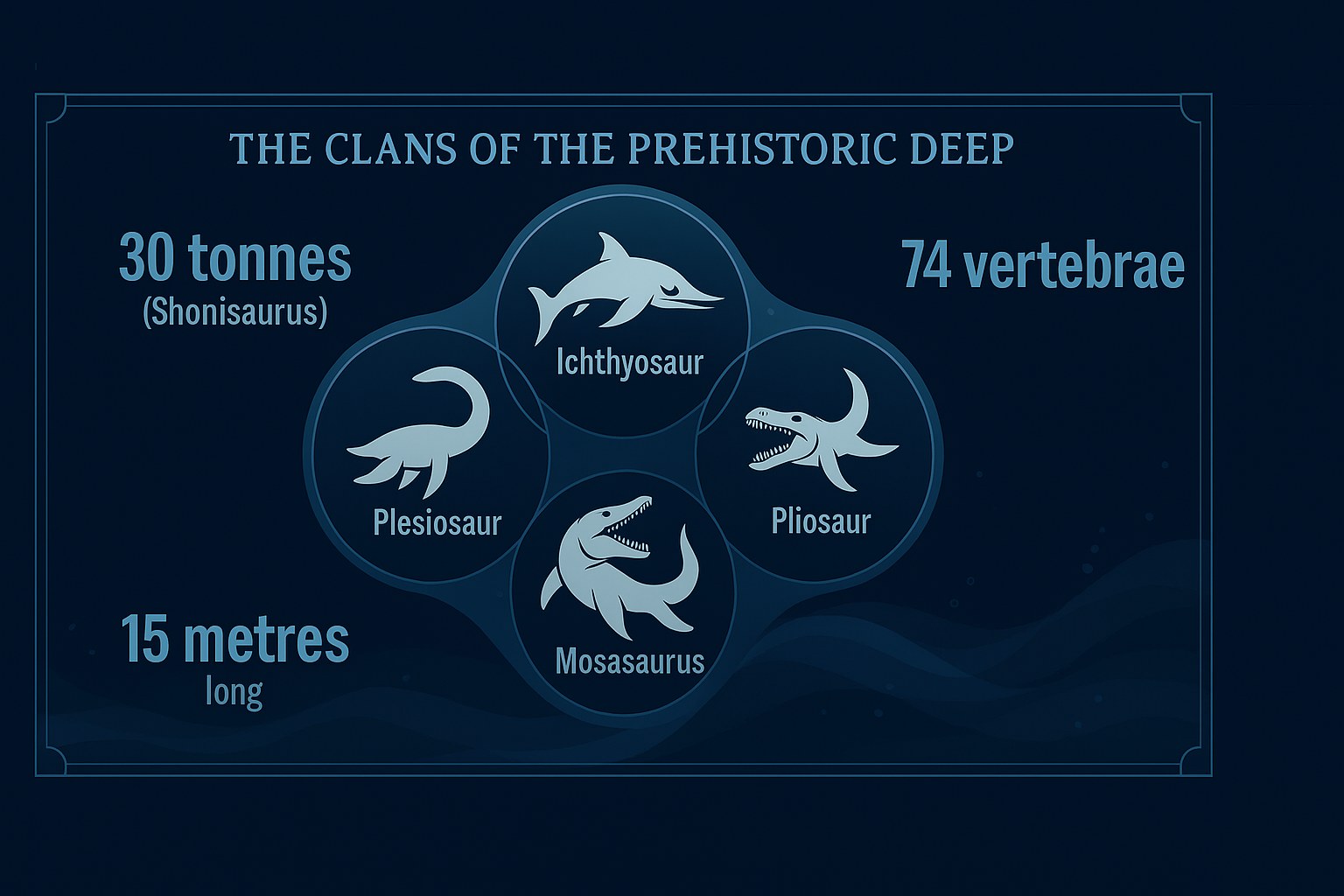
The Shonisaurus weighed about 30 tonnes. It was a true colossus of the Triassic seas. It probably hunted fast prey out in the open sea. Its huge size protected it well from the predators of the time, and so kept it alive.
- Estimated swimming speed: up to 50 km/h.
- Fish-eating diet: fish and cephalopods.
- Peak period of dominance: Triassic and Jurassic.
🦕 Plesiosaurs and pliosaurs, the feuding cousins
Comparing the long neck of Elasmosaurus to the jaws of Liopleurodon is striking. One relied on flexibility to catch its prey. The other used devastating brute force to crush any obstacle.
Some specimens had 74 neck vertebrae. This huge neck let it surprise schools of fish without being spotted. It was a formidable and very effective hunting weapon in clear waters.
The pliosaurs were powerful mega-predators whose bite force rivalled that of Tyrannosaurus rex.
🦈 The Mosasaurus, the terror of the Cretaceous
The 15-metre Mosasaurus was a war machine. It had a powerful tail for fast propulsion. Its jaws were lined with sharp teeth, ready to tear apart any prey.
Its link with snakes and monitor lizards is fascinating. It’s not a dinosaur but a big marine lizard. Its evolution was lightning-fast, letting it conquer all the oceans of the globe.
Its total dominance in the Cretaceous left no room for competition. It was at the top of the ocean food chain before the great extinction.
💧 Natural tricks for living underwater
Surviving in the ocean when you come from the land takes some pretty incredible biological gadgets, and these reptiles had plenty.
🫁 A very special way of breathing at the surface
These creatures absolutely had to come back up for air. Unlike fish, they had no gills. Their lungs therefore needed fresh air regularly to work properly.
Their nostrils were cleverly placed on top of the skull. This position let them breathe without lifting their whole head out of the water. It saved precious energy for hunting. Evolution really did a good job.
They also had record breath-holding abilities. They stayed underwater for long minutes without any trouble.
🌡️ Keeping warm in a cold bath
Their temperature control was impressive. Studies prove that ichthyosaurs were warm-blooded. Their body temperature could reach about 35 degrees, which is quite high.
This warm-bloodedness, close to that of mammals, changed everything. It let them swim efficiently in very cold waters. It was a major tactical advantage for ruling the oceans.
A high body temperature suggests a very active metabolism, ideal for chasing the fastest prey in the depths.
🥚 Babies born out at sea
Live birth was another brilliant adaptation. The ichthyosaurs no longer laid eggs on dry land. They gave birth directly to young that were already formed and independent.
Giving up laying eggs on the beaches was a smart choice. It avoided exposing them to dangerous land predators. Life thus became 100% aquatic and far safer.
Fossil evidence confirms this way of life. We’ve found the remains of petrified mothers with their embryos.
📏 A size comparison with our animals today
To grasp just how huge these beasts were, there’s nothing like putting them next to our familiar animals.
🐋 Shastasaurus next to the blue whale
Shastasaurus reached 21 metres long. That’s almost the size of a large modern whale. It clearly dominated its time with its impressive mass.
The blue whale is still heavier and more massive, though. But Shastasaurus was much longer than a school bus. It’s a scale that’s really hard to imagine.
| Species | Length | Estimated weight | Modern equivalent |
|---|---|---|---|
| Shastasaurus | 21 m | 75 t | Long bus |
| Mosasaurus | 15 m | 15 t | Large sperm whale |
| Blue whale | 33 m | 190 t | Boeing 737 |
| African elephant | 7 m | 6 t | Big lorry |
🐢 Archelon, the two-tonne giant turtle
This prehistoric turtle had record-breaking dimensions. It measured more than four metres across. Its total weight easily reached two tonnes.
Archelon was twice as big as the leatherback turtle. Its shell was less rigid than first thought. It was more like a structure of tough leather.
It preferred to eat jellyfish and soft cephalopods. Its powerful jaws were made for crushing. You can easily picture the strength of its hooked beak.
🐉 Monster myths and fossil realities
The plesiosaur often served as a model for the Loch Ness monster. It’s an image now fixed in the collective imagination. We fondly call it Nessie.
Sailors used to find strange bones on the coasts long ago. They then imagined frightening sea dragons. These fossils fed many local legends.
Yet science is clear on this point. None of these species still exist today. The giants of the oceans belong to the past.
🔬 How researchers make the bones talk
Bringing these skeletons back from oblivion takes painstaking work and technology that even the pioneers of palaeontology wouldn’t have dared dream of.
🧩 Cleaning and piecing together stone puzzles
The preparation of fossils takes place in the laboratory. Very fine precision tools are used. Every grain of rock has to be removed with great care.
The bones are often very fragile and crumbly. Special resins are used to protect them for the long term. It’s work that sometimes lasts years. Patience is the golden rule for these treasures.
Rebuilding a complete skeleton is a feat. It’s a giant three-dimensional puzzle.
📡 The 3D scanner to see the invisible
Modern imaging is transforming the field. The scanner lets us see inside the bones. We discover hidden details without breaking anything at all.
X-rays sometimes reveal ancient tissues. We can then guess the shape of the organs. This changes our view of their marine biology.
Modelling offers fresh perspectives. We simulate their movements to understand how they swam. Technology brings the fossils back to life.
🌍 The most impressive sites around the world
Some regions are very rich in fossils. Europe has exceptional sites in Normandy. North America is also full of many buried treasures.
Georges Cuvier made history here. He described the Mosasaurus from finds at Maastricht. It was the start of modern palaeontology.
Preservation often depends on the soil. Some fine sediments preserve precious anatomical details better.
💀 Why these masters of the world vanished
Everything stopped suddenly 66 million years ago, during a cataclysm that redrew the map of life.
☄️ An asteroid that changes the whole climate
The Cretaceous-Palaeogene crisis marked a radical turning point. A giant asteroid struck the Earth violently. The dust thrown up then blocked the sunlight for long months.
The surface waters became hostile and cold. Photosynthesis stopped in the upper layers. It was a thermal shock without precedent in history. The fragile species died first.
The fall of a meteorite caused this mass extinction.
🍽️ The end of the feast for the big predators
The food chain collapses completely. Plankton vanishes in huge amounts from the dark oceans. The small fish have nothing left to eat and die out.
With no prey, the big reptiles starve. The largest specimens are the direct victims of this shortage. The dominant predators can no longer find resources.
Turtles and crocodiles coped better with the lack. They had a slower metabolism. This allowed their survival.
🔍 The recent discoveries of 2026
The year 2026 brings its share of surprises. New specimens have come out of the ground. They sharpen our understanding of the end of these creatures.
We now understand the speed of the extinction better. It wasn’t a slow, gradual process. The data confirm a sudden, global break.
The Mesozoic saw the existence of at least 500 species of marine reptiles, with new discoveries every year. (Source: CNRS)
These incredible marine reptiles, from the ichthyosaurs to the mosasaurs, remind us that nature is an artist with no limits. Between their active metabolism and their live births, these old masters of the deep have everything it takes to fascinate our little explorers. Dive quickly into their secrets before they slip back into oblivion!
❓ FAQ
🤔 Did marine dinosaurs really exist?
It’s a very common mix-up! In reality, scientists explain that dinosaurs were land animals only. The giants that filled the oceans, like the famous Mosasaurus, were marine reptiles belonging to other evolutionary lines.
These creatures, impressive as they were, had a sideways anatomy different from that of dinosaurs. Their limbs were on the sides of the body, unlike dinosaurs, which had their legs well under the body for walking.
📏 How big was the largest known marine reptile?
The record is held by Shastasaurus, a true colossus of the Triassic seas. This giant could reach 21 metres long, which is the size of a very large bus!
Even though it was less massive than our blue whale today, it still weighed about 20 tonnes. Just imagine how much space it took up in the ocean with such a span.
🫁 How did marine reptiles manage to breathe underwater?
Unlike fish, these reptiles had no gills. They had lungs, just like us, and absolutely had to come back up to the surface to take in fresh air.
Evolution also placed their nostrils high up on the skull. This let them breathe discreetly without having to lift their whole head out of the water, a handy trick to avoid wasting energy.
🐉 Is the Loch Ness monster a surviving plesiosaur?
It’s a lovely legend to dream about, but the reality is more down to earth. The plesiosaur did indeed serve as a visual model for the monster, but these animals disappeared completely 66 million years ago.
Scientists have found no trace of survival after the great extinction. What’s more, the famous photo that fed the Loch Ness myth was recognised as a hoax a long time ago.
🌡️ Is it true that some marine reptiles were warm-blooded?
Yes, it’s an exciting discovery! Studies show that these animals were endothermic, with a body temperature close to 35 degrees.
This active metabolism gave them a major tactical advantage. They could swim and hunt efficiently in very cold waters, where other reptiles would have been completely paralysed by the cold.
🥚 How did these giants of the seas reproduce?
To avoid land predators, some groups like the ichthyosaurs adopted live birth. They no longer laid eggs on the beaches, but gave birth to already-formed young directly out at sea.
We have proof of this thanks to magnificent fossils showing mothers with their embryos. This let them lead a 100% aquatic life, safely far from the coasts.
