
Watching your child grow up between school and home often raises plenty of questions when new and sometimes puzzling behaviours appear. This article walks you through each stage of child development from 6 to 10 years old, to help you better understand their cognitive, motor and social progress. You’ll discover how to support their growing thirst for independence and their budding logic 🌱, thanks to caring tips that help you guide their future passions with calm confidence.
- Logic and reasoning: a giant leap forward
- Language and school: when words gain weight
- Coordination and precision: steadier movements
- Social life and emotions: stepping out of the bubble
- Independence and organisation: learning to fly a little
- The parents’ role: guiding without smothering
🧠 Logic and reasoning: a giant leap forward
After the nursery years carried along by imagination, your child enters a phase where their thinking becomes radically more structured as they make sense of the real world.
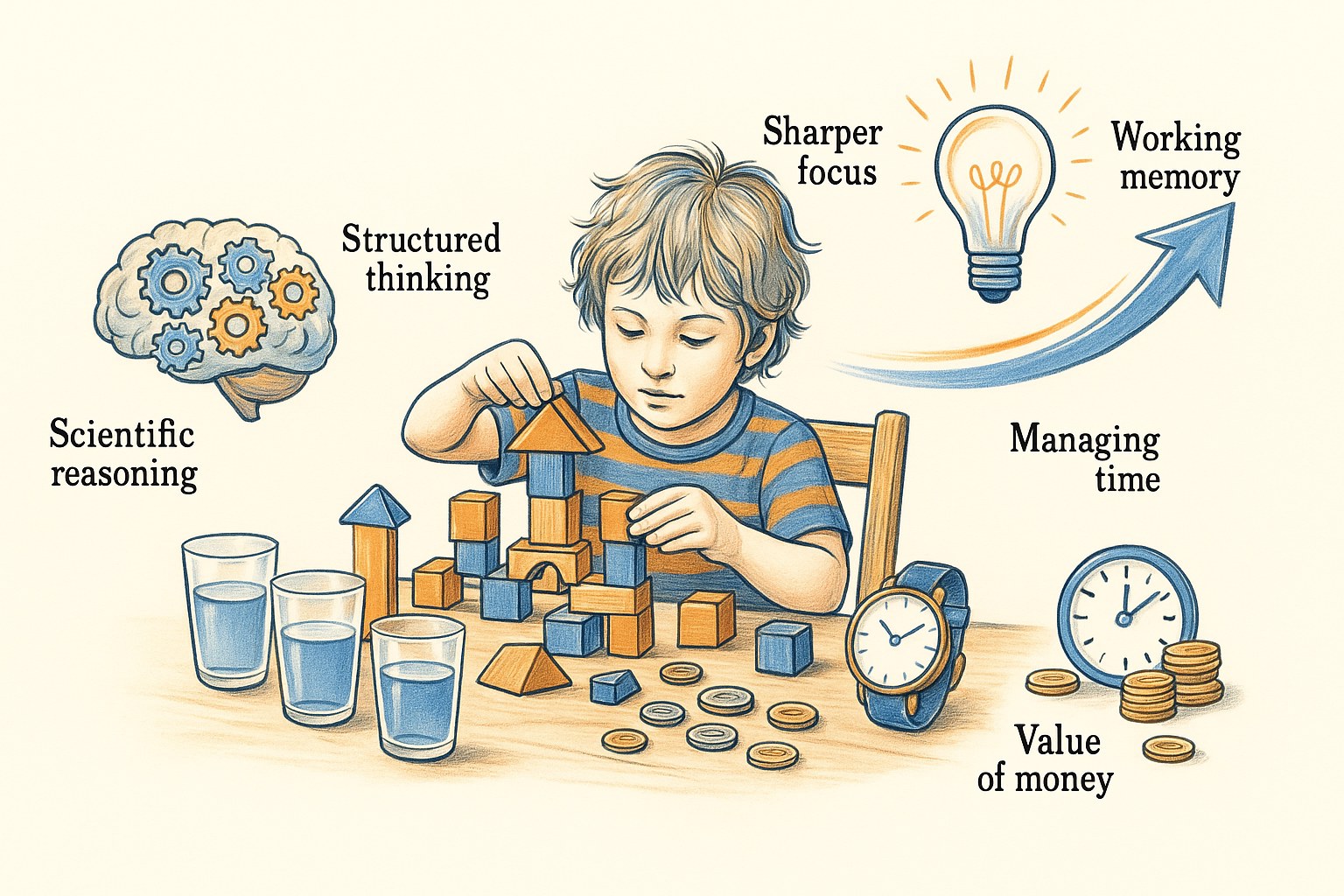
🧩 The concrete operational stage and hands-on play
Around the age of 6, your child reaches the concrete operational stage described by Piaget. They need to touch and handle real objects to take in abstract ideas. So hands-on play becomes a powerful learning tool in everyday life.
Grasping the conservation of quantity is a real turning point. Your child understands that a volume stays the same, even when the container changes shape. It’s a founding step towards scientific reasoning and pure logic.
They leave intuition behind for sharper, category-based thinking. They organise what they know by sorting objects according to criteria. This shift marks the move to structured, more flexible thinking when facing problems.
🎯 Attention and memory: stretching capacities
You’ll notice a clear rise in how long your child can concentrate. They stay focused on a tricky task for 20 to 30 minutes without drifting off. This is the start of the mental stamina they need to thrive in primary school.
Working memory plays a pivotal role. It lets them hold several instructions in mind at once to complete an exercise. Without it, independence in class stalls. So it’s worth training that memory through simple, fun games.
Repetition remains the main engine of lasting memory. Coming back to an idea several times helps it settle over time. Small, regular efforts always beat one big burst of work.
💶 Time and money: taming abstract ideas
A grasp of the calendar and of planning starts to settle in. Your child can finally find their way through months and seasons to look ahead. They slowly begin to manage their own timetable.
Introducing the value of money opens the door to real, concrete exchanges. Understanding that an object has a price calls for a certain mathematical abstraction. It’s a perfect first taste of economic life.
Cooking is a great way to handle measurements in a playful way. Weighing ingredients or following a recipe brings maths to life. It’s an excellent applied-logic exercise for the whole family.
- Learning to tell the time on an analogue clock
- Working out the change after a small purchase
- Following the steps in order when baking a cake
📚 Language and school: when words gain weight
As logic sharpens, it’s also through language that your child claims their new standing as a pupil and a citizen in the making.
📖 Reading and vocabulary: richer expression
Reading becomes fluent and natural. It’s no longer mere decoding but a doorway to understanding. Your child finally discovers the joy of diving into a long, well-built story.
Their vocabulary grows to describe precise feelings or tricky situations. You’ll notice shades of meaning and varied synonyms. Their spoken expression gains in clarity and the right choice of words in everyday conversations.
Your child draws links between their own life and the stories they read. They see themselves in the heroes to work through their own questions. Reading then becomes a true mirror of their personal growth.
🏫 School demands: adjusting to the primary rhythm
The shift towards formal learning sets in. The school setting grows more demanding and, above all, very structured. Your child needs to take in the codes of school success quickly to make smooth progress.
Listening, waiting their turn and following instructions takes constant effort. Being a pupil is a social as well as an intellectual skill. This is where self-discipline is built, day after day.
It’s better to praise the effort rather than the marks. Encouraging the learning process builds perseverance. Mistakes should be seen as a normal, useful step in making progress.
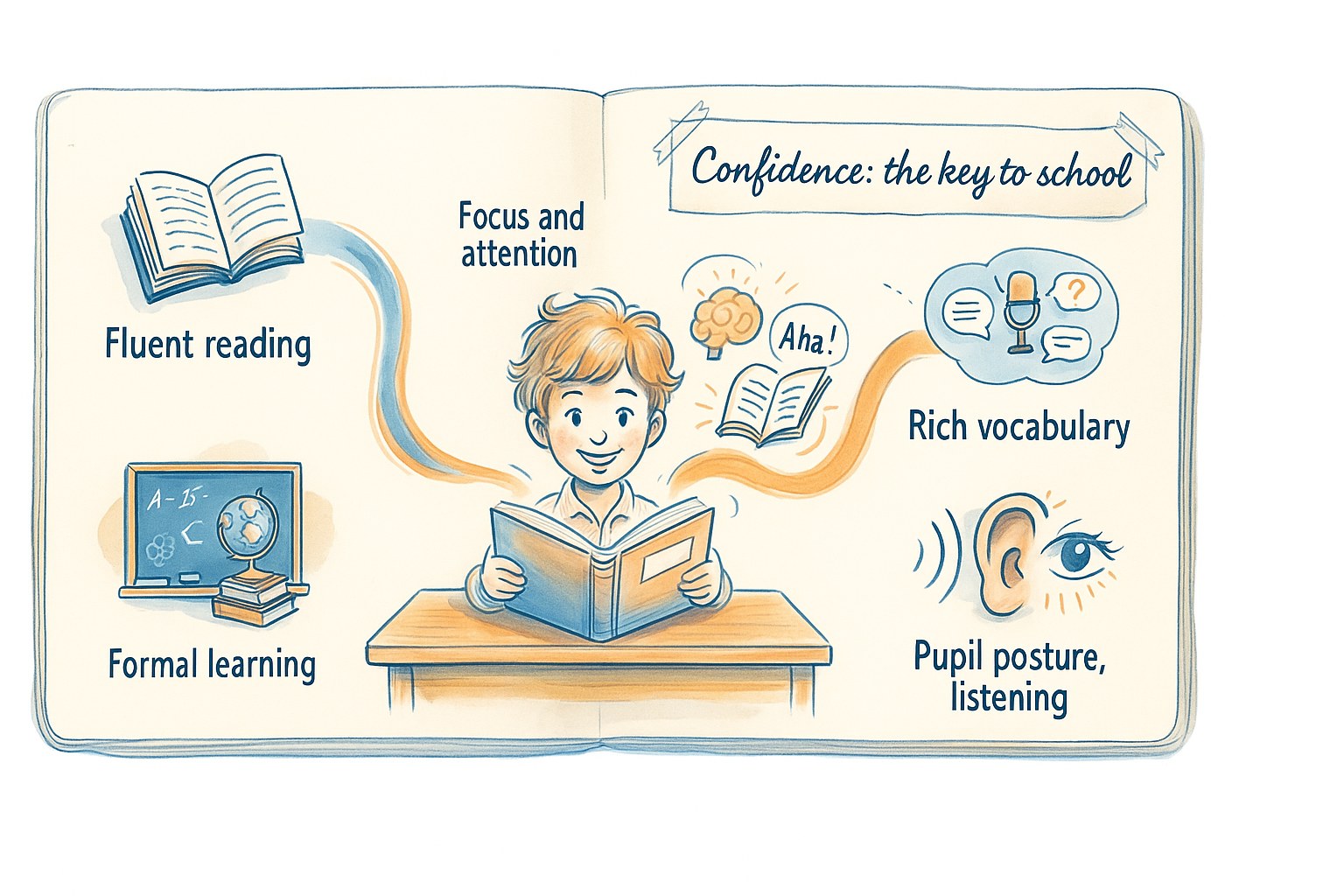
👂 Focus and listening: the keys to learning
A calm setting and clear instructions help attention. These factors are essential for working well. Your child gradually learns to filter out the sounds and sights that distract them.
Starting school is a key moment for building children’s confidence across many areas, from schoolwork to relationships.
Regular breaks or breathing exercises help keep alertness up. These methods make it easier to stay focused for longer. Children need to learn how to recharge their mental batteries throughout the day.
Natural curiosity remains the best engine. A child who’s interested in a subject learns with no apparent effort. Feeding their urge to discover makes the stages of child development from 6 to 10 years old far smoother.
🤲 Coordination and precision: steadier movements
Alongside the mind, the body goes through a subtle but real change, marked by growing technical control.
🤸 Gross motor skills: ease in space
Balance improves dramatically. Movements become smoother and more assured during physical activities. Your child gains power and overall agility day by day.
Spatial awareness sharpens too. Knowing where their body is in relation to others is essential in team sports. This body awareness prevents sudden or clumsy movements in a group.
Testing their limits helps children get to know their physical abilities. Sport is a vital testing ground for growth. It’s the ideal time to boost motor development and coordination.
✏️ Fine motor skills: skill at their fingertips
Precision in writing becomes obvious. Letters are more even and the movement turns automatic. It’s the fruit of finely tuned neuromuscular control over the months.
A taste for hands-on crafts takes hold. Model-making or DIY calls for great care. These activities build the patience and finger dexterity that school life needs.
Pulling off a tricky movement often takes many attempts. Your child learns that practice leads to true mastery. Persevering turns a difficulty into a real personal win.
🛠️ Technical activities: committing for the long haul
Your child can now follow a plan over several days. They happily take on long, concrete projects. They finally grasp the idea of progress in successive steps.
Building a technical kit means understanding a complex set of instructions. It’s a direct application of spatial and logical reasoning. The link between hand and thought grows stronger.
Sewing or light woodwork are excellent choices. They call for method, calm and close attention to detail. These structured hobbies soothe while building real talents.
| Activity | Skill developed | Patience required |
|---|---|---|
| Construction games | Spatial reasoning | Medium |
| Precision drawing | Concentration | High |
| Team sport | Team spirit | Moderate |
| Music | Coordination | Very high |
👫 Social life and emotions: stepping out of the bubble
Development would be nothing without meeting others, that social mirror that shapes the child within the group.
💞 The latency phase and emotional balance
The latency phase settles in for the long term. It’s a period of relative calm where urges quieten down. Your child seems more settled and ready to learn their lessons calmly.
They channel their boundless energy. Their emotions go into play and friendships. This inner steadiness helps better handle everyday school stress when facing tests at school.
They also have to manage frustration within the group. Learning that they’re not the centre of the world is a challenge. The limits set by peers help shape the putting of experiences and emotions into words.
🤝 Empathy and friendship: a place in the group
You’ll see empathy emerge. Your child starts to sense the needs and sorrows of others. They step out of their natural self-centredness to finally open up to others.
Loyalty becomes a core value. Friendships grow deeper and more exclusive. Children share secrets and stand up for one another against the rest. It’s the foundation of future social solidarity.
The need for social recognition grows. Feeling accepted by their peers is crucial for self-esteem. Belonging to a group shapes their social identity.
🎲 Board games: learning the rules and sharing
Respecting the rules is learned in the field. A game is a tiny social contract. Accepting the constraints lets children play together happily and for the long term, without falling out.
Next comes learning to lose. Losing without falling apart calls for great emotional maturity. Cooperating between players is also a key skill at this age. Playful resilience is built patiently.
The joy of sharing as a family is irreplaceable. These moments strengthen emotional bonds away from homework. It’s a necessary, steadying break for everyone.
- Strategy games to plan ahead
- Cooperative games for teamwork
- Fast-paced games for quick reflexes
🦅 Independence and organisation: learning to fly a little
To blossom socially, your child also needs to win their independence in everyday tasks.
🎒 Homework and school bag: managing their own work
Getting their things ready in the evening avoids the morning rush. Taking out their books in advance saves time. Your child should become responsible for their school kit in order to progress.
A fixed time slot and a quiet spot make work more efficient. You can use a visual to-do list to get organised. Independence comes through repetition. You need to set up a reassuring routine every day.
Reading back over their work helps them spot their own mistakes. It’s a major step towards being aware of their own intellectual abilities. Self-correction helps them remember their lessons more actively.
🧹 Daily chores: taking on first responsibilities
Setting the table or tidying their room makes your child feel valued. You can also ask them to empty the bin. They feel useful within the family by joining in like this.
Pulling off a household chore proves they’re capable. Around the age of 9, making their own breakfast reinforces that feeling. This active part reduces the sense of total dependence. The pride of a job done is a powerful engine.
The more you delegate, the more they want to do well. Trusting them with a small errand at the bakery sparks their reasoning. Your parents’ positive gaze is essential.
🚶 The need for independence: finding the right distance
Your child asks for independence while still needing protection. Between 6 and 10, their needs change quickly. You need to adjust the dial to their maturity and their wishes.
Avoiding being too intrusive lets your child experiment for themselves. Not constantly correcting their moves helps them learn through mistakes. The parent should be a safety net, not a hindrance. Active listening is vital here.
Keeping the emotional bond helps you get through growing-up crises. Talking about feelings helps your child understand their own reactions. They need to know they can always come back to you.
👨👩👧 The parents’ role: guiding without smothering
Supporting this flight calls for parents to stand back in caring watchfulness, between support and letting go.
🤗 Phases of doubt: reassuring during fragile moments
Around the age of 8, you’ll often notice fresh vulnerabilities. It’s an age of transition when old fears can resurface. Your child then needs to find a stable footing again.
Praising small daily wins really helps them climb back up. Unconditional support remains the best remedy against budding anxiety. It’s essential to validate their feelings, without judgement. You listen, you welcome, you reassure.
Whatever happens, the parent stays a model to look up to. Your calm in the face of difficulty naturally inspires your child. They learn, simply by copying you, to handle their own inner storms.
🎨 Passions and hobbies: encouraging natural curiosity
Suggesting new interests stimulates the mind. Free exploration often helps uncover hidden talents. You should open doors without ever forcing the way through, gently.
After-school activities offer a setting different from school. It’s a precious space of freedom for building themselves. Children often forge a lasting personal passion there that boosts self-esteem.
Valuing unstructured play matters just as much. Spending time outdoors with no set goal frees up creativity. Nature is an utterly unrivalled playground and learning ground.
🚨 Warning signs: knowing when to truly worry
You need to tell a simple rough patch from a lasting problem. Passing tiredness isn’t necessarily depression. Above all, watch the length of the change in usual behaviour.
Spot the signs of social withdrawal or retreat. If your child avoids their friends, it’s worth asking questions. A sudden drop in school results is also a strong signal. Stay alert but calm.
It’s important to tell a simple rough patch from a lasting change in behaviour, so you can act at the right moment.
Seeing a professional can sometimes untangle complex situations. A psychologist or paediatrician will bring a neutral viewpoint. Asking for help is a fine sign of parental responsibility.
Supporting your child’s development from 6 to 10 years old means nurturing their new logic and their growing independence. Between school and their first passions, your caring support is the engine of their confidence. Go for it — these years of closeness fly by at full speed! 💛
❓ FAQ
🧠 What are the big changes in children’s reasoning between 6 and 10?
This is the age when children move from pure imagination to far more logical thinking. According to Piaget, your child enters the “concrete operational” stage: they begin to sort, organise and understand that the quantity of an object doesn’t change even when its shape does. This is what we call conservation.
That said, this logic stays very tied to the tangible world. They still need to handle real objects or lean on concrete situations to think. Ideas that are too abstract, or pure hypotheses, will have to wait a little longer, until around 11 or 12.
📖 How do language and reading change at this age?
Vocabulary grows dramatically and sentences become more complex. Around 6 or 7, your child no longer just talks about themselves; they can tell structured stories with a beginning, a problem and a solution. Reading also becomes a way into understanding finer feelings.
Pronunciation steadies too, even for the trickiest sounds. If you notice that reading stays very halting, or that linking sounds to letters is hard after the first year, don’t hesitate to talk to a professional for a little tailored boost.
🤲 Why does motor coordination become more precise around 8?
From the age of 8, you’ll see a real leap in skill and precision. Movements are smoother as muscle strength and stamina grow. It’s the ideal moment for technical sports like basketball or swimming, because your child controls their body better in space.
This physical ease also supports fine motor skills. Writing becomes more even and detailed activities, such as model-making or precision drawing, become real pleasures. Moving every day is essential to feed these links between body and brain.
🌟 How can I help my child become more independent day to day?
Independence is learned through small, reassuring routines. You can encourage them to pack their school bag in the evening or to do their homework at a fixed time. Trusting them with missions at home, such as setting the table, also hugely boosts their self-esteem and sense of usefulness.
The idea is to stay a caring guide: you hand over the responsibility while staying available if needed. Praising their efforts and small daily wins is the best engine to make them want to progress on their own.
⚠️ Which signs should alert me about their wellbeing?
It’s normal to have small rough patches, especially around 8 when certain fears can resurface. On the other hand, stay alert if you notice a change in behaviour that lasts: a sudden social withdrawal, a loss of interest in their friends or a steep drop in school results.
If your child seems sad or anxious in a lasting way, talking remains your best tool. If the situation feels complex, asking a paediatrician or psychologist for advice is a very healthy step to ease the tension and start afresh on the right foot.
