
Struggling to explain to your children why the woolly mammoth died out despite its huge strength? 🦣 This article explores the story of these giants of the ice age, cousins of the Asian elephant, to clear up this mystery. You’ll discover how their thick fur and small ears protected them from the intense cold, thanks to Allen’s rule. From the incredible life of Kik the mammoth to the masterpieces in prehistoric caves, we share the secrets of their social everyday life and the climate reasons for their disappearance. Get ready for a journey into the Siberian permafrost, where science is now trying to wake these icons of the past.
- Who was the woolly mammoth really?
- Their everyday life on the frozen steppe
- A well-organised social life in the herd
- Early humans and the mammoths
- The reasons for their final departure
- Science tries to wake the giants
🦣 Who was the woolly mammoth really?
Forget the image of the scary, lonely monster from the films. The real biology of this iconic animal tells a much gentler and more fascinating story about adapting to the cold.
🐘 A not-so-distant cousin of the Asian elephant
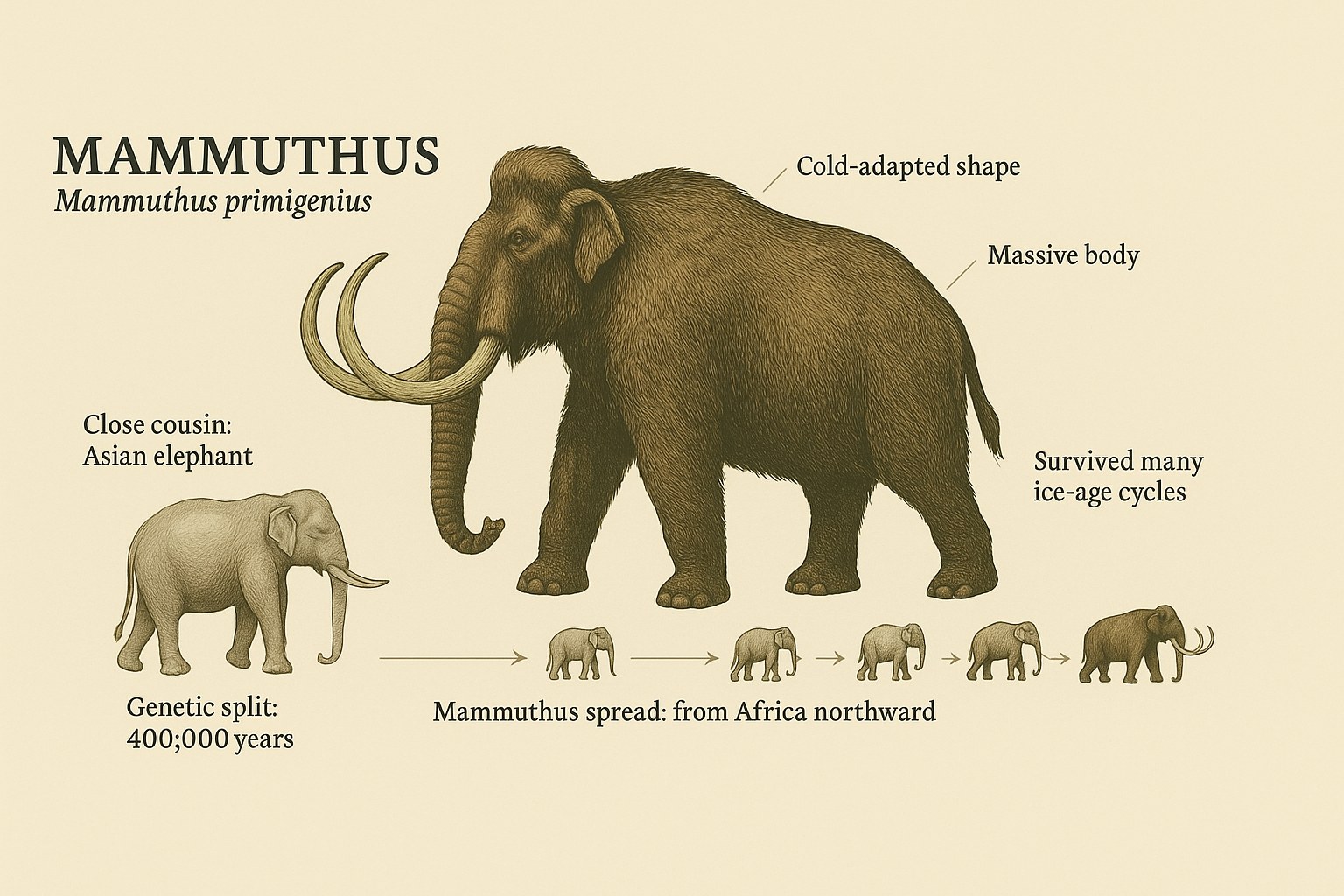
The woolly mammoth shares a surprising genetic closeness with today’s Asian elephant. They are very close cousins belonging to the elephant family, the Elephantidae. They are not ancestor and descendant.
The genus Mammuthus split off about 400,000 years ago. We use the scientific name Mammuthus primigenius for it. This branch separated quite late, in Eurasia.
Evolution thus created two separate lineages. Yet their biological structures stay extremely similar even today.
📏 A shape built for records
Its body is striking, with an arched back and a hump of fat. Its tall skull topped a massive shape. It was a true natural war machine against the frost.
Contrary to popular belief, it was not bigger than the African elephant. It was simply much heavier. Its mass helped it hold on to its body heat.
These giants weighed several tonnes. They physically dominated the frozen steppes.
⏳ How the species evolved over the millennia
The genus first appeared in the Pliocene, in Africa, before migrating. These animals then colonised the north of Eurasia. This journey took millions of years.
The shift towards the woolly mammoth happened gradually. It was a slow adaptation to the harsh climates of Siberia. Hair replaced the bare skin of its ancestors.
This sturdy lineage survived many ice ages. It settled into its final form during the Late Pleistocene.
❄️ Their everyday life on the frozen steppe
Now that we know the animal, let’s see how it managed to survive in the white hell of the steppe.
🧥 The secret of their resistance to the cold
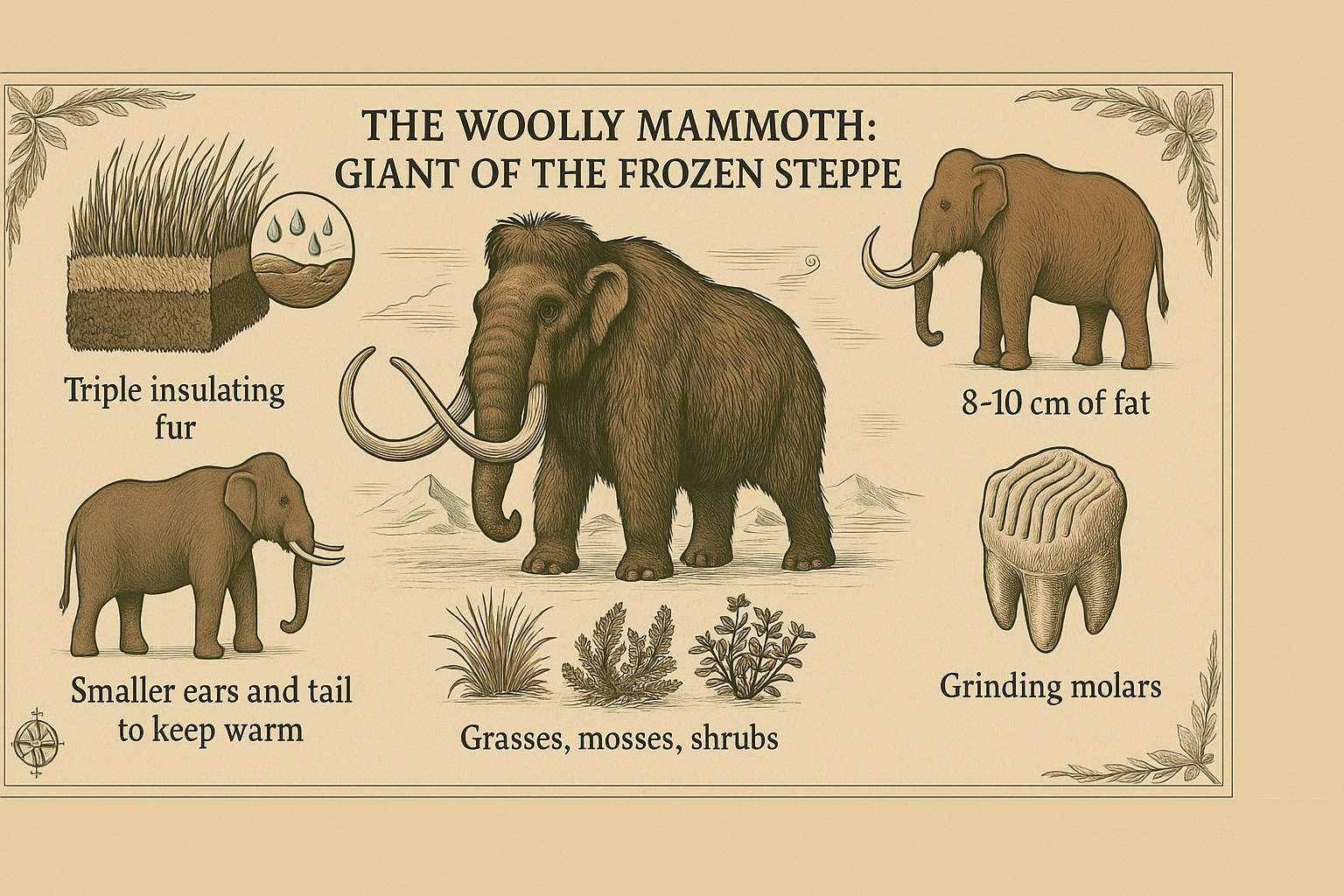
Their coat had three separate layers. There were long, protective guard hairs. These were sometimes a metre long. A dense undercoat completed this warming set-up.
A thick layer of fat beneath the skin insulated their body. It reached 8 to 10 centimetres thick. This store also acted as a vital energy reserve. It was their shield against the frost.
This coat stayed waterproof. The wind couldn’t get through.
🌾 The daily menu on the mammoth steppe
These giants searched for food under the snow. They mostly ate short grasses. Sedges made up the bulk of their daily meals. It was a non-stop job.
Their molars worked like powerful millstones. They ground up a particularly rough vegetation. These teeth wore down but stayed formidable. The adaptation was perfect for chewing very tough fibres.
Here are the plants they found:
- Dry grasses
- Hardy mosses
- Small tundra shrubs
👂 Ears and a tail built to keep the heat in
Allen’s rule applied perfectly here. Body extremities shrink in cold areas. This limits the risk of serious frostbite. Heat loss is therefore better controlled.
The contrast with the elephant is striking. The mammoth had tiny ears. Its tail was also very short. Its tropical cousin shows much wider features.
Every millimetre of exposed skin was a danger. Survival depended on this compact body shape.
👨👩👧 A well-organised social life in the herd
Beyond their physical toughness, it was their social intelligence that let them conquer vast territories.
👩 Groups led by mother chiefs
The clans followed a strict matriarchal structure. The oldest females led the herds. They carefully kept in mind the vital locations of waterholes across the plains.
We see the same solidarity in elephants today. The adults form a protective wall. This close bond kept the youngest sheltered from hungry predators.
The adult males often preferred independence. They lived alone or joined small bachelor groups once they reached maturity.
👶 From birth to adulthood
The life cycle of these giants took a lot of patience. Pregnancy lasted about 22 months, an endless wait. Weaning then took several years. It was an essential step to make sure the baby mammoth survived.
Sexual maturity came late, around 15 years old. This slow biological pace made the species fragile. Any rapid drop in numbers then became a huge danger for overall survival.
Social learning was fundamental. Throughout their youth, the young had to watch their elders to master the codes of the herd.
🦷 What their tusks tell us about their journeys
Isotope analysis of strontium offers incredible revelations. Tusks work like a chemical logbook. They record every geographical move the animal made during its life with great precision.
To understand these migrations better, just look at the incredible journey of Kik the mammoth. This real case is a perfect illustration of the phenomenal distances these ice-age giants could cover.
Kik walked 70,000 kilometres over 28 years. It’s a staggering figure. That’s almost twice all the way around the Earth.
🏹 Early humans and the mammoths
This huge presence did not escape our ancestors, who built a complex relationship with the giant, between survival and fascination.
🍖 A source of survival for the people
Hunting provided an impressive amount of meat. A single mammoth offered tonnes of essential protein. This fed a whole group for several weeks in a row.
People sometimes used traps to capture these giants. These techniques let them pin the animal down without risk. Direct confrontation was thus kept to a minimum.
The bones also served as frames. The tusks made it possible to build sturdy huts. This was vital on the treeless steppes.
🎨 The stars of the caves and of Palaeolithic art
The walls of Lascaux and Rouffignac show incredible drawings. These works show the spiritual importance of the animal. The anatomical details prove careful observation. Our ancestors knew their hairy neighbours perfectly.
The mammoth was not just a food store. It embodied a raw and mysterious power. It may even have stood for primitive gods for these clans.
The mammoth is the most often pictured animal in some caves, proving a fascination that goes beyond simple food needs.
🐭 The myth of the giant rodent living underground
In Siberia, local legends were born from strange discoveries. People found tusks coming straight out of the frozen ground. They then imagined creatures living hidden under the earth.
Seeing a whole carcass rise from the icy mud made a strong impression. It fed the myth of giant rats or monstrous moles. These beasts were said to die the moment they touched the light.
Yet these chance finds helped researchers. They were the first physical proof that these giants once existed. Science then took over from the tales.
💀 The reasons for their final departure
Despite their power, the mammoths finally gave way to a series of upheavals they couldn’t adapt to.
🌡️ The fatal warming of the climate
The end of the ice age rang the death knell for their world. The rapid rise in temperatures turned the dry steppe into dense forests. These new landscapes and impassable marshes broke their usual balance.
The changes in the environment directly reduced access to their favourite food. Their ideal habitat simply melted away.
They ended up being pushed into small, narrow areas.
🏹 The pressure from human hunting
Hunter-gatherers also played a part. Human pressure sped up the decline of groups that were already weakened. It wasn’t the only cause, but it was a worsening factor for these giants.
Yet the two species lived side by side for a long time. In some regions, this shared life lasted thousands of years. But the final break became inevitable as humans spread.
Here are the direct consequences of this pressure:
- Fewer births
- Groups breaking apart
- Local over-hunting
💀 A cocktail of causes for an extinction
It all comes down to interaction. It was the combined effect of food loss and predation that proved fatal. The mammoths did not survive this double challenge.
These large mammals were especially vulnerable. Their very slow breeding cycle couldn’t make up for the deaths. Every loss then became too heavy a weight for the species.
The last isolated specimens finally died out. This happened on Wrangel Island just 4,000 years ago.
🧬 Science tries to wake the giants
Today, the mammoth is no longer just a fossil; it has become the centre of dizzying technological experiments.
🧊 Intact treasures hidden in the permafrost
The permafrost acts like a giant freezer. It preserves the skin and the hair. We even find the contents of the stomach. This preservation is exceptional for researchers.
Fragments led to the discovery of RNA in the mammoth Yuka. This fragile molecule reveals its genetic activity. It’s a rare scientific feat.
Siberia delivers treasures. Every carcass helps the geneticists.
🧬 The slightly crazy dream of scientific cloning
Some companies are attempting the impossible today. They want to insert mammoth genes into Asian elephants. The goal is to create a cold-resistant hybrid.
But the technique has its limits. Creating a viable embryo is complex. Finding a compatible surrogate mother remains a colossal challenge for modern science.
Bringing the mammoth back raises major ethical questions: do we have the right to bring back a species without its natural habitat?
🌍 Lessons from the past for our biodiversity
The mammoth’s story is a warning. It shows that a dominant species can die out fast. Protecting our wildlife today is therefore an immediate must.
The end of the steppe illustrates climate change. Temperature radically transforms landscapes. We need to understand these mechanisms to anticipate future crises.
| Species | Time of extinction | Main cause | Current state of remains |
|---|---|---|---|
| Woolly mammoth | 4,000 years ago | Climate and hunting | Carcasses in the permafrost |
| Woolly rhinoceros | End of the Pleistocene | Change of habitat | Fossils and frozen tissue |
| Cave lion | End of the Pleistocene | Loss of prey | Bones and frozen specimens |
| Steppe bison | Start of the Holocene | Environmental pressure | Skeletons and mummies |
These woolly giants fascinate us with their incredible resistance to the cold and their social life, so close to that of elephants. Discovering the story of the woolly mammoth reminds us how fragile our biodiversity is in the face of the climate. Let’s protect our giants of today so their future stays bright and lasting.
❓ FAQ
🦣 Where exactly do mammoths come from and how did they evolve?
The story of these giants begins in Africa at the end of the Miocene. Over time, they travelled to Eurasia before reaching North America. People often think the steppe mammoth, Mammuthus trogontherii, is the common ancestor that gave rise to the famous woolly mammoth we all know.
It’s a slightly complicated family tree, with cousins who sometimes met up and mixed. The key thing to remember is that the woolly mammoth, or Mammuthus primigenius, is the closest relative of our Asian elephant today. They are not ancestor and descendant, but distant cousins that split apart about 400,000 years ago.
👂 Why did the mammoth have such small ears compared to the elephant?
It’s a trick of nature called Allen’s rule! To survive in the deep cold of the ice age, the mammoth had to shrink the size of its extremities. Its ears were only about thirty centimetres, which is tiny compared to those of its tropical cousins. Its tail was also much shorter.
The less surface exposed to the icy wind, the less body heat the animal loses. It was an essential protection to avoid frostbite and save energy. It’s a bit as if nature had knitted it a tailor-made outfit to face the snowstorms without shivering.
🐪 Is it true that mammoths had a hump of fat like camels?
Yes, it’s absolutely true and it’s a fascinating discovery! Scientists have spotted, on frozen specimens like little “Lyuba”, a large hump of fat at the back of the neck. It wasn’t there to look pretty, but to serve as an energy reserve and help regulate the body’s temperature through the harsh winters.
On top of this hump, these giants had a layer of fat 8 cm thick under the skin. Between this inner insulation, their thick skin and their fur made of three types of hair, they were real fortresses against the frost. Thermal gear worthy of the best modern puffer jackets!
🌾 What did these giants eat to grow so strong?
To keep up such a build, the mammoth followed a strictly herbivorous diet. It mainly fed on short grasses and sedges it found on the steppe. Its large curved tusks, which could reach 5 metres, were also used as tools to clear the snow and reach its food.
Their teeth were small marvels of natural technology too. They had four very sturdy molars, like millstones, able to grind tough, rough vegetation. Throughout their life, these teeth were replaced several times so they could keep feeding efficiently.
❄️ Why did the mammoths end up disappearing from our planet?
Their disappearance is the result of a rather unlucky cocktail of factors. The warming at the end of the ice age turned their habitat, the steppe, into forests or marshes where they struggled to move and feed. Their ideal world simply melted away under their feet.
The pressure of hunting by early humans also played a part, speeding up the decline of groups that were already weakened. Because they had a very slow breeding cycle, they couldn’t make up for losses quickly. The very last survivors died out on Wrangel Island just 4,000 years ago, when the pyramids of Egypt were already standing!
