
Explaining to your children how a dinosaur turns into a rock, without getting your facts in a tangle, is a real challenge! 🦴 Fossil formation needs quick burial under sand or mud to stop natural decay before the minerals can do their work. Here you’ll discover the secrets of this rare geological recipe, from footprints to insects trapped in amber, ready to impress on your next family walk.
- Understanding how fossils form and where they come from
- The key steps to becoming a rock
- The different types of fossils to discover
- How do we date these little treasures from the past?
- Where to track down fossils on your outings
- Hunting for fossils legally
🦴 Understanding how fossils form and where they come from
After a walk on a beach or in a forest, we often wonder how a simple bone becomes an everlasting rock. Here are the basics for grasping this geological wonder.
🔬 Palaeontology explained simply
Palaeontology is the thrilling science of lost worlds. It studies the mineralised remains trapped deep inside sedimentary rocks. It is a bridge between biology and geology.
But what exactly is a fossil? It is a trace of an organism, animal or plant, preserved by petrifaction or moulding. It also includes burrows and footprints.
These are precious witnesses of past life. The scientist then becomes a true detective of time, piecing together clues left behind millions of years ago.
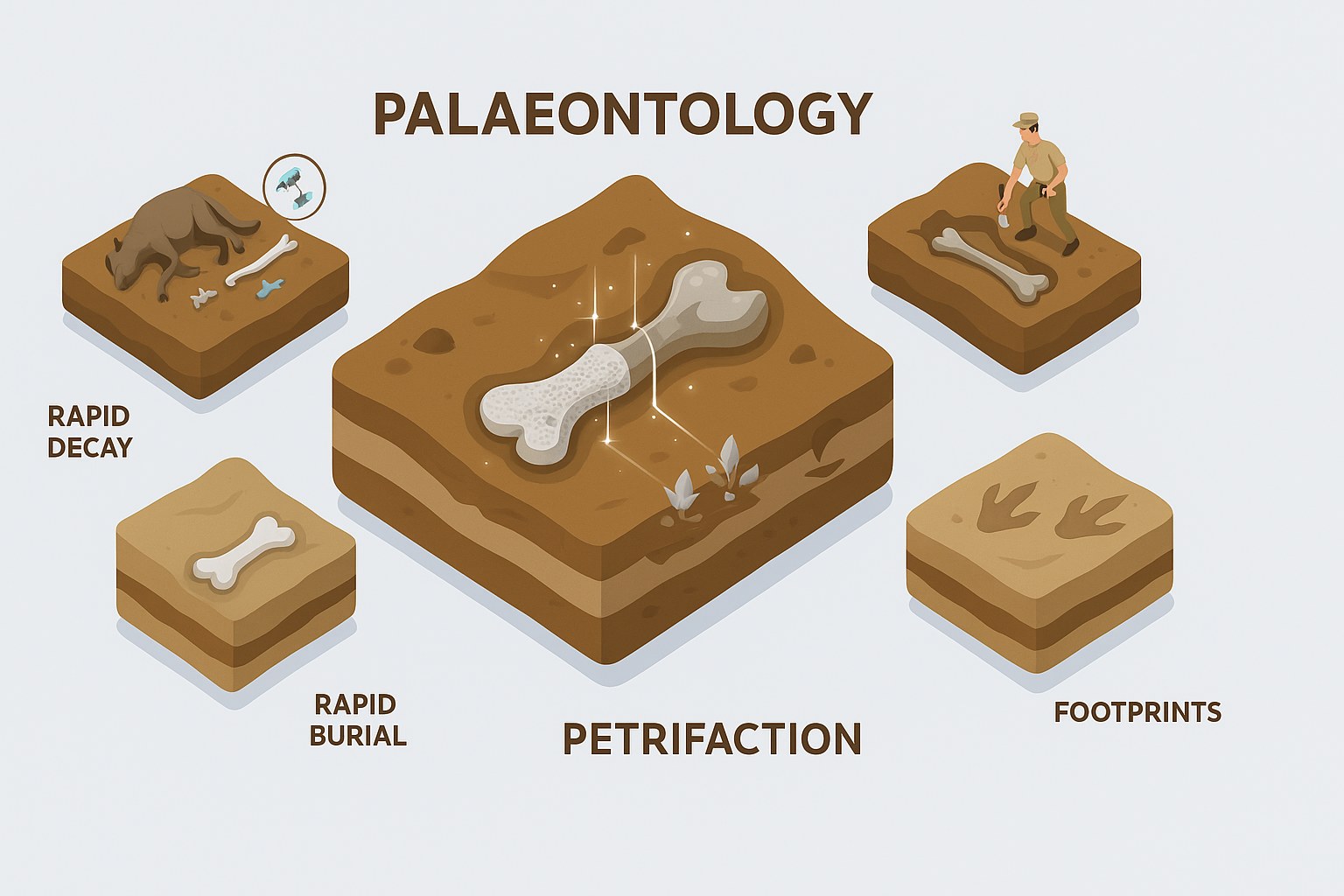
⏳ Why not every living thing lasts
Natural decay is the rule. Most soft tissues vanish very quickly after death. Bacteria and oxygen do their usual recycling job.
Scavengers and the weather also play a part. Bones are often scattered or gnawed by other animals. Wind and rain speed up the destruction of the remains.
So it’s very hard to be preserved. Without immediate protection, nature leaves no trace. This is the normal cycle of life and death.
💎 The rarity of a successful preservation
Becoming a fossil is a real stroke of statistical luck. The chances are tiny for any single individual. The process needs perfect, immediate conditions.
Most species left no remains at all. So our view of the past is bound to be incomplete. Palaeontologists work with the rare pieces of a huge puzzle.
Fossilisation is such an unlikely geological event that it’s almost a miracle for every specimen we find today.
🪨 The key steps to becoming a rock
To go from a dead body to a rock, the road is long and needs very precise, almost surgical conditions.
⛰️ A quick burial under the sediment
Sand or mud build up fast. The organism has to be covered right after death. This often happens in calm, watery places.
This layer of sediment cuts the body off from the air and from predators. This protection against attack is crucial. It is the very first barrier against being forgotten.
This step is the compulsory starting point. Without this mineral shroud, no petrifaction is possible.
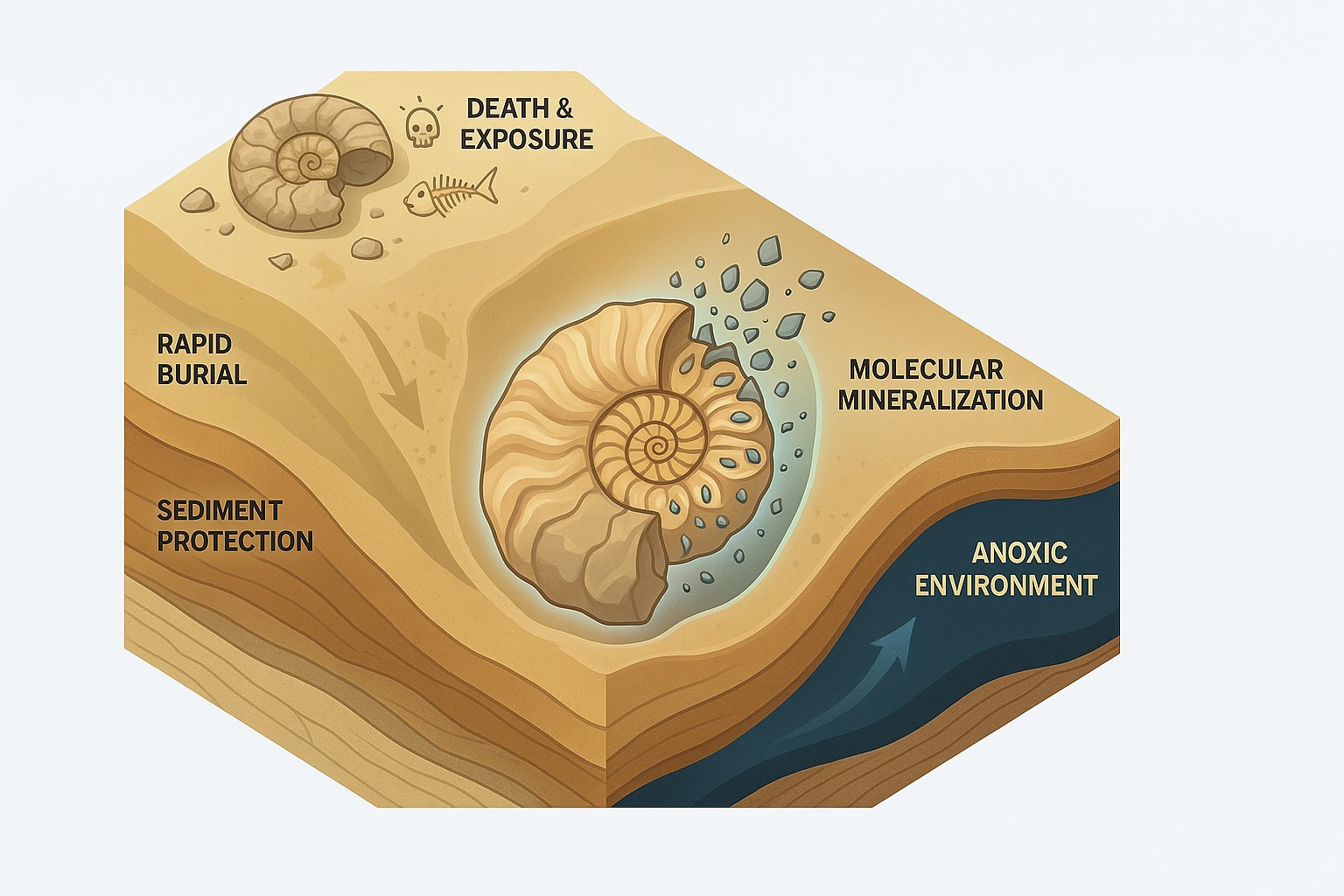
🚫 Anoxia, or the protective lack of air
Places with no oxygen are real allies. Anoxia stops bacteria from fully breaking down the remains. It is an extremely powerful natural preservative.
It slows chemical decay. In deep mud, time seems to stand still for organic matter. The finest structures then travel across thousands of years.
- Putrefaction stops
- Protection from scavenging organisms
- The structure stays intact
🪨 Mineralisation turns bone into rock
The replacement happens molecule by molecule. Mineral-rich water seeps into the pores of the bone. The calcium is slowly replaced by silica.
A perfect mineral copy appears. In the end, none of the original biological matter is left. It is a natural sculpture faithfully reproducing the living being.
This process takes thousands of years. It is a work of patience carried out by the Earth itself. Stone replaces the living for good.
🐚 The different types of fossils to discover
Not all fossils look alike, because nature uses several techniques to immortalise its creations.
🐌 Moulds and petrified remains
We need to tell the preserved shape apart from the hardened matter. Sometimes the organism disappears completely. It then leaves a hollow imprint in the rock, called a natural mould.
Classic shells and skeletons are the most common. You often come across them while hiking. The solid structure has been soaked with minerals until it becomes a compact block.
| Type of fossil | How it forms | Common example |
|---|---|---|
| Petrifaction | Mineral replacement | Petrified wood |
| External mould | Imprint in the rock | Ammonite shell |
| Internal mould | Filling of the cavity | Fossil mollusc |
🟡 Amber and ice for soft tissues
The sap of ancient trees sometimes traps small animals. As it seals the insect in, it hardens over the centuries. It then becomes protective, see-through amber.
Cold also allows exceptional preservation. In permafrost, we find mammoths with their skin still on. This natural freezing has defied time for thousands of years.
Such cases stay extremely rare and truly precious. They let us study DNA or soft tissues. It is a direct window onto our distant biological past.
👣 Palaeoichnology, or the study of traces
Footprints and crawl marks are fascinating. These traces are not the animal, but its activity. They tell us about how it walked and how fast it really moved.
Fossilised droppings, called coprolites, are also very useful. They reveal the diet of extinct species. They are an amazing source of information for understanding food chains.
These clues about behaviour are essential for researchers. They bring the lifeless skeletons back to life in museums. At last we can picture the animal moving and feeding.
⏳ How do we date these little treasures from the past?
Finding a fossil is one thing, but knowing whether it’s a hundred thousand or a hundred million years old is another.
🧪 Diagenesis and its chemical processes
Chemistry transforms the sediments over time. Under the weight of the upper layers, mud becomes rock. This is technically called diagenesis.
Pressure and temperature change everything. These physical factors alter the structure of the buried remains.
This process strengthens the fossil for the ages. Without this geological baking, the remains would stay too crumbly. The Earth’s chemistry is a real forge.
📅 Relative and absolute dating methods
We compare the strata and the radio-isotopes. Relative dating looks at the order of the rock layers. The deeper it is, the older it usually is.
Carbon-14 is used for recent remains. For distant ages, we use uranium or potassium. These atomic clocks give a precise age in millions of years.
The two scientific approaches complement each other. One gives context, the other an exact figure. This is how we map the history of the Earth.
🗝️ The Lagerstätten and their secrets
These deposits offer exceptional preservation. The German word means “storage place”. In them we find anatomical details that are normally lost.
The Green River is a famous example. Its finely layered sediments perfectly show this unique quality of preservation. It is an incredible piece of luck for researchers.
The Lagerstätten are the luxury archives of palaeontology, sometimes preserving every last scale of an Eocene fish.
🔍 Where to track down fossils on your outings
If you fancy setting off in search of these relics, you need to know where to look so you don’t come home empty-handed.
🪨 Why sedimentary rocks are best
Look for stones like limestone or marl. They alone trap organisms. These rocks are born from a slow build-up of sediment.
Forget volcanic rocks. Burning lava destroys every trace of life. In fact, granite never contains fossils.
Explore cliffs or old quarries instead. Natural erosion uncovers new layers there. That is exactly where the treasure is hiding.
🌡️ Understanding the climates of long ago
Fossils act like real climate archives. The presence of a particular species tells us about the conditions of its time. It’s a thermometer for the distant past.
Finding corals in cold areas always comes as a surprise. It proves that these regions were once under tropical seas. Continental drift explains these dramatic changes.
Here are a few precious clues for scientists:
- Fossil pollen
- Types of leaves (the CLAMP method)
- The presence of foraminifera
- Growth rings in petrified wood
🔬 Microfossils and tiny life
Micropalaeontology studies organisms invisible to the naked eye. Yet these tiny beings are the most numerous on Earth. Studying them is fascinating.
The oil industry uses this data to locate deposits. These microfossils identify the layers rich in hydrocarbons.
These little beings have a major ecological importance. They make up chalk and certain shales. The tiny literally builds the mountains.
🌍 Hunting for fossils legally
Before you grab your geologist’s hammer, a quick reminder of the rules of the game is in order, so you stay out of trouble.
📜 The rules for individuals
Picking up specimens lying on the surface is often tolerated on public paths. Yet the ground underneath always belongs to the landowner. So good manners remain your best ally on your outings.
It is forbidden to dig without permission from the local authority. Nature reserves and national parks enjoy strict protection. Never damage a site to pull out a prized piece.
Getting in touch with local geology clubs is a great idea. These enthusiasts know the allowed areas and good practice. Respecting these places keeps our hobby alive for the long run.
🤝 The helping hand of amateurs
Discoveries made by enthusiasts are precious. Many major pieces were spotted by sharp-eyed walkers. Their curious gaze genuinely helps science move forward every day.
Working with museums is essential to make the most of your finds. If an object looks unusual, quickly contact a specialist. Reporting a discovery helps enrich the world’s knowledge for the long term.
Here are a few good habits to adopt in the field:
- Note the exact spot of the discovery.
- Don’t clean it roughly, the object you’ve found.
- Take photos in place before moving anything.
⛽ Fossil or fossil fuel: let’s be clear
We need to tell biological remains apart from ordinary fuels. A fossil keeps a precise organic structure. A fossil fuel, on the other hand, is a transformed residue whose purpose is energy.
Oil and coal are born from intense compression. Plant debris 300 million years old transforms this way under the pressure of the sediment.
Humans use these resources for their daily needs. We literally burn prehistoric forests to light our homes. Yet this huge geological heritage is disappearing at an astonishing speed.
🤔 Panchronic species and pseudo-fossils
The idea of a panchronic species often means a “living fossil”. The Ginkgo or the Coelacanth are perfect examples. These organisms have changed very little physically for millions of years.
Watch out for misleading natural shapes scattered on the ground. Manganese dendrites mimic ferns but are purely mineral. These pseudo-fossils are classic traps for keen beginners.
Nature regularly enjoys creating familiar shapes. You need to keep a critical eye when faced with a surprising find. Your eye will train itself naturally.
Becoming a fossil is a real geological miracle that demands quick burial and patient mineralisation. By understanding how these precious witnesses form, you turn every walk into a fascinating investigation of the Earth’s history. Keep your eyes open, because the past is just waiting for your gaze to come back to life.
❓ FAQ
🦴 What exactly is a fossil?
To put it simply, a fossil is a trace or a remain of an organism that lived a very long time ago. It can be a bone, a tooth, a shell, or even a simple footprint left in the mud. These witnesses from the past have crossed thousands of years, slowly turning to stone inside sedimentary rocks.
The science that’s passionate about these treasures is called palaeontology. It lets us play detective to understand how animals and plants lived long before us. It’s a bit like opening a big picture book about the history of the Earth.
🔄 How does a living being turn into a fossil?
The secret of a beautiful fossil is often an express burial! Right after death, the organism has to be covered quickly by sand or mud, for example at the bottom of a river or a sea. This protects it from the hungry scavengers and from the air that rots tissues too fast.
Over time, more layers of sediment pile up on top. The pressure then turns the mud into hard rock. The water flowing through carries minerals that replace, molecule by molecule, the original remains. This is called mineralisation: the bone disappears to make way for a perfect copy in stone.
🦴 Which body parts fossilise best?
Nature does a bit of sorting: the hard parts are the big winners. Bones, teeth and shells are solid and decay very slowly, which gives them time to turn into mineral. That’s why we find dinosaur skeletons far more often than their muscles!
The soft parts, like organs or skin, almost always disappear very quickly. It takes truly exceptional conditions, like being trapped in ice or in resin (amber), for these fragile details to reach us.
🐚 Are there different types of fossils to collect?
Oh yes, there’s something for every taste! We find petrified fossils, which are real sculptures of stone. There are also moulded fossils: the organism has gone but it left its hollow imprint in the rock, like a natural cake mould that minerals sometimes fill in.
Let’s not forget fossilised traces, like footprints or even dinosaur droppings (the coprolites). Finally, trapped fossils are the most impressive: picture an insect perfectly preserved in a drop of yellow amber, or a mammoth kept intact in the cold of the permafrost.
⏰ How do scientists guess the age of a fossil?
Experts use two main tricks. The first is relative dating: we look at the fossil’s position in the layers of the earth. In general, the deeper it is, the older it is! It’s a bit like storing your old magazines at the back of the cupboard.
The second method is absolute dating, which is more precise. We use “atomic clocks” like carbon-14 or other chemical elements. This lets us give a more exact figure in millions of years. By combining the two, we manage to place our little treasures on the great timeline.
⛽ What is the difference between a fossil and a fossil fuel?
It’s a very common mix-up! A fossil is the object we admire in a museum, a structure that has kept the shape of the living thing. A fossil fuel, like oil or coal, is a rock or a liquid that comes from the transformation of tonnes of organic debris under high pressure for millions of years.
In one case, we want to preserve a shape for science; in the other, we use a resource to produce heat or electricity. We literally burn prehistoric forests to light our homes, which is a precious geological heritage but one we use up very fast.
