
Telling the Triassic and Cretaceous apart isn’t easy — especially when children ask precise questions about when the dinosaurs really lived! 🦕 This article sets the geological clock straight by exploring the three periods of the Mesozoic to finally make this timeline clear. You’ll uncover the secrets of Pangaea and the rise of these giants, from the first small two-legged runners right up to the ancestors of today’s birds.
- Understanding the dinosaur era and the Mesozoic
- The Triassic and the first steps on Earth
- The Jurassic, or the age of giants
- The Cretaceous and the great changes
- How we work out a dinosaur’s age
- How the species survived to today
🦕 Understanding the dinosaur era and the Mesozoic
Now that we’ve moved past the popular myths, it’s time to set the geological clock straight and place these giants exactly where they belong in our planet’s history.
⏳ The difference between an era and a period
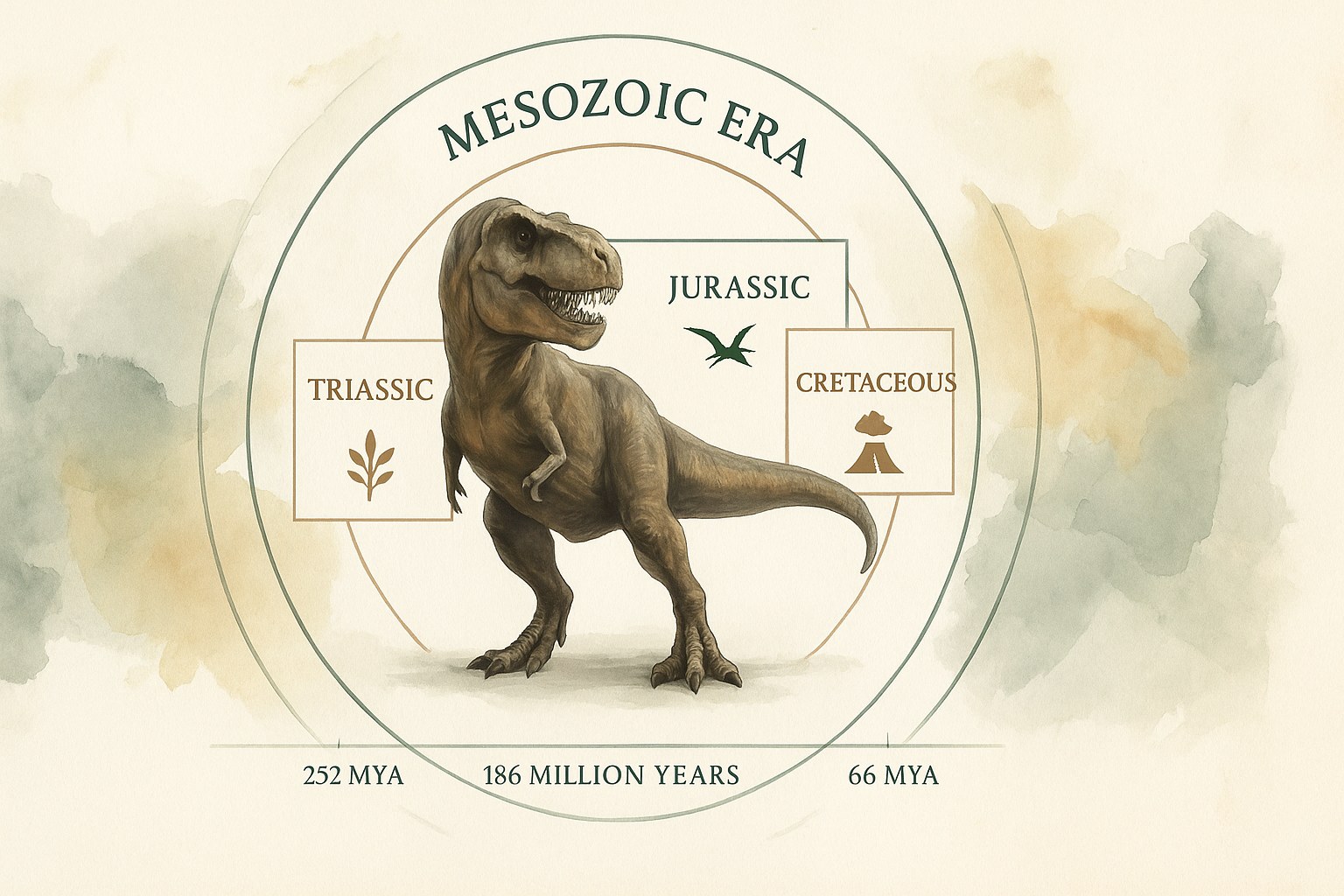
Geological time works like a clever set of nested boxes. An era is a huge chapter in Earth’s story. It then splits into several shorter, more precise periods.
The Mesozoic is the overall era that groups together the Triassic, Jurassic and Cretaceous. It’s the time frame in which the dinosaurs evolved. Each period has its own biological signatures and its own star species.
Picturing this hierarchy makes it easier to grasp Earth’s timeline. It’s simply a matter of scale.
📅 The Mesozoic, a 186-million-year calendar
This epic stretches from 252 to 66 million years ago. That vast window saw thousands of fascinating species appear and die out. It was an incredibly long reign for the animal kingdom.
The climate back then was warm almost everywhere. There were no polar ice caps. Earth looked like one giant greenhouse.
The Mesozoic, lasting around 186 million years, is the time of the dinosaurs, flying reptiles and marine reptiles.
The world was warm and welcoming, and that warmth helped life spread far and wide across the planet.
🚫 Why we avoid the word “prehistory” for these creatures
Prehistory is mostly about the arrival of humans, long after the dinosaurs. Using that word creates a real timing mix-up. We need to keep the human adventure separate from ancient geology.
The term is far too broad for scientists. The Mesozoic is the exact name for the age of reptiles. So let’s be precise in our vocabulary as curious parents.
Dinosaurs never crossed paths with our direct ancestors. Their world was completely different from ours. Respecting these timescales is essential if we want to understand their story.
🦖 The Triassic and the first steps on Earth
It all begins in a dry, clustered world where the dinosaurs were still quiet extras on the stage of life.
🦖 The arrival of the small two-legged models
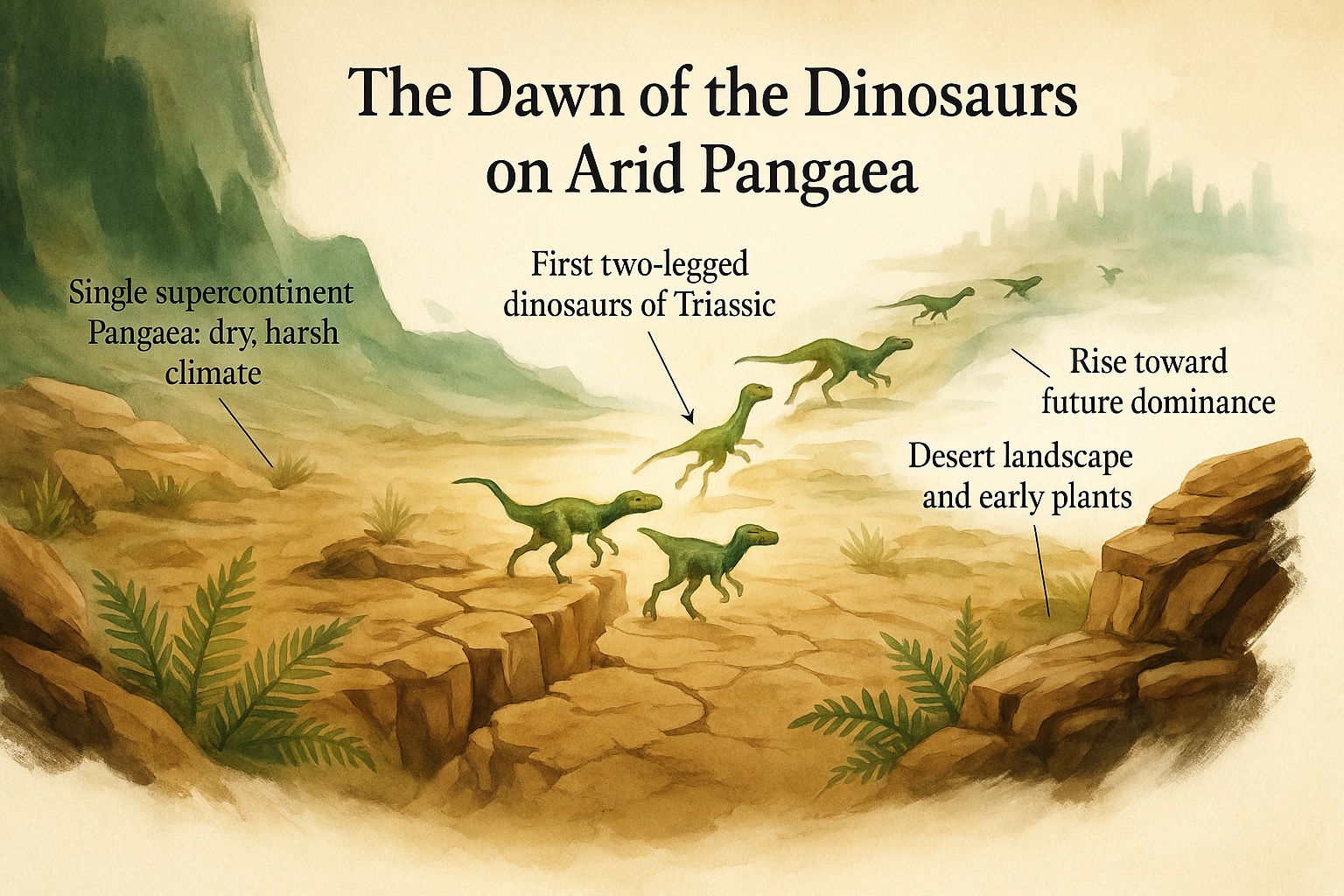
The first dinosaurs appeared in the late Triassic. They were small, light and often two-legged. We’re a long way from the giants of the films. At first they filled modest ecological niches.
These ancestors probably came from what is now the southern hemisphere. They looked like small, nimble, fast reptiles.
The first two-legged archosaurs date to around 230 million years ago. Their fossils rest today in Brazil and Argentina.
🗺️ Life on the single continent, Pangaea
Earth was one single block called Pangaea. Animals could roam freely from one pole to the other. There were almost no geographical barriers.
The centre of the land was extremely dry. Surviving there took real toughness. The dinosaurs knew how to adapt.
| Period | Layout of the continents | Main climate |
|---|---|---|
| Triassic | Single Pangaea | Dry |
| Jurassic | Breaking apart | Humid |
| Cretaceous | Isolated continents | Warm/tropical |
⏰ A reign that took its time
At first, they shared the land with fearsome mammal-like reptiles. The competition for resources was fierce. They weren’t the kings of the world just yet.
An extinction at the end of the Triassic changed everything. Their rivals vanished, leaving the field wide open. That’s when their numbers really exploded. They became dominant by seizing the chance.
Nature hates an empty space. The dinosaurs worked that out fast.
🦴 The Jurassic, or the age of giants
But it’s in the Jurassic that everything shifts, with an Earth that breaks apart to offer new playgrounds to creatures growing bigger and bigger.
🌍 Earth slowly splits apart
Pangaea begins to break into two great blocks. The young Atlantic Ocean separates the animal populations. This splitting helps distinct lineages evolve.
Geographical isolation creates brand-new, unique species. The ecosystems grow more varied and lush. It’s an age of deep change for the planet.
We then see the break-up of Pangaea. This process reshapes the continents for good.
🦒 Huge necks for the plant-eaters
Giant sauropods become the masters of the plains. Their long necks let them reach the tops of the trees. It’s an unbeatable feeding strategy for the time. They munch through tonnes of plants every day.
In response, the big theropod hunters evolve too. The biological arms race is on. Size becomes a major survival argument.
Being giant is no longer the exception. It’s now the rule.
🐦 The very first birds take flight
The ancestors of birds appear in the late Jurassic. They come straight from small, feathered, meat-eating dinosaurs. Archaeopteryx is the most famous of them all.
The sky wasn’t reserved for the pterosaurs alone. These newcomers develop the power of flapping flight. The family link is now beyond doubt for researchers. It’s a fascinating evolutionary change to watch.
Feathers were used as insulation first. Flight came much later.
🌍 The Cretaceous and the great changes
The scenery shifts again in the Cretaceous, with the arrival of flowers and a diversity that reaches its peak before the grand finale.
🌸 The arrival of flowers and insects
Flowering plants, or angiosperms, transform the landscape. They offer new food sources for the plant-eaters. Pollinating insects begin their long co-evolution.
Dinosaur teeth adapt to this new diet. Their dental batteries grow more complex and efficient. The plant world now sets the rules.
The continents look more and more like our map today. The isolation is complete.
🦏 Horned heads and pointed teeth
Ceratopsians and tyrannosaurs rule this final period. Bony armour and horns multiply for defence. It’s a time of extreme species specialisation. Each group has its own physical advantages.
Sea levels reach historic highs. Vast inland seas split the dry land apart. The dinosaurs live on huge island-continents.
Biodiversity is then at its peak. The reign seems eternal.
☄️ The shock at the end of the Cretaceous
66 million years ago, a major biological crisis strikes. An asteroid impact and intense volcanism turn everything upside down. Ecosystems collapse.
All the non-bird dinosaurs vanish for good from the surface. Only a few small backboned animals and the birds survive the chaos. It’s the sudden end of a rule with no rivals. Earth changes its face forever.
The curtain falls on the Mesozoic. A new era begins.
🔬 How we work out a dinosaur’s age
But how do palaeontologists travel back in time with such precision? The answer hides in the rock and the bones.
🦴 Reading bones like tree rings
Fossilised bones keep traces of growth. Inside them are growth-arrest lines. It’s the same idea as the rings of a tree.
These marks reveal the animal’s age at death. They also show times of stress or plenty. Dinosaur biology then becomes readable.
This method is called osteohistology. It has become essential for researchers.
🪨 Dating the layers of rock
We use relative dating thanks to the rock strata. The deeper the fossil, the older it is. It’s a vertical reading of Earth’s history.
For exact precision, we analyse volcanic minerals. Radioactivity lets us give an age in millions of years. We look for specific isotopes in the surrounding ash. It’s a very reliable natural atomic clock.
Geology thus confirms the biological timeline. Everything fits together.
🔍 The clues left behind by fossils
Teeth tell us about an animal’s past diet. Footprints reveal group behaviour. Every clue completes the puzzle of their existence.
A careful study adds precise details about their daily lives:
- Tooth wear shows the plants they ate
- The depth of tracks suggests their weight
- Feathers point to body-heat control
- The layout of nests reveals parenting instinct
A fossil is a silent yet chatty witness. You just have to know how to listen.
🐦 How the species survived to today
Contrary to what many people think, the dinosaurs didn’t vanish completely; they simply changed costume to slip into our everyday lives.
🐦 Birds are the true heirs
Scientifically, birds are theropod dinosaurs. They belong to the group of avian dinosaurs. Their lineage survived the great extinction.
The difference between avian and non-avian is key. The first group still flies above our heads. They’ve kept many ancestral traits.
Fossil studies confirm the survival of avian dinosaurs. This continuity is a proven biological reality.
🌿 A biodiversity that never stops
There are more than 10,000 bird species today. They fill every ecological niche on the planet. It’s an absolutely colossal evolutionary success.
Their success today rivals that of their ancestors. They’ve adapted to every modern climate. From the penguin to the eagle, the variety is total.
Birds are the guardians of a heritage millions of years old. They’re everywhere.
👑 The secret of such a long reign
Their secret lies in an incredible power to adapt. Their efficient metabolism allowed fast, sturdy growth. They survived radical climate changes. It’s a lesson in resilience for all living things.
The dinosaurs evolved and diversified for 165 million years, before making way for the mammals.
They shaped the world as we know it. Their shadow still lingers.
The Mesozoic offered a fascinating reign of 186 million years, from the Triassic to the Cretaceous. Understanding this dinosaur timeline helps you pass the passion on to your children. Dive into their secrets fast, before their feathered heirs take flight!
❓ FAQ
⏳ What’s the difference between a geological era and a period?
To find their way through our planet’s history, scientists use a system of chapters. An era is a very large slice of time that groups together several shorter periods. It’s a bit like a book of tales: the era is the title of the book, and the periods are the chapters telling precise moments of evolution.
For example, the Mesozoic is the era we care about for our giant friends. It splits into three very distinct chapters we know as the Triassic, Jurassic and Cretaceous. Each period has its own landscapes, its own climate and its own favourite species.
📅 When did the dinosaurs appear, and when did they disappear?
The reign of the dinosaurs sits within a huge window of time called the Mesozoic, which lasted around 186 million years. It all begins in the Triassic, about 252 million years ago, after a great extinction. That’s when the very first models, rather small and nimble, poke their snouts out.
Their adventure stops suddenly 66 million years ago, at the end of the Cretaceous. A major biological crisis, caused notably by an asteroid impact, ended the reign of the non-bird dinosaurs. Luckily for us, the bird lineage managed to make it through that ordeal and reach our gardens!
🌡️ What was the climate like on Earth during the Mesozoic?
If you could have travelled back in time, you’d probably have left your jumpers in the wardrobe! Overall, Earth was a real giant greenhouse, far warmer than today. There were no polar ice caps, and temperatures stayed high across almost the whole globe.
At first, in the Triassic, the mood was rather dry and arid because of the single supercontinent. Then, in the Jurassic and Cretaceous, the climate became more humid and tropical. This allowed lush forests to grow, offering an all-you-can-eat buffet for the huge plant-eaters of the time.
🗺️ What is Pangaea and how did it change?
Pangaea is the name of the supercontinent that brought together almost all the dry land at the start of the dinosaur era. Picture a huge jigsaw where all today’s continents are slotted into one another. In the Triassic, animals could travel on foot, dry-shod, from one side of the world to the other!
Over millions of years, this colossal block began to crack and drift apart, a bit like a crust of bread breaking off. This splitting created new oceans, like the Atlantic, and ended up isolating the dinosaur families on different continents. By the end of the Cretaceous, the map of the world was already starting to look like the one we study at school.
🔬 How do scientists manage to date fossils?
Palaeontologists are real time detectives! They mainly use two methods. The first is relative dating: we look at which layer of rock the fossil sits in. The deeper it’s buried in the sedimentary strata, the older it is. It’s a vertical reading of history.
To get an exact figure in millions of years, they turn to absolute dating. We analyse the volcanic minerals found near the bones. By measuring the natural radioactivity of certain elements, like an atomic clock, we can work out the exact age of the rock surrounding the dinosaur.
