
🦕 Spotting which plant-eating dinosaurs munched on greenery, among hundreds of species, can quickly turn into a headache for curious parents. This article lifts the lid on their wonderfully varied vegetarian diet, from mosses on the ground all the way up to the treetops, to finally make your search crystal clear. You’ll uncover the secrets of giants like Diplodocus, which swallowed stones to digest its meals, and Triceratops with its super-efficient parrot beak. Get ready to become an expert on these peaceful colossuses that turned every landscape into one giant all-you-can-eat buffet.
- Why the plant-eaters ruled the planet
- Diplodocus and the long-neck logistics
- Triceratops and the mystery of the frills
- Stegosaurus and its unique back plates
- Ankylosaurus, the fortress on four legs
- Brachiosaurus and the challenge of huge size
- The newcomers and life in a herd
🌿 Why the plant-eaters ruled the planet
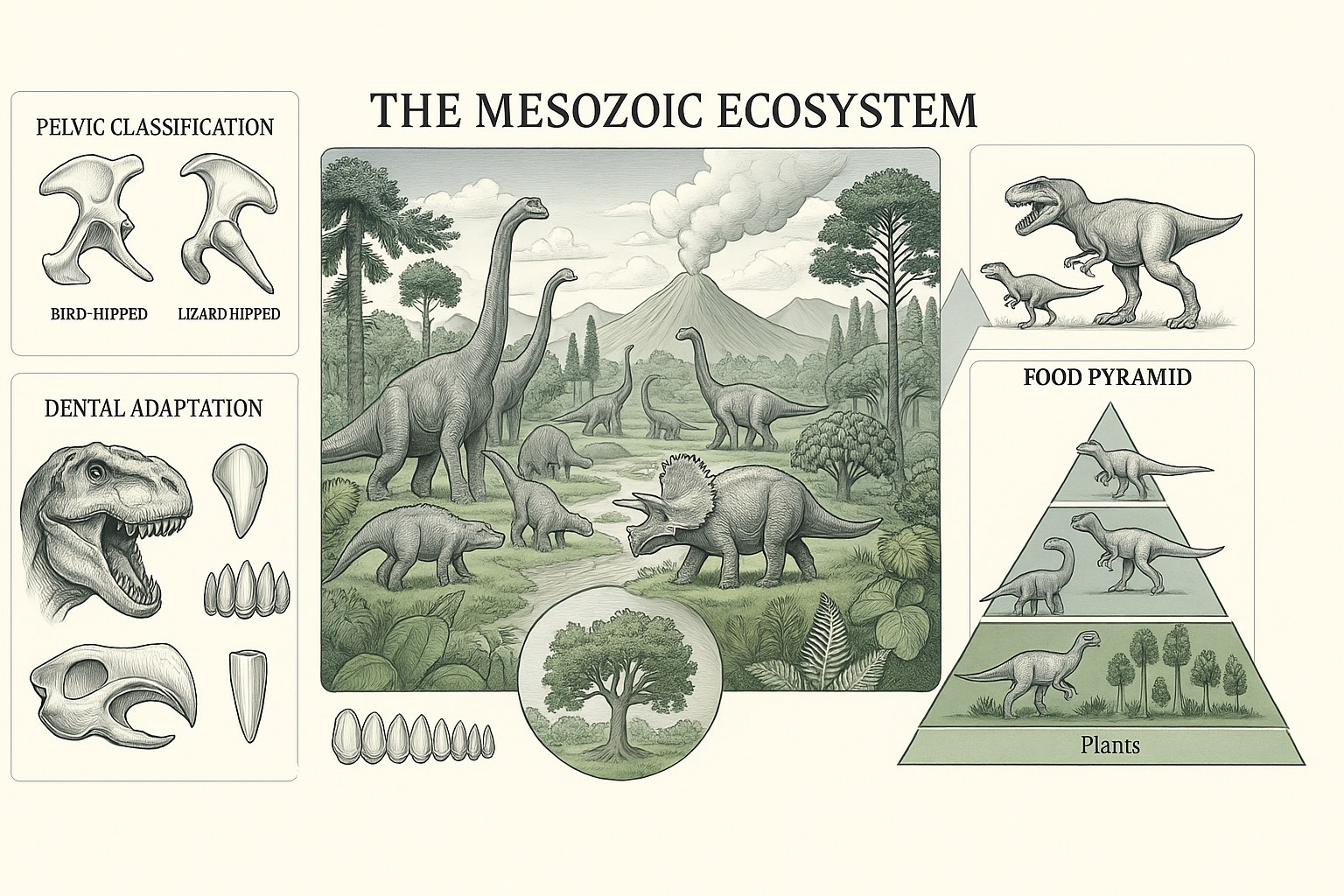
We often picture T-Rex as the absolute boss, but the reality of the Mesozoic was very different. The true power of that era lay in the incredible diversity of plant-eaters that filled every corner of the Earth.
🌱 An overwhelming majority over the carnivores
For a single predator to survive, it needed hundreds of prey animals around. That’s the basic rule of the food pyramid. So herbivores were everywhere.
The whole ecological balance rested on them. Without all that plant biomass turned into meat by the herbivores, the carnivores would never have made it. It’s a simple vital transfer of energy.
In short, they were everywhere. They filled absolutely every land habitat available.
🌳 The great split between Ornithischians and Saurischians
It all comes down to the shape of the hips when classifying them. Ornithischians had bird-like hips. Saurischians had lizard-like hips. That’s the ABC of modern palaeontology.
Scientists tell us that Ornithischians also had a unique predentary beak. It was their physical signature.
And yet, there’s a funny twist. Sauropods are Saurischians, just like T-Rex, but they stayed strictly plant-eating.
🦖 The case of T-Rex and diet mix-ups
Let’s set the record straight. T-Rex never touched a single leaf of lettuce. Its teeth were shaped to crush bone and flesh.
Nothing like the herbivores. It had no defensive horns, no flat teeth for chewing. With T-Rex, everything was built purely for attack.
“A dinosaur’s diet isn’t a matter of personality, but a biological necessity written into its bones and teeth.”
🦕 Diplodocus and the long-neck logistics
Now that we’ve set the big picture, let’s look at the extreme engineers, those giants that turned the telescopic neck into a massive survival weapon.
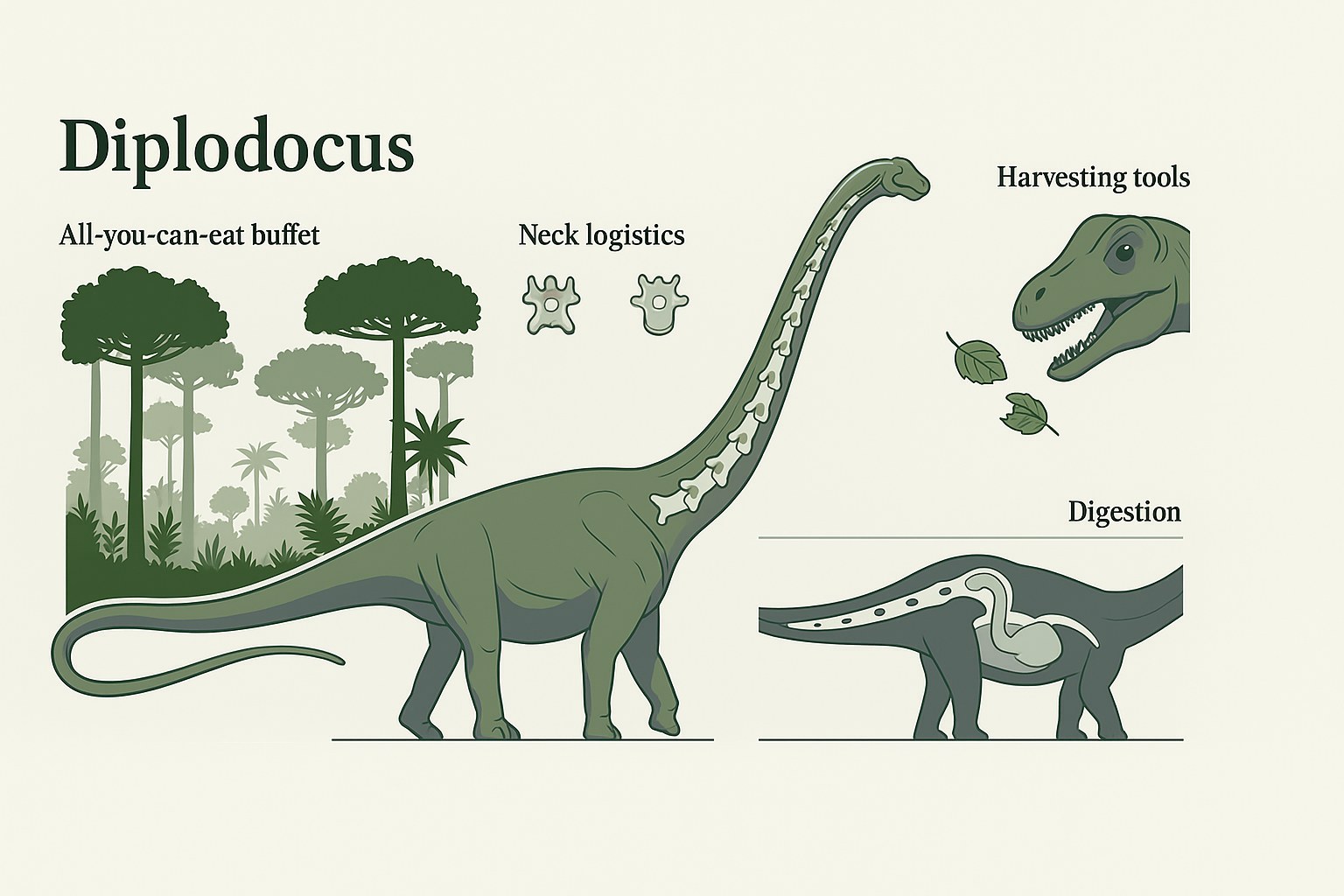
🍽️ A giant neck for an all-you-can-eat buffet
The neck worked like a crane arm. Diplodocus stayed put and swept the whole area. That’s a vital energy saving for such a heavy body.
Its bones were remarkably light. The vertebrae were full of air, just like in birds. Without that, the neck would have been far too heavy.
They reached the treetops. They got to resources that smaller herbivores could never touch.
🦷 Comb-shaped teeth for raking leaves
Their teeth didn’t grind. They looked like pegs or combs. The dinosaurs used them to strip leaves off conifer branches.
There was no chewing at all. Everything was swallowed whole. The jaw was just a harvesting tool, not a processing one.
That’s a major difference. Unlike Triceratops, Diplodocus never chewed its food before sending it down to its stomach.
🪨 The secret of gastroliths for digestion
With no grinding teeth, they used stones instead. These gastroliths were swallowed on purpose. They ended up in a powerful gizzard to mash the fibres into a pulp.
These stones are very easy to recognise. We find them polished and smooth in the fossils. That’s proof of their intense mechanical action.
Here’s what we know about these pebbles:
- Role of the stomach stones: grinding down tough plant fibres.
- Types of plants ground up: cycads, ferns and conifers.
- Fossil evidence found: smooth stones close to the skeletons.
When you look at how plant-eating dinosaurs fed, you quickly understand that Diplodocus had its very own trick for digesting its meals.
🦏 Triceratops and the mystery of the frills
While the long necks bet on height, others preferred raw power down at ground level, turning their skull into a real vegetarian battle tank.
🦜 A parrot beak for tough plants
Triceratops had a keratin beak. It was a fearsome cutting tool. It could slice through very tough woody stems with ease.
At the back, hundreds of teeth kept replacing themselves over and over. They formed dental batteries. It was a true factory for grinding the toughest fibres.
Nothing could resist that combo of beak and grinders. The efficiency was total.
🦏 The real use of the horns and the bony frill
The horns were used for defence. Facing T-Rex, that was vital. But the frill also had a social role. It probably helped with showing off or recognising other individuals.
These structures were full of blood vessels. That rich blood supply is a strong clue. They may also have helped regulate the animal’s temperature.
This group, the Ceratopsia, is fascinating.
🌾 An efficient low-level grazer
Its posture was low. It ate whatever grew at ground level. Ferns and small shrubs made up most of its daily menu.
Weighing several tonnes, it wasn’t nimble. Its heaviness forced a calm pace. Its stability was its best ally for staying firmly grounded.
| Species | Beak type | Main diet | Special feature |
|---|---|---|---|
| Triceratops | Parrot beak | Tough plants | Dental batteries |
| Diplodocus | Comb teeth | Soft leaves | Long neck |
| Ankylosaurus | Wide beak | Mosses | Bony armour |
| Stegosaurus | Narrow beak | Low vegetation | Back plates |
To work out which plant-eating dinosaurs ate what, you just need to look at these mouth tools. Each species had its own speciality for munching away happily.
🦎 Stegosaurus and its unique back plates
Let’s leave the front-facing horns behind to meet an even stranger shape, that of an herbivore that wore its armour on its back and its weapon at the tip of its tail.
🦷 Modest teeth for a giant appetite
Stegosaurus had a tiny head. Its teeth were very small. We still wonder how it fed such a massive body with so little.
It probably picked out mosses and ferns. Foods that were easy to swallow without complex chewing.
Its narrow snout let it pick out exactly the best shoots in the dense undergrowth.
🛡️ The heat and defence role of the plates
These plates weren’t attached to the skeleton. They were planted right into the skin. They probably worked as radiators. By changing the blood flow, the animal managed its inner heat.
Facing an Allosaurus, these plates made Stegosaurus look much bigger. It was an excellent visual bluff.
The plates were porous and fragile. They wouldn’t have survived a direct, powerful bite.
⚔️ The thagomizer, the deadly tail weapon
The real weapon was at the end. Four fearsome bony spikes. It’s called a thagomizer. It was an active, violent defence.
The animal swung its tail sideways. A well-aimed blow could pierce a predator’s leg or its soft belly.
Allosaurus fossils sometimes carry the marks of these wounds.
🛡️ Ankylosaurus, the fortress on four legs
But if Stegosaurus was a sentinel, Ankylosaurus was a true living bunker, almost impossible to knock over.
🛡️ Armour of impenetrable skin plates
Its back was covered in osteoderms. These are bony plates set into the skin. Even the eyelids of some specimens were armoured.
Let’s talk about bone fusion. Its whole body was rigid to absorb shocks. It was a passive defence strategy taken to the extreme.
Its weak spot? Only the belly was vulnerable. But good luck flipping it over.
🔨 The tail club as a deterrent
At the end of the tail sat a huge bony mass. It was able to break the ankles of the biggest theropods. The tail vertebrae were fused together to deliver the full force of the impact.
“A single swing of this club could end the career of any reckless predator.”
This confirms the classification of the Ankylosauria.
🫧 A digestive system built for fermentation
Its body was very wide. That was to house a gigantic gut. Digesting plants took time and plenty of space to ferment.
Just like our cows, it used bacteria. These tiny organisms broke down the cellulose that the stomach alone couldn’t handle.
In short, this slow fermentation let it squeeze the most nutrients out of otherwise poor plants.
🦒 Brachiosaurus and the challenge of huge size
Let’s leave the ground level and look up to the clouds, where Brachiosaurus redefined the limits of life on land.
🦒 A giraffe-like body to rule the canopy
Brachiosaurus had longer front legs. That gave it an upright posture. Its neck pointed naturally upward, unlike the other sauropods.
It browsed the tops of the conifers. It was an exclusive feeding niche. No other herbivore could bother it up there. To find plant-eating dinosaurs, you just had to look at the treetops.
That was the ultimate advantage. It stayed the undisputed king of the upper levels of the forest.
❤️ Managing blood pressure and weight
Pumping blood 12 metres up is a challenge. Its heart had to be massive and powerful. The blood pressure was probably phenomenal to feed its brain without fainting.
Now let’s talk weight. We’re looking at 50 tonnes. Its legs were like cathedral pillars to support such a mass.
It’s a true feat of nature, including the discoveries of giant sauropods.
🏆 The Titanosaurs and the extreme records
Titanosaurs like Argentinosaurus were even bigger. They represent the peak of herbivore evolution. It’s the biological maximum for a land animal.
To keep such a body going, they ate almost non-stop. Every waking minute was spent gathering food. No time for a nap!
- Patagotitan and Argentinosaurus: the kings of the Cretaceous.
- Estimated weight: up to 70 tonnes depending on the specimen.
- Total length over 35 metres.
👥 The newcomers and life in a herd
Beyond the lone giants, the survival of herbivores often rested on a complex social structure and constant adaptation to a changing world.
👨👩👧 Strength in numbers and parental care
Travelling in a herd was a protection. More eyes to watch for danger. The youngest often stayed in the centre of the group to be kept safe.
Let’s talk about nests. We’ve found massive egg-laying sites. This proves that plant-eating dinosaurs looked after their young after hatching.
And there was communication. Calls or vibrations let them keep in touch.
🔍 Recent discoveries and little-known species
Nigersaurus is fascinating with its flat snout. It worked like a plant vacuum cleaner. It’s proof of the incredible diversity of body adaptations among herbivores.
Studies explain how the skulls evolved to become vegetarian.
And there’s new technology. 3D scanners now let us see how their muscles chewed without damaging the precious fossils.
🌿 How the plants evolved during the Mesozoic
The landscape changed dramatically. At first, there were only ferns and conifers. Then flowers appeared, changing the nutritional picture.
Analysis of bromalites, a type of fossil, helps us better understand their incredible variety of diets.
To wrap up on adaptation: dinosaurs had to evolve their teeth to adapt to these new, richer plant resources.
From the giant neck of Diplodocus to the sharp beak of Triceratops, these greenery lovers developed incredible tricks to thrive. Explore our detailed fact sheets to identify every species of plant-eating dinosaur! Give your children a fascinating journey into the heart of prehistory right now.
❓ FAQ
🌱 What kinds of plants did plant-eating dinosaurs eat exactly?
These big foodies had a very varied menu! They feasted on leaves, stems, ferns and mosses. The luckiest ones could even nibble on fruits, seeds and flowers once these started appearing in the landscape.
For the more robust species, bark, cones and the branches of conifers or ginkgos were an important source of energy. It was a bit like one giant salad bar across the whole planet, where each one found what suited it, depending on the shape of its beak or teeth.
🪨 How did dinosaurs manage to digest all those fibrous plants?
Nature is clever: not always having teeth to chew, some giants like Diplodocus swallowed small pebbles called gastroliths. These stones stayed in their stomachs to grind down the plant fibres, a bit like a very efficient natural blender!
Others, like Ankylosaurus, had a very wide belly to house an impressive digestive system. This let plants ferment slowly thanks to bacteria, turning tough greenery into essential nutrients for their survival.
🌳 Did all plant-eating dinosaurs belong to the same family?
Not at all, they’re mainly sorted into two big groups according to the shape of their hips. There are the Ornithischians, like Triceratops or Stegosaurus, which have “bird hips” and often a beak to cut up plants.
The other group is the Saurischians. While that name also includes carnivores, it mainly covers the famous sauropods. These are the long-necked giants, like Brachiosaurus, that ruled the canopy to grab the highest leaves.
🌾 Why were the plant-eating dinosaurs so numerous?
It’s nature’s golden rule: for an ecosystem to work, you need far more prey than predators. Herbivores formed the base of the food pyramid, turning plant biomass into energy for the whole rest of the chain.
They filled every available niche, from the ground up to the treetops. Travelling in a herd also let them better protect the young from carnivores, ensuring the species lived on through the ages.
🦖 Could the famous T-Rex have eaten plants now and then?
It’s a common myth, but the answer is no! A diet is written into the bone structure. With its powerful teeth designed to crush bone, and a jaw able to apply phenomenal pressure, T-Rex was a strict carnivore.
Unlike the herbivores with their flat teeth or beaks for grinding fibres, everything about the Tyrannosaurus was geared towards hunting or eating carcasses. It simply didn’t have the biological equipment to digest salad!
