
Explaining the human timeline to young children can feel like an endless puzzle. This article presents prehistory explained for kids in a simple, engaging way to turn that dizzying stretch of time into a concrete adventure. You’ll discover how our ancestors survived thanks to fire and the invention of farming, while exploring fun activities to relive this epic journey as a family. 🦕
- The basics for understanding this long period
- Who are our prehistoric ancestors?
- The daily life of nomadic hunter-gatherers
- The revolution of the settled lifestyle
- The artists of the cave age
- Learning about prehistory as a family today
📜 The basics for understanding this long period
After getting the big picture, let’s dive deeper and lay the foundations of this extraordinary story.
⏳ The beginning and end of the adventure
It all starts 3 million years ago. The very first humans finally appear on Earth. This is the starting point of our incredibly long lineage.
The adventure comes to an end around 3000 BC with the invention of writing. This marks the shift into History. It is a radical change for all of humanity.
Let’s hold on to that date of 3000 BC. It acts as a symbolic boundary. Before it, there is only the silence of unwritten time.
📅 A timespan that boggles the mind
Prehistory is incredibly long. It dwarfs all of modern history with its immense stretch of time. It is a true abyss.
Imagine a 24-hour day. Writing would only appear in the very last minutes. That helps to visualize the true scale.
Writing takes up only a tiny sliver of human time. We are newcomers. The civilized world is remarkably young.
🔍 The clues left by archaeologists
Scientists dig the soil with patience. They are the detectives of the distant past. Every layer of earth matters enormously.
They find bones or chipped stones. These remains are our only witnesses. They tell the story of a life that was often harsh.
These traces allow us to piece the past back together. It’s like assembling a giant jigsaw puzzle. It takes tremendous precision.
🧔 Who are our prehistoric ancestors?
Now that the stage is set, let’s meet the faces that populated these millennia of solitude.
🚶 The first steps of the Australopithecines
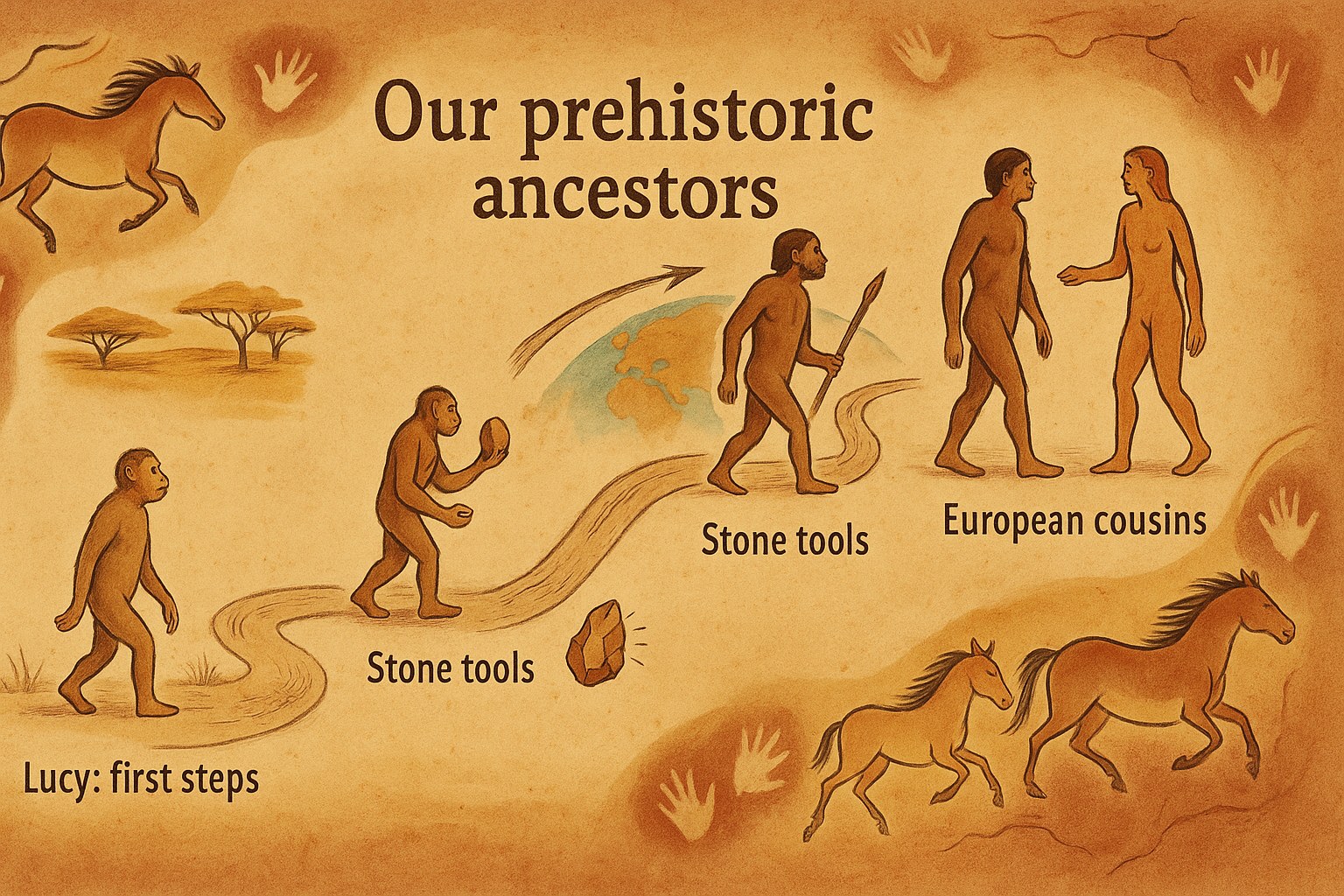
Lucy remains an undeniable worldwide icon. This small ancestor was already walking on two legs. She is not quite human yet, but getting very close.
Her main habitat was the African savanna. That was her home millions of years ago. They had to stay very alert to predators.
Their way of life stayed close to nature. They likely still climbed trees to sleep. Survival was a daily, wild struggle.
🧬 Homo habilis and Homo erectus
Handy Man invents the very first tools. This is the true beginning of human technology. Stone becomes an invaluable aid.
Upright Man begins to travel beyond Africa. He explores distant new horizons. He is officially our first great land explorer.
Brain size increases over time. Intelligence grows alongside the challenges faced. The skull rounds out in a very visible way.
🤝 The encounter between Neanderthal and Sapiens
Neanderthal has a robust build suited to the cold. Sapiens is more slender and agile. Their silhouettes were quite different across Europe.
Neanderthal was not the thick-skulled brute once imagined, but a sophisticated cousin capable of feelings and complex rituals.
Homo sapiens is our one and only direct ancestor. We carry his genes to this day. He is our true original bloodline.
These two species crossed paths. They mingled during this period of coexistence. It is an absolutely fascinating page of history to explore.
Learning about prehistory explained for kids — from cave dwellers to us — helps us better understand where we come from. You see, our ancestors were far from simple extras; they were true adventurers!
🏹 The daily life of nomadic hunter-gatherers
These ancestors never stayed still; their lives were a perpetual journey in rhythm with the seasons and the herds.
🦌 The quest for food and constant movement
Clans moved from place to place with the seasons. They followed available natural resources. Nomadism was a vital necessity.
Groups gathered berries and hunted large animals. Men and women worked closely together. Everyone had a role in feeding the group. Meat was scarce.
They used natural shelters like the entrances of caves. They did not live deep in the dark.
🔥 The secret of mastering fire
Striking stones together or rubbing wood created heat. It was a precise technique. Producing sparks required practice and skill.
Fire was used for cooking and protection. It drove away dangerous predators at night. Food became easier to digest.
The hearth bonded social life. People gathered around it to tell stories. Language likely developed there too.
- Fire allowed them to see in the darkness.
- It kept them warm during harsh winters.
- It was used to cook meat and prevent illness.
- It helped to harden the tips of spears.
🪨 Clever tools made from knapped stone
Making a hand axe meant striking two rocks together. The result was a very effective cutting edge. It was the Swiss army knife of the era.
Humans used bones to make needles and harpoons. Technology diversified with new materials. They began sewing animal skins together.
Hunting weapons became more precise. Arrowheads were genuine technical masterpieces. Accuracy improved noticeably.
🏘️ The revolution of the settled lifestyle
But a radical change was about to transform this wandering existence: humans decided to put down roots and reshape the land.
🌾 The invention of farming and animal herding
Humans finally learn to sow seeds. They observe the natural cycle with great attention. Harvesting now replaces simple gathering.
They domesticate the first animals, like sheep. The animal becomes a companion or a food reserve. A lasting bond is established.
Food becomes more predictable and abundant. They can finally store provisions for winter. Famine retreats a little thanks to these stores.
🏠 Sturdy houses built from wood and earth
The first permanent dwellings use wattle and daub. A mix of wood, straw and mud is combined. It is the true beginning of architecture.
Houses cluster together to form villages. Communal life organizes itself around a centre. The very first streets begin to appear.
The need to keep moving disappears. People now attach themselves to a specific territory. The notion of property emerges.
💡 Polished stone and new inventions
Polishing replaces simple knapping of pebbles. Tools become smoother and more durable. It is a major technical advance for the era.
Pottery appears to store harvests. Clay is shaped to create containers. Craftsmanship grows increasingly important.
Weaving allows the creation of the first clothes. Plant fibres or wool are used. Comfort improves greatly.
| Feature | Palaeolithic (Knapped Stone) | Neolithic (Polished Stone) |
|---|---|---|
| Shelter | Cave | Village |
| Food | Hunting | Farming |
| Main tools | Hand axe | Polished axe |
| Lifestyle | Nomadic | Settled |
| Key invention | Fire | Pottery |
🎨 The artists of the cave age
Beyond mere survival, our ancestors had an artistic soul capable of turning rocky walls into masterpieces.
🎨 The secrets of cave paintings
The Lascaux and Chauvet caves are true masterpieces. They testify to an incredible talent for drawing. The colours still vibrate despite millennia of time.
The artists used natural pigments drawn from the earth. Ochre was often mixed with animal fat. Hands served as brushes on the rock.
Common motifs depict horses and bison. The animals are rendered with striking realism. This discovery of Lascaux by children may have felt almost magical.
📿 Sculptures and jewellery from prehistory
Female statuettes, known as prehistoric Venuses, are fascinating. They often celebrate fertility and life. Craftspeople carved them carefully from ivory.
Ornaments were also made from teeth or shells. People already loved adorning themselves back then. Jewellery may have indicated a specific social rank.
Art also served to express deep beliefs. It is a window into their spiritual thinking. The sacred was already very much present in their daily lives.
👩👧 The place of women and children
We must dismantle the idea that only men hunted. Women played a crucial economic role. The modern view is often distorted by clichés.
The whole family actively participated in collective survival. Even the youngest helped with daily tasks. The effort was above all collective and built on solidarity.
Children learned a great deal simply by watching adults. Oral transmission was the only means available. This transfer of knowledge among prehistoric children happened through doing.
👨👩👧 Learning about prehistory as a family today
To wrap up this journey, let’s see how to bring this past back to life through concrete shared experiences.
🦣 The giant animals of the era
The woolly mammoth and the woolly rhinoceros are often awe-inspiring. These colossi ruled the frozen plains millennia ago. They naturally capture the imagination of the youngest.
These creatures disappeared because of major climate change. Global warming completely disrupted their natural habitat. Unfortunately they did not survive these transformations.
We can compare these species to modern animals. The modern elephant remains the very close cousin of the mammoth. The physical resemblances between them are truly striking.
🏛️ The best museums and sites to visit
Some places offer total immersion for families. Nothing beats direct contact with history to truly understand it. Children’s eyes light up at these discoveries.
Visiting replicas of famous caves remains a powerful sensory experience. You physically feel the atmosphere of ancient times. The magic works immediately on young and old alike. It is a lasting memory.
Fire-making demonstrations always captivate modern families. Learning through play is the key. You can test educational activities at the Préhistomuseum to practise for yourself.
🎲 Craft ideas and themed games
You can create stunning cave paintings using coffee. It is a simple trick to imitate natural ochre. Children love handling these fragrant textures.
Modern board games on this theme are excellent. You learn survival strategies without even realising it. It is both fun and very educational.
Making small clay tools is a rewarding activity. You touch raw material just like our distant ancestors. The final result always brings great pride.
From the mastery of fire to settlement, our ancestors showed incredible genius. To explore this epic story, visit a museum or try coffee cave painting with your little curious minds. Understanding prehistory explained for kids means giving future generations the keys to their own history.
❓ FAQ
⏳ When exactly does prehistory begin and end?
This immense adventure begins with the appearance of the very first humans, around 3 million years ago. It is the starting point of our incredibly long lineage on Earth.
It ends with an invention that changes everything: writing, around 3000 BC. That is the moment we officially shift into History, because texts finally allow us to hear what our ancestors had to say.
🔬 How do scientists know about the lives of cave dwellers without written texts?
It is genuine detective work! Archaeologists dig the soil patiently to find precious clues like bones, flint tools or the remains of hearths. Each layer of earth tells a small piece of their daily story.
They also use scientific techniques like carbon-14 dating or pollen analysis. This allows them to reconstruct the climate of the era, their diet and even vanished landscapes. It is a giant puzzle assembled piece by piece.
💡 What are the most important discoveries made by our ancestors during this period?
There are so many, but mastering fire is without doubt the most revolutionary. It allowed them to protect themselves from predators, to see in the dark and to cook meat. It was also the first gathering point for conversation and strengthening the group’s bonds.
Later, in the Neolithic, the invention of farming and animal herding completely transformed their way of life. By learning to sow seeds and domesticate animals like sheep, humans stopped their endless wandering to become settled and build the first villages.
🤔 Was Neanderthal man really a thick-skulled brute?
Not at all — that is a misconception researchers have managed to dispel! Neanderthal was a sophisticated cousin, very robust and perfectly adapted to cold climates. He already had complex feelings and even practised funeral rites for his dead.
He also coexisted in Europe with Homo sapiens, our direct ancestor. They crossed paths, shared territories and sometimes even intermingled. We actually still carry a little of his DNA in us today.
🦣 Why did mammoths and other prehistoric giants disappear?
These impressive animals, like the woolly mammoth and the woolly rhinoceros, were the kings of the frozen plains. Unfortunately, the climate began warming significantly toward the end of prehistory.
This climate change radically altered their natural habitat and food sources. Unable to adapt quickly enough to these new temperatures, these species became extinct, making way for the animals we know better today.
👩👧 What was the place of women and children in prehistoric tribes?
Contrary to old clichés, everyone took part in the clan’s survival! Women played an essential economic role and did not simply wait at the back of the cave. Gathering and crafts were pillars that fed and clothed the group.
Children, for their part, learned very early by watching adults. There was no school, so the passing on of knowledge happened through gesture and speech. Every member of the family, young or old, was an indispensable link in this chain of solidarity.
