
Explaining the world’s famous monuments to children can feel like a puzzle when all the dates get tangled up. 🌍 This guide turns old stones into living stories so you can explore history and geography without leaving your living room. You’ll uncover building secrets and playful tricks to grow your little explorers’ curiosity, together.
- Why introduce children to the world’s monuments?
- Treasures of antiquity to travel back in time
- Knights and builders in the heart of the Middle Ages
- Living like a king, from palaces to museums
- Feats of modern engineering around the globe
- Crafts and models to learn without a screen
🌍 Why introduce children to the world’s monuments?
Architecture isn’t just a grown-up thing. It’s above all a brilliant gateway to understanding our planet while having fun with incredible shapes.
🗺️ Opening their eyes to world geography without travelling
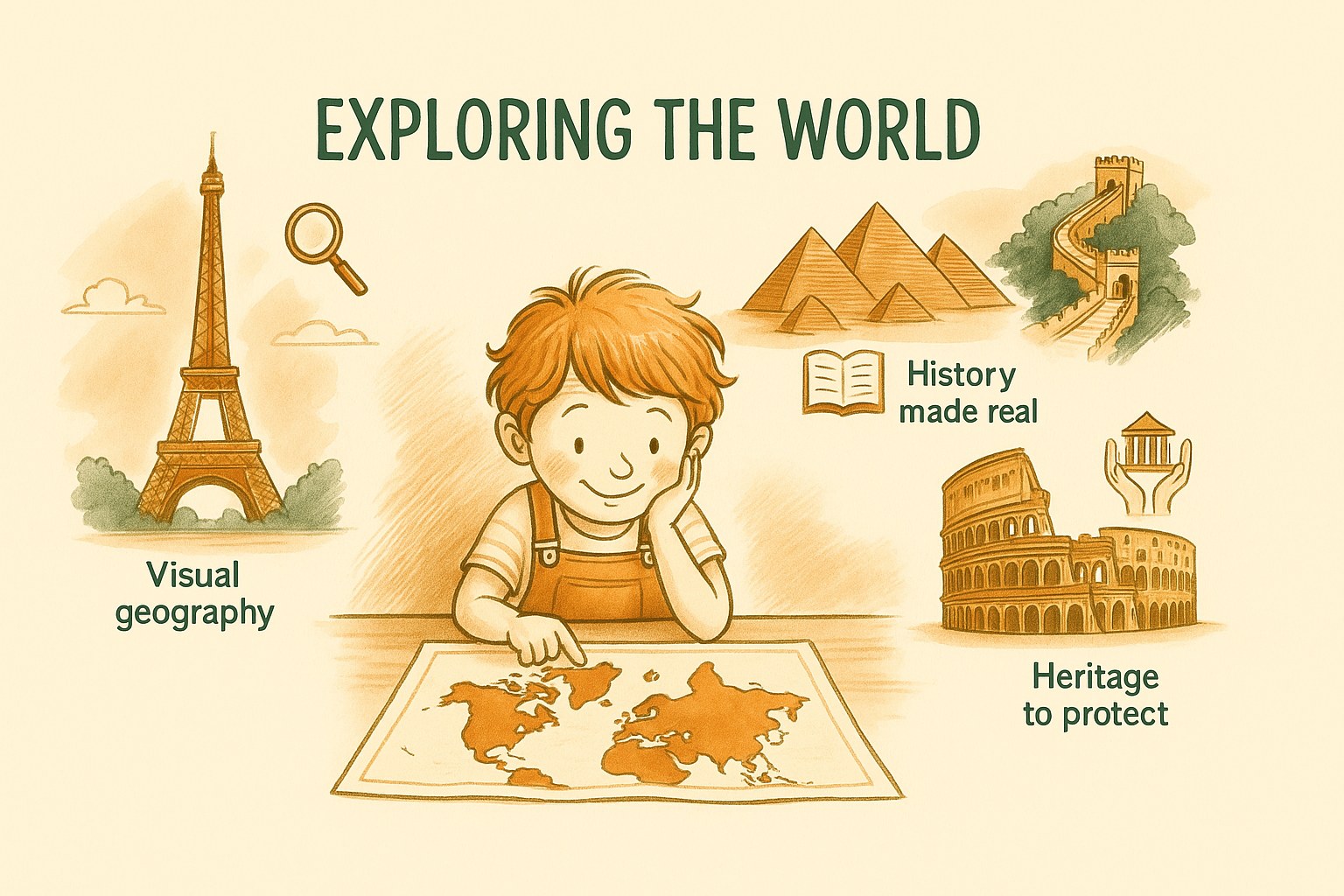
A building helps you place a country. The monument becomes a strong visual landmark. Children spot it quickly on a world map.
You can link shapes to climates. Steep roofs hint at snow. Flat terraces often suggest sunshine. It’s an instant lesson in visual geography.
Concrete images help. You remember the continents better.
📖 Making history real, far from school textbooks
Dates turn into things you can touch. Touching a stone means touching the past. History becomes a real adventure.
A style depends on the needs of its time. Why build pyramids or castles? Every building answers a precise, useful challenge from history.
How did the builders live on the worksite? That brings the old stones to life. It’s a playful way of discovering architecture for the youngest.
🪨 Passing on respect for old stones from an early age
Heritage is fragile. Monuments wear away with time and weather. We need to learn to protect them for future generations.
A restorer is a “stone doctor“. They carefully heal damaged buildings. It’s a job of incredible patience and precision.
These skills have been passed down for centuries. It’s a precious heritage we all share.
🏛️ Treasures of antiquity to travel back in time
Now that we know why it matters, let’s go exploring humanity’s first great achievements, starting in the desert.
🔺 The pyramids of Egypt and their building secrets
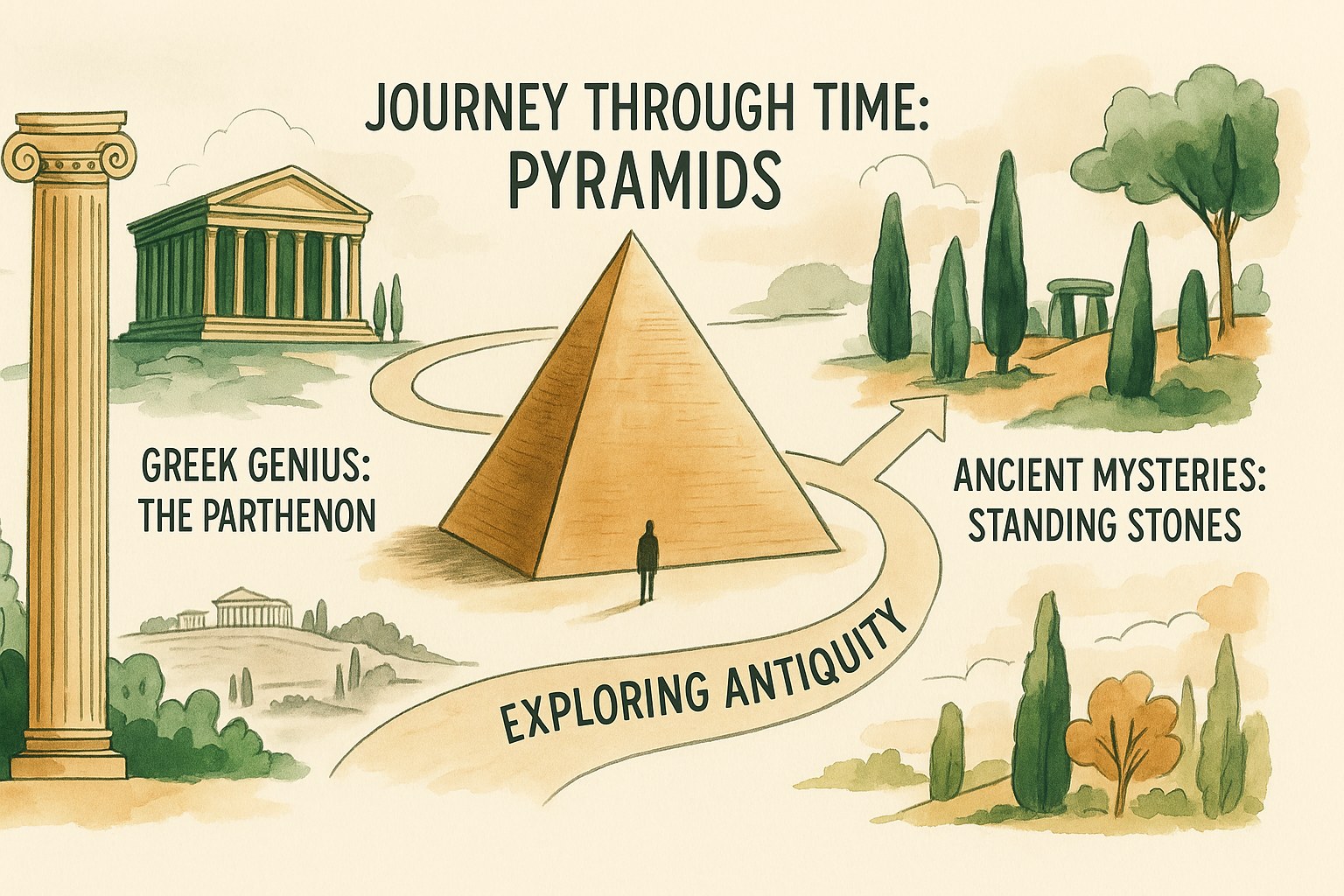
These monuments served as giant tombs for the pharaohs. Their triangular shape is still unique in the world. They’ve pointed proudly to the sky for thousands of years in the hot sand.
How do you move stones weighing several tonnes? The mystery of shifting these colossal blocks is still unsolved. The theories still fascinate engineers and curious children today.
The pyramids of Giza are the only wonder of the ancient world still standing today, a testament to Egyptian genius.
The workers probably used clever ramps. Human strength was the only energy available back then. It’s a collective feat achieved without any modern machine.
🏛️ The Parthenon, to meet the goddess Athena
This magnificent temple sits atop the Acropolis. It overlooks the city of Athens with rare elegance. It’s the strong symbol of Greek power and of ancient democracy.
The Doric columns hold up the roof with perfect regularity. The Greeks looked for absolute harmony in every line of stone. It’s a real lesson in balance and geometry.
Athena was the protector of the city. She stood for wisdom and just war.
🗿 Standing stones and ancient mysteries
In some places, thousands of standing stones line up in long rows. Prehistoric people set them there with infinite care. This display of granite is impressive.
Was it a giant calendar or a sacred place? The mystery remains and stirs the imagination of little explorers. We still wonder why they did it.
These stones are older than the pyramids. They are our most distant heritage.
🏰 Knights and builders in the heart of the Middle Ages
Let’s leave antiquity and step into the age of castles and cathedrals, where stone served as much for praying as for fighting.
🏰 Defending your castle behind the ramparts
To stay safe, people piled up the obstacles. The heavy drawbridge rises sharply to block the way in. The narrow arrow slits let defenders aim at the enemy without ever being seen by the attackers.
Why build round towers? They stand up far better to blows. Right angles were too fragile against the repeated attacks of war machines.
Behind the walls, a whole village is busily organised. You’d find noisy stables, kitchens and forges. It’s a real little town, sheltered from danger.
- The keep, for living in
- The water-filled moat
- The battlements, for hiding
- The iron portcullis
⛪ Cathedrals and their funny gargoyles
Gothic art changes everything. The walls grow thin and the stained-glass windows grow huge. It’s an incredible technical feat for the time of those brave cathedral builders.
Gargoyles have a very practical use. They aren’t only there to look scary. They carry rainwater away from the fragile walls to keep out the damp.
When a famous cathedral burns, it can move the whole world. Passionate craftspeople then bring the historic masterpiece back to life. The rebuilding moves forward to restore its glory.
⚔️ Roman arenas, to picture the gladiators
Roman arenas look a lot like our sports stadiums today. The Romans already passionately loved big popular shows. People came as families to cheer together.
Gladiators fought under the roar of a wild crowd. Chariot races were also hugely popular and truly spectacular. The atmosphere must have been absolutely electric.
Thousands of people could leave in just a few minutes. It’s a model of urban planning. The architects of the time really thought of everything for safety.
👑 Living like a king, from palaces to museums
After the fortresses, make way for the sheer luxury of royal palaces, where comfort finally starts to win out over defence.
🏰 The Palace of Versailles and its symmetrical gardens
Louis XIV loved excess. The Sun King absolutely wanted the most beautiful palace in the whole world. The famous Hall of Mirrors sparkles brilliantly with its glass.
The gardens are impressive too. Everything looks drawn with a ruler and a compass. Nature is tamed to create geometric shapes judged to be perfect.
The parties were spectacular. Versailles was a permanent theatre to entertain the court. Elegant balls and fireworks under the stars were held there regularly.
🔺 The glass pyramid of the Louvre and its hidden treasures
The Louvre keeps changing face. This palace was home to the kings of France for a long time. It’s now the official home of the most beautiful works of art you can admire.
The architecture surprises visitors. The modern glass pyramid stands out among the old stone walls. It’s a bold, successful blend of past and present.
You can’t miss the Mona Lisa. This small, mysterious painting draws millions of curious visitors. It’s the must-see landmark for everyone discovering this huge museum.
👑 Understanding royal architecture without getting bored
Learn to spot the symbols. Look carefully for carved lilies or suns. Every detail actually tells the glory of the ruler who lived there.
Life was different in the old days. No central heating or modern bathroom in the bedrooms. Castle life sometimes got very cold in winter.
Look at the noble materials used. The precious marble and the gilding visible everywhere show the wealth. It’s a real fairy-tale setting for children.
🏗️ Feats of modern engineering around the globe
Let’s leave the kings and step into the age of iron and concrete, where engineers defy the laws of gravity.
🗼 The Eiffel Tower, the iron lady of Paris
It’s a temporary monument. It was meant to be taken down after the 1889 World’s Fair. Not all Parisians liked it at first.
Gustave Eiffel’s genius is impressive. He used thousands of riveted iron pieces. It’s a giant, sturdy building set.
Its role today is vital. It works as an antenna for radio and television. Without it, communication would be far harder.
🗽 The Statue of Liberty and its journey by ship
It’s a gift from France. It crossed the Atlantic in separate pieces. It’s the symbol of friendship between two great nations.
The symbolism is powerful. The torch lights up the world and the broken chains celebrate freedom. Every detail carries a deep meaning.
Admire the hidden structure. Inside, there’s an iron framework designed by Eiffel. It lets the statue stand up to the winds.
🌉 A record-breaking bridge, to touch the sky
Here is a record-breaking bridge. It’s one of the tallest in the world. It soars over a valley with incredible lightness.
The cable-stay system is clever. These steel cables hold up the deck. It’s a very impressive modern technique to look at.
The architecture respects nature. The bridge seems to float among the clouds. It’s a true technical feat.
| Monument | Main material | Approximate height | Special feature |
|---|---|---|---|
| Eiffel Tower | Iron | 330 m | Meant to be temporary. |
| Statue of Liberty | Copper | 93 m | Arrived in 350 pieces. |
| Millau Viaduct | Concrete/Steel | 343 m | Taller than the Eiffel Tower. |
| Great Pyramid of Giza | Stone | 139 m | A tomb for a pharaoh. |
The world’s famous monuments explained to children show us that human imagination has no limits. These structures tell our history with pride.
🎨 Crafts and models to learn without a screen
After admiring these wonders, why not try building them yourself in your living room?
🏗️ Building models to strengthen patience
You develop fine motor skills. Putting small pieces together takes precision. It’s an excellent exercise for the fingers and for focus.
You memorise the details. By building, you understand how a monument stands up. You remember shapes better than by looking at a simple photo.
Choose suitable kits. There are 3D puzzles for every age. Avoid models that are too complex, so the child doesn’t get discouraged.
♻️ Recycling cardboard to build homemade monuments
Use household waste. Paper rolls become perfect Roman towers. Cereal boxes turn into castle ramparts.
Build castles. A few cut-up egg cartons make superb battlements. It’s an eco-friendly, free activity for the whole family.
Paint the creations. Use the original colours for more realism. A little grey for the stone or ochre for the sand.
💻 Setting up a fun virtual tour as a family
Explore sites in 3D. Many tools let you travel from your sofa. It’s a brilliant way to discover the real volumes.
Make card games. Create your own memory cards with photos. It helps you revise the names of the monuments while having fun.
Set up visual challenges. Look for hidden objects in the historic scenes. It’s an exciting digital treasure hunt. You can also leaf through children’s books about architecture to dig deeper into the subject.
Exploring these treasures helps you understand history and geography while protecting our heritage. Carry on the adventure right now by making your own cardboard models with your little builders. These famous monuments explained to children turn every living room into a fabulous journey through time.
❓ FAQ
🏛️ What exactly is a historic monument?
To explain it simply to children, a historic monument is a very special building that has crossed the centuries. It’s a bit like a time machine made of bricks and stone! These buildings help us remember a particular era or a person who left their mark on history.
Whether it’s a castle, a pyramid or an old temple, these stones tell us how people lived long ago, what they believed in and the feats they achieved. It’s a precious heritage that we protect so we don’t forget our past.
⛪ What are the funny statues on the cathedral for?
The famous gargoyles on a Gothic cathedral have two very precise missions. Their first role is very practical: they act as gutters to carry rainwater away from the walls. This stops the water from damaging the stone and the foundations of the cathedral. Clever, isn’t it?
Their second role is more mysterious. With their monstrous look, they were meant to scare off evil spirits and protect the church. Be careful not to confuse them with the chimeras, those statues of fantastical creatures added much later for decoration!
🔺 How did the Egyptians manage to build the pyramids?
It’s one of the greatest mysteries in history, and it still fascinates young and old alike. People think the Egyptians used a clever system of ramps to raise the enormous blocks of stone. They had no modern cranes, so everything rested on human strength.
It took a huge, very organised workforce to move these stones weighing several tonnes. These pyramids served as tombs for the pharaohs, and their unique shape pointing to the sky still bears witness today to their incredible genius.
🗿 Why are there rows of standing stones in some regions?
Standing stones are very large stones raised up by prehistoric people. We know they set them there with enormous care, but their exact purpose remains a well-kept little secret. Some stones are even older than the Egyptian pyramids!
Researchers think they could have been giant calendars for watching the stars, or sacred places for ceremonies. Even though we don’t know the whole story, these alignments fire the imagination and remind us of our most distant roots.
🎨 What crafts can you do to discover monuments at home?
There are loads of playful ways to become a little architect in your living room! You can have fun making paper monuments, like 3D models of the Eiffel Tower or pop-up cards of the Colosseum in Rome. It’s perfect for building children’s patience and fine motor skills.
Recycling is also a great option: toilet-roll tubes become Roman towers, and cereal boxes turn into castle ramparts. A little grey or ochre paint, and there you have a historic masterpiece ready to decorate the bedroom!
