
Mixing up a pterosaur with a dinosaur is a classic mistake that often makes budding palaeontologists smile. 🦅 This article lifts the lid on these incredible flying reptiles that first appeared in the Triassic, to help you see things more clearly. You’ll discover the secrets of their unique anatomy and how these masters of the sky, some as tall as a giraffe, ruled the air long before birds did.
- Flying dinosaurs: why this name is wrong
- Two distinct groups to classify them better
- A body built for flight
- Take-off and flying techniques
- Four famous species to discover
- Family life and the end of a reign
🦅 Flying dinosaurs: why this name is wrong
We often hear about “flying dinosaurs” when people talk about the giants of the prehistoric sky. Yet putting pterosaurs in the same box as the famous Triceratops is a scientific muddle that we’re going to clear up.
🦎 A completely separate reptile lineage
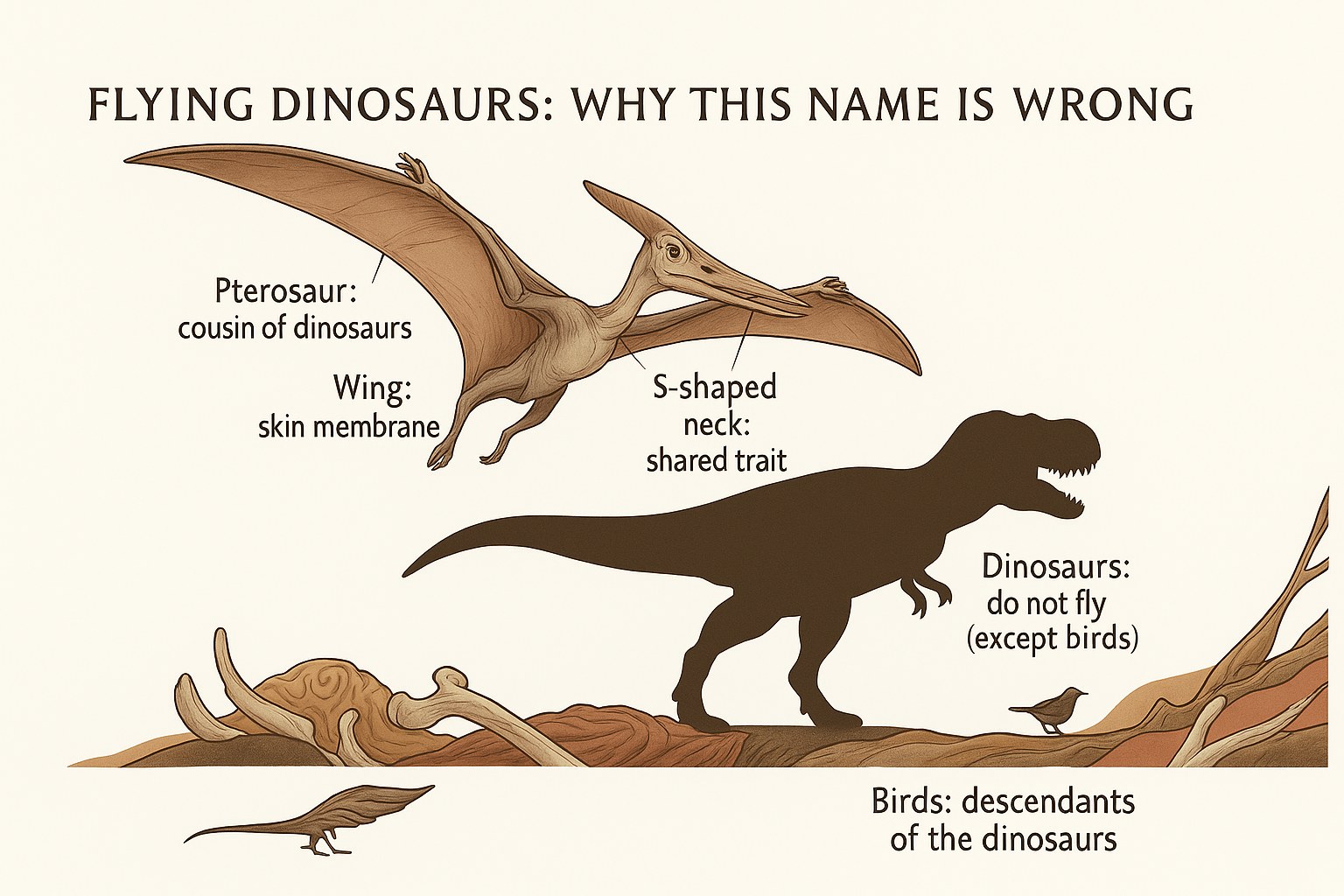
The order Pterosauria forms a reptile group all of its own. They are not the ancestors of today’s birds. Nor are they a spin-off of the dinosaur line.
These archosaurs split away from their cousins very early on. They share a common ancestor but followed their own evolutionary path. This branch died out 66 million years ago without leaving any descendants.
Their lineage stays completely unique. Think of them as distant cousins rather than blood brothers of the dinosaurs.
🧬 Their kinship within the ornithodires
There is a family link within the clade Ornithodira. This group brings together pterosaurs and dinosaurs. This is where their early resemblance in body shape comes from.
One striking physical trait unites them: an S-shaped neck. Both lineages share this feature. It points to a common origin that goes back a very long way.
But be careful, this closeness should not let us muddle them up. Belonging to the ornithodires does not make you a dinosaur.
🐦 Birds are the only dinosaurs that fly
Birds are the direct heirs of the theropod dinosaurs. The link here is genetic and structural. They are the only branch of dinosaurs still around today.
By contrast, the big dinosaurs like the T-Rex were unable to fly. Their massive bodies were built only for life on the ground. It’s a classic mistake people make.
Their flying methods are completely different. Birds use feathers, while pterosaurs flew on a membrane of skin, long before Archaeopteryx came along.
📊 Two distinct groups to classify them better
Now that we’ve sorted out how they differ from dinosaurs, let’s explore the variety within these masters of the sky by looking at their two big families.
🦖 The rhamphorhynchoids and their primitive look
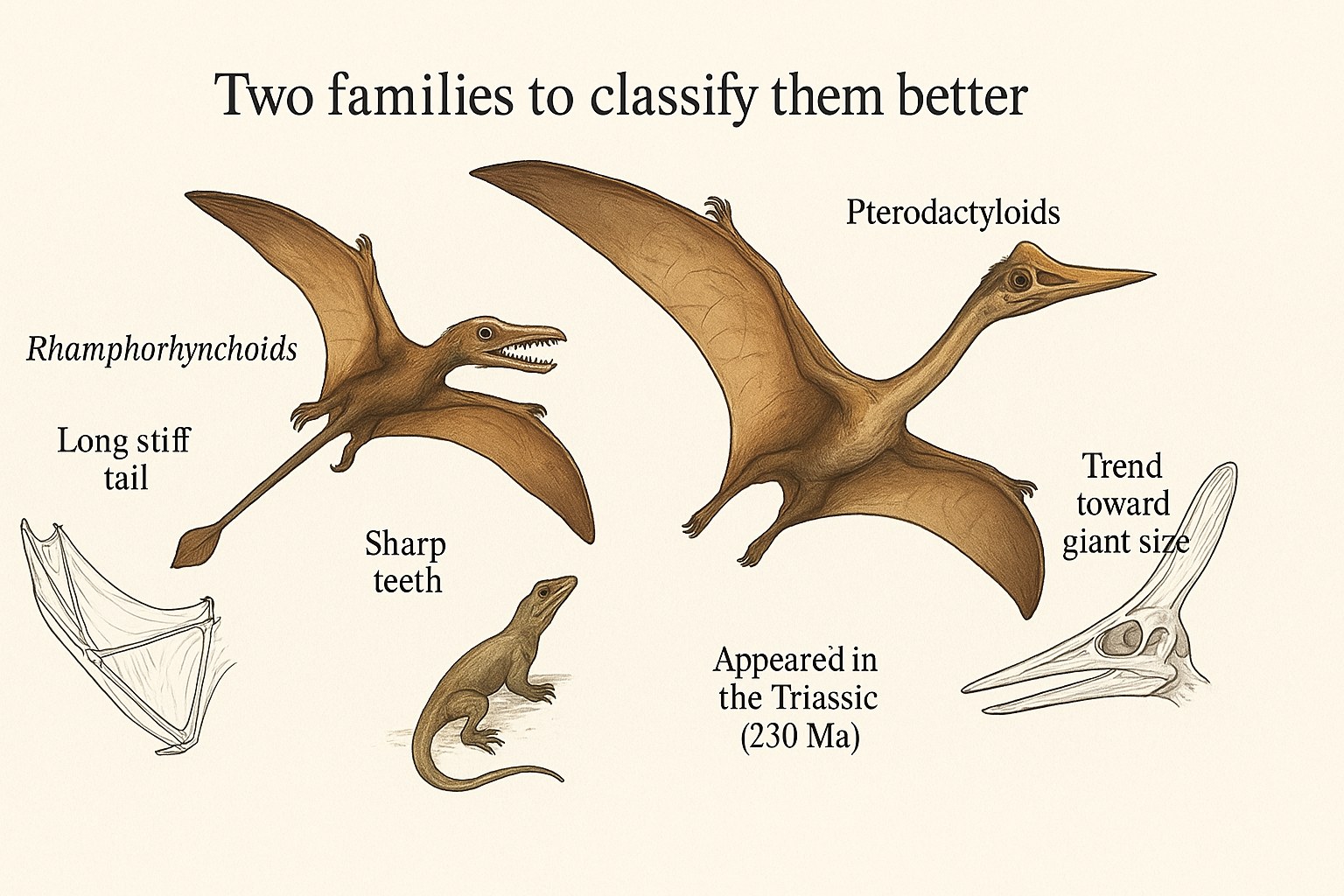
The rhamphorhynchoids had a long, stiff tail. This part acted like a rudder to keep them steady. It was the visual signature of the earliest forms.
They stayed fairly small during this period. Their jaws were often lined with sharp teeth. These let them grab their prey efficiently.
The genus Rhamphorhynchus is still the most famous example. It’s the perfect type specimen. It helps us understand this primitive Jurassic family.
🦅 The pterodactyloids, or the move towards giant size
The more recent species show major changes. Over time they lost their bulky tail. Their necks became noticeably longer and more flexible.
Their skull crests were often very impressive. These structures were probably used for courtship displays. They became spectacular during the Cretaceous period.
This group ended up ruling the skies. It filled every ecological niche before the great extinction.
⏳ A sudden appearance during the Triassic
Their land-dwelling ancestors are still quite a mystery. Their traces are rare in the fossil record we have today. We think small, nimble climbing reptiles existed.
These creatures appeared 230 million years ago. That’s the start of the adventure, in the Late Triassic. The evolutionary leap into flight seems to have been very fast.
From the moment they arrived, they were complete masters of their world. This is when the flying reptiles of the Mesozoic appeared, and they would go on to shape the history of our planet.
🪶 A body built for flight
To rule the air for millions of years, these animals had to develop a truly unique piece of biological engineering.
🪽 The fourth finger and the wing membrane
The fourth finger of the hand grew incredibly long. This unique bony structure supports the whole wing. It’s the central pillar of their flying anatomy.
The patagium is a thin but very tough membrane of skin. It links this giant finger to the rest of the body. It also attaches to the limbs to form the wing.
Bats use all their fingers to stretch out their membrane. Pterosaurs, on the other hand, rely on this one long finger alone. Their other fingers stay free.
🦴 Hollow bones and lightweight air sacs
The bone structure of these reptiles is extremely delicate. Their bones are hollow to keep the overall weight down. This doesn’t sacrifice any of the strength they need.
Air sacs extend the lungs all through the body. They reach right into the membranes to make the animal lighter. This breathing system is incredibly efficient.
The pteroid bone sits at the wrist. This small, special bone let them adjust the curve of the wing. It gave them precise control during flight.
🧶 Pycnofibres, or the fur of reptiles
Researchers have discovered the presence of pycnofibres. These are short filaments rather like hairs. They often covered a large part of the body.
These structures mainly served to keep body heat in. This suggests an active and very efficient metabolism. We’re a long way from the image of the cold-blooded reptile.
Soft tissues preserved in China confirm this look. Recent fossils show unexpected details about these filaments. These flying reptiles still have plenty of surprises in store for us.
- Maximum lightness: a drastic cut in weight to make take-off easier.
- Structural strength: thin bones, yet able to withstand heavy pressure.
- Link to the breathing system: the air-filled bones help with oxygen supply.
🚀 Take-off and flying techniques
Once they were kitted out for flight, they still had to break free of gravity — a real challenge for the biggest specimens.
🚀 Four-legged take-off, more efficient than a bird’s
The four-legged leap was their big secret. Their arms acted like powerful springs for the push-off. The animal literally catapulted itself into the air from the ground.
That’s very different from birds. Birds use only their hind legs. So pterosaurs had a far greater pushing power.
And yet, size changes everything. A short run was sometimes still needed to reach lift-off speed.
🪂 Flapping flight versus gliding, depending on size
The small specimens flapped their wings vigorously. Their chest muscles were anchored to a sturdy breastbone. This was active, very dynamic flight.
The big models preferred to glide. They used warm air currents to cover huge distances. This was a far more energy-saving strategy.
A neck membrane completed the set-up. It helped to handle turbulence and to steady their path.
🔄 The evolution of flight through convergent evolution
Convergent evolution is a fascinating thing. Different groups find similar solutions. Pterosaurs, birds and bats are the perfect example.
Nature tested stretched skin, the feather and the winged hand. Each method has its own mechanical advantages. It’s a feat of evolution to master gravity.
Let’s not forget they came first. They were the first vertebrates to conquer the sky.
Nature invented flapping flight three separate times, but pterosaurs were the absolute pioneers of this conquest of the air.
🦖 Four famous species to discover
To picture these creatures better, let’s pause on a few specimens that left their mark on the history of palaeontology through their sheer size.
🦒 Quetzalcoatlus, the giant the size of a giraffe
Its measurements are dizzying. Its wingspan reached twelve metres. On the ground, this reptile was as tall as a modern giraffe.
It was probably a land predator. It roamed the plains hunting small dinosaurs. Its long, sharp beak gave them no chance.
Despite its size, it weighed about 250 kilos. This relative lightness let it take to the air. It used all four limbs to take off.
| Species | Wingspan | Diet | Notable feature |
|---|---|---|---|
| Quetzalcoatlus | 11 metres | Carnivore | As tall as a giraffe |
| Pteranodon | 7 metres | Fish-eater | Long crest on the skull |
| Dimorphodon | 1.4 metres | Insects/vertebrates | Two types of teeth |
| Hatzegopteryx | 12 metres | Carnivore | Ultra-sturdy, massive neck |
🐟 Pteranodon and the fishers of ancient seas
Its famous crest is recognisable from a mile off. It acted as a counterweight to its long, toothless beak. It’s the species most often shown in popular culture.
It flew over the oceans to fish. Its flight was perfectly suited to sea winds. It probably lived in colonies near the coasts.
Thousands of them are found in the United States. These fossils come from ancient marine areas of Kansas.
🏝️ Hatzegopteryx and the mystery of island dwarfism
Hațeg was an island full of dwarf dinosaurs. This giant ruled it without rival. The lack of large land predators left the field clear for it.
Its neck was far wider than that of its cousins. It could hunt bigger prey on the ground. Its skull was massive and powerful. This sturdiness made it fearsome.
It was the super-predator of its island ecosystem. Nothing could stand up to it.
🥚 Family life and the end of a reign
Beyond their physical feats, it’s their everyday life and their sudden disappearance that complete the picture.
👶 Babies able to fly from birth
Discoveries of fossilised eggs revealed a big surprise. Some contained embryos with already well-formed wings. This suggests early independence for these little reptiles.
A lack of parental care seems to have been the rule. The young probably had to fend for themselves the moment they hatched. They flew off without their parents’ help to survive.
The comparison with birds stops there. Unlike chicks, baby pterosaurs didn’t need to stay in the nest to grow.
🐛 Varied diets, from fish to insects
There were many specialisations among these masters of the sky. Some ate insects in mid-flight. Others sifted through the mud like modern flamingos to feed.
The case of Nemicolopterus is also very interesting. This tiny specimen lived in the trees. It probably fed on small forest invertebrates found in the leaves.
The way their beaks adapted was a key to their survival. Each jaw shape matched a precise hunting technique.
🎬 Scientific reality versus the movies
Sometimes we need to bust some Jurassic Park myths. The films often exaggerate how aggressive they were towards humans. Their grabbing abilities were also far more limited than on the big screen.
Carrying humans off into the air was impossible. Their feet weren’t made to grip heavy loads. They didn’t have the powerful talons of eagles. It’s a pure cinema invention.
- Teeth on the Pteranodon (when in fact it had none).
- The ability to lift humans with their feet.
- Constant, exaggerated aggression.
Finally, let’s recall their sad end. They died out along with the dinosaurs 66 million years ago.
These fascinating reptiles of the sky, which appeared in the Triassic, mastered flight long before birds did. Remember that they form a lineage separate from the dinosaurs, with no living descendants, despite their kinship within the ornithodires. Take a good look at the birds in your garden: they are the real flying dinosaurs of today!
❓ FAQ
🦖 Are pterosaurs part of the dinosaur family?
It’s a very common mix-up, but no, pterosaurs are not dinosaurs. They are flying reptiles that form a quite separate group. They appeared in the Late Triassic and ruled the air while the dinosaurs ruled the land.
Even though they aren’t “brothers”, they are still close cousins. They both belong to the big group called the ornithodires. They even share a fun family trait: an S-shaped neck!
🪶 What physical features set pterosaurs apart from other reptiles?
Their anatomy is a real feat of nature. Unlike birds or bats, a pterosaur’s wing rests on a single finger, the fourth one, which grew extremely long to support a membrane of skin called the patagium.
To be able to fly, they had incredibly delicate hollow bones and air sacs to make themselves lighter. We also discovered they were covered in pycnofibres, a kind of small hair-like filament, which suggests they were warm-blooded.
🚀 How did these giant animals manage to take off from the ground?
It was quite a challenge, especially for giants like Quetzalcoatlus! Scientists think they used a four-legged take-off. They used their powerful arms like springs to catapult themselves skyward.
For the biggest specimens, sometimes weighing up to 250 kg, a short run or a slope of about 10 degrees was probably needed. They then made the most of air currents to glide majestically, a bit like our modern hang-gliders.
👨👩👧 Did baby pterosaurs need their parents to learn to fly?
This is one of the most fascinating points: the young were incredibly precocious. Fossil discoveries show that embryos already had well-formed wings inside the egg. So we think they could fly just a few hours after hatching.
Unlike our birds today, which stay in the nest for weeks, young pterosaurs were independent straight away. They had to fend for themselves to find food, with no parental care.
📏 How big was the largest flying reptile ever to have lived?
The title goes to giants like Quetzalcoatlus or Cryodrakon. Imagine a creature with a wingspan of 10 to 12 metres! Once on the ground, Quetzalcoatlus was as tall as a modern giraffe.
At the other end of the scale, there were tiny models too. Nemicolopterus, for example, had a wingspan of no more than 25 centimetres. There really was something for every size in the Mesozoic sky.
🐦 Did pterosaurs leave any descendants after they disappeared?
Sadly, no. Pterosaurs died out 66 million years ago, at the same time as the non-avian dinosaurs. Their lineage came to a dead stop with no direct descendants in our world today.
If you see a bird take flight today, know that it is the real dinosaur! Birds descend from the theropods, while pterosaurs will forever remain the lone pioneers of flapping flight among vertebrates.
