
Explaining to your children who the Cro-Magnon people really were can feel like a puzzle, caught somewhere between old clichés and historical fact. 🦴 This article lifts the veil on our Homo sapiens ancestor to show just how much this distant cousin looks like us, far from the image of a dim-witted brute. You’ll discover their survival secrets during the Ice Age, their artistic talents, and a family life shaped by the mammoth hunt.
- Who were the Cro-Magnon people, really?
- Shelter and clothing to survive the cold
- How they found food without a supermarket
- Making fire without a lighter or matches?
- Gifted and wildly creative artists
- Growing up and learning within the clan
🧔 Who were the Cro-Magnon people, really?
Forget the clichés about dim-witted brutes — we’re about to meet a cousin who looks just like us, two peas in a pod.
🧬 An ancestor who looks a lot like us
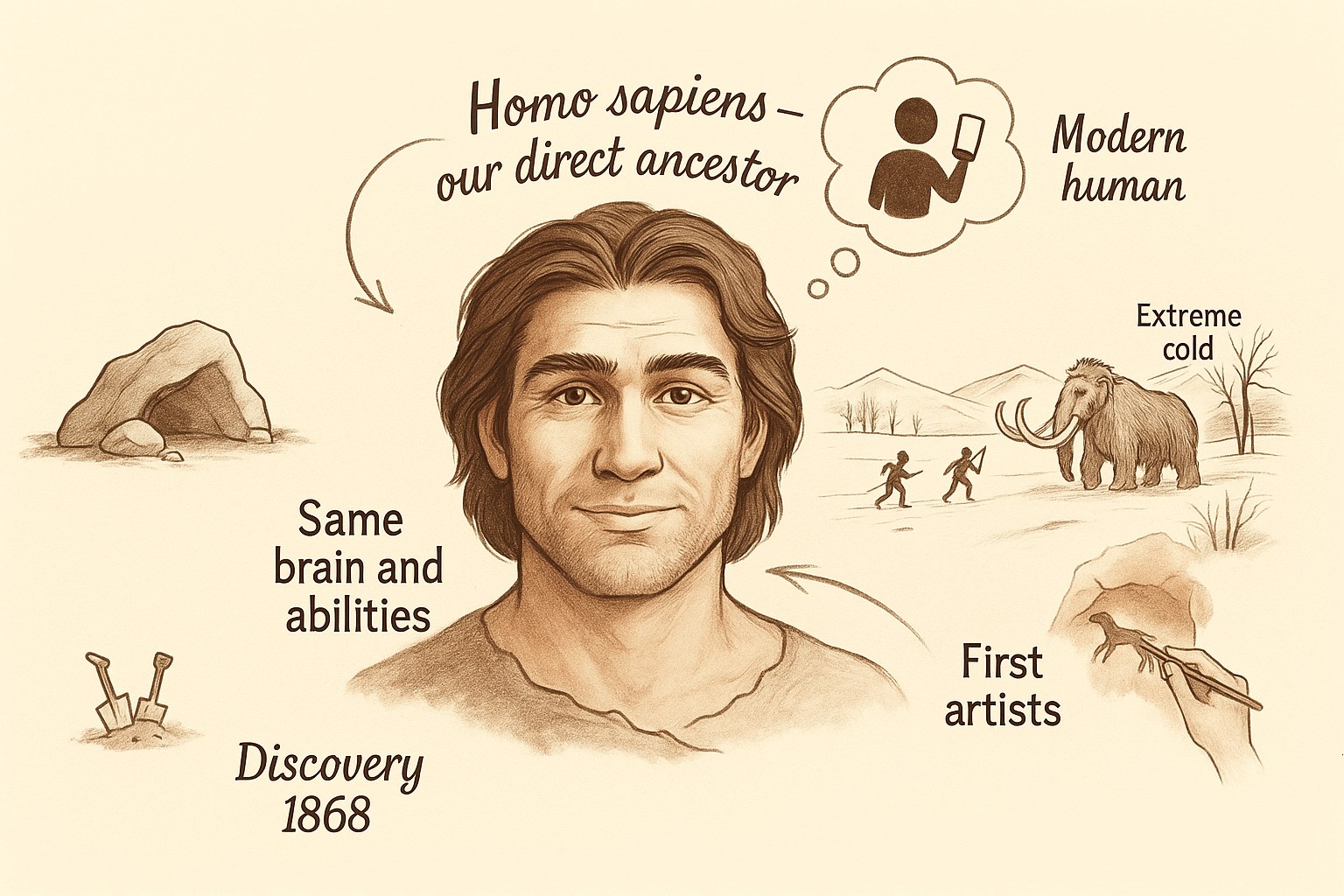
Cro-Magnon people were Homo sapiens, exactly like us. They had the same brain and the same physical abilities. They are our direct ancestors, not some strange, extinct species. Explaining Cro-Magnon to children means, above all, understanding how close they are to us.
If you dressed one in jeans today, nobody would notice the difference. They were tall, muscular, and very intelligent. Their face, with a strong chin and a high forehead, was very close to ours.
In short, they were modern humans. They simply lived in a time far harsher than our own.
📜 The funny story behind this odd name
In 1868, Louis Lartet found skeletons in the Dordogne region of France. It was a major milestone for archaeology.
The word “Cro” means “hollow” in an old local dialect. “Magnon” was simply the name of the landowner at the time. So it isn’t the name of some imaginary warrior tribe.
The name refers to the exact rock shelter where they were discovered. By extension, we use it to talk about these prehistoric humans.
❄️ A life during the Ice Age
It was extremely cold in Europe during the Upper Paleolithic. Winters were long and very harsh. Snow covered everything for months on end. It was a daily challenge just to stay alive.
They had to find ways not to freeze. Nature was their only resource for keeping warm.
This period is called the Upper Paleolithic. It was the age of the great hunters and the first artists.
🧥 Shelter and clothing to survive the cold
To avoid turning into icicles, our ancestors had to become seriously clever architects and tailors.
🕳️ The truth about life in caves
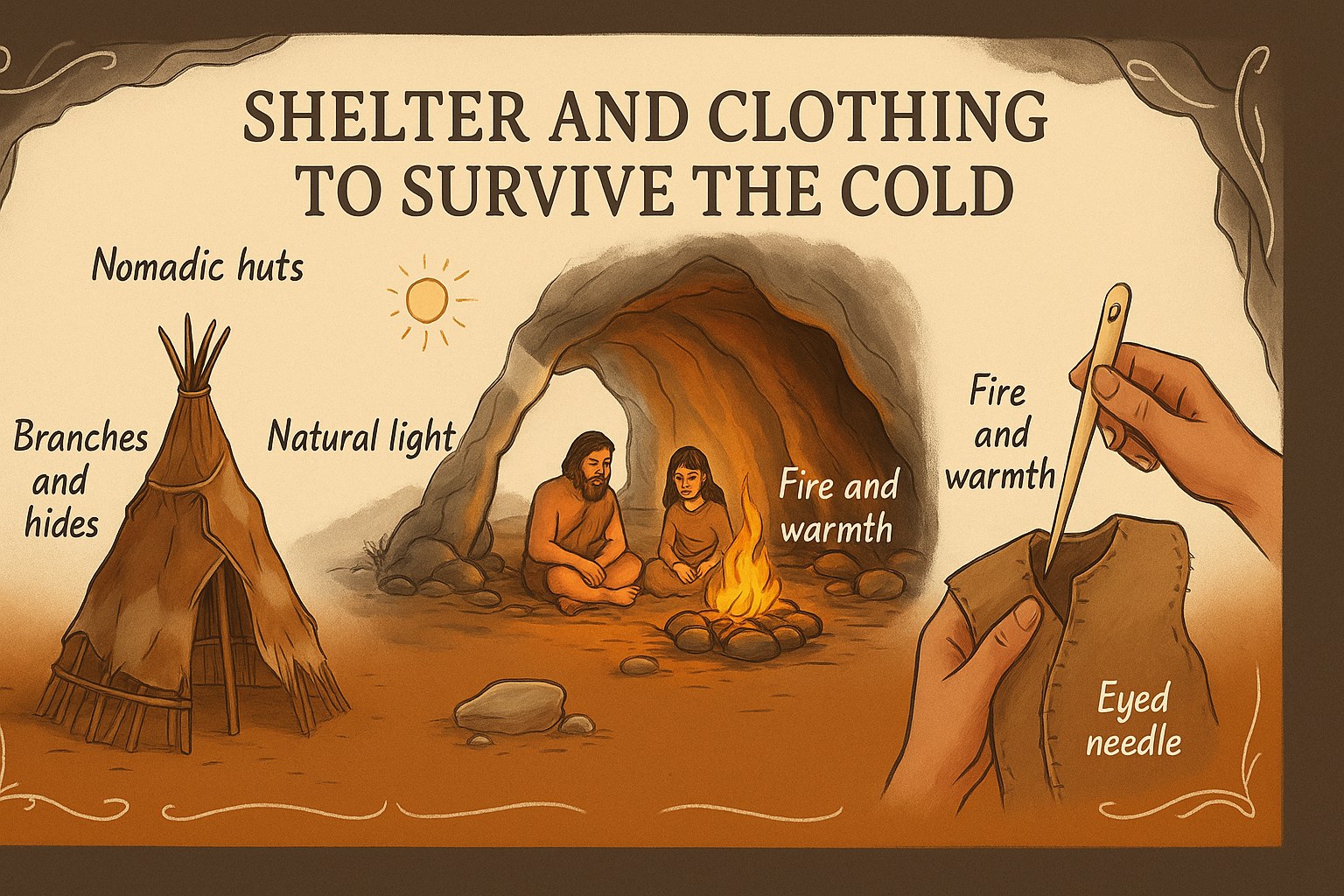
Cro-Magnon people weren’t necessarily deep-cave dwellers. They didn’t live at the back of dark caverns. It was far too damp and dangerous down there. They preferred to stay near the entrance.
By day, they made the most of the sunshine. Natural light was essential for their activities.
These rocky overhangs gave them a solid roof. They were their natural protection against the rain.
They cleared the space to settle in comfortably. The fire always stayed close by.
⛺ Clever open-air huts
They used branches and animal hides. It was light and very sturdy. These huts went up quickly.
They followed the herds of animals to find food. So they needed to be able to move on easily. Their homes were the ancestors of the camping tent.
Picture a hiking tent, but made of reindeer leather. It was basic but seriously effective.
🪡 The brilliant invention of the eyed needle
They invented the bone needle with a tiny hole. It was an incredible technical revolution for the time. It let them sew fitted clothing. The cold could no longer slip through the hides.
The thread was made from animal tendons. It was extremely strong and didn’t snap. They also made fur-lined boots.
The invention of the eyed needle allowed humans to conquer the coldest regions on Earth.
🏹 How they found food without a supermarket
No drive-through and no fridge back then — they had to be cunning to fill their bellies every single day.
🦣 Hunting the mammoth and the reindeer
Hunting a mammoth took perfect organization. The whole clan joined the chase. It was a matter of collective survival for these nomadic groups.
The spear-thrower changed everything. This invention let them launch spears with incredible force. It was their favorite precision weapon.
- The mammoth for meat and ivory
- The reindeer for hide and antlers
- The bison for fat and bones
Meat gave them the energy they needed to face the climate. Nothing was ever wasted.
🐟 Gathering and fishing as a family
They ate lots of berries, hazelnuts, and roots. Children were experts at spotting the good fruit. It was an essential complement to meat. Nature offered a free feast to anyone who knew how to look.
Fishing helped too. They made very sharp bone harpoons. The rivers were teeming with delicious fish.
Everyone helped with the harvest. It was a learning moment for the youngest members of the group.
🔪 Sharp tools knapped from flint
They struck the flint with precision. This created blades sharper than our knives. It was a very complex technical skill to master.
| Prehistoric tool | Main use | Modern equivalent |
|---|---|---|
| Scraper | Cleaning hides | Razor or brush |
| Hammerstone | Knapping stones | Hammer |
| Burin | Engraving bone | Wood chisel |
| Sharp flint | Cutting meat | Kitchen knife |
The Cro-Magnon story shows their ingenuity. They had to sharpen their blades regularly. A good tool lasted a long time.
🔥 Making fire without a lighter or matches?
Mastering flames was the ultimate secret to turning a life of hardship into royal comfort.
🪵 The stone-and-wood technique
Lighting a fire takes patience and technique. You use either stones or wood. It’s a gesture that’s both magical and scientific.
The percussion method. You strike flint against pyrite. This produces very hot sparks. You then catch them on dry tinder.
The friction method. You rub two pieces of wood together very fast. The heat eventually creates a small ember. It’s hard work, but it works every time.
🍖 Cooking meat to eat better
Cooked meat is much easier to chew. It also becomes far easier to digest. Fire kills off dangerous bacteria. It’s a key step in human evolution.
The hearth was the beating heart of the clan, the place where meals and stories were shared.
Around the fire, people chatted and helped one another. It was the friendliest moment of the day.
🛡️ Effective protection against predators
Lions and bears hate flames. Fire acted as a protective barrier at night. People slept far more peacefully that way.
Fat-burning lamps let them explore the caves. Fire also heated the inside of their tents. It was the central heating of prehistory.
Without fire, nighttime life would have been impossible. It was their best passive defense weapon.
🎨 Gifted and wildly creative artists
Cro-Magnon people weren’t only hunters — they were also brilliant painters with boundless imagination.
🎨 Painting animals on the walls
The masterpieces in the caves are breathtaking. Lascaux and Chauvet are true prehistoric museums. They painted magnificent horses and bison. It’s a one-of-a-kind testimony in the world.
To color their works, they used natural pigments found in the earth:
- Red ochre for earthy tones
- Charcoal for black
- Brushes made of animal hair
They had many different drawing techniques. They also used their fingers or blowpipes. The contours of the rock gave a sense of movement.
Their artistic talent jumps right out at you. Their drawings are incredibly precise. They observed nature perfectly.
🐚 Making jewelry from seashells
Prehistoric fashion already existed. They made necklaces with wolf teeth. Seashells were also prized for adornments. They pierced tiny holes with flint points. It was very careful, precise work.
Wearing jewelry had a real social meaning. It showed your rank in the group. It was a way to stand out.
They sought beauty and elegance. They liked to look good, just like us. Appearance already mattered a great deal to them.
💭 The birth of symbolic thought
Art was used to tell stories. It let them pass on beliefs. Each drawing probably had a hidden meaning. It was the beginning of human culture.
These groups felt shared emotions. They experienced fear, joy, and love. Their works express all of this sensitivity.
Their complex intelligence is fascinating. Their brains worked exactly like ours. They asked themselves questions about the world.
It’s our spiritual heritage. Their traces still touch us today. It’s a direct link to our past.
👨👩👧 Growing up and learning within the clan
Family life was the foundation of everything, because without others, nobody lasted long.
👶 The education of little Cro-Magnon children
Learning by example. Children watched the adults all day long. They imitated the gestures of hunting or sewing.
No traditional school. Writing didn’t exist yet in those days. Everything was passed on by word of mouth.
Serious play. They practiced knapping stones from a very young age. Play was their best teaching tool.
Early responsibility. Every child had to become independent fast. The survival of the clan depended on it.
👨👩👧 Everyone’s role in the family
The clan stuck together. Nobody stayed off in their own corner. Mutual help was the golden rule for everyone. They shared everything, from food to clothing.
- The elders passed on the secrets
- The adults hunted and protected
- The children gathered and learned
Respect for the elders. The oldest ones knew the best hunting spots. Their experience was a priceless treasure.
🧬 Cro-Magnon and Neanderthal: two different cousins
A historic cohabitation. They lived together for thousands of years. Neanderthals were stockier and physically very strong. Cro-Magnon people were more slender and agile.
The end of an era. Neanderthals eventually vanished completely from the Earth. Only the Cro-Magnon people carried on. We are their direct heirs.
A mystery of evolution. We don’t know exactly why only one of them survived. It’s a thrilling riddle.
Just remember that this Homo sapiens cousin looks a great deal like us: they mastered fire, sewed their clothes, and painted masterpieces. Go and explore a museum to admire their tools! Understanding the Cro-Magnon people means discovering the incredible strength of our own roots. A fascinating heritage to pass on, starting today.
❓ FAQ
🧔 Did Cro-Magnon people really look like us?
Yes, absolutely! Cro-Magnon people were Homo sapiens, exactly like us. If one wore modern clothes, they would go completely unnoticed in the street. They had a large brain, a straight forehead, and a well-defined chin.
Their skeleton was simply a little more robust and muscular than ours, because their hunter-gatherer life was very physical. Recent studies even suggest they probably had dark skin, a fascinating little detail that reminds us of our shared origins.
📍 Where does the strange name “Cro-Magnon” come from?
It’s not the name of a tribal chief, but of a place! In 1868, workers discovered skeletons in the Dordogne region of France, at Les Eyzies-de-Tayac, in a rock shelter. The land belonged to a certain Mr. Magnon.
In an old local dialect, “Cro” means “hollow” or “hole.” So the name simply means “Magnon’s hollow.” It was the geologist Louis Lartet who studied these bones for the first time, marking a key milestone in the history of humanity.
🕳️ Did prehistoric people really live in caves?
Not really deep inside! Caves were far too dark, damp, and cold to sleep in comfortably. In reality, they mostly settled at the entrance of caverns or under rocky overhangs to enjoy the daylight and stay dry.
They were also great travelers and built open-air huts. These tents were made from branches and covered with animal hides. It was very handy for following the herds of reindeer or mammoths as they moved around.
🧥 How did they get dressed without any shops?
They were very talented tailors! They used bone needles pierced with a tiny hole, called eyed needles. For thread, they collected animal tendons, which made the seams extremely strong and resistant to the polar wind.
Their clothes were made from hides and furs, carefully cleaned with flint scrapers. They made trousers, jackets, and even fur-lined boots to face the icy temperatures of the time.
🔥 What techniques did they use to light a fire?
Forget randomly rubbing two pebbles together! They used two precise methods. The first is to strike a flint against a special stone, pyrite, to create sparks. These sparks fell onto tinder, a dry fungus that catches fire easily.
The other technique is friction: you spin a wooden stick quickly against a wooden base. The heat created eventually produces a small ember. Fire was vital to them: it cooked meat, gave light in the dark, and kept away big predators like the cave lion.
🎨 Were they really the first artists in history?
Absolutely, and what artists! They decorated the walls of famous caves like Lascaux with paintings of horses, bison, and deer. They used natural pigments such as ochre for red and charcoal for black.
They didn’t just paint: they also sculpted small statues and made beautiful jewelry. They pierced seashells, wolf teeth, or pieces of ivory to make necklaces. It’s proof that they had great sensitivity and a taste for beautiful things.
🤔 What is the difference between Cro-Magnon and Neanderthal?
They are two cousins who coexisted in Europe for a long time. Neanderthals were shorter, very stocky, and extremely powerful, with pronounced brow ridges. Cro-Magnon people, on the other hand, were more slender and looked exactly like modern humans.
In the end, Neanderthals disappeared around 30,000 years ago for reasons that are still mysterious. Only the Cro-Magnon people survived, and that is why we are all their descendants today.
