
Do you ever picture the lives of prehistoric people as nothing more than a grim struggle to survive at the back of a dark cave? 🔥 This guide lifts the lid on what their days were really like, from the clever taming of fire to the well-organised hunts run by the clans. You’ll discover how our ancestors invented art and teamwork long before writing was ever born.
- The great stages of prehistoric human life
- The quest for food, from hunting to farming
- Living in nature, from shelters to buildings
- Tools and inventions that changed daily life
- Social life and communication within the clans
- Art and spirituality of the first human groups
📜 The great stages of prehistoric human life
Now that we’ve set the scene for our distant past, it’s time to break this vast timeline into chapters and understand how our ancestors shifted from one world to another.
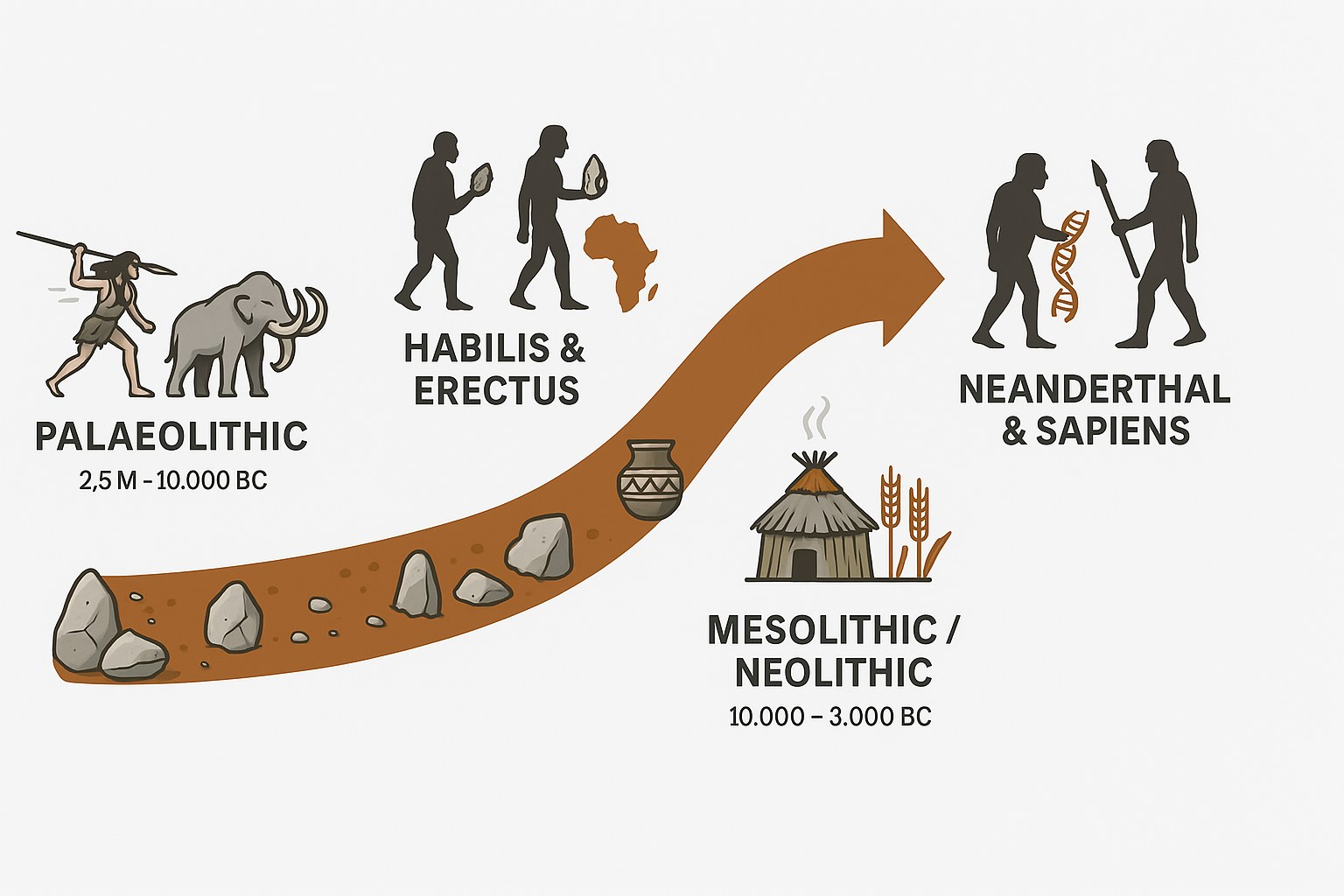
🗿 From the Palaeolithic to the Neolithic in a few key dates
The Palaeolithic is the longest period in our history. It revolves around a strictly nomadic way of surviving. This era began around 2.5 million years ago.
The Mesolithic, then the Neolithic, marked a turning point. We see a shift towards settling down and farming. Slowly, the old nomadic life of the Palaeolithic faded away.
Polished stone became a major breakthrough. After that, change sped up during the Neolithic. Everything then moved much faster.
🚶 Habilis and Erectus: the pioneers of the human adventure
Habilis and Erectus had clear physical differences. Habilis made do with rough chipped pebbles. Erectus, who was taller, invented the famous hand axe. His symmetrical tool made cutting up game far easier.
Erectus was also the first to leave Africa. He explored new lands with real daring. This constant adapting shows a practical intelligence that kept on growing.
“Homo erectus inventing the hand axe marks the start of a symmetrical mastery over matter.”
🧬 Neanderthals and Sapiens: a surprising shared world
Neanderthals and Sapiens had rich, closely related cultures. They shared burial rites and complex tools. Their time living side by side in Europe lasted thousands of years.
Science now proves there were genetic exchanges between them. Our DNA still carries traces of Neanderthals today. Their stone-shaping techniques also influenced one another.
Why the Neanderthals vanished remains a great mystery. Several theories still compete, with no final proof. In the end, Sapiens was the only human left standing.
🏹 The quest for food, from hunting to farming
Biological evolution shaped our bodies, but it was really the way we filled our stomachs that decided how our early societies were organised.
🏹 The daily life of nomadic hunter-gatherers
Their menu was very varied. Wild gathering provided most of the vital calories. Berries, roots and fruit stayed crucial every day for the group’s survival.
People also took part in group hunts. The clan would track big game such as reindeer or bison. We can see that these periods involved eating plenty of game.
Moving with the seasons was an absolute rule. People followed the animal migrations so they wouldn’t starve. The camp simply moved along with the available resources.
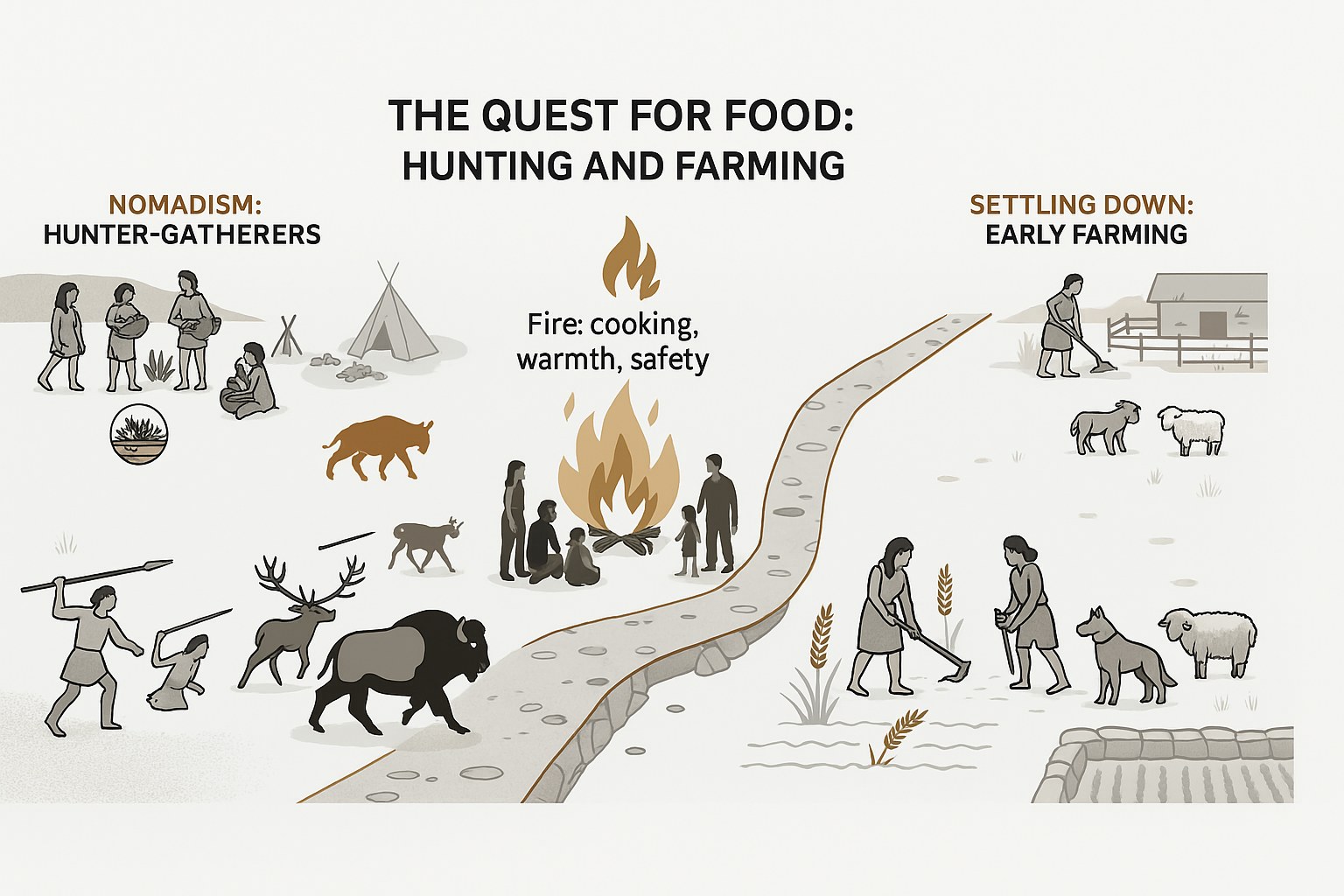
🔥 Fire: a revolution for cooking and staying safe
Cooking food changed everything for health. Nutrients became far easier to digest. Above all, this helped the amazing growth of the human brain over time.
The hearth quickly became the social heart of the clan. People gathered there to share stories and keep warm. The flames also kept night-time predators at a safe distance.
Taming fire literally lit up the nights of humankind, changing our biology.
🌾 The birth of herding and the first harvests
Domesticating the dog and the sheep marked a turning point. The animal became a precious ally or a supply of meat. This was the start of a new control over nature.
Next, humans selected the best wild plants. They favoured the most productive cereals to feed themselves. These first harvests ended up reshaping the whole landscape around them.
Yet this change had a cost for health. Diets became less varied than before. Diseases linked to living close to animals then appeared.
⛺ Living in nature, from shelters to buildings
Moving from chasing game to guarding herds forced people to rethink their homes, leaving makeshift refuges behind to build something solid.
🕳️ The end of the cavemen myth
Caves were not permanent homes. They served as short-stay refuges or sacred places. They often reveal the real living spaces of the first humans.
Open-air camps were set up near water. People used branches and animal skins. These light structures were genuinely easy to carry anywhere.
Prehistoric families varied their homes depending on their needs:
- Skin tents
- Branch huts
- Rock shelters
🏘️ The appearance of the first settled villages
Using stone and packed earth changed everything. Houses became lasting and fixed. People no longer followed the wild herds at all to survive day to day.
The way villages were laid out also changed. Round houses gave way to rectangular shapes. Shared spaces appeared for storage. Community life then took on a strong structure.
Settling down created the idea of ownership. The village became the heart of people’s identity.
🌍 Migrations and adapting to climate change
Ice ages shaped human journeys. The biting cold forced populations to migrate south. Plant resources then decided the routes they followed.
The post-ice-age warming later encouraged people to settle. The milder climate helped farming. Living areas became more stable and far longer-lasting.
Here is how the climate decided where people lived:
| Period | Main climate | Preferred type of home |
| Palaeolithic | Cold/Ice age | Nomadic |
| Mesolithic | Transition | Mixed |
| Neolithic | Temperate | Fixed/Village |
🔨 Tools and inventions that changed daily life
To adapt to these new surroundings, human cleverness had to turn raw stone into precision instruments.
🪨 From chipped stone to polished stone
Mousterian tools show surprising precision. The flakes grew finer and finer over the centuries. People were chasing top efficiency for cutting hides.
Next came the making of polished axes. This long process made the object very tough against knocks. It was the perfect tool for clearing land and, at last, carefully farming the soil.
Note too the use of microliths. These small stones fit easily onto wood. People could then create deadly arrows for hunting.
🏺 The invention of pottery and weaving
Pottery now made it possible to store grain. This protected the harvest from damp and from rodents. It was a real insurance against famine for the group.
Then the first plant-weaving techniques appeared. People used flax or hemp to make clothes. This slowly replaced the heavy animal skins. Everyday comfort clearly improved.
These inventions were tied to settled life. People no longer carried all their belongings around.
⚒️ The arrival of metals and new needs
Copper and bronze made their appearance. Metalworking needed intense, steady heat. It was a major, complex technological leap for these societies.
This deeply changed social relationships. Owning metal became a clear sign of power. Hierarchies grew much stronger.
We can see jobs becoming more specialised. The blacksmith became a central, respected figure. The division of labour sharpened in the villages.
👥 Social life and communication within the clans
Behind the tools and the walls, a complex social fabric was being woven, far from the simplistic clichés about primitive brutality.
👩 The role of women, far from modern stereotypes
Let’s forget the image of a passive woman staying at home. Bone analyses reveal strong muscle attachments. This proves intense physical involvement in the clan’s life.
Women did not just handle household chores. They were probably active artists or craftspeople. They also took care of the vital passing on of technical and cultural know-how.
Here is a glimpse of their daily activities:
- Gathering medicinal plants
- Raising and teaching children
- Textile craft
- Hunting small game
🧠 The growing brain and the birth of language
Making a symmetrical hand axe is no simple gesture. It calls for careful mental planning. The brain thus shaped itself to handle abstraction and anticipation.
Spoken language became the engine of group hunts. It let people share social rules and founding myths. This was the invisible bond that truly held each group together.
This communication boosted culture. Without words, new ideas quickly disappeared.
⚔️ The archaeological proof of the first social tensions
Skeletons sometimes carry the marks of violent blows. Some stone impacts suggest clashes between rival groups. Total peace was clearly not the rule.
Settling down gave rise to jealousies over territory. People began to protect their food stores and their land. Resources then became something worth fighting over.
The rich Neolithic tombs mark the appearance of chiefs. Hierarchies took hold. The old equality of the nomadic clans slowly began to fade.
🎨 Art and spirituality of the first human groups
Beyond survival and conflict, our ancestors sought to give their lives meaning through beauty and the sacred. ✨
🎨 Paintings and engravings: expressing an inner world
Artists used ochre for red tones. Charcoal helped trace the black outlines. The cave walls then became true canvases.
Horses and bison often dominate these compositions. This is not just pretty decoration for its own sake. These figures fill the space in a very deliberate way.
A ritual or magical role seems likely. Perhaps people hoped to make the hunt go well. In fact, art is a bridge to the invisible.
🕯️ Burial rites and respect for ancestors
The first deliberate burials appear very early. Precious objects were placed beside the dead. This proves a genuine belief in an afterlife.
The care given to the body shows deep affection. Yet some practices, like removing front teeth, remain mysterious. They may mark a rite of passage or a particular rank. It is a strong mark of identity.
Burying your dead means stating that a human is not just biological matter.
📿 The use of ornaments and symbolic objects
We find jewellery made of shells and bone. Craftspeople pierced animal teeth to wear them proudly. These objects tell a unique personal story.
An ornament is a marker of social status. It lets people stand out easily from others. It also strengthens the feeling of belonging to the group.
We can see an awakening of an everyday sense of beauty. People decorated even their simplest tools. The beautiful became as vital as the useful for prehistoric people.
From nomadic survival to the brilliant invention of farming, our ancestors showed incredible resilience. Understanding their daily life helps us appreciate our modern comfort. Dive into history and pass these treasures of knowledge on to children: the human adventure is only just beginning!
❓ FAQ
🍖 How did the first humans feed themselves every day?
For most of prehistory, our ancestors were true experts in nature. They lived mainly on gathered berries, roots and wild fruit, which made up most of their meals. To round out this menu, they took part in group hunts, tracking large grazers like bison or reindeer.
Everything changed with the Neolithic. This is the period when farming and herding appeared. By starting to grow cereals and tame animals like sheep, people gradually left their nomadic life behind to settle down.
🚶 What is the difference between Homo habilis and Homo erectus?
Homo habilis, nicknamed the handy man, is the pioneer of simple tools with his chipped pebbles. He was smaller, with fairly long arms. Homo erectus, on the other hand, was taller and had a bigger brain. He was a great traveller who explored new lands beyond Africa.
On the technical side, Homo erectus took a major step by inventing the hand axe, a symmetrical tool that was far better for cutting. He is also the one who began to tame fire, a revolution for the group’s safety and for cooking food.
🕳️ Did prehistoric people really live in caves?
This is a very stubborn myth! In reality, caves were used mostly as temporary refuges or sacred places for art and rituals. Most of the time, families lived in open-air camps set up near water to make daily life easier.
They built clever shelters such as animal-skin tents or huts made of branches and mammoth bone. It was only in the Neolithic, with the invention of sun-dried earth bricks and the use of stone, that the first true villages with lasting houses appeared.
🕯️ Why were burial rites so important to them?
Caring for the dead is a sign of great sensitivity and spiritual thought. As early as Neanderthal times, we see deliberate burials where bodies are protected in pits. This proves these people were not brutes, but beings capable of affection and belief.
With Homo sapiens, these rites become even richer, with offerings of objects, ornaments or tools laid beside the departed. Burying your dead is a way of saying that a human is far more than a simple biological shell and that there may be a beyond.
💡 Which inventions changed their lives the most?
The move from chipped stone to polished stone was a key step, allowing people to make solid axes for clearing land and farming. But comfort also took a leap forward with the invention of pottery to store harvests and weaving to make clothes lighter than animal skins.
Finally, mastering metals, such as copper and then bronze, marked a huge technological turning point. These new materials not only transformed tools but also reshaped social organisation by creating new specialised jobs, like that of the blacksmith.
