
Are your children firing tricky questions about the world’s animal record-breakers, and you’re running out of answers? This guide gathers nature’s most jaw-dropping feats, from the lightning-fast cheetah to the elephant with 10,000 muscles, turning every question into a fun discovery. You’re about to amaze your little explorers with incredible stories of creatures that live for 400 years or fly backwards. 🐆
- Speed demons of the animal kingdom
- Giants of land and sea
- Tiny creatures with mighty powers
- Brainy beasts and clever birds
- The oldest living things on Earth
- Weird and wonderful record-breakers
💨 Speed demons of the animal kingdom
Now that we’ve glimpsed nature’s incredible variety, let’s dive straight in with the kings of the stopwatch.
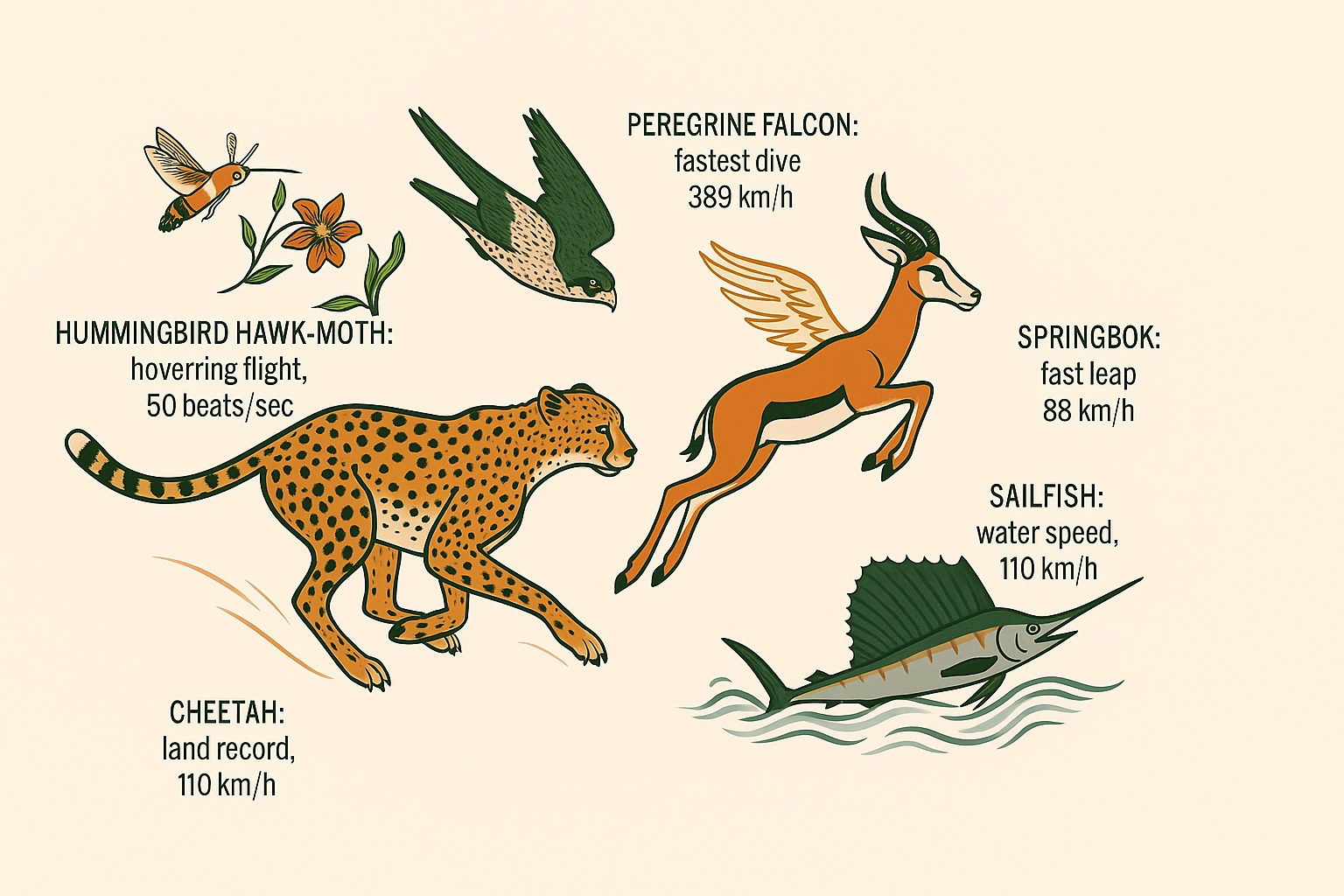
🐆 The cheetah and the springbok on dry land
The cheetah is a real rocket. It hits 110 km/h thanks to a blistering burst of acceleration. It is, without a doubt, the fastest land mammal over short sprints across the savannah.
Its secret lies in its paws. Unlike other cats, its claws don’t retract. They work like a footballer’s studs, giving it perfect grip on tight turns.
The springbok has plenty of bounce too. This antelope races along at 80 km/h. To shake off its chasers, it makes amazing 10-metre leaps over the tall grass.
🦅 The peregrine falcon and the hummingbird hawk-moth in the sky
The peregrine falcon holds the all-time record. In a dive, it tops 300 km/h to swoop down on its prey. It’s the fastest move ever seen in any living creature on our planet.
Among insects, the hummingbird hawk-moth surprises everyone. This little moth reaches 55 km/h in full flight. That’s a remarkable performance for its weight class — trust me, it’s quite the athlete.
Flight technique is the key. The shape of their wings steadies the path. This lets them resist the pressure of the air, even when the speed becomes truly impressive.
🐟 The sailfish and the swimming champions
Let’s dive in now with the sailfish. It clocks 100 km/h in warm tropical waters. That speed makes it a living torpedo, slicing through schools of fish in a flash.
Its physical trick is brilliant. It has a fin on its back that folds away. It tucks it in completely to glide through the water. That way, it meets almost no resistance during its bursts of speed.
To picture it, that speed matches a car on the motorway. But here, it’s happening under the ocean. It’s a show you can sometimes spot between January and March in the Caribbean.
🐘 Giants of land and sea
Speed is impressive, but the size and weight of some giants make us look tiny by comparison.
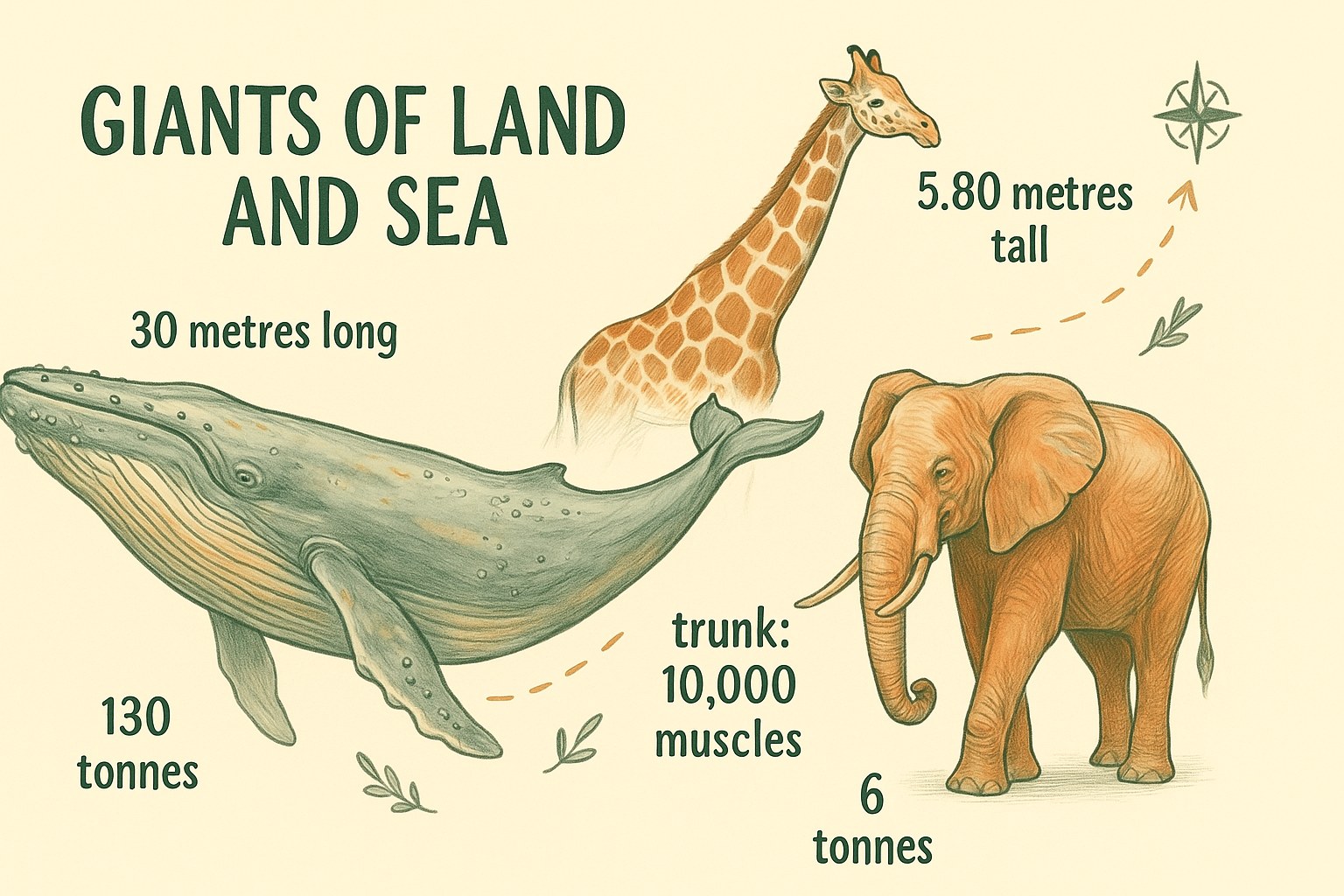
🐋 The blue whale, queen of the deep
The blue whale is a living monument. It reaches 30 metres long. Its weight climbs to 130 tonnes. It is quite simply the largest animal known on our planet.
Its tongue is a record all by itself. It weighs as much as an African elephant. Such a mass of flesh is hard to picture. Yet it’s a fascinating biological fact about these incredible whales.
Water plays a vital role for it. Buoyancy supports its bones. On dry land, its own skeleton would collapse instantly. Physics rules its survival at sea.
🐘 The African elephant and its muscle power
The African elephant is king of the land. Males weigh around 6 tonnes. They rule the savannah with calm confidence. Nothing seems able to stop them.
Their trunk is a masterpiece of nature. It contains about 10,000 different muscles. It can rip up massive tree trunks. It can also pick up a single peanut with care.
The comparison with us is rather funny. The human body has only 639 muscles. So this nose shows off an incredible complexity. It’s a one-of-a-kind, multi-purpose tool.
🦒 The giraffe and its neck up in the clouds
The giraffe is always reaching for height. It stands up to 5.80 metres tall. That lets it pick the best leaves. It loves the tender shoots tucked at the top of acacia trees.
Its body holds a big surprise. Its neck has only seven vertebrae. That’s the same number as in a human. Its bones are simply far longer than ours.
Such a neck puts the heart to the test. It has to pump the blood very hard. The blood must climb against gravity. That’s vital to feed its brain perched so high up.
🐜 Tiny creatures with mighty powers
Let’s leave the world of giants to discover that strength and stamina hide inside the smallest bodies too.
🐦 The bee hummingbird, the tiniest bird of all
The bee hummingbird is a marvel of nature. It measures just 5 centimetres long. It is officially the smallest bird in the world.
Its body is a super-fast engine. Its heart beats up to 1,260 times a minute. This rhythm is vital for its energy-hungry hovering flight.
This bird has an incredible superpower. It is the only one able to fly backwards. It’s a true feat of natural piloting.
🐭 The Etruscan shrew, a pocket-sized mammal
Here is a real featherweight. It weighs less than 2 grams on average. That’s lighter than a single coin.
This little creature has a fierce appetite. It must eat twice its own weight every day. Otherwise, it simply risks starving to death.
Keeping warm is a constant challenge. Its body cools quickly, so its metabolism runs ultra-fast. It must keep moving non-stop to stay warm.
🐸 The Paedophryne amauensis frog, champion of hide-and-seek
This frog is the size of a fingernail. It measures only 7.7 millimetres long. It holds the title of smallest known vertebrate.
Its home stays a hidden secret. It lives tucked under dead leaves. You’ll find it in the rainforests of Papua New Guinea.
Finding it is a real challenge for researchers. It’s almost impossible to spot with the naked eye. So scientists use its call to locate it.
🧠 Brainy beasts and clever birds
Muscles aren’t everything; some animals use their brains to pull off feats worthy of the greatest engineers.
🐬 The bottlenose dolphin and passing on knowledge
Some dolphins use sea sponges as tools. They place them on their snouts to dig through the sand. This protects their delicate noses from cuts. It’s a clever hunting trick.
These dolphins have a truly complex language. They give themselves unique whistles. These sounds act as names so they can call to each other. They communicate precisely across the vast ocean.
The young learn these methods from their parents. This passing-on proves there is a true animal culture. It isn’t instinct. It’s knowledge shared between generations.
🦅 The New Caledonian crow, engineer of the forest
This bird carefully makes its own tools. It bends twigs to create hooks. This ability is unique among birds. It uses them to fish out hidden grubs.
It shines at solving problems. The crow cracks multi-step puzzles. It understands that each in-between action is needed. The final reward proves its logical thinking.
Its intelligence often surprises researchers. Its reasoning skills are compared to a child’s. It sits at the level of a 5- to 7-year-old. That’s an impressive feat.
🐒 The chimpanzee and its photographic memory
Visual memory tests are astonishing. Chimpanzees remember numbers on a screen very quickly. They beat any human at it. Their instant recall outdoes ours.
Some individuals manage to communicate with us. They learn sign language successfully. This lets them express their wishes or feelings. It builds a fascinating bridge between our two species.
Technical know-how is also passed on by watching. Cracking nuts takes great care. The young watch the adults for years. They finally master this tricky move after a long apprenticeship.
🐢 The oldest living things on Earth
After intelligence, let’s look at those who have all the time in the world and cross the centuries without ageing a day.
🦈 The Greenland shark, record-holder of cold waters
Imagine an endless life beneath the ice. This shark can live more than 400 years in the depths of the Arctic. It’s the all-time longevity record among vertebrates.
Its growth happens in extreme slow motion. It grows only about one centimetre a year. This extreme slowness shields its body from the effects of passing time.
It’s a bit like life in a permanent fridge. Its metabolism is very slow. In the icy waters, everything runs in slow motion. That spares its huge body from early wear and tear.
🐢 The Seychelles giant tortoise, memory of the land
Jonathan is a simply incredible example. This famous tortoise recently turned 190. That’s a world record for an animal living on dry land.
Its biology is tough as nails. Inner mechanisms protect its cells efficiently. They naturally fight off the illnesses that normally come with old age.
The secret also lies in its calm. These tortoises lead a very peaceful life. They spend little energy day to day, which helps an exceptional lifespan.
💧 The Turritopsis dohrnii jellyfish, the secret of immortality
Let’s talk about biological immortality with this unique species. It has the power to transform its own cells. It turns back into a young polyp after reaching adulthood.
This tiny jellyfish has the incredible power to turn back time, becoming a baby again when it’s in danger or unwell.
It follows a cycle that seems endless. This rejuvenation process is unique in the world. It could, in theory, repeat this cycle forever if no predator eats it.
This extreme survival is a response. The mechanism kicks in mostly after a serious injury. Starvation can also trigger this return to youth.
🤪 Weird and wonderful record-breakers
To wrap up our world tour, let’s meet a few champions with truly strange — and sometimes rather yucky — talents.
👃 The black-footed polecat and the smelliest champions
Defence by smell is a fearsome strategy. The polecat uses its scent glands to spray intruders. This chemical weapon is extremely effective against threats. It’s a truly surprising natural protection.
This stink is a clear signal. It warns predators to keep their distance. Anyone who gets too close may bitterly regret it. Nature has thought of everything.
There are other smelly record-holders in nature. The striped polecat, an African cousin, is just as fearsome. Here’s a quick look at these champions:
- The black-footed polecat and its powerful jet of musk.
- The striped polecat, often mistaken for a skunk.
- The hoatzin bird, which smells of manure because of its digestion.
🦈 The great white shark and its thousands of teeth
The shark is a real tooth factory. This predator can replace up to 30,000 teeth over its lifetime. That’s a number to make your head spin, isn’t it?
Its secret lies in a system of rows. As soon as a tooth falls out, the one behind moves up. It takes its place straight away, like a conveyor belt. Nothing is left to chance.
This ever-new set of teeth is vital. It guarantees maximum hunting efficiency. Sharp teeth are essential for catching its sea prey every day.
| Species | Tooth record | Special feature |
|---|---|---|
| Great white shark | 30,000 teeth in a lifetime | Constant renewal |
| Snail | 25,000 teeth on its tongue | Teeth on a radula |
| Narwhal | One single giant tooth (tusk) | Twisted 3-metre tusk |
🦘 The kangaroo and the lightning growth of its babies
A kangaroo’s birth is a tiny moment. The baby measures just two centimetres when it’s born. That’s barely the size of a little jelly sweet.
Then begins its first big journey to the pouch. With no help at all, the tiny baby must crawl through the fur. It uses its front limbs to reach its destination. What courage!
Once snug and warm, it enjoys its mother’s milk. Its make-up changes to suit its growing needs. It stays there for several months to finish growing safely.
These animal record-breakers prove that nature beats imagination, from the speed of the cheetah to the immortality of the jellyfish. Explore these wonders as a family to feed your little explorers’ curiosity. Tomorrow, they’ll look at every little creature with the eyes of a giant. 🌍
❓ FAQ
🐆 What is the fastest animal in the world?
The overall champion is the peregrine falcon. In a dive, this bird of prey can reach the incredible speed of 389 km/h to catch its prey — that’s as fast as a high-speed train!
On dry land, it’s the cheetah that holds the record, with bursts of 110 km/h. In the water, the sailfish is a true torpedo, able to swim at over 100 km/h.
🐦 Is there a bird that can fly backwards?
Yes — it’s the little hummingbird! It’s the only bird in the world able to pull off this technical feat. It can also hover, a bit like a tiny helicopter, to sip nectar from flowers.
To do this, it beats its wings dozens of times a second. Its little heart is a champion too, since it can beat up to 1,260 times a minute during the effort.
🐋 What is the largest animal living on our planet?
The blue whale takes the gold medal for size. It can measure up to 30 metres long and weigh 130 tonnes. To give you an idea, its tongue alone weighs as much as an African elephant!
Among land animals, the African elephant is the most imposing. Males can weigh around 6 tonnes. Their trunk is a fascinating tool made of 10,000 muscles, while we only have 639 in our whole body.
🦷 Which animal has the most teeth?
The great white shark is a real tooth factory. Over its lifetime, it can use and lose up to 30,000! Its teeth are arranged like a conveyor belt: when one tooth falls out, the one behind takes its place.
Yet some small animals beat it surprisingly. A simple snail can have up to 25,000 tiny teeth on its tongue to grind up its food.
🐢 Which animal lives the longest?
In the icy waters of the Arctic, the Greenland shark can live more than 400 years. It grows very slowly, about one centimetre a year, which seems to shield its body from passing time.
There’s even an “immortal” creature: the Turritopsis dohrnii jellyfish. When it’s unwell or in danger, it can turn back into a baby (a polyp) to start its life cycle all over again.
🦨 Why do some animals smell so bad?
It’s often a brilliant defence technique! The black-footed polecat and the striped polecat use their glands to spray a very smelly musk at intruders. It’s a very effective chemical weapon for scaring off predators.
Others have more natural reasons, like the hoatzin bird. Because of its unusual digestion, it gives off a manure-like smell that doesn’t exactly encourage other animals to come near it.
