
Explaining to your children how bees make honey without getting your wires crossed is sometimes a real parenting challenge. This article breaks down every step inside the hive to turn this curious question into an exciting family adventure. 🐝 You’ll discover the secrets of gathering nectar, the must-know safety rules for babies and some tasty tips for enjoying this golden treat safely.
- How bees make honey, explained for children
- The bees’ kitchen turns nectar into gold
- Storing it in the hive for perfect keeping
- Why honey is banned before the age of 12 months
- 3 nutritional benefits for children over one
- Recipes and tips to enjoy honey safely
🐝 How bees make honey, explained for children
After flying over the garden flowers, the adventure begins with a careful search for food.
🌸 The search for nectar in the flowers
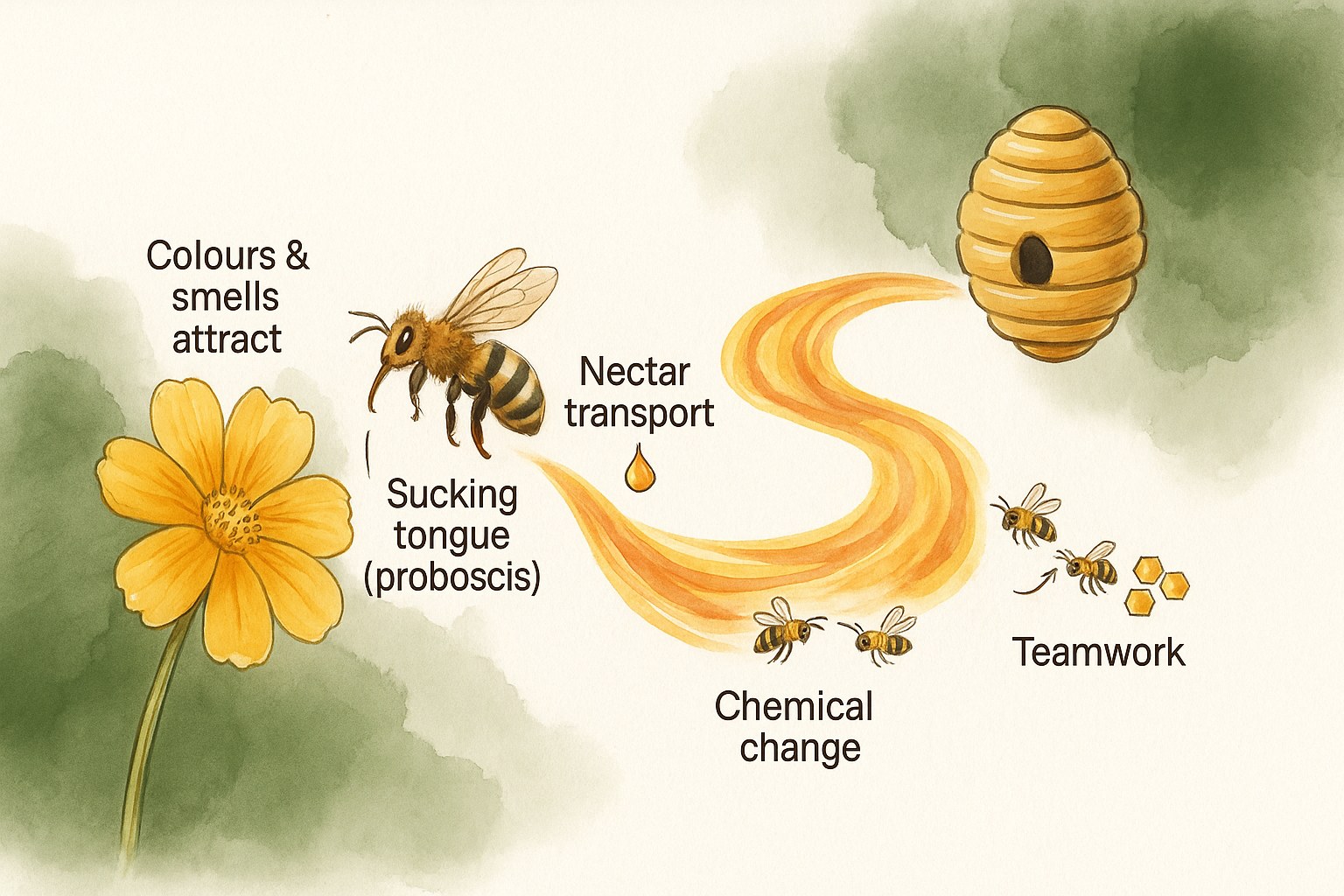
The forager bees spot the nectar-rich flowers thanks to their bright colours, like blue or yellow. Their antennae also pick up sweet smells. That’s how they choose the best plants.
The bee uses its tongue, the proboscis, to suck up the nectar in the heart of the flower. It’s precision work. It gathers this precious liquid with great care. Then it moves from flower to flower to fill up its stores.
Pollination then happens. The bees carry pollen without meaning to, on their little legs.

🐝 Carrying the loot in the honey stomach
The honey stomach is a special tank in the abdomen. It’s a second stomach used only for storage. The nectar stays nice and warm in there during the long trip home.
The chemical change starts during the flight back to the hive. Natural juices, called enzymes, begin to alter the sugar. The honey-making process already kicks off in the flying bee.
A single worker is very strong. It can carry almost its own weight in nectar. It’s truly impressive.
👥 The busy life of bees serving the colony
The jobs are shared out precisely. Each bee has a role depending on its age. Some clean, others feed the larvae or protect the queen, the mother of them all.
Teamwork is vital for the group’s survival. Nobody works alone here. Solidarity is the absolute golden rule. The colony works like one big organism. It’s a perfect set-up that commands real admiration.
The coordination between foragers and receivers is total. The nectar handover has to be fast and efficient.
🍯 The bees’ kitchen turns nectar into gold
Once the nectar is delivered to the hive, the bees step behind the stove for the final transformation.

🤝 Passing the nectar between the workers
Trophallaxis is a mouth-to-mouth exchange. It’s a way of passing food along. This is how bees share the nectar they’ve gathered.
This sharing lets them mix the nectar with saliva. The bees’ enzymes then get to work. The liquid starts to change in texture and taste.
The liquid moves between several receiver bees. The nectar passes from one to another several times. It’s real teamwork.
⚗️ How enzymes act on the sugars
Invertase is the natural tool for breaking down complex sugars. It’s a magic ingredient made by the bee. It turns the raw nectar into something new.
Sucrose becomes easy-to-digest glucose and fructose. These sugars are simpler for our bodies. Honey becomes a source of instant energy. It’s a natural chemical reaction. Children love this taste.
Gluconic acid also appears during this step. This element protects the mix against germs. The honey then becomes very healthy.
💨 Natural drying through ventilation
The workers beat their wings to evaporate the water. They create a steady warm air current. It’s like a giant fan inside the hive.
They absolutely must reach a moisture level below 18%. Without that, the honey could ferment and spoil. The bees check the texture carefully.
It’s a bit like reducing a sauce in cooking. You take out the water to concentrate the flavours. The result is delicious.
That’s how bees make honey: explained for curious children and parents!
🏠 Storing it in the hive for perfect keeping
Once the recipe is ready, the treasure now has to be tucked away in natural safes.
🕯️ Sealing the cells with wax
The wax-making bees produce very thin little white plates. It’s their own body that makes this material. They then shape these scales to create the wax caps.
This airtight lid protects the honey from outside moisture. Nothing can get in or out once the cell is closed. The honey then stays perfectly dry and pure in its shelter.
The honey can keep this way for several years. It’s a magic food that never goes off, thanks to this careful work.
🔒 The secrets of natural keeping
Hydrogen peroxide, made by the bees’ enzymes, plays a major role. It’s a very powerful natural disinfectant. It stops bad germs from settling in the hive’s combs.
Bacteria can’t grow in honey. There’s too much sugar and too little water. It’s a hostile place for germs. They can’t survive there for long.
The acidic pH is an extra barrier. It’s an effective chemical protection. The honey is armoured against attacks.
🏭 The difference between pure honey and an industrial product
A natural, unprocessed honey keeps all its vitamins and original aromas. It’s the raw product of the hive. It gets no additions after the beekeeper harvests it.
Be wary of the sugar syrups added to some shop products. These blends are less good for your health. They don’t have the goodness brought by the bees.
Here are the key points for choosing well:
- Artisan honey: rich in enzymes, local origin, respect for the bees.
- Industrial honey: often heated, vague blends, fewer nutrients.
🚫 Why honey is banned before the age of 12 months
Despite all its qualities, this natural product hides an invisible danger for the youngest among us.
⚠️ The risk of infant botulism explained
The bacterium Clostridium botulinum hides everywhere. You find it in soil or dust. It sometimes travels on the bees’ legs all the way into the honey.
The spores look like little sleeping seeds. They wait patiently in the raw product. They simply watch for the right moment to wake up and become active.
Infant botulism is a rare but serious illness that paralyses the baby’s muscles. It needs immediate hospital care to protect the infant’s breathing.
👶 The fragility of babies’ digestive systems
A baby’s tummy still lacks good bacteria. Its protective gut flora hasn’t formed yet. It has no effective way to defend itself against outside intruders.
By contrast, adults’ digestive systems are mature and strong. We get rid of these spores naturally without even noticing. For us, honey is therefore completely harmless.
Around the age of one, the defences are finally ready. The threshold of maturity is reached. The danger linked to the spores disappears.
🎂 The question of honey baked into cakes
The heat of a home oven isn’t enough. The spores survive very high temperatures. So the risk for the infant stays the same, even after long baking.
You must avoid honey pastries for the very young. A simple biscuit can contain the bacterium. It’s better to choose other sweet flavours for their first snacks.
Be careful with industrial products. Some cereals or little jars contain hidden honey. Always read the labels very carefully to protect your child.
💪 3 nutritional benefits for children over one
Once the first candle is blown out, honey becomes a precious ally for growth and energy.
⚡ A boost of energy and antioxidants
Honey is a great replacement for refined sugar. It contains nutrients that plain white sugar doesn’t have. It’s a living, complete food for your child.
Its flavonoids help to strengthen the natural defences. These elements let the body stay strong. They fight effectively against everyday little attacks.
Its natural sugars are absorbed very quickly. It’s an ideal fuel for playing. The energy is available straight away.
👀 A gentle introduction and watchfulness
Offer small amounts to test tolerance. Start with half a spoonful in a yoghurt. Watch how the child reacts to this rich food.
It’s nice to vary the pleasures. Acacia, wildflower or lime honey offer different tastes. This helps to develop the palate of little foodies.
Keep daily intake moderate. Honey is still a very sugary product. You have to protect the milk teeth.
🚨 The warning signs of an unusual reaction
Watch for red patches appearing on the skin. Sometimes the tummy becomes sore after the meal. The child may also have trouble breathing. These skin or digestive symptoms should raise the alarm.
An allergy directly involves the immune system. It’s a much more serious reaction. An intolerance is just a simple digestive problem.
A paediatrician will quickly reassure you. See a doctor at the slightest lasting doubt. Never take needless risks.
🍞 Recipes and tips to enjoy honey safely
To finish in style, let’s see how to put a little bee magic on your children’s plates.
🍓 Ideas for spreads and fruity mixes
Mixing honey into fromage blanc is a great idea. It’s a creamy and really gentle dessert. Add a few apple pieces for crunch and vitamins.
For snack time, make healthy and tasty open sandwiches. Use wholemeal bread with a thin layer of honey. It’s much better than industrial spreads.
Drizzling it over your cereal is also very simple. A trickle is enough to flavour the bowl. It’s a morning treat.
🗣️ Using honey to soothe a sore throat
Make a warm lemon drink for your little ones. It’s the granny’s remedy par excellence. Honey calms the irritation when you’re coughing a bit too much.
This natural product has soothing properties on the mucous membranes. It lays down a protective film in the throat. This eases the pain very quickly and naturally.
Keep an eye on the water temperature. It should be warm, not boiling. Heat destroys the goodness.
👨🌾 Choosing a trusted local beekeeper
| Criterion | Supermarket honey | Local beekeeper’s honey |
|---|---|---|
| Origin | Often non-EU blends | Direct local harvest |
| Heat treatment | Sometimes heated (pasteurised) | Cold extraction preserved |
| Taste | Standardised and uniform | Rich, true to the region |
| Support for biodiversity | Little direct impact | Protects local bees |
Learning to read the labels is essential. Check that the honey really comes from your country. Avoid vague blends.
Valuing local work supports biodiversity. Buying from a nearby producer helps the bees in your area. It’s a responsible thing to do.
The foragers gather the nectar, transform it as a team thanks to enzymes and fan it to create this golden treasure. To enjoy its benefits after the age of one, choose a local beekeeper. Quickly offer this natural energy to your children to sweeten their future the healthy way!
🎬 Watch the video
❓ FAQ
🌼 How do bees make their honey from flowers?
It all starts with a little nectar harvest! The forager bees visit the flowers and suck up this sweet liquid with their tongue, called the proboscis. They then store it in a special tank, the honey stomach, where the transformation already begins thanks to natural enzymes, even before the trip back to the hive.
🐝 What exactly is trophallaxis in bees?
It’s a very community-minded way of sharing the work. Once back home, the forager passes the nectar to the receiver bees mouth to mouth. This passing between several workers mixes the nectar well with their enzyme-rich saliva, like invertase, to turn complex sugars into easy-to-digest honey.
This process isn’t just for cooking! It also lets important information travel around the whole colony and strengthens the bonds between all these little workers.
💨 Why do bees flap their wings over the honey?
They play the part of fans! The nectar has far too much water to keep for long. By beating their wings very fast, the workers create a warm air current that evaporates the moisture. They stop when the honey reaches about 18% water, which gives it its creamy texture and stops any fermentation.
⏳ Can honey really keep for years?
Yes, it’s a real treasure that never goes off! Thanks to its natural acidity and the presence of hydrogen peroxide (a kind of natural oxygenated water), germs can’t grow in it. Once the bees seal the cells with a little airtight wax cap, the honey is protected from moisture and can stay intact for centuries.
👶 Why should you never give honey to a baby under one?
It’s a very important safety rule. Honey can contain spores of a bacterium called Clostridium botulinum. While these “seeds” are harmless to adults, a baby’s tummy isn’t strong enough yet to defend itself. This can cause infant botulism, a serious illness that tires their little muscles.
Even if the honey is baked into a cake or a biscuit, the danger stays the same because the oven’s heat isn’t enough to destroy these spores. So we wait patiently for the first birthday before letting them taste this treat!
💚 What are the health benefits of honey for older children?
After the age of one, honey becomes a super ally! It’s a source of instant energy for running and playing, far richer than white sugar. It contains antioxidants that strengthen the natural defences, and it’s perfect for soothing a slightly sore throat thanks to its calming effect.
🛒 How do you choose the right honey to enjoy its benefits?
The secret is to go local! Honey from a beekeeper near you guarantees a pure, unheated product rich in nutrients. By reading the labels carefully to avoid industrial blends or added sugar syrups, you give the best to your children while protecting the bees in your area.
