
Are your children firing a thousand questions at you about fearsome meat-eating dinosaurs, and do you feel a bit lost in front of their complicated names? 🦖 This article unlocks the secrets of the theropods, those famous two-legged predators with razor-sharp claws that once ruled the past. You’ll soon discover how the T-Rex or the Velociraptor really lived, while learning to recognise their surprising descendants that sing in your garden today.
- Meat-eating dinosaurs are theropods
- Jaws and claws built for survival
- Famous species from the Triassic to the Cretaceous
- Varied menus between hunting and scavenging
- Group tactics and life in the wild
- A sudden extinction and a modern legacy
🦖 Meat-eating dinosaurs are theropods
After skimming through the popular imagination, it’s time to tackle the real family tree of these monsters, starting with their scientific classification among the theropods.
🦵 The simple definition of a two-legged theropod
The word theropod comes from ancient Greek. It literally means “beast foot“. This name highlights their unique way of moving on solid ground.
These creatures walked on two legs, a posture inherited from their ancestors. According to experts, this body shape gave them efficient propulsion for running. Their powerful tail-and-thigh muscles made fast movement much easier.
They belong to the saurischians. Their hips look like those of reptiles.
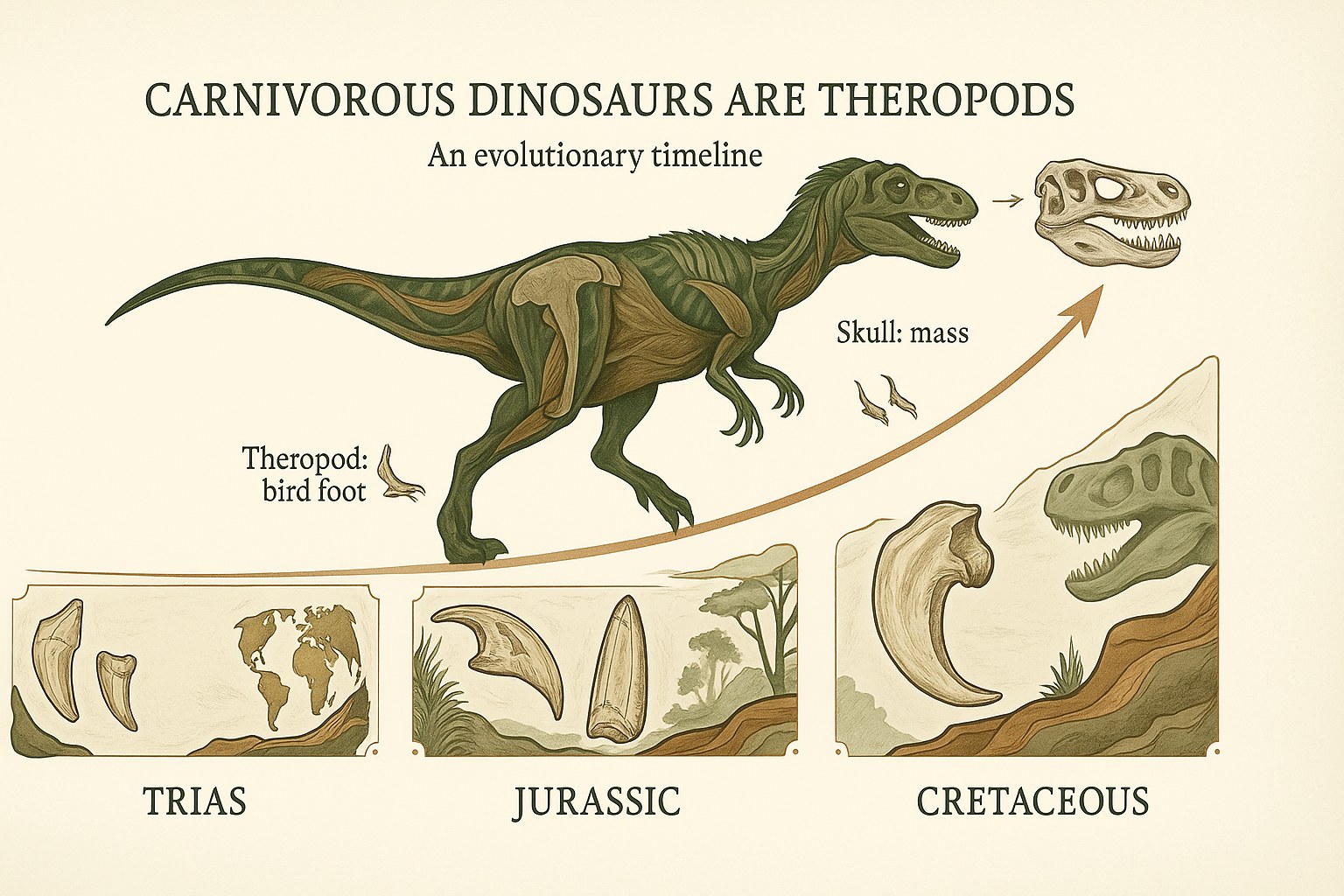
📜 The three great geological periods of their lives
The first specimens appear quietly during the Triassic. Back then, they stayed quite small. They were already very agile next to the other reptiles around them.
The Jurassic then marked a true golden age. Their sizes grew impressively. Ecosystems became complex and these predators set themselves up as the absolute masters of the land.
The Cretaceous closes this epic with total domination. It is the peak of their evolution. The most famous giants in history then roamed our planet.
🧬 A physical evolution over millions of years
Their body shape changed radically, going from small primitive forms to colossi weighing several tonnes. This incredible diversity mainly depended on the isolation of the different continents.
You can see a shrinking of the front limbs in favour of massive skulls. The overall balance of the body shifted. They had to make up for that heavy weight at the front.
Yet evolution is not a straight line. Several lineages lived together with varied physical specialisations.
🦷 Jaws and claws built for survival
But beyond their classification, it’s their battle arsenal that really strikes the mind, with a body entirely shaped for pure predation.
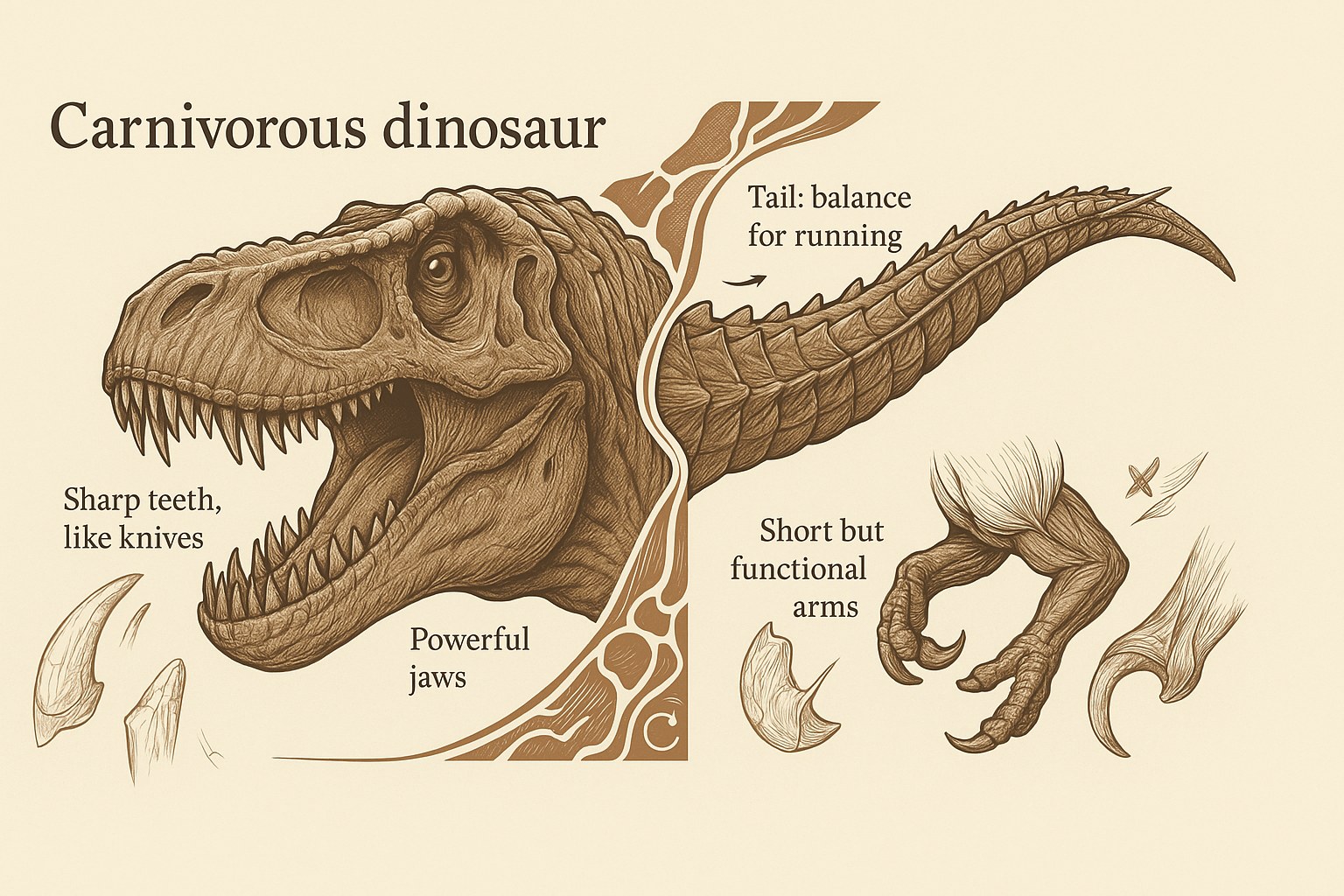
🦷 Sharp teeth and powerful jaws
Their teeth were curved and serrated. They worked like real steak knives. This structure let them tear through the toughest flesh effortlessly.
The skull muscles applied phenomenal pressure. This incredible force let them crush bones. The teeth were in no danger of breaking during these violent attacks.
A constant renewal system replaced worn teeth. A new tooth grew as soon as the old one fell out. So the dinosaur was never left toothless.
🏃 How the tail helped with running
The tail acted as an essential counterweight every day. It perfectly balanced the huge weight of the head. Without this balance, walking on two legs would simply have been impossible. It is a natural stabilising tool.
It played a crucial role when changing direction. It worked like a rudder to steady the animal. This made fast chases against agile prey much easier.
Bony tendons kept the tail stiff. So it stayed nice and straight.
💪 The mystery of the T-Rex’s short arms
Several theories explain the reduced size of the arms. The massive growth of the skull made these limbs secondary for catching prey.
These limbs may have been useful during mating. Despite their small size, they had powerful muscles. So they stayed perfectly functional for specific tasks.
It was absolutely not a handicap for the animal. It was a consistent evolutionary choice. It fitted perfectly into their overall hunting strategy.
📅 Famous species from the Triassic to the Cretaceous
These biological tools allowed the rise of true icons of prehistory, whose names still echo in our museums today.
👑 Tyrannosaurus Rex remains the most impressive
This giant of the Late Cretaceous had truly staggering dimensions. Some specimens weighed more than eight tonnes. Its massive build embodies the raw power of that distant age.
It lived mainly on the plains of North America. This king of predators roamed a huge territory. Large herbivores made up most of its daily menu.
Tyrannosaurus Rex sat without question at the top of the food chain, fearing no other predator of its time.
💨 The Velociraptor and its surprising agility
Forget the giants from the films, the reality is different. This dinosaur was actually quite small. It was barely bigger than a large modern turkey.
Its retractable sickle-shaped claw was its favourite weapon. It used it to aim at the vital spots of its prey. Here are its main strengths:
- High top speed
- Precise binocular vision
- Sharp claws on its feet
Its social intelligence impresses researchers. It is thought to have had higher cognitive abilities.
🦖 The Allosaurus, a major predator of the Jurassic
This hunter widely dominated the landscapes of the Jurassic. It measured around 7.5 metres long. It was a fearsome carnivore.
Its silhouette was far slimmer than that of the famous T-Rex. The animal relied above all on its suppleness. Its speed of action made it an efficient killer.
Its traces are found on several continents. This evolutionary success proves its great ability to adapt. It left its mark on the history of the planet.
🍖 Varied menus between hunting and scavenging
Behind these famous names lie eating habits far more complex than a simple thirst for blood, changing with their needs and opportunities.
⚖️ The difference between predator and scavenger
Active hunting demanded a crazy amount of energy. The theropods had to work out precise strategies. They often took real physical risks facing their prey.
Eating an abandoned carcass was far more restful. It is a fearsome and economical survival tactic. Why wear yourself out when the buffet is already served by chance?
In reality, most theropods were a bit of both. They never turned down an easy little snack. Yet they stayed perfect killers when needed.
🐟 The Spinosaurus and its taste for fish
Its unique body was completely geared towards water. Studies on calcium confirm that spinosaurids were mainly fish-eaters. A true professional fisherman’s diet.
Its long snout looks strangely like that of our crocodiles. Its conical teeth gave fish no chance. Slippery prey stayed firmly stuck in its mouth.
Its dorsal sail probably served as a heat regulator. It may also have helped impress onlookers. A very handy fashion accessory for intimidating rivals.
🦴 The scientific proof of cannibalism cases
Tooth marks have been found on identical bones. These marks prove meals between members of the same species. It was often the last resort during famines.
The Majungasaurus of Madagascar is the best-documented example. The fossils show signs of tearing with no ambiguity at all. This predator really showed no mercy.
It was not a systematic behaviour or a pleasure. It was a brutal response to survival. The environment simply became too hostile to be fussy.
👥 Group tactics and life in the wild
To capture this prey or survive the changing climates, the carnivores had to develop social strategies and surprising physical adaptations.
🐺 Hunting in a pack or preferring solitude
Some sites reveal clues of cooperation. Parallel trackways show coordinated movements. These organised groups probably hunted together.
The large predators often hunted solo. The small, agile theropods, on the other hand, preferred the pack. This let them bring down much bigger prey.
The ambush stayed a very effective technique. Hidden in the vegetation, they waited patiently. Silence was their best asset to take prey by surprise.
🪶 The importance of feathers for temperature
Many theropods had a primitive down. These structures were not for flying. They mainly helped keep the body warm.
This coat insulated them from harsh climate swings. The feathers were also useful in the nest. They protected the eggs effectively during the whole incubation.
Colours played a major visual role. They were used during the courtship display. It was a health signal to attract a mate.
🌿 An environment full of giant ferns
The flora of the Mesozoic was very specific. Conifers and ferns dominated the whole space. This landscape looked nothing like our forests.
Grass did not exist yet during their reign. The ground stayed covered in thick mosses. Damp plant debris constantly carpeted the earth.
| Period | Dominant climate | Main flora |
|---|---|---|
| Triassic | Dry and hot | Gymnosperms, ferns |
| Jurassic | Humid and hot | Conifers, giant ferns |
| Cretaceous | Hot, marked seasons | Appearance of flowering plants |
🐦 A sudden extinction and a modern legacy
Despite their apparent supremacy, these kings of creation ended up dying out, leaving behind precious traces and an unexpected line of descendants.
☄️ The likely causes of their massive disappearance
A giant asteroid struck the Earth. This impact and intense volcanism then upended the atmosphere. Sunlight stayed blocked for a long time.
Yet biodiversity was already declining 10 million years before the impact. The cooling climate was already weakening the herbivores. So the populations were already fragile.
A few opportunistic little groups survived. Only the most adaptable crossed this geological boundary.
🐦 The direct link with the birds in our gardens
The small theropods share striking similarities with our birds. Their skeletons have the same hollow bones. This light structure is a direct legacy.
Their scales slowly evolved into complex feathers. This change of body shape took millions of years. That is how flight became possible.
Scientifically speaking, birds are not the descendants of dinosaurs, they are theropod dinosaurs that survived the extinction.
🔬 Studying fossils to understand their past
Out in the field, palaeontologists do painstaking work. They dig up bone fragments with great care. Each piece helps to rebuild this age-old puzzle.
Many countries are full of treasures hidden under our feet. Famous dig sites keep revealing this rich geological heritage.
3D scanners are now transforming our research. Modern imaging reveals biological details invisible to the eye. We understand their inner life better.
These two-legged theropods dominated the past thanks to their hunting arsenal and incredible adaptation, from insulating feathers to retractable claws. Go and explore the museums soon to admire these giants before history flies away. Our birds today remain the proud heirs of these fearsome meat-eating dinosaurs.
❓ FAQ
📖 What does the name “theropod” actually mean for these dinosaurs?
The word theropod comes from ancient Greek and literally means “foot of a wild beast“. It is a name chosen by the palaeontologist Othniel Charles Marsh at the end of the 19th century to group these fascinating creatures together.
Beyond the etymology, it refers to a group of dinosaurs that move on two legs. While most were fearsome carnivores, this big family is very varied: it ranges from tiny specimens a few centimetres long to giants over 15 metres!
🦵 Why did meat-eating dinosaurs walk on two legs?
Walking on two legs was their main way of moving. Their back legs were true pillars, perfectly suited to carrying their weight while allowing efficient movement. It is a legacy from their most distant ancestors.
By freeing their front limbs from walking, evolution let them develop other talents, such as grabbing prey. To keep their balance in this posture, they used their tail-and-thigh muscles, a powerful junction between the hips and the tail that acted as a counterweight.
📅 In which geological period did these predators live?
The theropods’ adventure began around 240 million years ago, during the Triassic. Back then, they were still small, agile carnivores with light bones and a long neck.
They then reigned and diversified during the Jurassic and the Cretaceous. It was during these millions of years that they evolved into incredible forms, including the famous tyrannosaurs, but also the first ancestors of the birds we cross paths with today.
🐟 Is it true that some dinosaurs mainly ate fish?
Absolutely! Not all carnivores hunted big land herbivores. Some groups, like the spinosaurids, were what we call fish-eaters. They spent much of their time in or near the water.
Their anatomy was actually suited to this special diet: they often had a long snout and conical teeth, perfect for catching slippery prey.
🦎 Did all meat-eating dinosaurs have scales?
Well, no, science has some lovely surprises in store for us! We now know that many theropods had feathers or down.
These feathers were not always made for flying. They first served as heat insulation to keep warm or as a means of communication. It is a legacy we find in birds, which are technically the only theropod dinosaurs that survived the extinction.
💪 How do scientists explain the reduction of the T-Rex’s arms?
It’s a question that often makes people smile, but it has a logical explanation. Over the evolution of the tyrannosauroids, we see a massive increase in the size of the skull and the power of the jaws.
As the head became the main, ultra-efficient hunting tool, the front limbs gradually lost their usefulness for catching prey. So they shrank, without ever stopping these predators from dominating their environment.
