
Imagine a snack with no fresh fruit and no honey on toast, because our precious little workers have stopped foraging. You’re probably wondering why bees are disappearing, when 75% of the world’s food depends on their invisible work. This article lifts the lid on the chemical cocktail of pesticides and the parasites that threaten our plates, and shares simple things you can do to turn your balcony into a flowery refuge. 🐝
- The impact of disappearing bees on our meals
- Pesticides and the chemical cocktail effect
- Why are natural habitats disappearing?
- Biological threats and hive parasites
- 3 climate and technology disruptors
- Simple ways to protect our foragers
🍽️ The impact of disappearing bees on our meals
Imagine a breakfast with no strawberry jam and no fresh orange juice. This could really happen, because our plates depend on tiny, tireless workers who are slowly fading away.
🍓 The role of foragers in our food
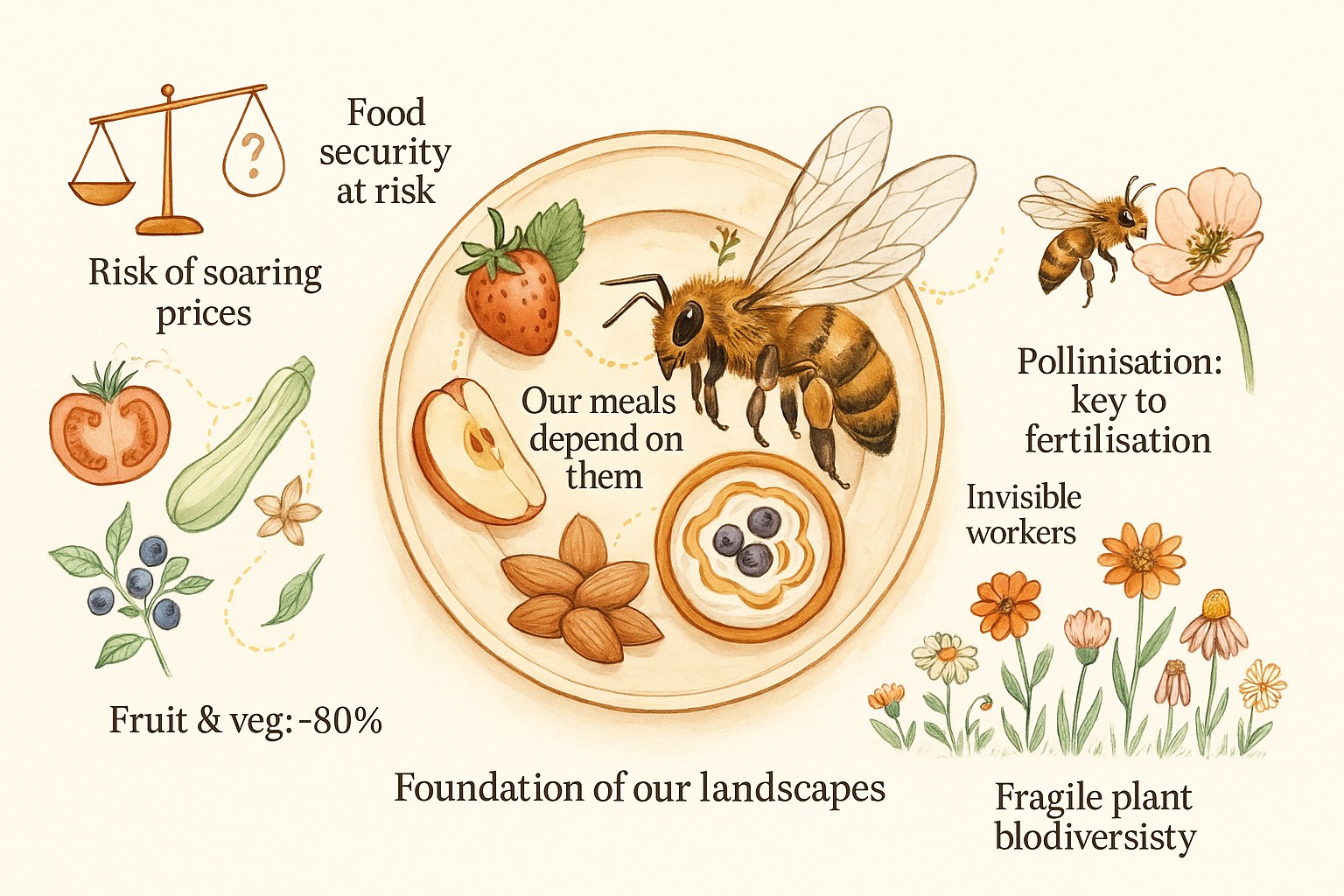
Without pollination, most of the fruit and vegetables we love would simply vanish. This natural service is completely free. Yet it stays vital for our own food supply.
A bee gathers pollen by brushing its hairs against the stamens. It then carries this precious seed dust to other flowers. This constant back-and-forth makes the fertilisation of plants possible.
Insects help reproduce 80% of all flowering plants. Without them, the balance of our meals collapses completely.
🌿 The survival of plant biodiversity
Wild plants cannot multiply on their own. They rely on insects to break the isolation between populations. This is the true foundation of our natural landscapes.
The strength of local ecosystems weakens without this diversity. A plant that isn’t pollinated slowly dies out. One link in the chain then breaks for good.
The loss of pollinators isn’t just a farming crisis. It’s the silent collapse of the biological diversity that supports all life on Earth.
⚠️ The real risks for food security
Falling harvests are already a real, concrete problem. Fewer bees means smaller, less nourishing crops. Prices could then shoot up fast.
A future without pollinators looks very bleak indeed. We’d have to make do with cereals carried by the wind. Goodbye to the bright colours and vitamins of the orchard.
Pollination generates around 150 billion euros every year. Why are bees disappearing? It’s a question of economic and health survival.
☠️ Pesticides and the chemical cocktail effect
Let’s leave our gardens and take a closer look at what’s happening in our fields, where our farming model poisons its most precious allies. In fact, the question of why bees are disappearing finds a chilling answer in the heavy use of chemical products.

🧪 Neonicotinoids and disoriented worker bees
These insecticides act like powerful nerve poisons. They flood the bees’ nerve receptors. The bee then loses its most basic thinking skills.
A disoriented worker never finds its way home. It dies of exhaustion far from its colony. The hive slowly empties this way.
Here are the effects seen in these insects:
- Memory loss
- Disrupted flight
- Inability to communicate where the food is
- Lower fertility in the queen
☠️ The dangerous build-up of toxic substances
The danger often comes from chemicals piling up. Fungicides and weedkillers mix with insecticides out in nature. This blend creates a multiplied toxicity. It’s called the cocktail effect. It’s an invisible poison for the swarm.
Nectar and water get contaminated with residues. Bees carry these substances right into the heart of the hive. The whole home then becomes toxic.
Yet solutions do exist, thanks to NGOs fighting against pesticides to protect pollinators.
📜 The limits of today’s regulations
Legal bans move forward at a snail’s pace. Industry lobbies often slow down political decisions. Meanwhile, the colonies keep collapsing.
Exemptions are still granted for sugar beet and maize. These exceptions cancel out wider protection efforts. It’s a dangerous game with the living world.
| Molecule | Legal status | Main risk | Crops affected |
|---|---|---|---|
| Imidacloprid | Banned | Nerve toxicity | Past exemptions |
| Thiamethoxam | Banned | Nerve toxicity | Past exemptions |
| Glyphosate | Allowed | Disruptor | Various crops |
| Sulfoxaflor | Banned | Nerve toxicity | Various crops |
🌾 Why are natural habitats disappearing?
But chemicals aren’t the only culprit. The lack of “housing” and varied food finishes off the weakening of these insects.
🌽 The dangers of too much monoculture
Monoculture landscapes are green deserts. A bee finds only one source of food there. This single diet weakens its immune system.
Once the flowering is over, there’s nothing left. The colonies starve in the middle of the fields. Yet a variety of flowers is the key to their health. Without varied flowers, there’s no hope for the swarm.
You understand the multiple causes of the decline much better when you look at these fields stretching as far as the eye can see. Why are bees disappearing? The uniformity of crops is part of the answer.
🪓 The end of hedgerows and wild areas
Land reorganisation has removed protective hedgerows. Yet these gave bees shelter and food. They also worked as travel corridors.
Wild flowers in the fields have become rare. We treat them like weeds. Yet they are essential for wild pollinators.
“By clearing every stray weed from our landscapes, we’ve turned our countryside into hostile ground for the very creatures that feed us.”
🏙️ The impact of urban growth on nests
Concrete gains ground every day. Ground-level nesting sites disappear. Many solitary bees can no longer find bare earth.
The tidying-up of urban gardens is a problem. Lawns mown short are useless. Insects need wild little corners.
The picture is alarming, with 9% of wild bee species threatened in Europe. Our cities need to relearn how to leave a small space for the wild.
🦠 Biological threats and hive parasites
Beyond the environment, biological enemies take advantage of weak colonies to attack them from the inside.
🦠 The Varroa destructor mite and its viruses
The Varroa is a fearsome vampire mite. It clings to the bee to suck out its fat. This seriously weakens the insect from birth.
This parasite also carries many viruses. It injects diseases straight into the bee’s blood. Deformed wings are a common symptom. The colony eventually dies. It’s a worldwide plague.
Experts highlight just how urgent the situation is, with a recently recorded winter death rate of 29.4%.
🧬 The loss of genetic diversity in colonies
Humans have over-selected the queens. We look for gentleness and productivity. But we often forget natural resistance.
Hives are becoming genetically too uniform. They are all vulnerable to the same threats. A single disease can then wipe out everything.
This standardisation weakens populations, as shown by the threat hanging over the native black bee, a true pillar of our ecosystems.
🚚 The stress of intensive transport
Hives now travel on lorries. They get moved around to suit farming needs. This transport causes huge stress.
The bees wear themselves out reorienting again and again. Their natural cycles are completely upset. Physical exhaustion ends up killing the workers.
Why are bees disappearing? This nomadic lifestyle puts heavy physical strain on the colonies:
- Excessive shaking from lorries
- Sudden temperature shocks
- Mixing of different populations
- Breaks in the egg-laying cycle
🌡️ 3 climate and technology disruptors
On top of everything, an upset climate and our modern technology add brand-new pressure on these ancient insects.
🌸 The fatal shift in flowering times
Winters that are too mild wake the hives up too early. The insects come out when no flower is ready. They burn through their reserves for nothing.
The gap between insects and plants is fatal. A timing that took thousands of years to build is breaking apart. If a flower blooms with no forager, it dies alone. It’s a huge biological waste caused by warming.
The climate is changing faster than insects can adapt, creating a deadly food gap.
📡 The suspected influence of electromagnetic pollution
Mobile phone waves are under watch. Some studies show changes in behaviour. Bees use magnetism to find their way.
In the lab, these waves disturb their inner compass. They struggle to find the way back home. It’s a serious lead to help explain some of the declines.
- Interference with magnetite crystals
- Changes to the waggle-dance communication
- Cell stress detected
- Sudden abandoning of the hive
🌺 The little-known toxicity of some garden flowers
Some decorative plants are traps. They are chosen for their beauty alone. They often produce neither pollen nor nectar.
Some exotic species can even be toxic. The bee wears itself out on them without getting any real food. It’s an invisible threat in our gardens.
| Ornamental plant | Value for bees | Risk/flaw |
|---|---|---|
| Garden geranium | None | Sterile |
| Forsythia | Very low | Sterile |
| Oleander | None | Toxic |
| Hydrangea | Very low | Sterile |
🐝 Simple ways to protect our foragers
Faced with this gloomy picture, there are luckily levers for action within everyone’s reach.
🌱 Make a little corner of nature on your balcony
Plant thyme, lavender or sage. These nectar-rich plants are very easy to grow. They offer a feast to city insects.
Put up a small insect hotel. Solitary bees will find a safe refuge there. It’s a simple and very educational gesture.
A small water point with pebbles helps too. Bees need to drink without drowning. It’s vital during hot spells.
🥬 Choose local and organic food
Buy your honey straight from the beekeeper. You’ll support an industry that’s often struggling. Avoid industrial blends of doubtful origin.
Switching to organic reduces the chemical pressure. Every purchase is a vote for the environment. It’s the best way to change the model.
You can also get involved by supporting respectful farming models. These efforts help transform our countryside and our plates for good.
🐞 Help the lesser-known wild species
The mason bee is just as useful as the honeybee. It doesn’t make honey, but it pollinates a huge amount. Let’s learn not to be afraid of them.
Leave a corner of your garden wild. Natural nests do better in the mess. Nature knows very well how to look after itself.
Protect banks and old walls. These are precious habitats for wildlife. Every square metre saved counts for the future.
Between pesticides, parasites and lost habitat, our foragers face a cocktail of threats that puts our plates at risk. By choosing organic or filling your balcony with flowers, you take real action against the causes of disappearing bees. Together, let’s protect these precious allies for a tasty and colourful future. 🐝
🎬 Watch the video
❓ FAQ
🐝 Why are our little bees disappearing?
Sadly, it’s a mix of several things wearing our foragers out. The main causes are the use of pesticides like neonicotinoids, the loss of their natural homes because of intensive farming, and climate change turning their calendar upside down. Imagine leaving the table and no longer finding your way home: that’s what many of them go through because of chemicals.
On top of that come biological enemies like the Varroa destructor mite, which weakens them terribly, and the lack of varied flowers in our countryside. It’s a bit like being forced to eat the same thing every day in a noisy, polluted place. Their health is bound to suffer in the end.
🍎 What’s the risk for our food if pollinators leave?
The risk is very real for what ends up on our plates and our children’s. More than 75% of the world’s crops depend on pollination. Without these insects, we could say goodbye to a big share of fruit and vegetables, but also to coffee and chocolate. That would be a serious blow to the variety of our meals and to our vitamin intake.
As well as variety, it’s also a question of quantity and price. Harvests would be far less generous, and quality produce would become a luxury. Bees don’t just make honey, they keep billions of people food-secure by making plants more productive and fruit tastier.
🧪 How do pesticides affect the health of hives?
Pesticides, and especially neonicotinoids, act like powerful nerve poisons. They don’t always kill the bee instantly, but they completely disorient it. An affected worker can lose its memory, fail to recognise flowers, or be unable to find its hive. It’s a bit like losing its inner compass.
There’s also what’s known as the “cocktail effect”. Bees sometimes eat pollen containing up to seven different pesticides. This blend weakens their immune system, making them far more vulnerable to diseases and parasites. Even in small doses, this repeated exposure ends up being fatal for the swarm.
🌡️ Does climate change really disturb bees?
Yes, and it’s a real headache for them. With winters that are too mild, the colonies sometimes wake up far too early. They go out looking for food while the flowers haven’t bloomed yet. This gap creates a deadly food shortage: the bees wear themselves out searching for nectar that doesn’t exist yet.
This loss of timing between plant and insect is a biological waste. If a flower blooms without its forager, it can’t reproduce properly. Warming moves faster than our little insects can adapt, which weakens the whole balance of nature.
🤝 What can we do at our own level to help?
Good news, we all have a little power to act! You can start by filling your balcony or garden with nectar-rich plants like lavender, thyme or sage. Putting up a small insect hotel, or simply leaving a corner of lawn wild, also helps offer a precious home to wild bees that just want a little peace.
When it comes to shopping, choosing organic and local is a real gesture of support. By buying your honey straight from a beekeeper, you help an industry that protects the living world. Every flower planted and every responsible purchase is a little boost so our countryside keeps buzzing for a long time to come.
