
Have you ever wondered how your little scaly friends avoid drowning without ever coming up for air? Understanding how fish breathe underwater lifts the lid on the vital role of gills, those clever organs that pull dissolved oxygen out of the water with amazing skill. You’re about to discover the secrets of their anatomy, from how the lamellae work to the invisible release of carbon dioxide, so you can better protect the balance of their precious watery world. 🐟
- How do fish breathe? A look at the mechanism
- Gills are the lungs of the oceans
- The journey of water through the body
- Humans compared with water animals
- Species that do nothing like the others
- The factors that disturb their breathing
🐟 How do fish breathe? A look at the mechanism
We often think water is a space with no air, but it’s the complete opposite. For our scaly friends, this liquid is a real tank of life-giving gas, a bit like our atmosphere but in a wet version.
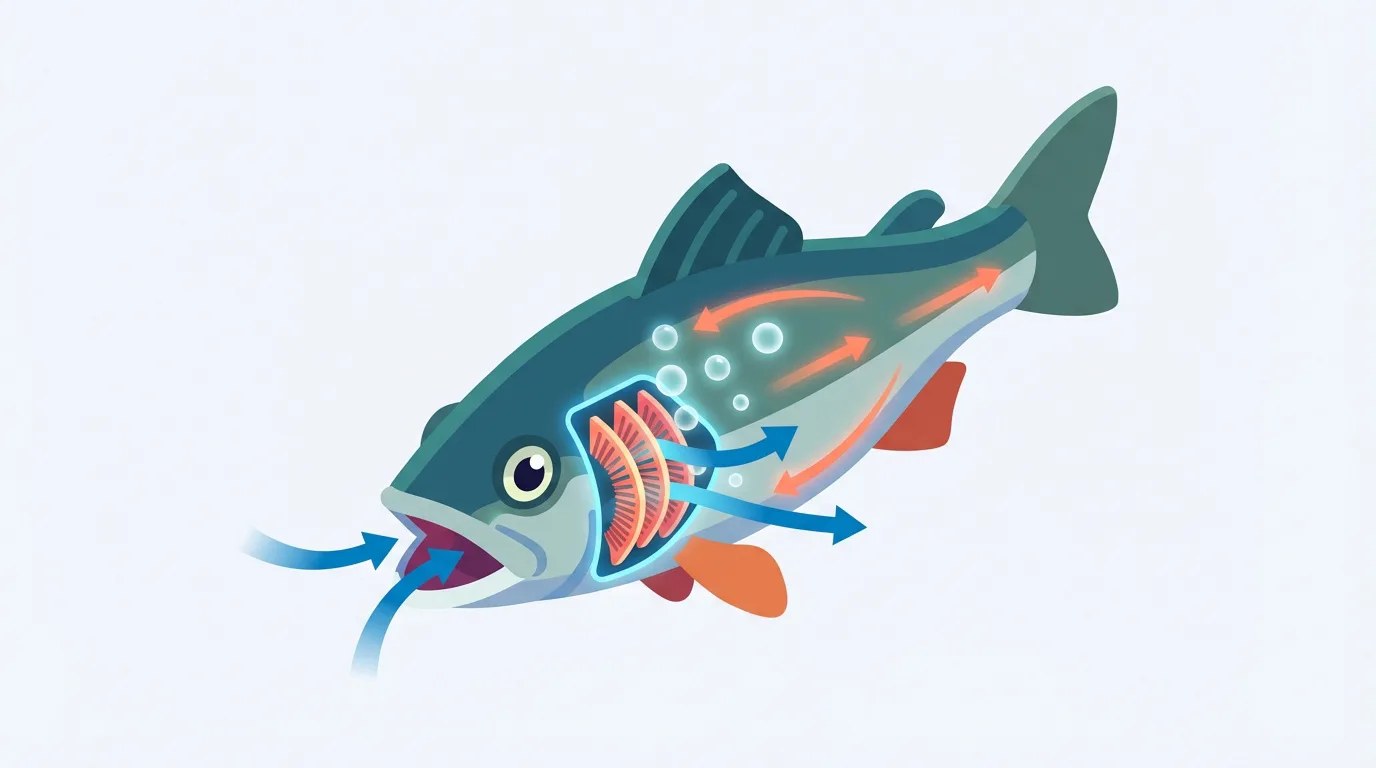
💧 The oxygen hidden in every drop of water
Water holds oxygen in a dissolved form. It’s invisible to the naked eye, unlike bubbles. It’s actually oxygen gas trapped between the water molecules. This element is essential for all underwater life.
Without this resource, the body’s machinery stops at once. Fish have special tools to capture this gas. It’s far less plentiful here than in the air on land. It’s a challenge every single moment.
So water isn’t just something to swim in. It’s the vital tank that holds their gas fuel. How do fish breathe underwater? They simply draw from this invisible store.
🫧 Why fish don’t make bubbles
Unlike a diver, a fish releases CO2 in a dissolved form. This carbon dioxide mixes straight into the surrounding water. It’s a quiet chemical exchange. So you see nothing coming out of their gills.
The visible bubbles you sometimes see usually come from rotting plant matter. Normal breathing, though, stays completely silent. It’s simply a matter of gas physics. The mixing happens without making any plume of gas.
So that mystery is solved. The breathing cycle is smooth and clean. It produces no waste in the form of vapour or air bubbles.
⚡ Vital energy drawn from the current
The oxygen pulled in turns nutrients into pure energy. This power boosts the red muscles for endurance. Without a steady flow, a fish wears out. It ends up sinking for lack of fuel.
The flow of water acts like a conveyor belt. The more the water moves, the bigger the oxygen supply. This lets predators reach incredible bursts of speed. It’s their secret for staying sharp.
The water flow directly affects growth. A well-oxygenated environment means the best possible development. The animal grows better and stays in great health.
🌊 Gills are the lungs of the oceans
Now that we understand oxygen is everywhere, let’s see how nature has equipped our scaly friends. Gills are a true feat of biological engineering.
🧬 Well-organised filaments and lamellae
Under the operculum hide red arches lined with filaments. These look like very fine combs. They hugely increase the contact area with the outside water.
Microscopic lamellae cover each filament to make the exchange as big as possible. It’s an ultra-precise filter that only lets useful molecules through. The design is fine-tuned to lose not a single scrap of oxygen.
Marine science confirms that these organs are perfectly suited to life in the water. Their precision is fascinating.
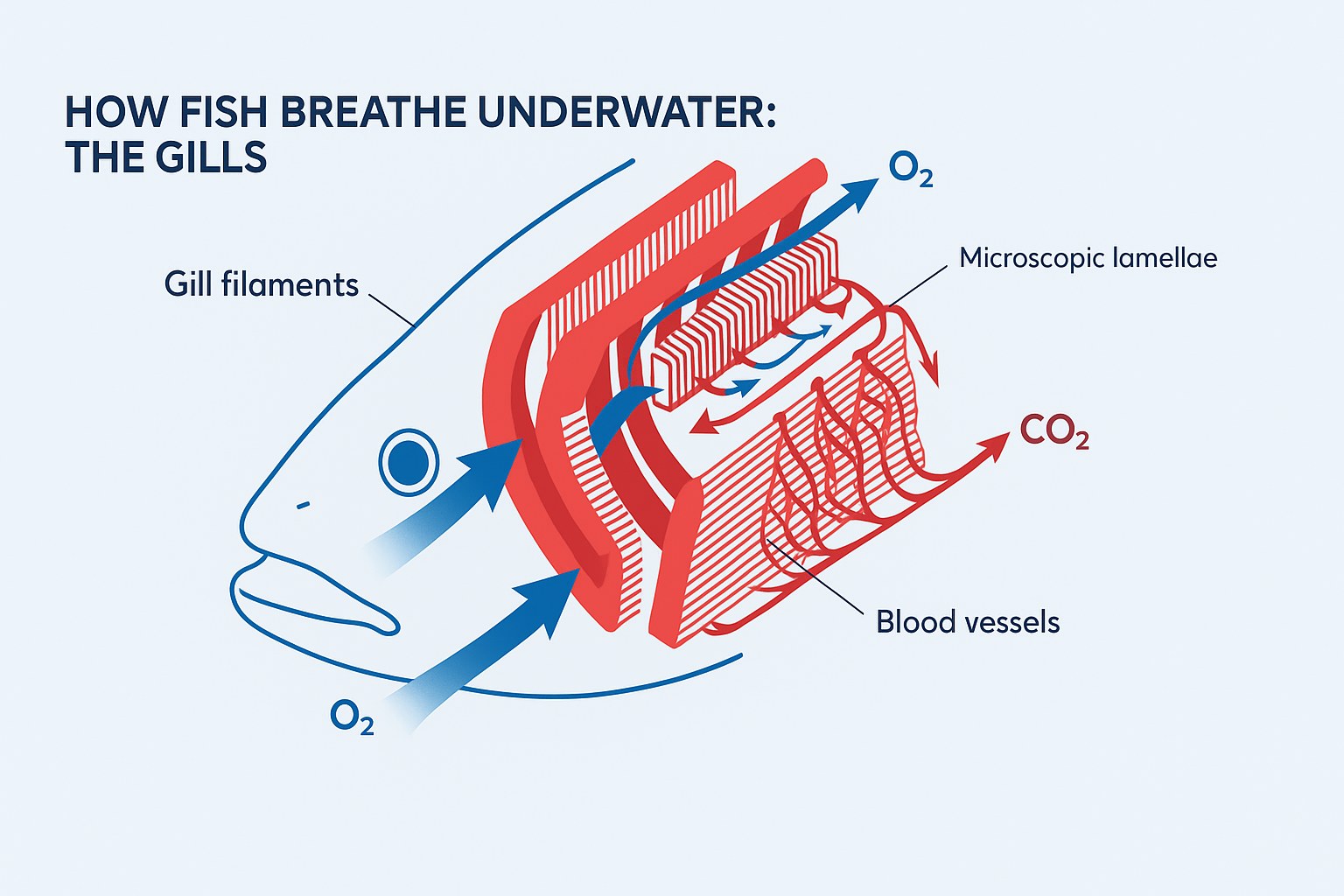
🩸 A high-performance network of blood vessels
The blood flows the opposite way to the water for maximum efficiency. The vessel walls are so thin that oxygen crosses the membrane instantly. It’s a passive but extremely fast transfer. The iron in the blood then grabs the vital molecules.
This intense web of vessels gives gills their bright red colour. It’s the sign of a chemical factory hard at work. The blood, now free of its carbon dioxide, heads back to the organs.
The structure of gills can extract up to 80% of the oxygen held in the water, a performance far better than that of our land lungs.
💯 The record extraction of dissolved oxygen
Water is a poor source of oxygen compared with air. Yet gills are outstanding extractors. They capture a share of gas that our own air sacs would be unable to grab.
Even moving slowly, the system stays productive. The fish adjusts how wide it opens its mouth to control the flow. It’s a perfect adaptation to the density of water.
This efficiency beats that of sea mammals, which are forced to surface. The fish, on the other hand, stays master of the depths without a break. How do fish breathe underwater? Simply with flair.
💧 The journey of water through the body
Now that we’ve seen the tool, let’s look at the mechanics of the flow, a real water-powered dance between the entrance and the exit.
👄 A mouth that sucks in non-stop
The fish gulps water to create a drop in pressure. This pumping has nothing to do with digestion. The liquid is sent to the pharynx, then to the gill chambers on each side.
The mouth and the gill covers work in perfect turns. When one opens, the other closes. This cycle ensures a one-way flow of water over the breathing tissues.
Here’s how it happens:
- The mouth opens
- The gill covers close
- The flow is sucked in
🛡️ The protective role of the gill covers
The opercula are movable bony flaps. They protect the delicate gills from outside threats like sand or debris. Their movement also helps push the water out after filtering.
In bony fish, these plates are essential for ventilation. They act like a suction-and-force pump. Without them, the flow wouldn’t be strong enough to oxygenate the blood.
Keeping them intact is vital. An injury to the gill cover exposes the breathing organ and threatens survival right away. They’re a bit like the fish’s personal shield.
💨 Pushing carbon dioxide back outside
Once the oxygen is captured, the water fills with carbon dioxide. It is then pushed outside through the opening of the gills. It’s the final stage of the underwater breathing cycle.
This process is extremely fast in active species like the tuna. The water has to be renewed constantly to avoid suffocation. The release is immediate and needs no internal storage.
| Stage | Mechanical action | Main role |
|---|---|---|
| Breathing in | Mouth open | Suck in oxygen-rich water |
| Exchange | Flow over gills | Capture O2 and release CO2 |
| Breathing out | Gill covers open | Push out the used water |
That’s how we understand how fish breathe underwater without ever making bubbles.
🤿 Humans compared with water animals
Why can’t we simply copy our scaly friends? Physics and biology set us strict limits.
🫁 Why our lungs are useless underwater
Our air sacs are built to pull oxygen from dry air. With water inside, they collapse and lose all ability to exchange gas. The liquid physically blocks the way in for the vital gas. That’s the mechanism of drowning by blockage.
The surface tension in our lungs stops them from handling fluids. Unlike gills, our tissues can’t take being underwater for long. The way our organs are specialised ties us to the land for good.
Every species is a prisoner of its own environment. Evolution chose paths that diverged and can’t be swapped.
⚖️ The difference in density between air and water
Water is about 800 times denser than air. Moving that much volume takes a huge muscular effort. Fish use external structures to cut down this constant energy cost.
Our lungs would have to do exhausting work to pump such a weight. The thickness of the liquid would make our breathing useless within minutes. Gills, on the other hand, make the most of this density.
The shape of gills is suited to the resistance of the fluid. They float and spread out in the water, where they would collapse in the open air.
🌡️ Heat adaptation and the need for air
Mammals have a high metabolism to keep their temperature up. That calls for a massive amount of oxygen. Fish, often cold-blooded, use far less energy at rest.
This difference explains why a human can’t survive without air. Our needs are huge compared with the resources dissolved in water. The fish manages its supply with remarkable thrift.
That’s the limit of human survival. Without technology, going underwater is a race against the clock that biology always wins in the end.
🐠 Species that do nothing like the others
Nature loves exceptions, and some animals have developed survival methods that break the usual rules.
🦈 The gill slits of sharks and rays
Cartilaginous fish have no movable gill covers to pump water. They have slits visible on their sides. To breathe, many have to keep swimming without stopping, mouth wide open.
This constant movement is vital. Indeed, the need to keep moving in some predators keeps a flow of oxygen-rich water running over the gill filaments to avoid suffocation.
Recent research on the hammerhead shark also shows how these animals adapt to the pressures of the deep to fine-tune their energy use.
🐟 The fish that breathe through their skin
The eel is the champion of skin breathing. Its thin, damp skin allows direct gas exchange with the air. So it can crawl over wet grass to reach another body of water. It’s an amazing survival trick.
This ability is limited in time. Without moisture, the skin dries out and the exchange stops dead. It’s a backup solution for night-time journeys or marshy areas.
Some fish use their skin like a spare lung to survive several hours out of their natural element.
😮 The surprising case of the air gulpers
In still waters, oxygen becomes scarce. Some catfish come up to gulp air at the surface. They use their gut to pull out the gas before releasing the surplus.
You can see this double breathing system in some tropical species, which lets them make up for the lack of dissolved oxygen in poor or very crowded waters.
This adaptation lets them settle in harsh places. It’s a major evolutionary advantage during dry seasons or extreme heatwaves. How do fish breathe underwater? Sometimes they simply choose not to!
⚠️ The factors that disturb their breathing
The mechanism is sturdy, but it still depends on water quality, a fragile balance that human activity and the climate threaten.
🌡️ The direct influence of temperature
The warmer the water, the less dissolved oxygen it holds. During a heatwave, fish go into severe breathing stress. They gasp for breath just as their body needs more, because of the heat.
The current helps stir the water and re-oxygenate it. Still areas are the first to turn deadly. It’s a vicious heat cycle that strikes fragile ecosystems.
Here are the main impacts seen:
- Rising temperature
- Falling oxygen
- Faster heartbeat
🏭 The impact of pollution on water quality
Fine particles and chemicals attack the gills. They can block the lamellae or cause chemical burns. Gas exchange then becomes impossible.
Heavy metals also build up in these well-supplied tissues. This damages the animal’s overall health over the long term. Pollution acts like a slow poison on the breathing system.
Protecting water means, above all, protecting the breath of biodiversity. Cloudy water often means suffocation for sensitive species.
🎈 The swim bladder and buoyancy
Don’t mix up breathing and buoyancy. The swim bladder is an internal sac of gas. It lets the fish rise or sink without useless muscular effort.
This organ acts like the ballast of a submarine. The gas sometimes comes from the blood, but it isn’t used to oxygenate the cells. It’s a navigation tool, not a survival one.
This confusion comes up a lot with beginners. The fish has two separate gas systems: one for energy, the other for its position in the water column.
Thanks to their gills and the steady passage of water, fish capture oxygen with fascinating skill. Protect the quality of their environment starting today to preserve this vital breath. Give them a calm future in clean water full of energy. 🐠
🎬 Watch the video
❓ FAQ
🐟 How do fish manage to breathe in water?
It’s a little miracle of nature! Fish use their gills, organs on each side of their head. Put simply, they gulp water through their mouth and send it to these gills. There, the oxygen that’s naturally dissolved in the water passes straight into their blood thanks to very fine lamellae filled with tiny blood vessels.
While the oxygen comes in, the carbon dioxide goes the other way and leaves with the water through the opercula, those little movable flaps that protect the gills. It’s a continuous, very efficient cycle that lets them live without ever needing to come up for air like we do.
🫧 Why don’t fish release bubbles when they breathe?
Unlike us when we blow through a straw at the bottom of the pool, a fish makes no bubbles. The carbon dioxide it releases is in a dissolved form. So it mixes instantly and invisibly into the water. If you see bubbles, they often come from an aerator or from rotting plants, but rarely from the breath of our scaly friends!
🐠 Can some fish breathe out of the water?
Nature has more than one trick up its sleeve! Some species, like the eel, have skin so well supplied with blood that they can absorb oxygen from the air as long as they stay damp. This lets them take little trips across wet grass to change their body of water. It’s a real biological spare wheel.
Other tropical fish, which live in waters very poor in oxygen, sometimes come up to the surface to gulp a bubble of air. They then use their gut, like the stomach or intestine, to pull the oxygen out of that bubble. It’s an amazing adaptation to survive where others would run out of breath.
🤿 Why can’t humans breathe underwater like fish?
It’s a question of design! Our lungs are made for dry air. If water gets in, our tiny air sacs collapse and can’t extract anything at all. On top of that, water is 800 times denser than air. Our muscles would wear out within minutes if they had to pump such a heavy liquid to draw energy from it.
🎈 What’s the role of the swim bladder in breathing?
Careful not to mix up the two! The swim bladder is a little sac of gas that works as a float, a bit like a diver’s buoyancy vest. It helps the fish rise or sink effortlessly, but it isn’t used to breathe. For energy and oxygen, everything really happens at the gills.
