
Does your child often ask you what their little fingers are called, while you look for a simple way to teach them the names of the fingers in order? This article gathers fun tricks and the funny story behind each finger’s name to turn this lesson into a moment you share together. You’ll discover an easy memory trick and surprising tales that will finally fix these names in their memory for good. ✋
- Learning the names of the fingers in order
- Where do our fingers’ names come from?
- 3 major jobs for our nimble hands
- How to remember these names without getting muddled
- Surprising anatomy and physical quirks
- Traditions and sayings about our hands
🖐️ Learning the names of the fingers in order
After looking at our hands, we often wonder how to name each member of this small, close-knit team.
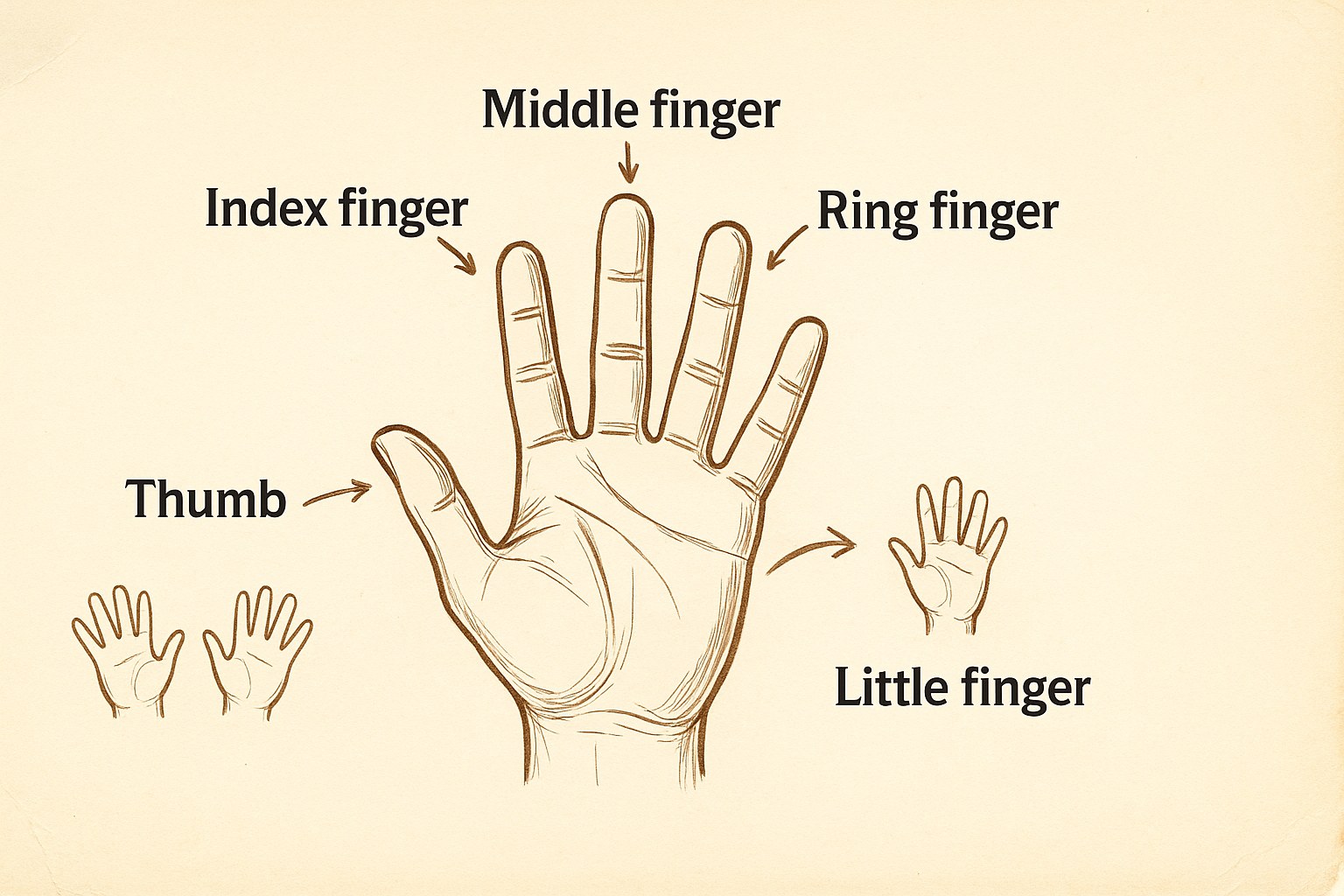
The names of the fingers, in order, are: the thumb, the index finger (pointer), the middle finger, the ring finger and the little finger (the pinky). These five finger names are the same for the right hand and the left hand, so there’s only one list to learn with your child. 🖐️
🖐️ Meet the five members of the hand family
Each hand has five separate fingers. We count the thumb, the index finger, the middle finger, the ring finger and the little finger. Together, they make a complete and essential team. They always work side by side to grab or hold objects.
The left hand and the right hand are mirror images. Yet the finger names stay the same on both sides. So there’s only one list to remember. That makes it much simpler for children.
To explore the anatomical vocabulary, it helps to picture each finger one by one. It’s a useful base to start learning from.
Each finger has its own unique identity. Despite being so close together, they don’t look alike. Their jobs and sizes vary hugely from one end to the other.
👉 The names of the fingers at a glance
To get straight to the point, here are the names of the fingers your child needs to remember, from the strongest to the thinnest: 👍 the thumb, 👆 the index finger, ✋ the middle finger, 💍 the ring finger and 🤏 the little finger. This short list of five finger names comes up in every nursery rhyme and finger game.
📏 The natural line-up, from the sturdiest to the smallest
When you look at your palm, you notice a precise line-up. The thumb stands a little apart from the others. The four other fingers stay neatly lined up side by side.
You can read your hand from left to right easily. Then size works as an instant visual marker for the child. It’s a logical order that the eye follows without effort.
- The thumb (thick and short)
- The index finger (the leader)
- The middle finger (the peak)
- The ring finger (the helper)
- The little finger (the tiny one)
This natural step pattern creates a perfect visual harmony. Each finger has its own particular size. The middle finger, in the centre, is the longest. The thumb, a little apart, is the shortest but the strongest.
✅ Why the order helps you not get it wrong
Learning the names in sequence is very effective. Following a logical order avoids common slip-ups. Beginners remember information better in a set direction. It’s a method that has proved itself.
The brain links the spatial position to the job. Information organised by place sinks deeper into memory. Placing the names of the five fingers then becomes child’s play.
A clear order turns a simple list into a real mental map for the child.
Having a fixed starting point is reassuring. The thumb often works as the first solid marker. After that, you just follow the path to the little finger.
📚 Where do our fingers’ names come from?
But beyond their position, these names hide stories that go all the way back to ancient times.
📜 The Latin roots of our little names
The word “digit” comes straight from the Latin “digitus”, meaning finger. The thumb’s Latin name, “pollex”, brings strength to mind at once. It highlights how powerful this finger is for grabbing objects well.
The index finger gets its name from the verb “indicare”. It’s quite simply the finger that points. We use it to show a direction or even to point at someone precisely.
Then comes the middle finger, the longest of the family. Its central position makes it very easy to spot on the hand. In Latin it was called “medius”, the one in the middle.
These Latin roots are still fundamental today. They still shape our whole modern understanding of anatomy. It’s a solid and very concrete heritage from language.
👂 The mystery of the little finger and the ear
In Latin, the little finger was called “auricularis”, a name with a direct link to our ear. It comes from “auricula”, meaning little ear. Its small size really does let you clean or scratch your ear easily.
In everyday speech, we often use the friendly word pinky for it. It’s an affectionate term that children pick up very quickly while having fun.
Casual language ended up simplifying this technical word. Over the centuries, daily use made its name easier for everyone. It feels more natural that way.
It was called the “ear finger” because it’s the only one small enough to fit into the ear to scratch it.
💍 The secret of the ring finger and the wedding band
The ring finger owes its name to the ring. It’s the finger chosen to wear the wedding band. Its name comes straight from this social role. You can’t get more obvious than that.
An old legend talks about the “vena amoris“. People in ancient times thought a vein linked this finger to the heart. This romantic belief has lasted through the ages, despite the facts of biology.
This tradition still lives on today. It stands for commitment and lasting love.
It’s a lovely example of anatomical symbolism. History meets biology. We love this little touch of poetry on our hands.
✋ 3 major jobs for our nimble hands
These names aren’t there by chance, because each finger plays a crucial role in what we do.
👍 The thumb’s superpower of opposition
The thumb has a unique ability called opposition. Thanks to a special muscle, it can touch the tip of every other finger on the hand. It’s an impressive movement.
This mobility lets us make a pinch. Without it, holding a pen properly is impossible. Picking up a small coin would then become an impossible challenge for us.
Evolution turned this finger into a wonderful tool. It let humans make complex objects. That’s how our ancestors learned to tame their surroundings.
The thumb stays the trump card of our dexterity. It’s the central pillar of every hand movement. Without it, the hand would lose its strength and precision.
👆 The surgical precision of the index and middle fingers
The index finger steps in whenever something needs pointing out. It’s used to point in an exact direction. We also use it to press a lift button precisely.
The middle finger, for its part, steadies every important grip. It gives essential support when we write. It sits in the middle to balance the whole hand.
Used together, they allow incredibly fine movements. Think of sewing or handling a pair of tweezers. These two fingers are the kings of precision.
💪 The holding strength of the ring and little fingers
The ring finger and the little finger are the pillars of power. They are essential for closing your fist with force. Without them, gripping an object would be very hard.
They also keep the hand steady. These fingers stop heavy objects from slipping down. They lock the grip during an intense effort.
| Finger | Main job | Strength vs precision |
|---|---|---|
| Thumb | Opposition | Precision and strength |
| Index finger | Pointing | High precision |
| Middle finger | Support | Balance |
| Ring finger | Strength | Holding strength |
| Little finger | Stability | Locking strength |
Never underestimate these “little” fingers. Though quiet, they keep our hands solid. Learning the names of the five fingers helps children understand this lovely balance.
🧠 How to remember these names without getting muddled
Now that we know their roles, let’s see how to fix them in our memory forever.
🧠 A simple sentence trick to forget nothing
Here’s an easy trick: make a silly sentence where each word starts with the first letter of a finger. Try “Tiny Iguanas Marry Royal Penguins”: T for Thumb, I for Index, M for Middle, R for Ring, P for Pinky, in the usual order.
The sillier the picture, the easier it sticks! This kind of mental gymnastics works really well for children. Repeat your magic sentence often and it will soon become a funny habit.
It’s the perfect tool for schoolchildren. Simple, fast and really hard to forget.
🎵 Singing to learn with nursery rhymes
You can also use songs like “Where Is Thumbkin?”. The rhythm and the melody make it much easier to remember things. It’s far more cheerful that way.
The brain loves music, that’s a fact. The memory areas are stimulated by rhymes and sounds. You remember without even noticing.
It’s a good idea to mime the movements while singing. Linking the movement to the sound strengthens the learning for the long term. You move, you sing, you remember.
We find these traditions in old finger rhymes too. These little verses travel through the ages with great success.
🎭 Stories and finger games to play together
Turning the fingers into characters helps a lot. The thumb becomes the dad and the index finger the mum. This creates a lively, lovable story.
Here are a few ideas to have fun:
- The “climbing ladybird” game that crawls up the arm.
- Finger puppets drawn with felt-tip pens.
- The hide-and-seek of the hands.
Playing these games at bedtime is an excellent idea. It’s a calm moment, perfect for closeness between parents and children.
Having fun is still the best way to learn the names of the five fingers for children. The child doesn’t even notice they’re working.
🦴 Surprising anatomy and physical quirks
Behind these games hides an absolutely fascinating and unique piece of biological machinery.
🦴 Counting the bones and the missing muscles
Did you know our fingers have almost no muscles? They move only thanks to tendons. These are connected straight to the muscles in your forearm.
As for the skeleton, the count is exact. Each finger has three separate bones called phalanges. Only the thumb breaks the rule, with just two small bones.
This structure gives incredible flexibility. It also helps make our hands lighter every day.
It’s a true masterpiece of natural engineering. Everything is perfectly fine-tuned to help movement.
👆 Fingerprints and the magic of touch
Tiny ridges cover the tips of our fingers. They act like a natural non-slip surface. This helps us grip even the smoothest objects firmly.
Their role doesn’t stop there. These prints boost the vibrations during contact. So we feel the tiniest rough texture with precision.
Each pattern is totally unique in the world. Even identical twins have different patterns on their hands.
It’s our own personal biological signature. It stays faithfully with us throughout our whole life.
🦶 Why our toes are so different from our fingers
Mobility varies hugely between our limbs. The hand is built to handle objects. The foot, on the other hand, focuses on walking.
The big toe has lost its power of opposition. In humans, it stays in line with the others. This helps our balance when we stand up.
Our hands are true craftsman’s tools. Our feet, meanwhile, are solid pillars that carry us.
This specialisation is truly unique to our species. It defines exactly how we walk, on two feet.
👋 Traditions and sayings about our hands
Finally, fingers don’t only serve to grab, they also speak for us in our culture.
💬 Colourful sayings in everyday language
“To put your finger on the problem” is a common image. It means finding the exact answer. You point straight at the difficulty.
“To be within a finger of succeeding” shows a victory that’s close. Here we stress how near in time it is. Success really is within reach.
There’s also “to twist someone around your little finger”, meaning you can get them to do whatever you want. Many languages keep these little gems.
They make our speech more lively. Using the names of the five fingers then becomes a game.
👋 Body language and gestures
Looking at the gesture of pointing is instructive. In some cultures, it’s rude. Yet for others, it’s perfectly natural to point this way.
The role of hands in speech matters a lot. They underline our emotions. They make our thoughts clearer during a conversation.
A simple thumbs-up shares more joy than a long thank-you speech.
Our fingers are real ambassadors of our social communication. They send messages without saying a word. It’s magic.
🤝 Right hand or left hand, depending on customs
Let’s look at cultural differences. In some traditions, the left hand is kept for impure tasks. It’s never used for eating.
The story of left-handed people is worth telling. Long looked down on, they are now fully accepted. Their difference is at last valued everywhere.
- The Hand of Fatima
- The military salute
- The right-hand oath
It’s a pleasure to end on how rich these customs are. They show that the hand is sacred. Every gesture carries an ancient story.
Remembering the names of the fingers becomes child’s play thanks to nursery rhymes and a silly sentence trick. By linking each little finger to its Latin story or its job, your little treasure will quickly grow more skilful. Try these gestures this very evening to turn learning into a tender, shared moment. ✋
🎬 Watch the video
❓ FAQ
👶 At what age can children start learning the names of the fingers?
Learning can begin very gently from a young age, often around one or two years old, through games and simple gestures. It’s usually around three, with slightly more structured activities like nursery rhymes, that little ones start to really memorise each name.
💍 Why is our fourth finger called the ring finger?
This name comes quite simply from the Latin “anulus”, meaning “ring”. It’s the finger chosen to wear the wedding band, because an old legend said a tiny vein, the “vena amoris”, linked this finger straight to the heart. It’s a symbol of love that has travelled through the ages!
👂 Where does the funny name “pinky” come from?
The little finger’s old Latin name, “auricularis”, is linked to the ear. It was called that because its small size is perfect for scratching your ear or removing a speck of dust. In everyday life, we often prefer the affectionate name “pinky”.
👆 What’s the origin of the name “index finger”?
The index finger gets its name from the Latin word “indicare”, which means “to indicate” or “to show”. It makes perfect sense, since it’s the finger we instinctively use to point at an object, show a direction or even press a doorbell.
📏 Is the middle finger really the longest?
Yes, and that’s exactly why it has its place at the centre! It sits in the middle of the hand and rises above its neighbours. In Latin it was called “medius” because it takes the central spot in our little team of fingers.
💡 Is there a simple trick to remember the order of the fingers?
A very effective method for schoolchildren is to make a silly sentence where each word starts with a finger’s first letter, like “Tiny Iguanas Marry Royal Penguins” (Thumb, Index, Middle, Ring, Pinky). It’s a little piece of mental gymnastics that stops you from getting muddled!
🎲 Which fun activities help children memorise these names?
Nursery rhymes like “Where Is Thumbkin?” are perfect, because rhythm and music boost the memory. You can also turn the fingers into story characters or use finger puppets. Slipping the names into daily gestures, like brushing teeth or drawing, also works very well.
❓ Common questions about the fingers of the hand
🖐️ What are the names of the 5 fingers of the hand?
The 5 fingers of the hand are, in order from the outer edge: the thumb, the index finger, the middle finger, the ring finger and the little finger.
🤏 What is the little finger called?
The little finger is also called the pinky. Its old name comes from the fact that it’s thin enough to fit into the ear (“auricula” means little ear in Latin).
📏 Why is the middle finger called that?
The middle finger has this name because it’s the longest of the five fingers. It’s also called the medius, or the finger in the middle.
👆 What is the name of the finger between the index and the ring finger?
The finger between the index and the ring finger is the middle finger, that is, the 3rd finger starting from the thumb.
💍 Why is the ring finger called that?
The ring finger takes its name from the Latin word “anulus”, meaning “ring”: it’s the finger on which we traditionally wear the wedding band.
🧒 How can you teach a child the names of the fingers?
The simplest way is to use a nursery rhyme, colouring pictures and an illustrated sheet to print, to link each finger to its name in a fun way.
👶 At what age can a child learn the names of the fingers?
From the age of 3 to 4, a child can start to memorise the names of the 5 fingers using visual aids and repetition games.
👆 What’s the difference between the index and the middle finger?
The index finger is the one used to point or show; the middle finger is the longest finger of the hand, right next to it.
