
Explaining dinosaurs to children quickly turns tricky when you still mix up the Diplodocus and the T-Rex. This article lifts the veil on these straight-legged reptiles to help you answer the questions of your budding little palaeontologists. You’ll discover their secrets, from being born in perfectly round eggs to fun tricks for telling leaf-eaters apart from the fearsome meat-hunters. 🦕
- Dinosaurs for kids: who were these giants of the past?
- 5 famous dinosaur species to introduce to little ones
- How to tell plant-eating dinosaurs from meat-eaters
- The job of a palaeontologist explained simply
- 3 hands-on dinosaur craft ideas
- Choosing the best toys and handling a dino obsession
🦕 Dinosaurs for kids: who were these giants of the past?
We all know it: our budding little explorers are often fascinated by these colossal creatures that seem to step straight out of a dream. Yet explaining dinosaurs to children starts with one big idea — these animals really did rule our Earth long before us.

🦎 A family of reptiles like no other
Contrary to popular belief, these giants weren’t simply overgrown lizards. Their bodies worked differently from the reptiles we come across in our gardens today.
Their legs were straight and sat right under their bodies, just like ours. Unlike crocodiles, which crawl along the ground, this sturdy build gave them great stability. That’s how they could run so fast.
This tiny anatomical detail changes everything. It’s what truly defines their very special way of walking.
🌋 Their home on Earth millions of years ago
Their adventure lasted an eternity, spanning three great chapters: the Triassic, the Jurassic and the Cretaceous. This incredible journey through time stretched over more than 150 million years.
It was their golden age during the Mesozoic era, a time when nature was queen. Back then they filled every corner of the whole planet.
Keep one thing firmly in mind: no human ever crossed paths with a T-Rex. We arrived much later, once their reign was over.
🥚 Born in a perfectly round egg
Like birds, dinosaurs laid eggs. The mothers carefully built nests of earth or sand to hold their precious eggs.
To meet the world, the babies had to crack their shell with all their might. This birth looks a lot like that of the chicks or tortoises we know today.
Some groups stayed close together to watch over the little ones. Family life was already a priority back in those faraway days.
🦖 5 famous dinosaur species to introduce to little ones
Now that the historical scene is set, let’s meet the stars of the playground, those must-know figures your little one would spot among a thousand.
🦖 The Tyrannosaurus and its pointed teeth
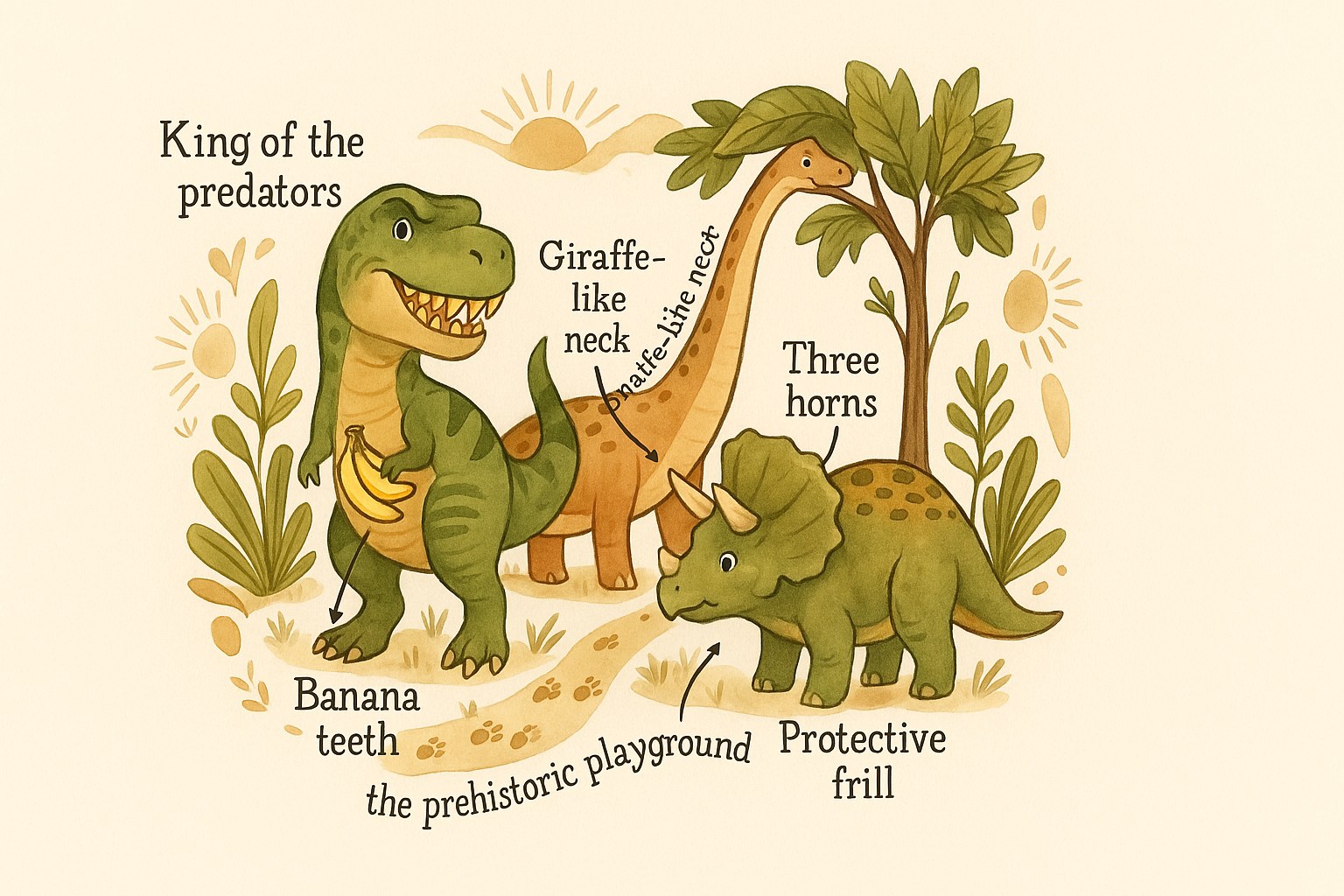
The T-Rex was the true king of the predators. Its head was enormous, with a super-powerful jaw. It’s hard to picture how big its teeth were. They were as big as bananas.
To help you imagine it, this animal was impressive in size. It was as long and as tall as a big school bus. That’s quite a beast in the playground.
Its little arms often make us laugh. Even so, it stayed downright fearsome.
🦕 The Diplodocus and its giraffe-like neck
Here’s a peaceful giant that ate only plants. Its long neck helped it reach the treetops. It calmly nibbled the leaves of the tallest trees.
It never fought a Tyrannosaurus. They lived in different times. Millions of years separate them in history.
Its huge tail worked like a whip to defend itself. It was a truly impressive animal because of its length.
🦏 The Triceratops with its three horns on the snout
Its head is one of a kind, with its three famous horns. A wide bony frill protected its fragile neck. It was a very effective natural shield.
You could compare it to a modern rhinoceros. It was, however, far more imposing. It walked heavily on its four sturdy legs.
Despite its warrior looks, it preferred to graze quietly. It was a very calm plant-eater.
🌿 How to tell plant-eating dinosaurs from meat-eaters
Spotting these colossal creatures is one thing, but understanding what they ate helps you picture their wild daily life.
🌿 The leaf-eaters with flat teeth
The shape of the teeth is the best clue. Plant-eaters had wide, very flat teeth. They were made for grinding tough branches. They’re a bit like our molars, only far tougher.
Here are their favourite foods:
- Tender ferns
- Damp mosses
- Leaves from giant trees
- Tree bark
They spent the whole day eating. They had to feed their enormous bodies.
🦅 The meat-hunters with razor-sharp claws
The predators had knife-shaped teeth. These teeth were often serrated to slice better. They let them grip the meat without letting go.
Their legs carried curved, pointed claws. These were essential for catching and holding their prey. They were their main tool for survival.
Meat-eaters often had a jaw able to apply several tonnes of pressure to break the toughest bones.
🔍 The tricks for recognising them at a glance
Looking at the position of the eyes is a great trick. Hunters have their eyes at the front to aim well. This helps them work out the exact distance to their meal.
Plant-eaters often have their eyes on the sides. This lets them watch for danger all around. They can see almost everything happening behind them.
Also look at the number of legs. The fastest ones often ran on two legs. With that, explaining dinosaurs to children becomes child’s play.
🔬 The job of a palaeontologist explained simply
To know all of this, you need detectives of the past — passionate people who dig through the ground in search of clues.
⛏️ Searching for treasures hidden underground
The digging work takes endless patience. The experts use fine brushes to clear away the sand. Small precision tools keep them from damaging the fragile finds.
Fossilisation is an amazing natural process. Over time, sediment covers the remains. The bones then slowly turn into very solid, hard-wearing stone.
As early as the 19th century, the first pictures of dinosaurs appeared in books. These drawings were already trying to imagine these vanished creatures.
💀 Turning bones into museum skeletons
After the discovery, it’s off to the lab for the next step. The scientists clean each fragment with extreme care. They remove the rock to free the fossil completely.
Rebuilding a dinosaur is like a giant puzzle. You have to find the exact place of each vertebra. Sometimes pieces are missing and you have to guess the shapes. It’s real detective work.
Once it’s finished, the skeleton joins a museum. Children can finally admire it.
🐾 Discovering giant footprints
Studying footprints is fascinating. It reveals whether the animal walked alone. You can also tell if it lived in a tight group for protection.
Leftover nests are treasures too. They tell us how the parents looked after the little eggs. This proves that some dinosaurs were very caring.
Every clue helps us understand their lives better. It’s a science that takes a lot of observation.
🛠️ 3 hands-on dinosaur craft ideas
There’s nothing better than getting stuck in to turn your living room into a real prehistoric dig site.
🧂 Making salt-dough fossils
Whip up a homemade dough in no time. Simply mix two cups of flour with one cup of salt. Then add one cup of water to form a nice smooth ball.
Grab your figures of vanished reptiles. Press their feet firmly into the dough. You can also draw skeleton shapes to mix things up with the little ones.
Pop the creations in the oven at 100°C for one hour. Let these treasures cool down. Your explorers can then have fun hiding them and digging them up in the garden.
🌳 Creating a prehistoric trail in the garden
Set up an original obstacle game outside. The child has to copy the light flight of the Pteranodon. They can also mimic the heavy, powerful step of the famous Triceratops.
Set out zones using everyday objects. Use cushions to stand for cosy nests. Place basins of water to act as muddy swamps. Add a few funny obstacles to spice up the activity. It’s perfect for getting moving.
Imagination turns every bush into something new. It’s a complete adventure.
🥚 Cooking up colourful dinosaur eggs
Easily make hard-boiled eggs with a marbled look. Gently crack the shell after cooking. Then dip them in a mix of black tea and natural food colouring.
Peel off the shell to reveal the result. The egg then shows surprising geometric patterns. This visual experiment is great fun for children and sparks their natural curiosity.
The little ones love nibbling on their own find. It’s a fun way to shake up the usual menu. Explaining dinosaurs to children even works its way onto the plate!
🧸 Choosing the best toys and handling a dino obsession
To keep the adventure going, choosing the right gear and supporting this thirst for knowledge are key for parents.
🧸 Figures suited to each age
For ages 2-5, go for soft models. Gentle materials such as plush feel reassuring. Absolutely avoid small parts that could be swallowed.
For older children, choose excavation kits. These mini-archaeologist sets are captivating. They let kids scrape away the plaster to extract a skeleton in a realistic way.
| Age | Type of toy | Benefit | Safety |
|---|---|---|---|
| 2-4 years | Soft figures | Sensory awareness and handling | No small parts |
| 5-7 years | Puzzles and figures | Storytelling role-play | Sturdy CE plastic |
| 8 years+ | Excavation kits | Patience and discovery | Tool use |
❤️ Why do children love these creatures so much?
This passion helps develop their imagination. These vanished animals are both frightening and fascinating. They often serve as a way to tame childhood fears day to day.
Learning tricky names gives a real confidence boost. The child becomes the household expert on a precise subject. This mastery values their learning abilities in front of parents and friends.
Mastering complex scientific vocabulary from a young age boosts memory skills and intellectual curiosity.
🔬 Supporting this scientific curiosity day to day
Turn this obsession into a learning engine. Use dinosaur books to encourage reading. It’s a brilliant way to link enjoyment with discovering new words.
A visit to the natural history museum is ideal. Seeing real bones makes the knowledge concrete. It lets children grasp the immense size of these reptiles that once ruled the Earth.
Also encourage drawing and creating. It’s an open door to every science. A simple colouring page can become a lesson.
These amazing egg-laying reptiles, with their straight legs and fascinating fate, hold no more secrets for your little explorers. Make the most of this momentum to create your homemade fossils this very evening. Offer them this journey back to the age of dinosaurs to turn their curiosity into a true scientific calling. 🦖
🎬 Watch the video
❓ FAQ
🦎 Were dinosaurs a kind of giant lizard?
Not quite. Even though they belong to the reptile family, dinosaurs had a posture all of their own. Unlike lizards or crocodiles, which have legs on the sides and crawl, dinosaurs stood up nice and straight.
Their legs sat right under their body, just like today’s mammals or birds. This physical feature let them carry their weight and, for some, run very fast without dragging their belly on the ground.
👤 Did the first humans ever meet dinosaurs?
It’s a question children often ask, but the answer is a flat no. Dinosaurs died out around 66 million years ago, while the first humans arrived on the planet much later.
There’s a huge gap in time between us and these giants. Even in films, when we see them together, it’s only thanks to the magic of special effects. In reality, no human has ever seen a living T-Rex.
⏳ Did all the dinosaurs live at the same time?
We often picture one big party where all the dinosaurs hang out together, but that’s a little trap. They ruled during the Mesozoic era, which lasted 150 million years, split into three periods: the Triassic, the Jurassic and the Cretaceous.
For example, the famous Diplodocus and the fearsome Tyrannosaurus never met. The Diplodocus had already been gone for millions of years when the first T-Rex showed up.
🥚 How were baby dinosaurs born?
Like birds or tortoises, dinosaurs laid eggs. That means all the mother dinosaurs laid eggs. They built nests in the earth or sand to protect their future young.
The shape of the eggs varied from species to species: some were perfectly round like balls, while others were more stretched out. Scientists even think some dinosaurs sat on their eggs to keep them nice and warm.
🍖 How can we know what dinosaurs ate?
It’s real detective work that plays out at the jaw. Palaeontologists study the shape of the teeth: plant-eaters had flat, wide teeth for grinding plants and branches.
By contrast, meat-eaters had pointed teeth, often serrated like knives, to slice through flesh. The claws and the position of the eyes (facing forward for hunters) are also excellent clues about their diet.
