
Explaining the Moon to children can feel like a puzzle when bedtime brings a flood of questions about its ever-changing shapes. This article lifts the veil on the mysteries of our natural satellite by breaking down its phases, eclipses and role in the tides in simple words. 🌙 You’ll discover how this giant mirror shapes our oceans, why there’s no need to fear its red glow, and you’ll pick up some fun tips for spotting it together as a family right from your garden.
- The Moon: our neighbour in space
- The 4 secrets of the lunar phases
- Understanding eclipses without fear
- Why does the sea level change?
- Myths and facts about sleep
- 3 tips for watching the night sky
- Extreme conditions on the lunar surface
🌙 The Moon: our neighbour in space
Let’s take a look together at this big, bright rock that watches over our nights. The Moon, with its phases, eclipses and tides, is a thrilling adventure that begins right above our heads.
🛰️ A very close natural satellite
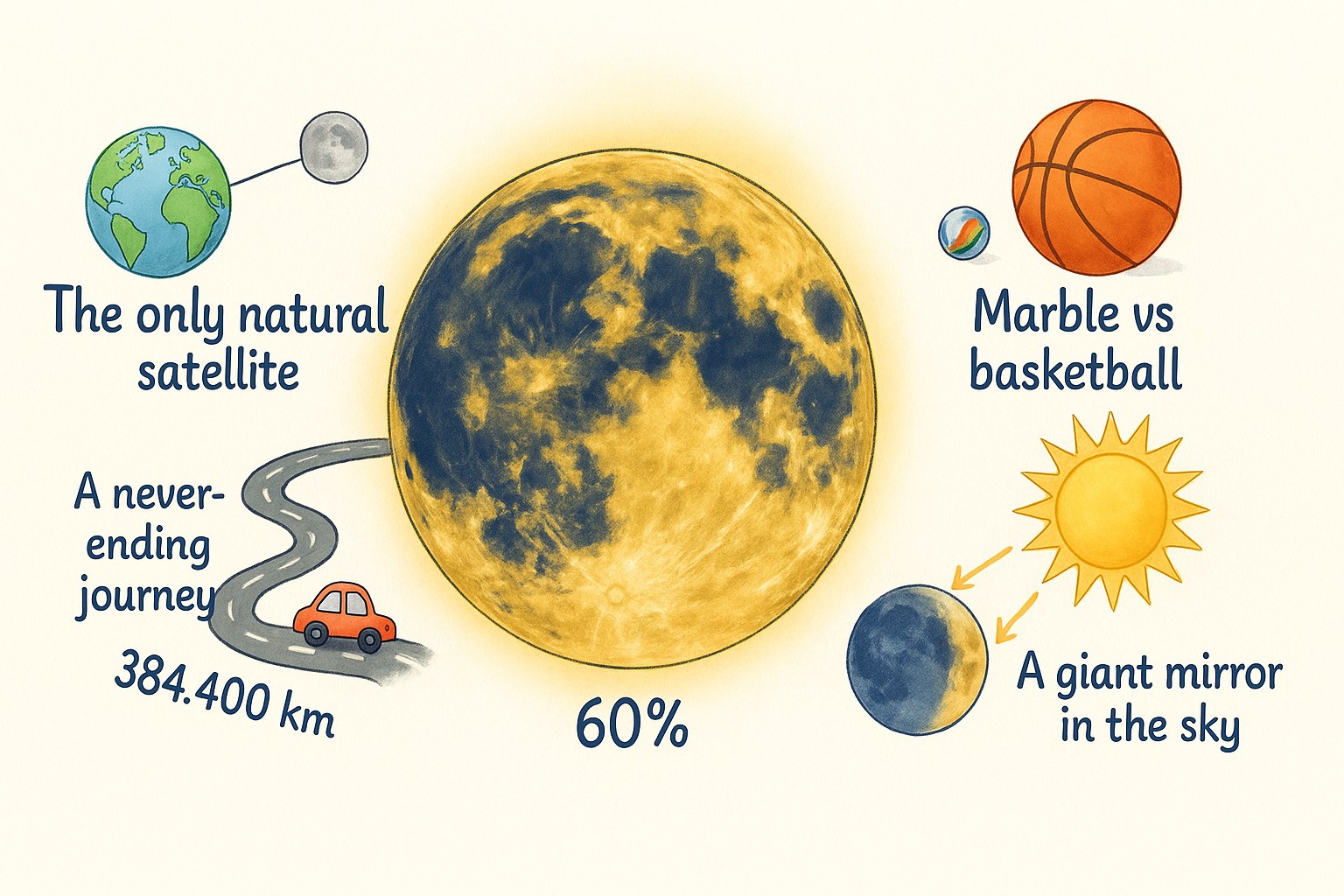
The Moon is the only natural satellite of the Earth. It orbits us without ever stopping its journey. It’s our most faithful companion in the vastness of space.
It sits 384,400 kilometres away from us. That’s enough room to line up all the planets in the Solar System. Even at that distance, it’s still our closest neighbour.
Do you really know this night-time friend? It has plenty of surprises in store.

📏 Marble-sized next to the Earth
The Moon’s diameter is far smaller than that of our blue planet. The Earth is much bigger and heavier. It towers over its small grey neighbour.
Picture a marble sitting beside a big basketball. That’s exactly the difference in size between them. You could fit fifty Moons inside the Earth.
The Moon is small, but it’s still very powerful. Its invisible force makes our oceans move.
✨ A giant mirror in the sky
This world doesn’t make its own light. It’s a dark rock that doesn’t shine on its own in the blackness. Without help, we wouldn’t see it at all.
The Sun’s rays bounce off the lunar surface and travel towards us. The Moon acts like a giant mirror that reflects the Sun’s brightness. That’s what lights up our gardens at night.
This gentle night-time glow puts us at ease. It guides our steps in the dark.
🌗 The 4 secrets of the lunar phases
Now that we know our neighbour a little better, let’s see why it seems to change its face from one day to the next.
📅 A 29-day cycle
One full lunar cycle lasts exactly 29.5 days. This unchanging cycle repeats every month. The Moon always keeps the same rhythm in the sky.
Following this journey through time is easy for families. You watch the changes night after night. It’s a great way to understand how time passes.
The Moon doesn’t really change shape; it’s only the way we see it that shifts over the course of the month.
🌒 Why does its shape change?
It all depends on where the Sun and the Earth are. Light and shadow play across the lunar surface. This game of hide-and-seek creates the shapes we see.
Here are the stages you can admire:
- The new Moon (invisible)
- The first crescent
- The first quarter
- The dazzling full Moon
These stages form an endless loop. It’s a free show you can enjoy from your own garden.

🔄 The hidden side and the spin
We always see the same side of the Moon. It spins on itself at the very same time as it travels around us. It’s a perfectly synchronised movement.
Picture a dancer keeping their eyes fixed on their partner. The Moon does exactly the same thing with the Earth. Its spin takes just as long as its orbit.
So the hidden side stays a great mystery. Nobody can see it from the ground. It’s a secret zone reserved for space probes.
These changes in shape are regular, but sometimes the sky treats us to a far rarer and more impressive show.
🌑 Understanding eclipses without fear
🌚 When the Moon hides the Sun
During a solar eclipse, the Moon, the Earth and the Sun line up perfectly. The little Moon passes right in front of the big Sun. It suddenly plunges us into shadow.
You absolutely must protect children’s eyes with special glasses that meet the ISO 12312-2 standard. Never look straight at the Sun without this protection. An eye burn is painless but can sadly cause blindness.
It’s a magical moment. The day turns into a strange night.
🌑 The Earth’s shadow on the Moon
A lunar eclipse is a different but equally fascinating event. This time, it’s our Earth that casts a shadow on its little neighbour. It slips in between the Sun and the Moon.
This show is very easy to watch from the ground. Unlike the Sun, you can watch the Moon grow darker with no danger at all. Your children won’t need any special gear.
The Moon seems to fade out slowly. It looks as if it’s walking into a big dark room.
🔴 Surprising red colours
The coppery tint comes from the Earth’s atmosphere, which acts like a filter. Our air scatters the blue colours. It only lets the red rays through to the Moon.
This spectacular event is completely natural and can be predicted by astronomers’ calculations. It isn’t a bad omen. It’s simply a wonderful physics lesson in the open air for little ones.
People call it a blood Moon. The name sounds dramatic, but the result is gorgeous.
🌊 Why does the sea level change?
If the Moon plays with light, it also has an invisible power over our oceans.
🧲 The pull of the lunar magnet
The Moon pulls the ocean water like a giant magnet, thanks to gravity. It’s fascinating.
In practice, the Moon tugs hard on the sea. This creates a sort of big bulge of water on the Earth. The ocean then rises up towards the sky. This is what we call high tide, quite simply.
This power stays completely invisible to our eyes. Yet it shifts billions of litres of water. This enormous movement repeats every day without a sound. Nature is wonderfully clever.
🌊 Why the water moves but we don’t
The ocean is a huge mass, but it’s very fluid. Water slides and changes shape easily when a world pulls on it. It’s far more flexible than a solid object.
For children, the physical effect is non-existent. We’re far too light and small for that. The Moon absolutely cannot lift us off the ground.
So rest assured on this precise scientific point. Your body doesn’t feel the Moon’s gravity. The Atlantic Ocean, on the other hand, is vast enough to react to it.
☀️ The Sun’s part in the tides
Sometimes the tides are very strong and impressive. Other times they’re more shy. We then talk about spring tides or neap tides.
It all depends on how the two bodies line up in the sky. When the Sun and the Moon pull together, the water rises higher. It’s their forces added up.
It’s a real team effort between the stars. Nature follows a well-oiled mechanism.
😴 Myths and facts about sleep
Since we’re talking about influence, it’s time to tackle the stories people tell about our restless nights.
😴 Does the full Moon keep you awake?
Science stays doubtful on this one. No real proof links the lunar phases to sleepless nights. Researchers haven’t found any solid connection in their work.
In the old days, night-time brightness played a major part. Without electricity, a bright Moon shone straight into bedrooms. This natural light could then wake sleepers more easily than a pitch-black night.
Today, our closed shutters block this light well. Sleep tight, the Moon isn’t watching you.
🧒 Is children’s restlessness linked to the Moon?
The beliefs about mood swings are often groundless. Children don’t get grumpier because of the full Moon. International studies show no spike in physical activity.
Confirmation bias plays a big role for parents. We notice the usual restlessness more when we see the round Moon. We then wrongly link the child’s excitement to the lunar phase.
It’s a simple psychological coincidence. Science is clear on this precise point.
🐠 Sea animals and their cycles
Animal behaviour is very different from the human biological cycle. Some shellfish use the tides exactly to move around. They match their swimming rhythm to these water movements in order to feed.
Only certain sea animals have this special sensitivity. For them, the Moon works as a vital clock. It keeps them alive in the vastness of the ocean across the gravitational cycles.
But for us land mammals, it changes nothing. We aren’t crabs.
🔭 3 tips for watching the night sky
To check all this for yourselves, nothing beats a little family stargazing session.
📓 Keeping a monthly logbook
Suggest drawing the shape you see each evening. It’s a brilliant activity for understanding how the heavenly bodies move while having fun. That way you watch the Moon grow then shrink.
Encourage doing it regularly over a 30-day stretch. Note the weather and the Moon’s colour too, to become a real little expert. It’s rewarding to watch the full cycle take shape before your eyes.
A simple notebook and a pencil are all you need. It’s the start of a great scientific adventure.
🔭 Binoculars or the naked eye
It helps to give advice on simple kit for beginners. Your own eyes are already excellent tools for admiring the craters and the seas. Earthshine looks gorgeous then.
The trick is to move away from city lights. Look for a really dark spot to see every detail of the lunar surface. The relief stands out better far from streetlamps.
Here are a few must-haves:
- Bring a blanket
- Use binoculars
- Pick a cloudless evening
🏥 A closer look at “children of the Moon” disease
Xeroderma pigmentosum is a rare genetic condition. It has nothing to do with astronomy or the heavenly bodies. It’s an extreme sensitivity to the Sun’s UV rays.
The name comes from the strict sun protection these patients need. These children can only go out at night to protect their fragile skin. Their body can’t repair the damage to its DNA.
It’s important to understand this difference. The Moon is their friend, not their enemy.
🌡️ Extreme conditions on the lunar surface
To round off our journey, let’s imagine that we set foot on this grey, mysterious ground.
🤫 Total silence with no atmosphere
The air is completely missing up there. With no gas to carry the vibrations, no sound travels at all. On the Moon, you could shout very loudly and nobody would ever hear you.
The sky stays a deep black, even in broad daylight. No atmosphere scatters the sunlight to create any blue. Space stays dark despite the burning Sun right overhead.
It’s a world of absolute silence. It’s rather strange when you think about it.
🌡️ Temperatures that swing wildly
The thermometer shoots up or crashes down very suddenly. The Moon, with its phases, eclipses and tides, clearly shows this lack of thermal protection.
The lunar thermometer goes from 127 degrees in the daytime to -173 degrees at night.
| Feature | Earth | Moon |
|---|---|---|
| Max temperature | 58°C | 127°C |
| Min temperature | -89°C | -173°C |
| Breathable air | Yes | No |
| Liquid water | Yes | No |
Life is impossible without very special equipment. Our planet is a cosy nest compared with this desert of ice and fire.
🚫 No wind and no rain
Up here, footprints last forever. With no wind to wipe them away, the astronauts’ boot marks are still visible today on the ground. It’s a real time capsule.
The ground is covered in regolith. It’s a grey dust that’s very fine and, above all, very sharp. This scratchy powder clings to everything and can even damage the explorers’ suits.
Nothing ever moves up there. Time seems to have stopped forever.
Understanding the Moon, its changing phases and its role in the tides becomes child’s play with a little observation. Grab your binoculars tonight to admire this giant mirror before the clouds roll in. Turn every night into a memorable space exploration as a family.
🎬 Watch the video
❓ FAQ
🌗 Does the Moon really change shape during the month?
Not at all, don’t worry! The Moon always stays one big ball of rock. What changes is simply the part the Sun lights up and that we can see from our garden. It’s a bit like circling around a lamp with a ball: depending on where you stand, you don’t always see the light the same way.
This magical cycle, called the lunar cycle, lasts about 29.5 days. During that time, the Moon goes through different stages, from the new Moon (where it hides) to the bright full Moon, before starting its journey again.
🔴 Why does the Moon turn all red during an eclipse?
It’s a gorgeous sight sometimes called a “blood Moon“. It happens during a total lunar eclipse, when the Earth lines up exactly between the Sun and the Moon. Our planet then casts its shadow on its little neighbour.
The Earth’s atmosphere filters the Sun’s light and only lets the red rays through, and they colour the lunar surface. It’s a completely natural event and harmless to your eyes, unlike solar eclipses, which need special glasses.
🌊 How can the Moon move the water in our oceans?
The Moon acts like a giant invisible magnet! Even though it’s far away, its gravity pulls on the ocean water. That’s what creates the tides: the water rises and falls twice a day along our coasts.
Sometimes the Sun lends the Moon a hand. When they’re well lined up, they pull together very hard and this creates big tides. It’s a real dance between the heavenly bodies that shifts billions of litres of water without a sound.
🤫 Can you hear any sounds if you walk on the Moon?
It’s total silence up there! Because the Moon has no atmosphere (there’s no air), sound can’t travel. Even if you tried to shout very loudly or pop a balloon, nobody could hear you.
It’s a very quiet world where nothing moves, because there’s no wind or rain to wipe away the marks. In fact, the first astronauts’ footprints are still there, exactly as they were on the first day!
🌡️ Why is it so cold or so hot on the lunar ground?
On the Moon, there’s no little blanket of air like on Earth to balance the temperature. It’s the land of extremes: in the daytime, the Sun beats down hard and it can reach 127 degrees. That’s much hotter than a baking oven!
As soon as night falls, the big freeze sets in with temperatures dropping to -173 degrees. Without a very sophisticated spacesuit to protect them, astronauts couldn’t cope with these drastic temperature changes.
