
Explaining pollution and global warming to young children can sometimes feel like a puzzle with no solution. This article introduces renewable energy, such as solar, wind and water power, to turn these tricky ideas into a positive adventure for the whole family. 🌱 You’ll discover secrets about the power of water and pick up tips to become a little hero for nature, thanks to simple actions and fun experiments.
- Understanding renewable energy and our needs
- Why fossil fuels tire out the planet
- How do the Sun and the wind make electricity?
- 3 secrets about the power of water and the Earth
- Using plants and insulating your home better
- What simple actions turn you into a little hero?
🌱 Understanding renewable energy and our needs
Energy isn’t an abstract or magical idea. It’s a very real force that powers our daily life, before we discover what a renewable source really is.
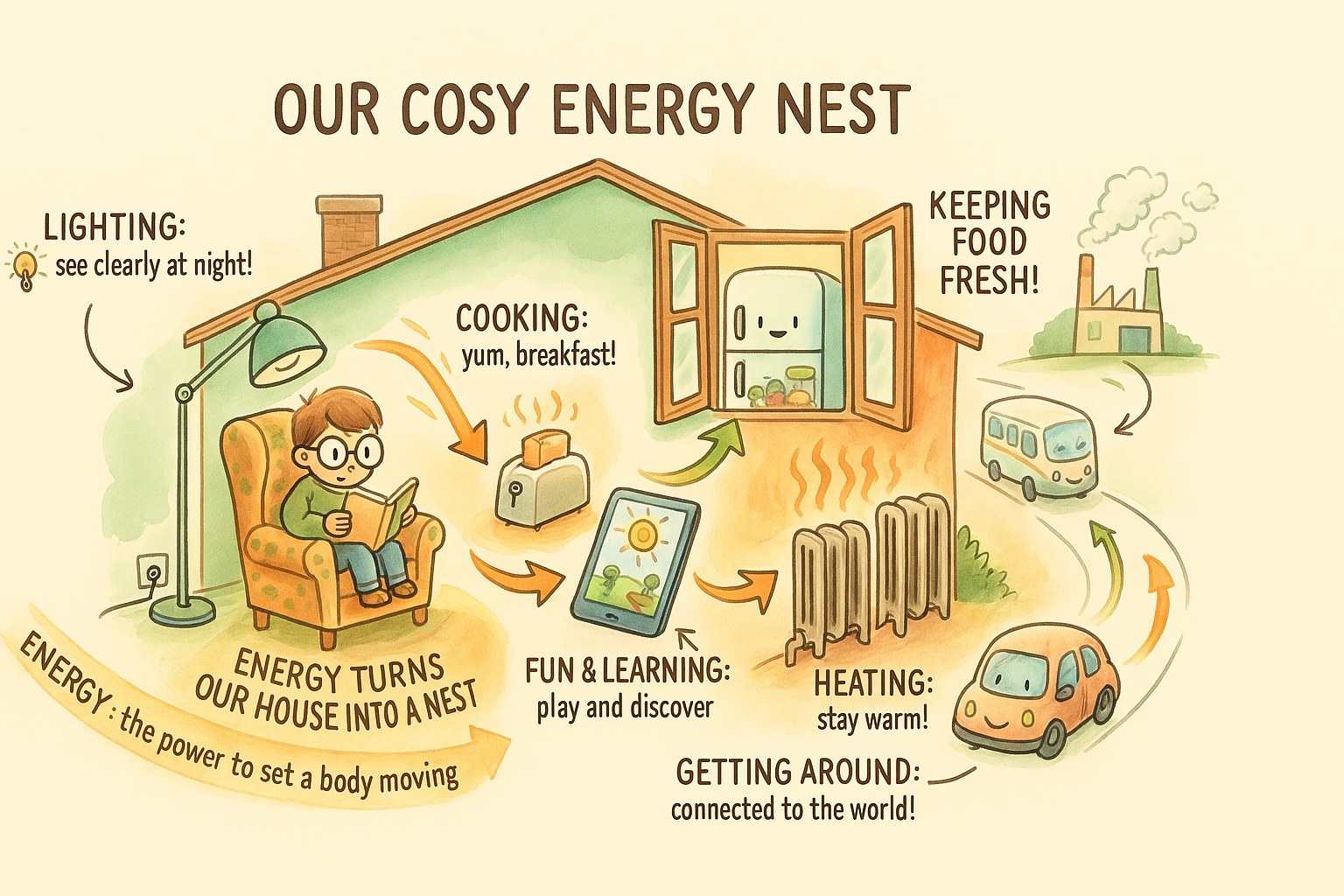
🏠 What is energy for in our home?
Look at your toaster or your games console. Without electricity, these objects stay completely still. They’re just useless boxes in the kitchen or the living room.
The fridge also keeps your milk nice and cold. The television and tablets need this power to work too. All of it uses an invisible but essential force for our fun.
Energy is the ability to do work or to cause a change. Without it, nothing happens in our homes.
💡 The need for heating and lighting
Switching on a lamp lets you read or play in the evening. Without bulbs, we’d be in total darkness as soon as the Sun sets. It’s an essential need for living comfortably.
In winter, radiators keep us nice and warm. Heating a room takes a lot of electrical power. It’s a bit like making a little Sun in your living room.
Modern comfort relies on these systems. Heating and light turn our homes into cosy nests all year round, whatever the weather outside.

⚡ Why energy is all around us
Watch the buses or cars in the street. Factories also need power to make your favourite toys. Absolutely nothing can move on its own.
Every movement needs a real physical force. It’s like your muscles when you run fast. The whole Earth uses engines or heat to keep working all the time.
- Transport for travelling
- Industry for making things
- Technology for communicating
In short, energy is the engine of our lives. Understanding renewable energy — solar, wind and water power — shows how nature helps us keep this world turning without using it up.
🌍 Why fossil fuels tire out the planet
Now that we’ve seen our needs, let’s understand why our current methods, based on old coal, cause a serious problem for our environment.
⛏️ Why fossil resources end up running out
Oil and coal are old buried remains of plants. They took millions of years to form under the ground. They’re an ancient treasure.
These stocks don’t renew themselves at all. Once we’ve burnt them all, there’s none left. It’s like a jar of jam that you empty without ever refilling it.
Coal and gas are non-renewable resources. They’ll end up disappearing completely.
🌡️ The greenhouse effect, explained simply for kids
Imagine a too-warm blanket laid over the Earth. The smoke from factories creates a layer of gas that traps the Sun’s heat. The planet starts to sweat.
The glaciers melt and the weather turns strange. The greenhouse effect is the result of too much pollution in the air, which throws our climate off balance.
Fossil fuels are responsible for about 75% of the world’s greenhouse gas emissions, which is causing today’s climate crisis.

♾️ The secret of endless natural resources
There are forces that never stop, like the wind or the Sun. Unlike oil, they come back every morning. It’s an incredible bit of luck for us.
The wind is far cleaner than black smoke. Green energy doesn’t give off nasty gases. It leaves the sky blue and the air pure.
Using renewable energy helps protect animals and forests for a very long time. It’s our brightest hope for tomorrow.
☀️ How do the Sun and the wind make electricity?
Since we know fossil fuels are running out, let’s now see how the magic of technology turns light and air into electricity.
☀️ How solar panels work
Silicon cells catch the light. The Sun’s rays hit the panel and set tiny grains of energy moving. That’s the start of the electric current.
A special box changes this force so it can light up your lamps. It works even when there are a few clouds in the sky. It’s a really handy solution for the home.
The Sun is the most abundant energy resource. It shines for everyone.
🌬️ How wind turbines catch the power of the wind
The wind blows and turns the blades like a big modern windmill. It’s a dance with the air that creates power. The blades catch every gust.
Inside, a coil spins very fast thanks to the movement of the blades. This spinning makes electrons that then travel through the cables. The generator turns all of this into electricity.
Wind power uses the kinetic energy of the wind to power whole towns with no pollution at all. It’s clean and efficient.
⚡ The link between wind speed and electricity
The faster the blades turn, the more the motor makes electricity. It’s a matter of rhythm and natural force. The wind has to be fairly steady.
The machines are often placed on hills or out at sea. Up there, nothing stops the wind, giving maximum output. The location makes all the difference.
Here’s a quick summary:
| Energy source | Natural element used | Capture device |
|---|---|---|
| Solar | Sun | Panel |
| Wind | Wind | Wind turbine |
| Hydro | Water | Dam |
Renewable energy — solar, wind and water power — is, in the end, fairly simple to understand.
💧 3 secrets about the power of water and the Earth
The Sun and the wind aren’t alone; flowing water and the heat deep underground also hide endless treasures of energy.
💧 The power of dams and turbines
Water falls with huge force to turn a wheel. This fall then sets turbines spinning. They hide at the bottom of great concrete walls.
We keep water high up in lakes to use it later. It’s a precious reserve for whenever we need it. It’s like a huge natural battery, ready to use at any moment.
Remember that hydroelectricity is the biggest source of green energy for making our electricity today.
🌋 The natural heat of the ground with geothermal energy
The centre of the Earth is scorching hot. Beneath our feet there’s hot rock and steam. It’s a sort of giant, free boiler.
We send water down into the ground so it heats up. Then it rises back to the surface. This heats homes or powers machines. It’s clever.
This technique is called geothermal energy. It works day and night, whatever the weather or the season.
🌊 Why water is an incredible force
The sea moves all the time thanks to the Moon. These are the tides and currents. We put propellers underwater to catch this never-ending movement.
The force of a river is like a powerful engine. Water weighs far more than air. As it rushes by, it can break rocks or light up homes with no effort.
The island of El Hierro uses water and wind. That way, it manages to be completely self-sufficient and green.
🌿 Using plants and insulating your home better
Beyond the elements, we can also rely on the plant world and on clever building to use less and use it better.
🪵 Using wood and waste as fuel
Biomass uses living matter to heat us. Burning branches or compressed wood pellets lets us make heat naturally. Trees grow back, so this resource renews itself again and again.
Our leftover food can also ferment in big tanks with no oxygen. This process releases a special gas, biogas, which we then burn. It’s a clever way to turn our peelings into useful energy for the home.
Nothing is wasted. Even our bins become a precious resource for protecting the planet.
🚗 The impact of transport on our environment
A petrol car gives off gases that warm up the Earth. The bicycle is much cleaner for the air. It only uses the strength of your strong legs to move along without polluting.
Modern electric buses and trains are great allies. They carry lots of passengers using clean energy. It’s far more efficient than having hundreds of small, noisy cars in town.
Here are a few good habits:
- The bike for short trips
- The train for holidays
- The electric bus in town
🏠 Insulating your home to keep the heat in
Windows and walls act as a barrier. If the house has gaps, the heat quickly escapes outside. So you need to give the walls a good coat to stay nice and warm.
A well-insulated home no longer needs to heat very hard. It’s the most effective thing you can do to save nature’s resources. You use less energy while staying comfortably settled at home.
Thermal insulation is fundamental. It’s like wearing a thick wool jumper when it’s cold, but for your home.
🦸 What simple actions turn you into a little hero?
Now that you’re an expert, here’s how to take action with fun experiments and champion eco-habits.
🛠️ Building a mini wind turbine or a solar oven
Use cardboard and paper to make a windmill. Cut out light blades and fix them onto a kebab stick. Blow hard to watch them spin with delight.
Then test the heat in the garden. Put a cardboard box with foil lining and a glass cover facing the Sun, with a square of chocolate inside. The natural rays will melt the snack quickly. It’s magic.
These little DIY projects prove that nature is an incredible source of power.
♻️ A sorting game between clean and polluting energy
Set up a fun sorting exercise. Draw two columns on a blank sheet. On one side, put the Sun and the wind; on the other, oil and black coal.
Then check what you’ve learnt about natural sources. Ask your friends to guess which ones never run out. It’s perfect for learning while having fun with family or friends.
“More than 90% of the growth in world electricity demand was met by renewable energy last year.”
💡 The right habits to save energy at home
Pick up habits like switching off the lights when you leave. Don’t let the hot water run too long in the shower. Every little action counts to save the polar bears.
Keep an eye on the family’s energy use. Become the energy guardian at home. Gently remind your parents to switch off the television when nobody is watching the living-room screen.
By taking on these eco-habits, you become a true protector of our beautiful blue planet.
The Sun, the wind and water offer endless resources to protect our sky. By taking on eco-habits and understanding this renewable energy explained for kids, everyone becomes a hero of the planet. Let’s act fast to give a fully green future to the generations to come!
🎬 Watch the video
❓ FAQ
🌱 What exactly is renewable energy?
To put it simply for children, it’s energy that comes from natural sources that never run out. Unlike coal or oil, which take millions of years to form, the Sun, the wind and water are always there, ready to offer us their power every day.
We say they renew themselves naturally. It’s a bit like a magic well that fills back up on its own as you draw water from it. It’s an incredible chance to protect our lovely blue planet while still enjoying modern comfort.
☀️ How can the Sun make electricity?
It’s thanks to solar panels, often fitted on the roofs of houses. These panels contain special cells that catch the light. When the Sun’s rays hit these cells, it creates a tiny movement of energy that then turns into electric current for the home.
The Sun is the most abundant energy resource on Earth. Even when there are a few clouds, the panels keep working. It’s a very clean solution that can heat water or switch on lamps without polluting.
🌍 Why do people say fossil fuels are bad for the Earth?
Fossil fuels, like coal or gas, give off lots of smoke and invisible gases when we burn them. These gases create a sort of too-thick blanket around the Earth, which holds in the heat: this is what we call the greenhouse effect. As a result, the planet catches a fever.
On top of warming the Earth, these resources will eventually disappear because the stocks are limited. Once the jam jar is empty, there’s none left! That’s why it’s urgent to turn to gentler, endless solutions.
🌬️ Is wind enough to light up a whole town?
Yes, thanks to wind turbines! The wind turns big blades, a bit like the sails of a windmill. This movement powers a motor inside the machine that makes electricity. We call this kinetic energy, which means the energy of movement.
The harder the wind blows, the more power the turbine produces. That’s why they’re often placed in nice open spots, like out at sea or on hills. It’s a natural method that gives off no nasty gas into the air.
💧 Can you really make energy with water?
Absolutely, this is what we call hydroelectricity. In fact, it’s the most widely used source of green energy today for making electricity. We use the force of falling water, for example in a dam, to turn big wheels called turbines.
Water is a very powerful force of nature because it’s far heavier than air. By storing water in big mountain lakes, we can choose to produce energy exactly when families need it most, like in the evening when everyone switches on their lights.
🌾 What is biomass and how does it work?
Biomass is the energy we get from organic matter, like wood or even our food waste. For example, we can burn wood pellets for heating. Since trees grow back, it’s energy that renews itself if we look after our forests well.
We can also turn our leftover food into gas in big tanks. Nothing is wasted! It’s a very clever way to make use of what we usually throw away, to create heat or electricity while taking care of the environment.
