
🐋 Explaining to your children why the blue whale beats the dinosaurs can quickly turn into a puzzle without the right numbers. This complete guide walks through the biggest animals in the world, with records and fact files, so you can answer their endless curiosity with concrete comparisons. You’ll uncover incredible secrets, like a heart the size of a car or tongues that weigh as much as an elephant — plenty to shine with at the next homework session.
- The blue whale, the largest animal in the world
- The African elephant, the giant of the land
- The giraffe, a silhouette above the trees
- The whale shark, a huge and peaceful fish
- The saltwater crocodile, a giant from the past
- The ostrich, the champion of the birds
- The colossal squid, the hidden titan of the oceans
- The polar bear, the white lord of the ice
- The reticulated python, a truly record length
- Why do some animals grow so big?
🐋 The blue whale, the largest animal in the world
After flying over the variety of life, we have to start with the absolute king of the oceans, the one that smashes every record for sheer mass.
📏 Sizes that are hard to imagine
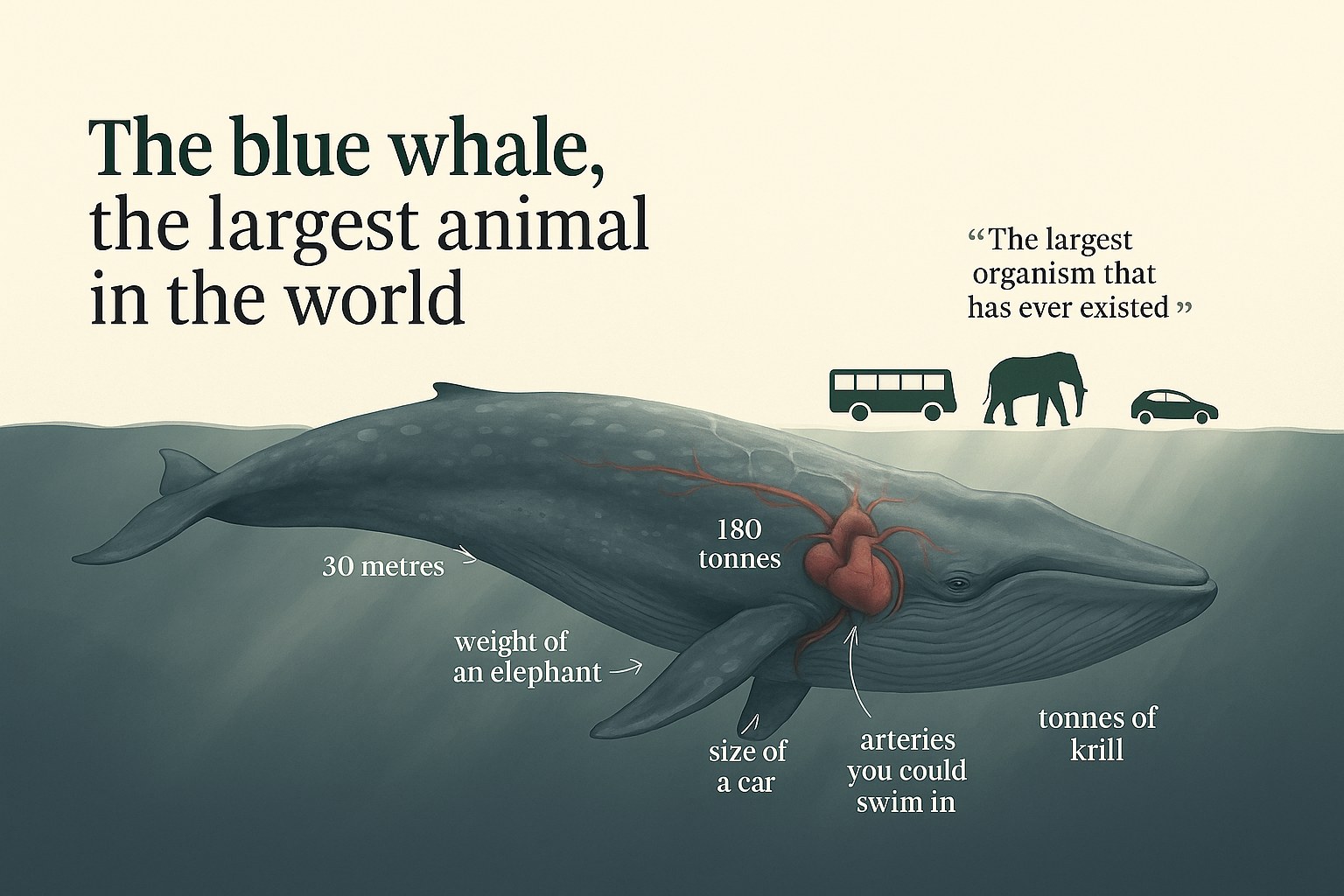
This colossus reaches 30 metres long. Its weight of 180 tonnes is the same as a whole fleet of buses. The giant size of these cetaceans really is hard to picture.
Its tongue is simply enormous. It weighs as much as a full-grown elephant, which is utterly mind-blowing.
❤️ A heart and organs beyond compare
Its heart is the size of a car. Its arteries are so wide that a person could swim through them without any trouble.
The animal filters a colossal amount of water. Each mouthful gulps down tonnes of krill. It’s a perfectly tuned biological machine.
🦕 Compared with the giants of prehistory
It beats the dinosaurs thanks to the water. Buoyancy holds up this record weight. On land, no animal could have survived at that size.
The blue whale isn’t just a giant of the seas — it’s the largest living thing that has ever existed, bigger even than the most colossal dinosaurs.
The species leaves its mark on the history of Earth. It stands for the high point of giant size in animals today.
🐘 The African elephant, the giant of the land
If the whale rules the water, the throne of dry land belongs without question to a titan with enormous ears.
⚖️ A heavyweight of the savanna
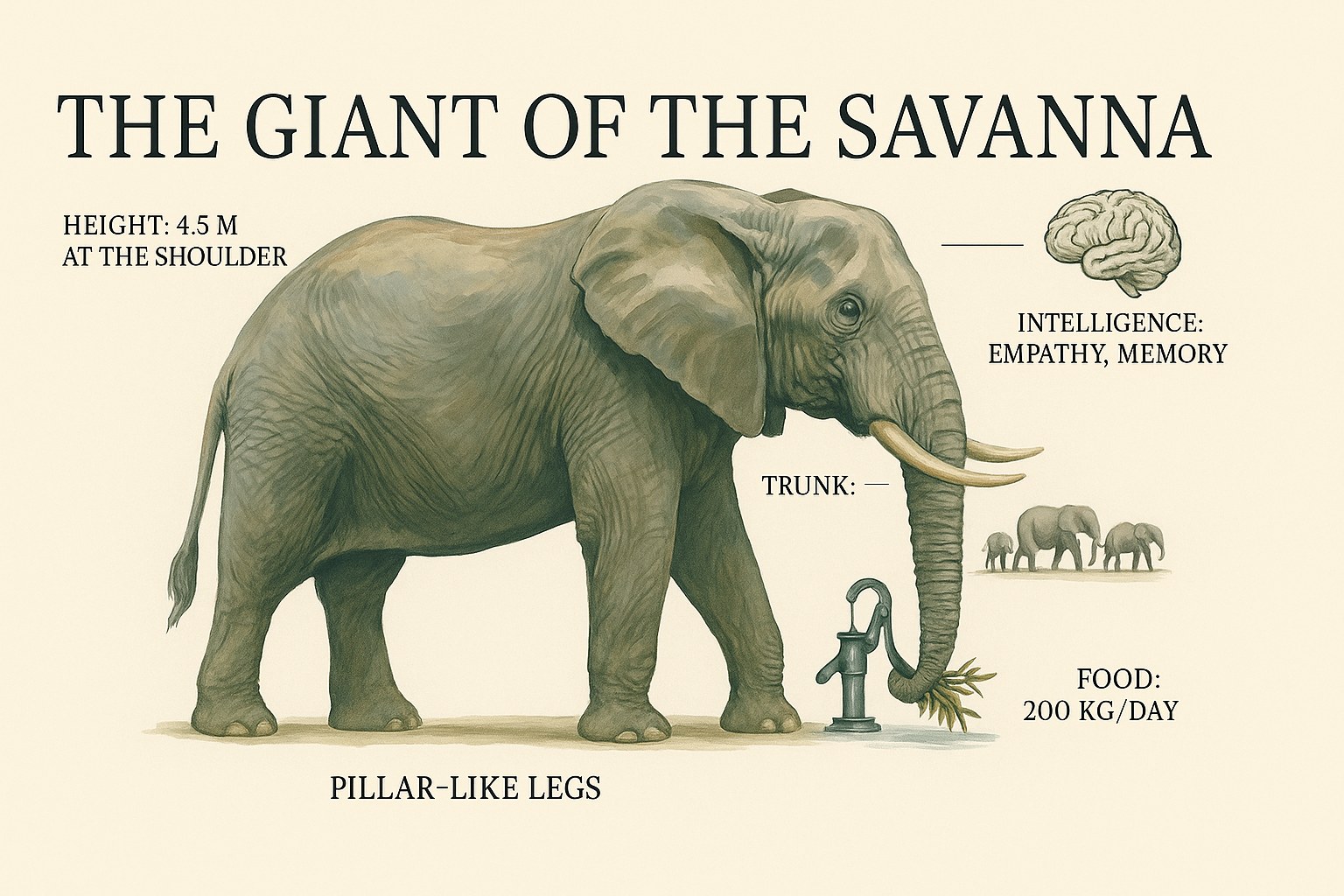
This giant reaches 4.5 metres at the shoulder. Males often weigh 6,000 kg. Their massive skeleton holds up that impressive bulk.
Their legs look like sturdy columns. This special structure supports their record weight very efficiently.
🌿 A diet to match its size
It swallows 200 kg of plants a day. The elephant nibbles non-stop to feed its huge body. It’s a full-time job.
Its trunk is a brilliant jointed arm. It pumps up water and grabs leaves. Without that tool, it couldn’t survive.
🧠 The brains and social life of the land giants
Their thinking skills are astonishing. Their large brain handles complex emotions. They show empathy and even grieve with touching sincerity.
The matriarch leads the herd. Her memory guides everyone towards water. Her experience often saves the whole family.
🦒 The giraffe, a silhouette above the trees
Let’s leave the raw power of the elephant to look at a piece of biological engineering, all height and grace.
📐 A height that makes you dizzy
This giant can reach 6 metres tall. Its neck stays graceful despite having just seven very long bones. Its front legs are especially huge compared with the rest of its body.
This unique build makes it easy to watch over the savanna. It spots predators from a long way off to stay safe.
🩸 The blood-flow challenge
The blood has to climb all the way up to the brain against gravity. So the heart pumps with incredible force. The measured blood pressure is twice as high as ours.
Special one-way valves protect its blood vessels. This stops a sudden rush of blood to the head when it lowers its neck to drink.
🌳 Feeding high up in the treetops
Its blue, grasping tongue cleverly takes hold of plants. It grabs acacia leaves without ever getting pricked by the thorns.
That’s a huge advantage for the species. It faces no competition for food up high. It’s its very own protected ecological niche.
🦈 The whale shark, a huge and peaceful fish
Let’s go back below the surface to meet a giant that, despite its name, is completely gentle.
🏆 The size record among fish
This colossus regularly reaches 18 metres long. Its huge weight is much like that of a big lorry. Its tough skin is as thick as leather armour.
It’s officially the largest cartilaginous fish. It glides very slowly through the tropical waters of the world.
🦐 A diet built on the tiny
This giant uses passive filtering. It simply swims with its mouth open to catch plankton and small fish.
Its gill slits have a unique structure. They work like giant, very efficient sieves. In the end, this colossus feeds on the smallest things in the sea.
⏳ Slow growth and a long life
Its lifespan often passes a hundred years. It becomes able to have young very late, around 30. Sadly, this makes the species extremely vulnerable to outside threats.
Fishing and shipping are real dangers. Protecting it has become a worldwide priority.
🐊 The saltwater crocodile, a giant from the past
From the blue waters to the muddy estuaries, we now meet a predator that seems to have forgotten to die out with the dinosaurs.
🦖 Dinosaur measurements on a reptile
Males show dizzying sizes, sometimes more than 7 metres. Their mass easily passes the one-tonne mark. This species completely overshadows the other crocodiles of our time.
It’s a real prehistoric monster. Its huge size lets it take on buffalo or even sharks.
🦷 A phenomenal bite
Its bite force holds the absolute record in the animal world. Once the prey is caught, it has no chance.
This reptile prefers ambush hunting, staying still for hours. Then it lunges suddenly at its target. The way it copes with salt is unique in the world.
👑 A predator at the top of the chain
Its huge territory stretches from India to Australia. It rules without rival over coasts and rivers alike. Its fierce reputation has become legendary over the centuries.
Its territorial behaviour is ferocious. It tolerates no intruder on its patch, whether human or animal.
🦓 The ostrich, the champion of the birds
Let’s leave those steel jaws for the African plains, where a bird has swapped its wings for legs of fire.
🦤 A bird taller than two metres
This bird reaches 2.7 metres tall. It holds the weight record for a living species. Its heavy body and small wings make it completely unable to fly.
Yet it makes up for it with extraordinary stamina. It’s a true force of nature every single day.
💨 Record strength and speed
Its top speed nearly hits 70 km/h. So it can outrun most predators.
The power of its back legs is phenomenal. A single well-placed kick can kill a lion. Its size stays its best line of defence against danger.
🥚 The features of those giant eggs
The egg weighs up to 1.8 kg and measures 18 cm. It’s the biggest single cell in the world. Its shell is incredibly tough under pressure.
The birds brood in groups. Several females lay in the same nest. This helps to give the chicks the best chance of survival.
🦑 The colossal squid, the hidden titan of the oceans
Now let’s dive into the icy depths of Antarctica, where ocean nightmares take a very real shape.
🌊 Mysterious sizes in the deep
Its length is thought to be 14 metres. It turns out to be bulkier than the famous giant squid. Its tentacles have terrifying rotating hooks.
We only know it from a few rare specimens. It remains one of the great ocean mysteries today.
👁️ Giant eyes for seeing in the dark
Its eye is 27 centimetres across. That’s the size of a basketball, an absolute record on Earth.
This amazing eyesight helps in the depths. It picks up the glow of its prey. It sees perfectly where everything is pitch black.
⚔️ The epic battle against the sperm whale
Sucker marks are often found on sperm whales. These fights are among the most violent in nature. The squid defends itself fiercely.
It plays a major role in its ecosystem. It’s a vital food source for the great diving whales.
🐻❄️ The polar bear, the white lord of the ice
From the dark depths, let’s rise back to the harsh light of the Arctic to salute the largest land carnivore.
🐾 The biggest land carnivore alive today
Males reach an impressive weight, often up to 700 kg. Standing up, their size becomes enormous. This giant regularly outsizes the Kodiak bear on average too.
It’s the undisputed king of the pack ice. No other predator can match its quiet strength.
❄️ A body built for extreme cold
Its 10 cm layer of fat is vital. It works as an energy store and a perfect insulator.
The size of its paws helps it get around. They act like natural snowshoes. Its fur is actually see-through and hollow to trap heat.
🏊 An outstanding swimmer despite its bulk
The distances it swims are incredible. It can swim for days on end. Its hunting style relies on endless patience by the breathing holes.
Yet the melting ice is becoming alarming. Its habitat is shrinking, directly threatening the survival of this giant of the snow.
🐍 The reticulated python, a truly record length
Leaving the cold for the damp of the Asian jungles, where another length record slips by in silence.
🐍 The longest snake in the world
An official record confirms a length of 8 metres for this giant. That’s as long as a school bus. It lives in dense, damp tropical forests.
Its net-like pattern gives it perfect camouflage. It becomes almost invisible once it lies on the ground.
🌀 A hunting trick by squeezing
This predator pins down its prey by squeezing it. The gripping force it uses is absolutely colossal and deadly.
What it can swallow is surprising. It can gulp down deer or pigs. Its jaw stretches in an astonishing way for a meal.
📊 The difference between length and body mass
The python is longer than the green anaconda, but the anaconda is much heavier. These are two different ways of being giant. The biggest animals in the world, with their records and fact files, show us this variety.
Despite its huge size, it moves with ease. It stays a nimble, quick hunter as it slides along the ground.
🤔 Why do some animals grow so big?
After this tour of the titans, what lets an animal reach such extremes?
🌊 The physical advantages of life in the sea
Buoyancy helps. The water holds up the weight instead of the skeleton. This frees the body from the limits of growth.
Krill feeds gigantic bodies with no effort out on the open ocean. It’s an all-you-can-eat buffet.
🚧 The biological limits of being giant on land
On land, gravity shows no mercy. Weight quickly becomes a deadly enemy for the bones.
A big body heats up fast and eats a huge amount. It’s a delicate balance every day.
| Species | Record |
|---|---|
| Blue whale | 30 m / 180 t |
| African elephant | 4.5 m / 6 t |
| Giraffe | 6 m |
| Whale shark | 18 m / 20 t |
| Saltwater crocodile | 7 m / 0.5 t |
| Ostrich | 2.7 m / 160 kg |
🛡️ Why we must protect these vulnerable giants
Poaching threatens these colossi. They need vast spaces. Losing them throws the whole ecosystem off balance.
Protecting these umbrella species saves thousands of others. It’s a vital thing to do.
- Need for huge territories.
- Slow rate of reproduction.
- Sensitivity to the climate.
These fascinating records, from the blue whale to the giants of the land, reveal a fragile web of life we must protect urgently. To go on admiring the biggest animals in the world, let’s stay curious and watchful in the face of climate challenges. Nature offers us a grand spectacle that our children deserve to discover too. Let’s be the kind guardians of these giants.
🎬 Watch the video
❓ FAQ
🐋 What is the largest animal that has ever lived on our planet?
It’s the blue whale that holds this absolute record, beating even the biggest known dinosaurs. Reaching a length of 30 metres and a weight of up to 190 tonnes, it uses buoyancy to support a mass that no land skeleton could ever hold up.
To give you an idea of how huge it is, its heart is as big as a car and its tongue weighs as much as a whole elephant. It’s a true titan of the oceans that far outweighs Argentinosaurus and its estimated 90 tonnes.
🐘 Which mammal holds the weight record on dry land?
The title of biggest land heavyweight goes to the African savanna elephant. This colossus can weigh up to 6,000 kg and stand 4.5 metres at the shoulder, making it the undisputed king of the savanna for raw power.
Its legs are built like real columns to carry its phenomenal weight. To keep up such a frame, it has to eat around 200 kg of plants every day — quite a grocery bill if we had to cover it!
🦒 Why do giraffes have such high blood pressure?
The giraffe is the tallest animal, reaching 6 metres, which forces its heart to do a mammoth job. To get blood all the way up to its brain, 3 metres higher up, it has to keep a blood pressure twice as high as ours.
Nature is clever: its long legs help cut the energy its heart has to spend, and special valves stop blood rushing to its head too fast when it bends down to drink. It’s a feat of biological engineering.
🦈 What is the biggest fish you can come across at sea?
It’s the whale shark, a giant of the tropical waters that can reach 18 metres long. Despite being the size of a lorry and looking like a battleship, it’s a very peaceful swimming companion that feeds only on plankton and tiny fish.
This cartilaginous fish lives for a very long time, sometimes over a century, but it grows slowly. Becoming able to breed so late sadly makes it fairly vulnerable to changes in its environment.
🐍 Are there snakes longer than 7 metres?
Yes — the reticulated python is the length champion, with confirmed records of 8 metres, as long as a school bus. It hides in the Asian jungles thanks to perfect camouflage that makes it almost invisible on the ground.
While it’s the longest, it isn’t necessarily the heaviest. That title goes to the green anaconda which, though a bit shorter, has a far bulkier body that can reach 250 kg.
🦓 Which bird is considered the largest in the world?
The common ostrich is the all-round champion among our feathered friends. It can stand up to 2.7 metres tall and weigh 160 kg. Because of that record weight, it had to give up flying, but it more than makes up for it with its speed on the ground.
It’s also the one that lays the biggest eggs in the world. A single one of these “giant cells” has a shell so strong that it keeps the future chicks safe out on the African plains.
