
Watching a tiny grub nibble away at your roses can be annoying, but did you know that this hungry little appetite is getting ready for an incredible transformation? 🦋 This guide walks through every stage of the butterfly’s metamorphosis to help you understand how a simple caterpillar turns into a colorful flutterer. You’ll discover the secrets of the chrysalis, plus friendly tips for giving these precious pollinators a flowery home in your garden.
- It all starts with a tiny hidden egg
- The caterpillar, or the art of growing fast
- Why do some caterpillars spin a cocoon?
- The birth of a brand-new butterfly
- 3 everyday habits of the adult butterfly
- A few ways to give them a helping hand
🥚 It all starts with a tiny hidden egg
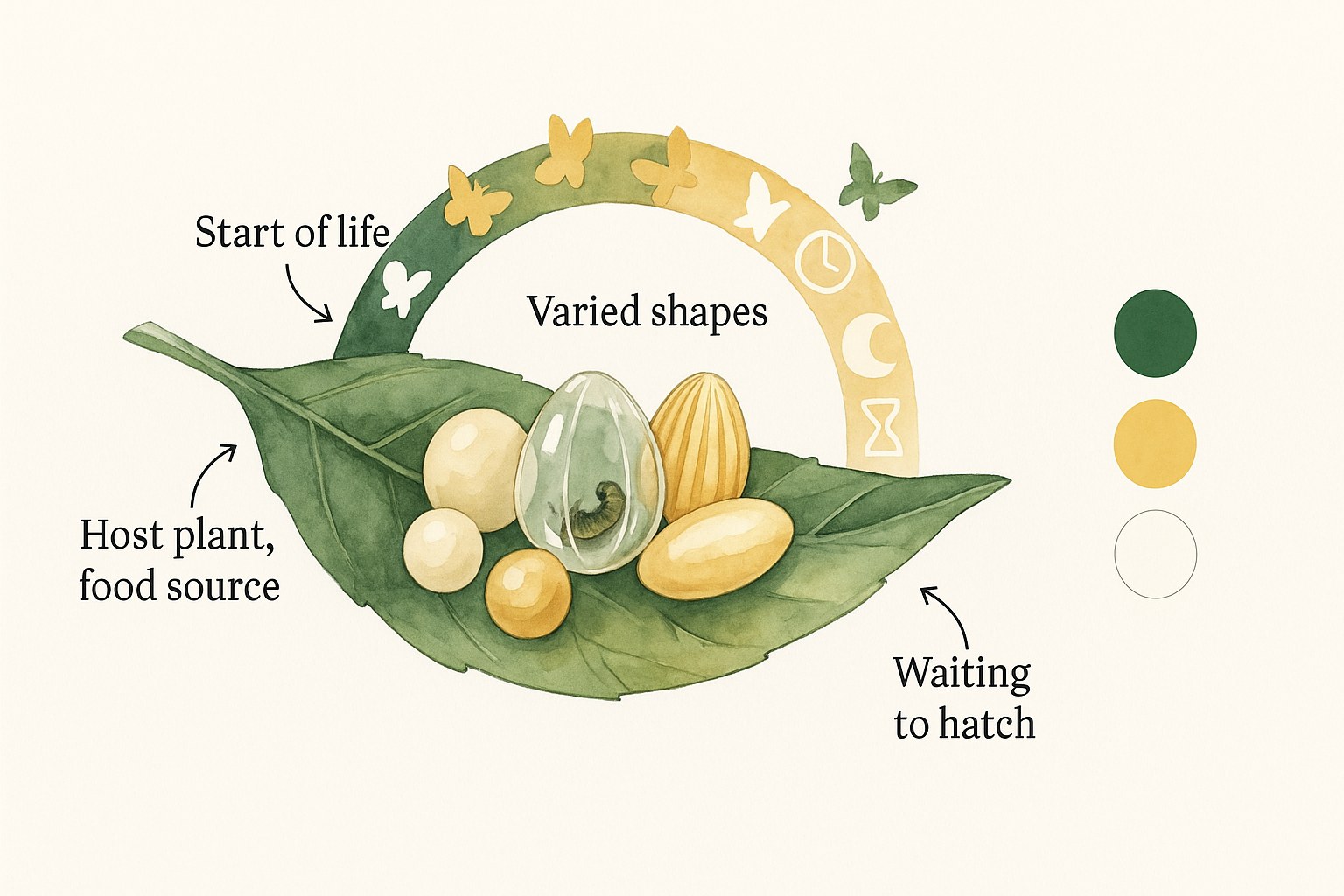
After fluttering over the gardens, the female butterfly stops to carry out the act that kicks off the whole cycle: laying a tiny egg that holds a whole future life inside it.
🎨 All kinds of shapes and colors
Life begins on a carefully chosen plant. Each species picks its own strategic spot, often tucked under a leaf. A dab of natural glue holds the egg firmly in place. This is the start of the butterfly’s metamorphosis: from caterpillar to butterfly.
The variety is amazing. Eggs can be round, oval, or carved with pretty ridges. Their colors range from creamy white to bright yellow. It all depends on the family these little butterflies belong to.
Over the days, the shell changes color. It often darkens just before the big moment. You can almost make out the tiny grub wriggling impatiently inside. It’s a pretty incredible miniature show.
🌿 Why the host plant matters
The host plant plays a vital feeding role. The mother never picks it by chance. It has to offer all the nutrients the future caterpillar needs. Without it, survival is impossible.
She is incredibly picky. The female uses her feet to “taste” the leaves. She detects very specific chemicals. If the plant isn’t right, she looks elsewhere. It’s that important.
A good plant means fast growth. Caterpillars can’t handle pollution or dried-out leaves. So that first choice really shapes everything that follows. A healthy plant is the key to success.
⏳ How long it takes to hatch
The weather has a huge effect on how fast the egg develops. Warmth speeds up the embryo’s growth. Cooler air, on the other hand, slows the whole process down. A bit of moisture also keeps the egg from drying out completely.
Usually, hatching takes between three and ten days. It varies from one butterfly species to the next. Some grubs are in a real hurry to come out. Others prefer to take their time inside their safe little shell.
Some eggs laid in the fall spend the winter waiting. They go into a resting state called diapause to survive the cold. Hatching has to wait for warmer days. It’s a tough, clever survival trick for the species.
🐛 The caterpillar, or the art of growing fast
Once the eggshell is broken open, a soft-bodied creature crawls out with a single idea in mind: eat, and turn every scrap of leaf into pure energy.
🍽️ A big appetite and one molt after another
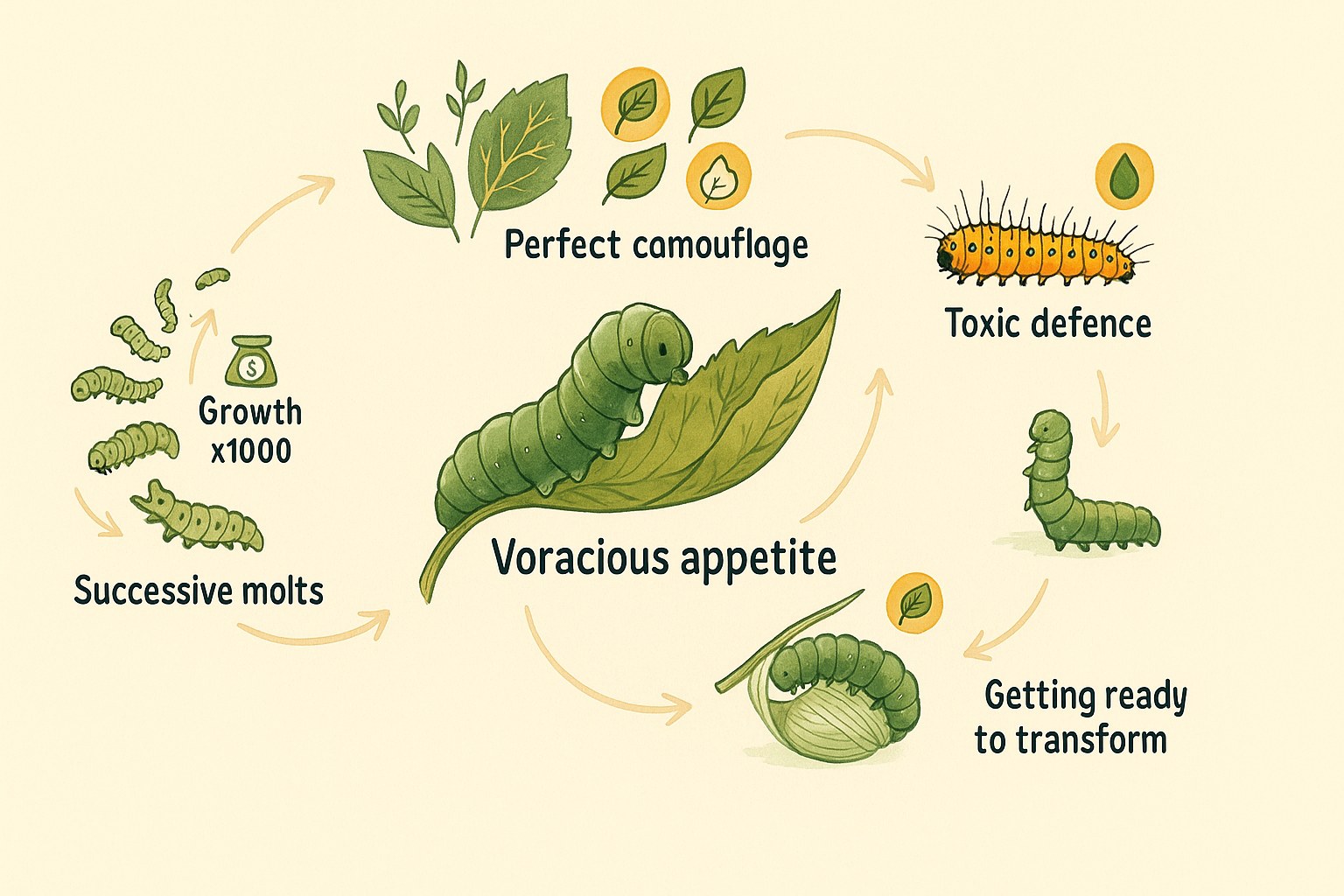
The growth is truly explosive. The little creature munches on leaves nonstop. Its weight can multiply a thousand times in just a few weeks. It’s an incredible machine for turning plants into energy.
Its outer skin can’t stretch. So it has to molt regularly. A new, softer skin forms underneath. In the end, it sheds the old one, now far too tight.
These fat reserves are vital. They keep the insect going through the whole still phase. The plumper the caterpillar, the stronger and healthier the future butterfly will be. It’s a whole stockpile of energy.
🛡️ Clever ways to stay safe
Camouflage is a common trick. Many caterpillars match the exact shade of the leaves. Others look just like twigs or even bird droppings. They become invisible to predators.
Some species store up the poisons from the plants they eat. They wear bright colors to warn of the danger. Stinging hairs are another powerful weapon. They cause instant irritation to any enemy that comes too close.
Acting tough works well too. Some rear up to look bigger. Others can give off a truly nasty smell. Anything goes when it comes to scaring off a curious bird.
🔄 Getting ready for the big change
All of a sudden, the caterpillar stops eating. It empties its gut completely. Then it grows restless and wanders away from its usual plant. The butterfly’s metamorphosis, from caterpillar to butterfly, begins right here.
It looks for a spot well sheltered from the wind. This hideout is often under a branch or a stone. Safety matters most for the days ahead. It tests several spots before finally settling on one.
Then it spins a small, sturdy silk pad. It grips onto it firmly with the back of its body. Sometimes a thin silk belt holds its middle in place. It’s now ready for its great final transformation.
🕸️ Why do some caterpillars spin a cocoon?
This turning point is often misunderstood, because behind the stillness of the pupa hides a biological makeover of rare intensity.
🐛 Telling the chrysalis from the cocoon
The chrysalis is the insect’s own body, which hardens. The cocoon is a protective silk casing spun around it. Not every butterfly makes one. It’s a major difference in biology.
Daytime butterflies usually form bare chrysalises. Moths prefer to wrap themselves in a silk cocoon. That offers extra protection on the ground.
The cremaster is a tiny hook at the tip of the pupa. It lets the insect hang on tight to the silk. Without it, a fall would be fatal.
🔬 A complete rebuild of the body
Inside, the caterpillar’s tissues literally dissolve. It’s a deep biological process that changes everything. It’s called pupation. This is the radical shift from larva to adult.
Special hormones trigger this transformation. One molting hormone guides every step with precision. Another, the juvenile hormone, has to fade away for the change to happen.
The wings, legs, and antennae start to appear. They grow from clusters of reserve cells. The future butterfly takes shape in this living soup.
🛡️ Strong protection against danger
The chrysalis often takes on the color of its surroundings. It can look like a dead leaf or a fleck of bark. That keeps it invisible.
The outer shell is waterproof and very tough. It shields against pounding rain and wind. Some species can even handle freezing temperatures. It’s a real biological shield.
This stage can last two weeks or several months. It all depends on the season and the species. The insect waits for just the right moment to come out.
🦋 The birth of a brand-new butterfly
The waiting is almost over when the casing turns see-through, revealing the wing colors ready to unfold.
🦋 Breaking out of the casing
A split appears at the top of the chrysalis. The butterfly pushes with its back to wriggle free. It’s an intense, exhausting effort.
At this moment, the body is soft and defenseless. The wings are still crumpled and damp. The insect has to quickly find something to hang onto.
The emerging itself is very fast. It often takes just a few minutes. Even so, the butterfly stays still for a long while afterward. It has to recover its strength before its first flight.
🪽 Unfolding the new wings
The butterfly pumps fluid into the veins of its wings. Under the pressure, they unfold like little fans. It’s a mechanical show of incredible precision. As the wings expand, they quickly reach their full size.
Once spread, the wings have to harden in the open air. The insect stays perfectly still, wings hanging down. If they dry badly, it will never be able to fly.
The butterfly releases a reddish fluid often mistaken for blood. It’s simply the waste built up during metamorphosis. Its body is now clean and light.
🌈 Where the colors on the scales come from
The wings are covered with thousands of tiny plates. Some hold ordinary chemical pigments. They give the blacks, browns, and oranges.
The blue and rainbow-like colors are physical. Light bounces off complex microscopic structures. That creates shifting reflections depending on the angle. It’s a pure optical effect, with no pigment at all.
The patterns help attract a mate or scare off enemies. “Eyespots” sometimes mimic the eyes of predators. It’s essential visual armor for survival. The butterfly’s metamorphosis, from caterpillar to butterfly, ends with this burst of color.
🌺 3 everyday habits of the adult butterfly
Now a master of the skies, the adult leaves solid leaves behind to explore a world of liquid flavors and airborne meetings.
🌸 A menu of sweet liquids
Its tongue, the proboscis, coils and uncoils like a tiny spring. This handy organ reaches deep into flowers. The butterfly sips the liquid up like a straw.
Flower nectar is its main food. But butterflies also love the juice of fallen fruit. Some feed on sap or organic matter. It’s a liquid-only diet, packed with energy.
You often see butterflies at the edge of puddles. There they take in essential minerals. These nutrients are crucial for future breeding.
💐 The job of pollinating flowers
As it feeds, the butterfly brushes against the flower’s stamens. Grains of pollen catch on its hairs. It then carries them to the next flower.
This back and forth lets wild plants get fertilized. Without butterflies, many plant species would vanish. They keep our ecosystems in balance. It’s a free, vital service for nature.
Some flowers have evolved to be reachable only by butterflies. It’s a close, ancient partnership. Each one depends on the other to survive.
💞 The search for a mate
Females release invisible chemical signals called pheromones. Males pick them up with their sensitive antennae. They can travel for miles to reach them.
The flights turn acrobatic and rhythmic. The partners circle each other in a precise dance. It’s a necessary step to confirm mating. Wing colors play a charming role too.
After mating, the female heads straight for a host plant. There she carefully lays her eggs. The butterfly’s metamorphosis, from caterpillar to butterfly, comes full circle, and life goes on.
🤝 A few ways to give them a helping hand
Understanding this cycle is one thing, but actually doing something to protect these fragile flutterers is another, and far more urgent.
🧠 The mystery of kept memories
Memory survives the metamorphosis. Studies show that a butterfly remembers shocks it felt as a caterpillar. Even as tissues dissolve, some nerve circuits live on. It’s a major scientific discovery.
This memory helps the adult spot familiar dangers. It may also shape where it lays its eggs. It’s a precious gift for survival.
Some parts of the larval brain aren’t fully dissolved. They serve as the base for the adult’s brain. Nature never starts from scratch.
⚠️ The threats facing butterflies today
The heavy use of pesticides kills caterpillars outright. Single-crop farming also wipes out the variety of flowers. Butterflies can no longer find food.
Winters that are too mild wake the insects too early. Then they find no flowers to feed on. This mismatch between plants and insects is dangerous. Populations crash fast in some regions.
City growth eats away at wild meadows. Without nettles or brambles, many species can’t lay eggs. The landscape becomes a desert for butterflies.
🌻 Setting up a welcoming garden
Pick nectar-rich plants like lavender or butterfly bush. Mix up the blooms to cover the whole season. Steer clear of chemicals completely. A natural garden is an essential refuge.
- Leave a patch of wild grass
- Keep some nettles for the caterpillars
- Add a small water source
- Ban insecticides
Keep your distance and use a zoom lens. Avoid touching the wings, since they’re extremely fragile. Respect is the golden rule.
This fascinating cycle, from egg to adult, keeps our pollinators alive. To watch the butterfly’s metamorphosis unfold in your own garden, set aside a wild little corner of nature soon. Give them that refuge today so you can watch beautiful colors take flight tomorrow. Life is a never-ending transformation.
🎬 Watch the video
❓ FAQ
🦋 What are the main stages of a butterfly’s life?
A butterfly’s life cycle, known scientifically as a complete metamorphosis, breaks down into four distinct phases. It all starts with a tiny egg, which gives rise to a larva (our famous hungry caterpillar). Next comes the pupa stage (the chrysalis), wrapping up beautifully with the emergence of the adult, the butterfly we love to watch in our gardens.
🥚 How long does it take for a butterfly egg to hatch?
Patience is key, because the incubation time depends on the species and the weather! If the sun is out and it’s warm, hatching can happen in just a few days. But if temperatures drop, the egg may wait several weeks, or even a few months, before letting the little caterpillar out.
🔍 What exactly does the cremaster do for the chrysalis?
The cremaster is a super-handy little body part at the tip of the chrysalis’s abdomen. It works like a hook. It lets the insect anchor itself firmly to a little silk pad or a branch. Thanks to it, the chrysalis stays safely hung up, with no risk of falling during its transformation.
🐛 How does a caterpillar actually turn into a butterfly?
It’s a real biological magic trick! Inside the chrysalis, the caterpillar releases enzymes that dissolve its own tissues into a kind of nutrient-rich “soup.” Special groups of cells, called imaginal discs, then use that energy to build the butterfly’s new organs: the wings, the legs, and the antennae.
🧠 Can a butterfly remember its life as a caterpillar?
As surprising as it sounds, the answer is yes! Scientific studies suggest that butterflies keep some memory of what they learned as larvae. Even though the body changes completely, certain nerve circuits survive the metamorphosis, letting the adult hold on to memories.
🌺 What do butterflies eat once they’re grown up?
Unlike the caterpillar, which munches on leaves, the adult butterfly has a liquid-only diet. With its coiled tongue, it mainly sips the sweet nectar of flowers, though it won’t turn down the juice of a nice ripe fruit. These liquids give it the energy it needs to fly and breed.
🌻 How can we help butterflies thrive in our garden?
To invite these pretty flutterers over, nothing beats a slightly “wild” garden. You can plant nectar-rich flowers like lavender and, above all, keep a corner of nettles to feed the caterpillars. Here are a few simple tips:
- Leave a patch of wild grass.
- Add a shallow water source.
- Completely ban insecticides and chemicals.
It’s a small gesture for us, but a big refuge for them!
