
Watching your child panic over a subtraction is heartbreaking, but it often hides simple emotional stress rather than a lack of ability. This guide explains how to give your child a taste for maths by turning abstract numbers into hands-on, playful fun. You’ll discover tips for using everyday objects and board games to turn every mistake into a rewarding win for their confidence. 🧮
- Why do some children end up hating numbers?
- 3 steps to love maths through hands-on play
- Turn your home into a maths playground
- The right attitude to your child’s mistakes
- Handling homework without stress or tears
- Spark curiosity with family challenges
😣 Why do some children end up hating numbers?
A dislike of maths is often born from emotional stress or a lack of concrete examples, not from a lack of intelligence.
Moving from frustration to success starts with understanding what’s really getting stuck in the minds of our young learners.
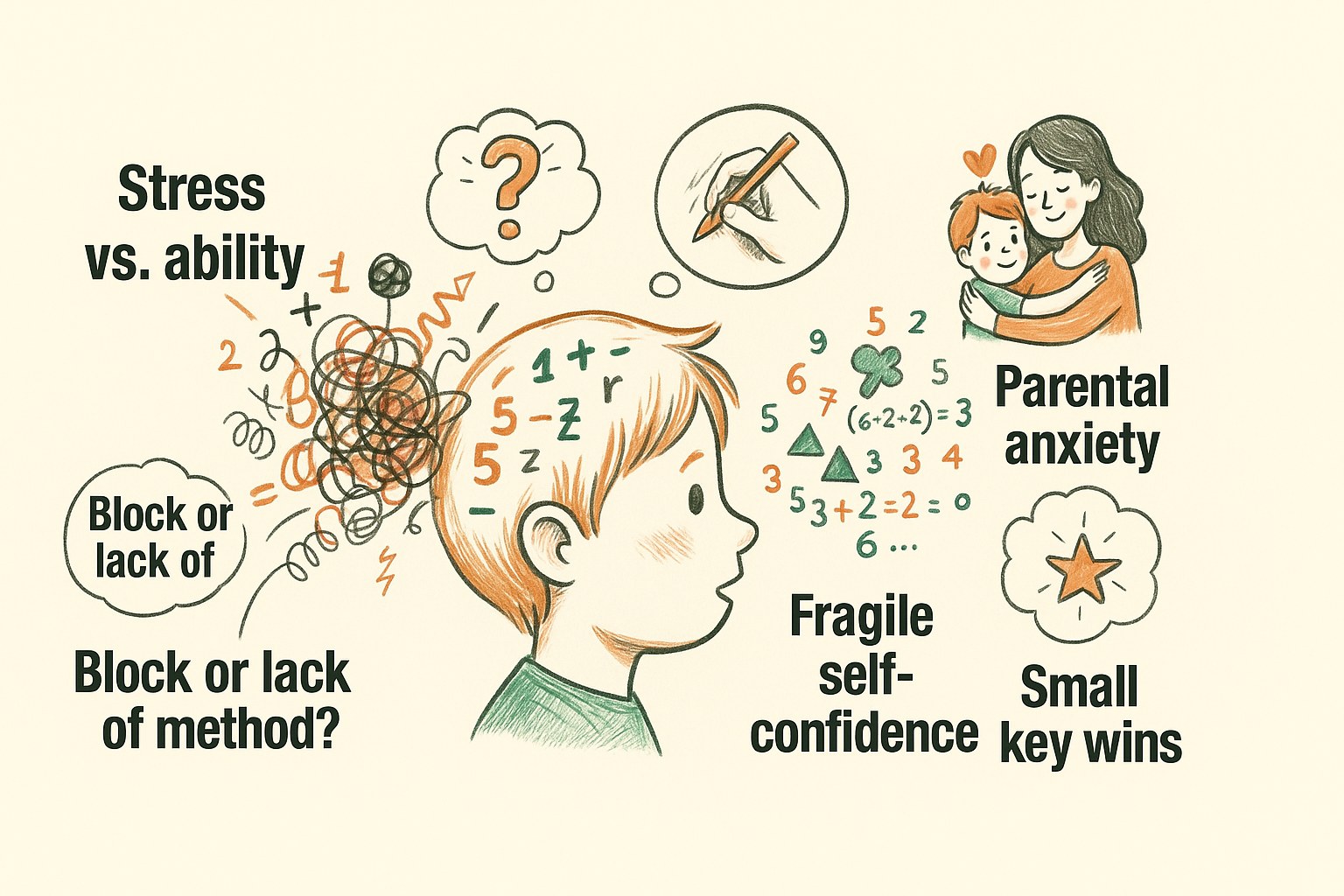
🔍 Telling a real block from a simple lack of method
It’s important to tell dyscalculia apart — a condition affecting 3 to 6% of children — from a simple lack of organisation. Some pupils scatter their efforts with no clear working method. They quickly lose their footing.
The approach is often too abstract for them. Yet hands-on practice is vital for children who struggle. Using real objects helps fix number concepts for good.
A feeling of helplessness then sets in. The child feels useless. They no longer see any link between the numbers on the page and their everyday life, like working out the slope of a skate ramp.
💪 How self-confidence shapes results
Fear of failure literally freezes the brain. Stress blocks access to working memory. Effort then becomes impossible to give, no matter how much goodwill there is.
“Maths anxiety can interfere with cognitive performance, sometimes activating pain-related areas of the brain when a child anticipates an exercise.”
You need to rebuild a positive self-image. Celebrate every small win, however tiny. This restores a sense of personal effectiveness and finally brings back the urge to try without trembling over the page.
😟 How parental anxiety affects learning
Sometimes fears are passed on unconsciously. If the parent hates numbers, the child senses it. They end up copying it through pure imitation, believing maths is “mean”.
Spot your own school-day fears. Keep your past as a parent separate from your child’s future. Staying neutral is the finest gift you can give their journey ahead.
Adopt a calm attitude. Create a quiet workspace. Mistakes should be seen as a normal step in learning, not as a source of tense family conflict.
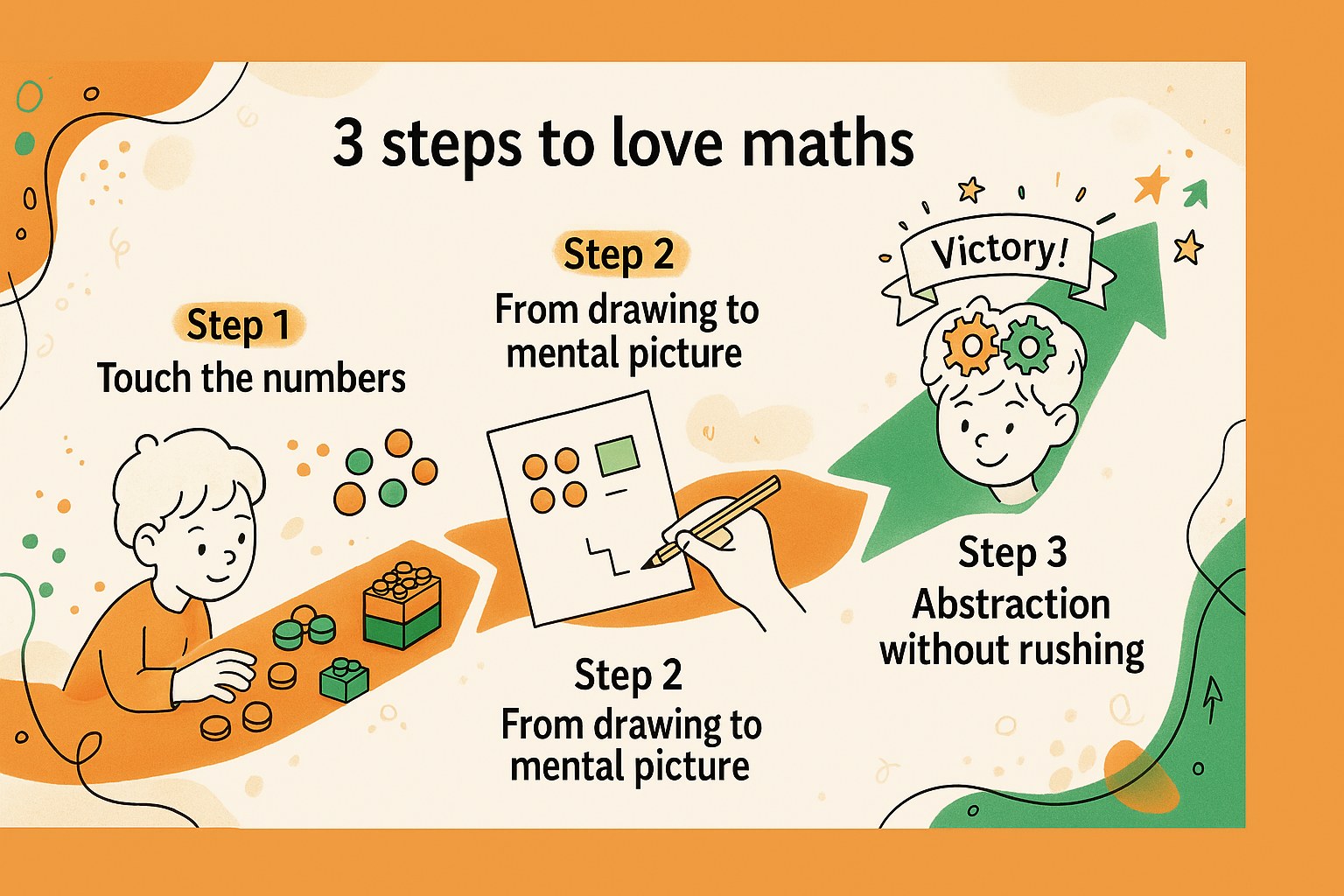
✋ 3 steps to love maths through hands-on play
Since the block is often caused by abstraction, let’s look at how to give numbers a body again through a step-by-step method.
✋ Touching numbers to make them real
Let’s use physical objects. Beads, counters or building bricks let children see quantities and groups physically. It’s concrete and reassuring to start with.
Going through the body helps enormously. Handling objects helps fix concepts in long-term memory through touch and movement. We remember better what we actually touch.
Let’s take real, concrete sums. Adding apples or sharing out a pile of sweets makes the operation logical and clear. The result then becomes a physical certainty.
✏️ Moving from drawing to mental pictures
Sketch before you calculate. Drawing the problem lets you check the wording is understood before writing any numbers. It’s a step of useful visual checking.
Using visual tools makes the shift easier. Number bars or diagrams act as a bridge between the real object and the maths symbol. We gently move away from the toy.
It’s a smooth shift towards the mind. We slowly let go of the object to keep only its simplified picture on paper. The brain starts to work with its own inner images.
📈 Reaching abstraction without rushing the steps
Learn to spot the right moment. A child drops the visual support when the inner mechanism has become automatic and smooth. There’s no need to rush this natural movement of the mind.
You should value the reasoning above all. The answer matters less than understanding “why” the operation works the way it does. That’s the key to logic and confidence.
Let’s see abstraction as a victory. Present this step as the finish line of a successful treasure hunt rather than a chore. Giving your child a taste for maths then becomes a shared pleasure.
🏠 Turn your home into a maths playground
Beyond formal exercises, daily life is full of chances to practise without even noticing, far from any workbook.
🍰 Cooking to handle fractions and measurements
The kitchen becomes a real laboratory. Weighing flour or measuring milk teaches volumes and weights. These hands-on actions give numbers meaning without any effort.
Practising proportions becomes a game. Asking your child to double the amounts for six people means multiplying fractions. This avoids the stress of purely abstract exercises.
Handling the ingredients helps them grasp the basic ideas. It’s a wonderfully concrete way in.
🛒 Shopping for fun with the budget
Giving them the “total price” mission works well. Asking them to add up three simple items lets them practise mental addition. It’s a real-world use that values their skills.
Understanding the offers helps them grasp trickier operations. Explaining discount percentages shows the value of money. It turns a chore into a very handy logic lesson.
Comparing to analyse builds critical thinking. Looking at the price per kilo helps choose the best-value product. The child learns to use maths to make smart decisions.
🎲 Using board games for strategy
Some classic games are perfect for making progress while having fun:
- Property-trading games for managing money and giving change.
- Dice for getting an intuitive feel for probability.
- Chess to build up logic and pure thinking.
Board games push players to plan their next moves. This boosts planning and the way thoughts are organised. The child learns to work out clever strategies without even noticing, purely for fun.
Pleasure stays the main driver. Play lifts the mental barriers so often tied to maths. The point is no longer the mark on a report, but simply to win as a family.
🤗 The right attitude to your child’s mistakes
For these activities to bear fruit, our reaction to failure has to change completely.
💡 Valuing mistakes as a step in the search
Getting it wrong is completely normal. It’s the visible sign that the brain is actively looking for a solution. It simply proves a child is right in the middle of learning and building.
It helps to look at the path taken. Instead of correcting straight away, ask your child to explain their reasoning. This lets you see exactly where their logic took a wrong turn.
The mistake then becomes a shared discovery. You can turn it into a fun little detective challenge. The goal is to find the flaw in the reasoning together so you can set off again.
💞 Building emotional safety without pressure
It’s best to drop all judgement. At home, you happily forget about school marks. You focus only on the genuine pleasure of solving a tricky maths puzzle.
Betting on perseverance changes everything. Use encouraging phrases that value the effort your child puts in. That’s far more effective than praising natural cleverness or a raw result.
Don’t be afraid to show a grown-up’s humility. Admit that you too can get stuck on a hard problem. This honesty completely takes the drama out of the situation and eases the tension around numbers.
⚖️ Knowing when to step in or step back
Learn to spot rising frustration. If your child starts getting cross, step in gently. It’s important to act kindly before the emotional block sets in.
Ask open questions to guide without imposing. Never give the answer outright. Offer subtle hints instead, so they feel the huge pride of finding the solution alone.
Finally, encourage each child’s own methods. Giving your child a taste for maths runs through this freedom. They should be able to use their own ways of thinking, even if they seem long.
😌 Handling homework without stress or tears
A good attitude is useless if the working setup stays oppressive. Here’s how to organise sessions well.
⏱️ Going for short, well-paced work sessions
Apply the twenty-minute rule. A child’s brain can’t stay intensely focused on numbers for too long. It’s physiological, so there’s no point forcing it.
Build in regular active breaks. Let them move, walk or jump between two sums. This helps release the nervous tension built up during the mental effort. One little jump and they’re off again.
You absolutely must avoid total exhaustion. It’s better to stop on a win, however small, to keep spirits up. Pushing to the point of tears is completely counterproductive when you’re trying to give your child a taste for maths.
🪑 Setting up a space that helps thinking
Aim for absolutely zero distractions. Switch off screens and tidy away any stray toys. These objects could draw your child’s attention away while they try to solve their geometry problems.
Keep all the materials within reach. Get the ruler, sharpened pencils and scrap paper ready. This avoids the constant interruptions that abruptly break the thread of logical thought.
Set up a symbolic starting ritual. A small habit, like tidying the desk, helps the mind. It signals to the brain that it’s now going to enter a phase of calm, settled thinking.
🧘 Managing your own frustration during the exercise
Remember to breathe to stay calm. If you feel irritation rising over a mistake, stop everything. Take a few seconds’ break before speaking to your child gently again.
Don’t hesitate to hand over. If your explanation isn’t landing, let the other parent or an older sibling try. Sometimes, simply changing the voice or the angle is enough to unblock things.
It’s vital to remember what matters most. The top priority is to keep the bond and the joy of learning. Finishing the worksheet at all costs should never come before their wellbeing.
🧩 Spark curiosity with family challenges
Finally, to change the relationship with maths for good, you need to weave curiosity and creativity into every exchange.
🧩 Offering logic puzzles at mealtime
Dinner is ideal for having fun. Throw out riddles about food, like pizza or honey. These little logic challenges call for thinking rather than pure calculation.
Encourage everyone to explain their thinking. Ask how the solution was found. It’s far richer than giving the bare answer. It values intuition and the exchange between parents and children.
Show that logic really helps. It’s there to solve real problems. You can, for example, share out a round cake fairly. Maths then becomes a very useful social tool.
🌿 Spotting shapes and patterns in nature
Wild geometry is hiding everywhere. Look for symmetry on tree leaves. Notice the hexagonal patterns of beehives on a walk. It’s a visual and mathematical treasure hunt.
Look at architecture and everyday objects. Notice the angles of nearby buildings. Take in the perfect circles of bike wheels. Maths is everywhere around us, visible and very real.
Link watching the world to the beauty of numbers. This scientific wonder creates a spark. It stirs up natural, lasting curiosity. The child no longer sees numbers, but secrets.
🧠 Encouraging reasoning over rote learning
Understanding the point changes absolutely everything. Explain why a formula really exists. Don’t have them recite it with no practical sense. Giving your child a taste for maths runs through meaning.
| Method | Goal | Benefit |
|---|---|---|
| Rote learning | Memorising | Passive storage |
| Understanding | Logic | Intellectual independence |
| Hands-on play | Tangibility | Real-world grounding |
Value roundabout routes and originality. Looking for a personal solution is a sign of intelligence. Mathematical creativity shows a lively mind. That’s how you make progress with pleasure and grit.
By betting on hands-on play, games and a kind attitude to mistakes, you turn anxiety into curiosity. Weaving numbers into daily life helps you give your child a taste for maths without pressure. Offer them this precious key to their future today, and savour every little logical win together. ✨
❓ FAQ
🤔 Why does my child seem stuck in front of a maths exercise?
A block isn’t necessarily linked to a lack of ability. Often, it’s intense emotional stress that freezes the brain, a bit like physical pain. Maths anxiety creates a vicious circle where the fear of failure blocks access to working memory.
It can also be a lack of method or an approach that’s too abstract. If numbers aren’t tied to concrete objects, the child quickly feels lost. In rarer cases, a lasting difficulty can signal dyscalculia, a condition that needs a specific diagnosis.
🩺 How can I tell whether my child has dyscalculia or simply a lack of organisation?
Dyscalculia is a neurodevelopmental condition that affects the very understanding of numbers and quantities, regardless of intelligence. The child struggles to recognise symbols or memorise times tables, despite their efforts. It’s a lasting condition that often needs a specialist’s opinion.
By contrast, a lack of method shows up as difficulty planning homework or structuring reasoning. These poor working habits can be corrected with new learning strategies and a calmer environment, unlike dyscalculia, which needs specific adjustments.
😰 Could I pass on my own maths stress to my child?
It’s possible, because children are real emotional sponges. If we show apprehension over a sum, they may copy it by imitation. Studies even suggest that homework help from a very anxious parent can sometimes slow a child’s progress.
To break this cycle, the idea is to work on our own relationship with numbers. By adopting a calm attitude and showing that mistakes are a normal step in learning, we give the child the freedom to discover this subject without the weight of our own school-day scars.
🏠 How can I make learning maths more concrete at home?
The secret is to leave the workbooks behind and use tangible objects. Handling building bricks, beads or even slices of cake lets children picture quantities. Going through touch and drawing helps build a solid bridge to abstraction at the end.
Daily life is also a fantastic playground. Cooking together to handle fractions or working out the price of a few items at the supermarket gives numbers meaning. When maths helps solve real problems, it suddenly becomes far more interesting.
🤗 What attitude should I take to my child’s mistakes so I don’t discourage them?
It’s essential to value the effort and the journey rather than the raw result. Instead of correcting straight away, you can ask your child to explain their reasoning. This lets you see where the logic took a wrong turn and turn the mistake into a gripping little investigation.
Building emotional safety is key. You forget the marks and the pressure to focus on the joy of searching. By showing that we adults can get stuck on a problem too, we take the drama out of the situation and encourage perseverance.
📚 How can I organise homework to avoid tears?
It’s better to go for short sessions, say 20 minutes, to respect a child’s attention span. It’s also very helpful to build in active breaks where they can move. Stopping on a small win is always better than total exhaustion.
The environment also plays a major role. A space free of distractions, with all the materials within reach, helps them stay in the thread of thought. If tension rises too high, don’t hesitate to hand over to someone else or take a breathing break to find calm again.
