
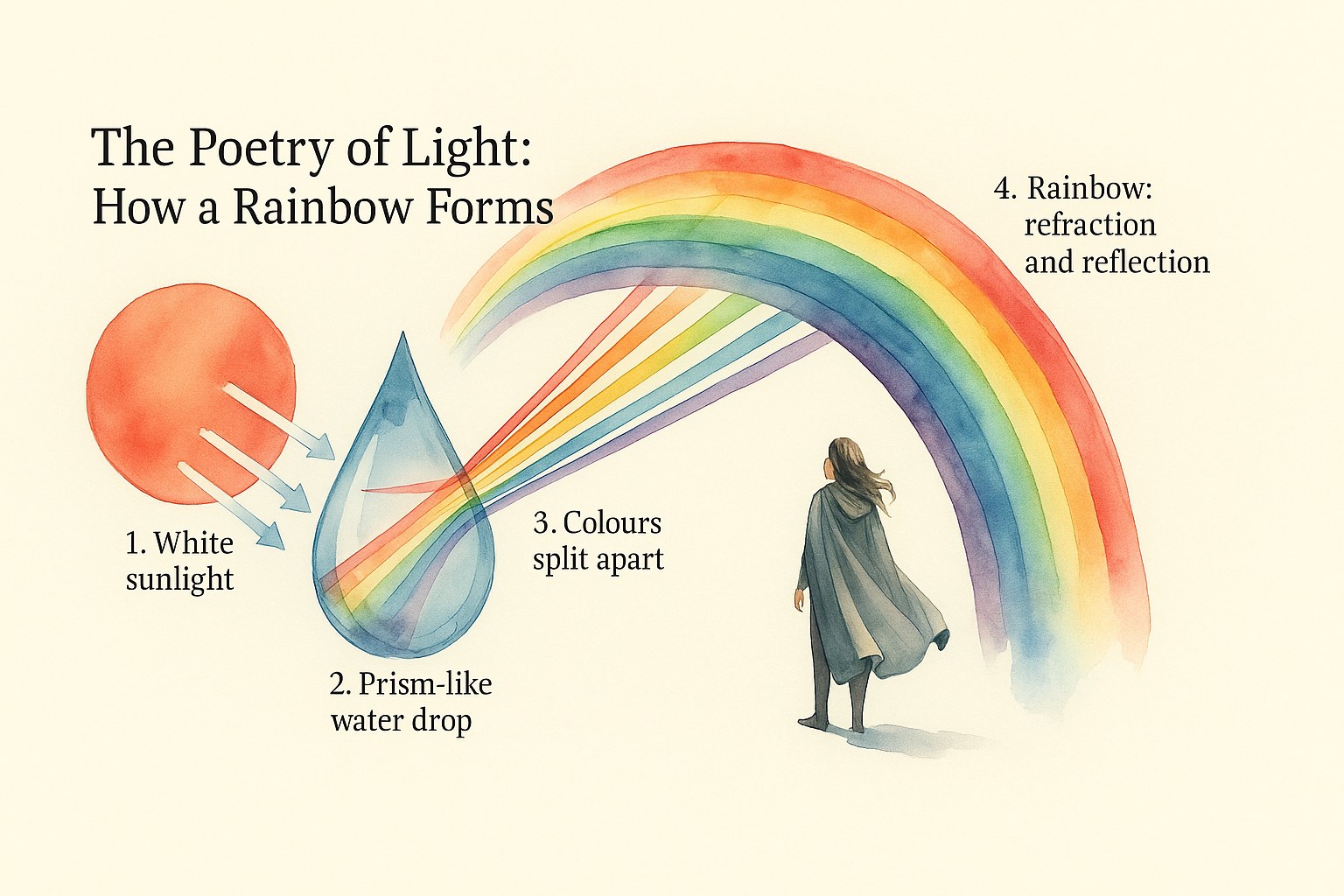
Explaining to your children how a rainbow forms often feels harder than finding the famous pot of gold. This guide breaks down the refraction and reflection of light inside water drops to turn this weather mystery into a fun moment to share. 🌈 You’ll see exactly why this colourful ribbon appears, and how to spot its rarest forms.
- The secrets behind how a rainbow forms
- The hidden geometry behind this colourful show
- Rare optical effects to look out for
- Myths and facts about these sky lights
🌈 The secrets behind how a rainbow forms
After a shower, the sky often gives us a colourful show whose physics, though well known, hides a fascinating complexity tied to the way water and light work together.
💧 The role of light and water
The white light of the sun is the main engine. Without a direct light source, the effect simply can’t happen. It’s the light that carries all the hidden colours.
The water drops act like millions of tiny mirrors and prisms. The air has to be full of moisture. The rain absolutely must fall in front of you for the magic to work.
The sun has to be low on the horizon. It absolutely must be behind your back for the arc to appear. It’s a question of precise geometry.

💡 The ray’s journey through the drop
The ray first passes through the watery wall of the droplet. It then undergoes a first bend called refraction. The light changes direction as it enters the water.
The light then hits the back surface of the water drop. It is sent forward again by a process of internal reflection. The drop behaves like a curved mirror.
A second refraction happens as it leaves the water. The ray is bent one last time towards the air. The colours then start to clearly split apart before our amazed eyes. How does a rainbow form? It’s this journey that explains it.
🎨 Splitting the colours through dispersion
Each colour reacts differently depending on its own frequency. Blue bends more strongly than red as it passes through. This split is the key to the whole show.
Red comes out at about 42.4 degrees exactly. Blue sits closer to 40.5 degrees. This difference in angle creates the spread of colours that we admire from the ground.
The original mix of white light breaks down into a continuous spectrum. This is dispersion, shaped by the water’s refractive index for each colour. The result is simply magnificent.
📐 The hidden geometry behind this colourful show
If physics explains the colours, it’s pure geometry that dictates the perfect shape and position of this sky-borne sight.
⭕ Why a rainbow is a circle
Everything is built around the antisolar axis. The bent rays create a cone of light. Your eye sits exactly at the tip of this imaginary cone.
The horizon sadly blocks the view. The ground cuts off the lower part of the circle. That’s why we only see a half-circle on the ground.
On a plane, things change. The horizon no longer gets in the way at altitude. You can then see a full, perfect circle. It’s quite a rare visual treat.
A rainbow isn’t a fixed physical object, but an optical illusion whose round shape depends entirely on where you’re looking from.

📐 Why the forty-two degree angle matters
There is a critical angle of deviation. It’s the exact point where the light becomes intense. For the primary arc, it’s forty-two degrees.
The arc moves with you. If you move, the angle to the drops changes. New drops instantly take over. So the arc seems to follow you everywhere.
Reaching the end of the arc is impossible. Since it depends on your position, it backs away as you move. So the treasure stays a legend.
👀 The perfect spot to watch from
The line-up has to be perfect. The sun, your head and the centre of the arc are all in line. This is what we call the antisolar line.
The distance to the curtain of rain barely matters. The bigger the drops, the brighter the arc. The main thing is to keep the right angle.
The shadow of your head marks the centre of the circle. You’re always in the middle of your very own rainbow. Nobody sees exactly the same one as you. How does a rainbow form? Above all, it’s a matter of personal perspective.
✨ Rare optical effects to look out for
Beyond the classic arc, nature offers subtler variations that need a trained eye to be spotted.
🔁 Secondary and supernumerary arcs
The light bounces twice inside the drop. This double internal reflection is fascinating. It creates a second, wider arc around the first.
In this secondary arc, the colours flip completely. Red sits on the inside. Violet ends up on the outside, the opposite of the usual pattern.
The Airy function explains the coloured fringes below the main arc. These are the famous supernumerary arcs. They come from complex light interference between the rays. It’s a mathematical and visual show.
| Feature | Primary arc | Secondary arc |
|---|---|---|
| Number of reflections | 1 | 2 |
| Brightness | Strong | Weak |
| Colour order | Red on the outside | Violet on the outside |
| Viewing angle | 42° | 51° |
🌙 Night-time or man-made rainbows
The Moon can create this effect too. We then call it a “moonbow”, or night-time rainbow. It’s quite a poetic and rare sight.
Moonlight is far weaker than sunlight. Our eyes often see the arc as white. The colours only show up in long-exposure photos.
A simple garden hose is enough to have fun in the garden. Just spray water with your back to the sun. The show is instant and always delights children.
☀️ Other illusions, like sun dogs
It’s important to tell these sky effects apart. A rainbow uses liquid drops. Halos and sun dogs, on the other hand, use ice crystals high up.
These six-sided ice prisms float in high clouds. They bend the light in a very specific way. This creates bright spots of light on either side of the sun.
The circumhorizontal arc is a flat and very colourful effect. It’s sometimes wrongly called a “fire rainbow”. It’s stunning and always surprises with its shape.
📖 Myths and facts about these sky lights
To round off this journey through science, let’s go back to the roots of our fascination with this bridge of light.
🔬 How our scientific understanding grew
In ancient times, Aristotle thought the arc was simply a reflection off the clouds. People didn’t yet know the true nature of light. The mystery stayed complete for the scholars of the day.
Later, Snell and Descartes worked out the mathematical laws of refraction. This made it possible to calculate the precise angle of forty-two degrees. It was a major scientific step forward. Calculation finally replaced guesswork.
Finally, Isaac Newton proved that a prism doesn’t colour the light. It only separates the colours already inside it. This discovery changed the way we see the effect for good.
🧚 Taking apart the popular legends
People often say that a pot of gold waits patiently at the end of the arc. It’s a very famous Irish legend. Many children have dreamed of finding this treasure hidden in the grass.
Yet, because the arc only exists in relation to you, it has no fixed location. So it has no end. You can never reach it, even running very fast.
For some, it’s a bridge to the realm of the gods. For others, it’s a sign of universal peace. Here are a few famous interpretations that have travelled through the ages:
- The Bifröst bridge (Norse)
- The rainbow of the covenant (religious)
- The leprechauns’ pot (Irish)
This dance between sun and rain is born from the refraction and reflection of light inside each drop. To admire this colourful spectrum, quickly keep the sun behind your back before the shower stops. Understanding the formation of a rainbow turns every sunny spell into a moment of pure magic.
🎬 Watch the video
❓ FAQ
🌦️ How does a rainbow actually form in the sky?
A rainbow appears when sunlight meets raindrops. The light enters the drop, reflects off its back wall, then comes out again. During this little journey, the white light splits into several colours: this is what we call dispersion.
To enjoy this show, the sun needs to be well placed behind you and the rain has to fall in front of you. Each water drop then acts like a tiny prism that sends the colours back to your eyes.
🔃 Why is the colour order flipped in a second rainbow?
Sometimes a second, fainter arc appears above the first. This effect comes from a double reflection of the light inside the water drops. As the light bounces one more time, the colours come out in the opposite order.
So in this secondary arc, you’ll see red on the inside and violet on the outside. It’s a lovely little wink from nature that needs a bit of attention to spot, as it’s often less bright than the main arc.
👣 Can you really reach the end of a rainbow?
Sadly for the pot-of-gold legend, it’s impossible to reach the end of a rainbow. It isn’t a physical object sitting somewhere, but an optical illusion that depends only on your position relative to the sun.
If you move, the arc moves with you because it forms in your own gaze. So it has no real anchor point on the ground, which is why it always seems to back away when you try to get closer.
⭕ Why do we see an arc and not a full circle?
In reality, a rainbow is a perfect circle! However, from the ground, the curve of the Earth and the horizon hide the lower part. So we only see half of this big colourful ring.
If you’re lucky enough to fly during a sunny shower, look carefully out of the window. As you gain height, the horizon no longer blocks the view, and you may spot a full, magnificent ring of colour.
