
Does your child sometimes seem a little clumsy when grabbing toys or scribbling their first masterpieces? Building fine motor skills in children is an exciting journey that turns those hesitant little movements into real everyday wins for independence. 🤲 Discover playful activities and simple tips, tailored to each age, to strengthen those fingers and boost precision while having fun with next to nothing.
- Understanding the basics of fine motor skills in children
- Key stages of development from birth to 2 years
- Fine motor activities for children aged 3 to 5
- Refining skills between 5 and 8 years
- DIY tips to boost dexterity at home
- Supporting and observing motor development
✋ Understanding the basics of fine motor skills in children
Watch a child at play and you quickly realise that every tiny movement is a victory. But to support them well, you first need to understand what lies behind this manual skill.

💪 Telling apart big muscles and small muscles
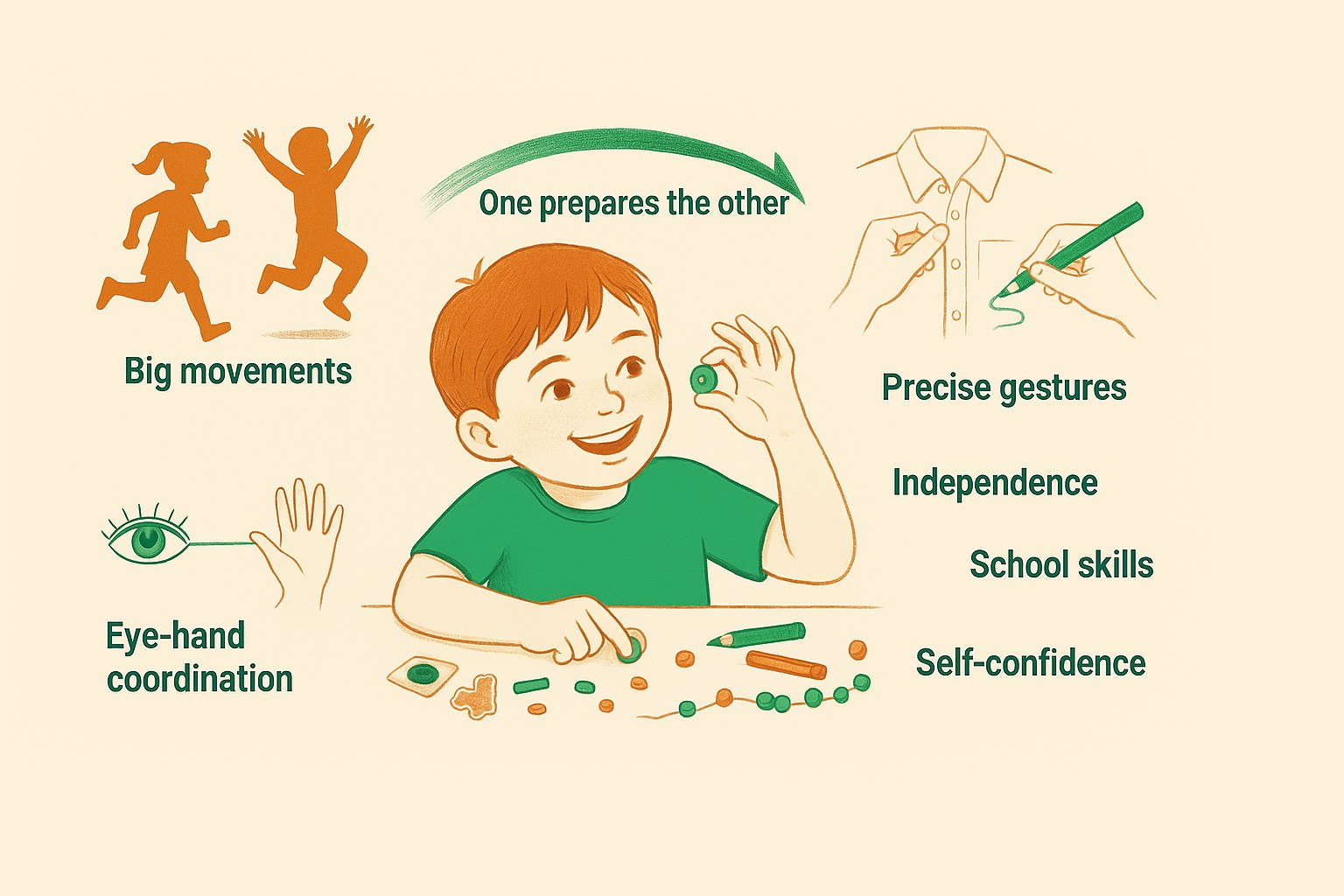
Gross motor skills involve big movements like running or jumping. Fine motor skills, on the other hand, call on the small muscles in the fingers. It’s worth noting that strength in the large limbs prepares precision in the extremities.
These two systems always work together. A steady arm gives the hands a solid base. This muscular teamwork then makes it possible to handle objects with great delicacy every day.
The hand is the most capable human tool there is. It lets us carry out tasks of incredible precision. Thanks to it, we manage our hygiene and our work every single day.
Fine motor skills are a set of precise movements aimed at a concrete goal. These delicate gestures call for very specific muscle control.
🎒 The impact on independence and school
Dexterity is tied to a child’s first tasks at school. Holding a paintbrush or sticking on stickers takes real mastery. These small successes often mark the start of the most important learning.
Managing to button up a coat brings enormous pride. Children gain confidence as they notice their own progress. They then feel more capable and, above all, far more independent in daily life.
These micro-movements also make group life easier. The child keeps up with the pace of activities without feeling frustrated. A nimble hand really does help maintain good focus on the task.
Independence radically changes how a child sees themselves. Being able to eat alone or get dressed without help is a major step. It’s a pillar of their overall development.
👁️ Why eye-hand coordination matters
Visual guidance is a fascinating mechanism. The eye sends information to the brain to correct the position of the fingers. This creates a constant feedback loop between sight and movement.
This synchronisation is the foundation of every action. Without it, we couldn’t stack blocks or aim accurately. Vision provides the stability the hand’s muscle tone needs.
This mechanism simply improves with practice. The more a child handles objects, the more the link becomes automatic. The connections between eye and hand then grow much faster.
Vision plays a crucial role in developing grasping skills, because it ensures both precision and two-handed coordination.
👶 Key stages of development from birth to 2 years
Understanding the theory is one thing, but watching this progress unfold in real time in a baby is a fascinating show that follows a precise timetable.
🤲 From reflex grasping to the first deliberate movements
At the very start, a newborn works on pure reflex. They grip tightly onto anything that touches their palm, with no intention behind it. Then, around three months, they finally begin to aim for objects on purpose.
Passing a toy from one hand to the other is a major step at around 5 to 7 months. This simple gesture proves that the two halves of the brain are talking to each other. It’s a big leap for coordination.
Sensory exploration then becomes the main engine of their days. Babies put everything in their mouths to work out the textures. Their hands turn into genuine tools for discovery.
It’s vital to remember that every little one moves at their own pace. Your warm, attentive watching is the best support there is. There’s no need to compare, because every step of progress counts enormously.
👌 The arrival of the pincer grip
Around nine months, a physical change happens in the way they grasp things. The child drops the whole-palm grip. They start using only their thumb and index finger.
This new precision lets them pick up crumbs or tiny pebbles off the floor. It’s a real revolution for their independence. The pincer grip is an important developmental milestone, well worth keeping a friendly eye on.
This famous pincer grip is the direct ancestor of holding a pen later on. It’s a fundamental milestone for learning to write in the future. Without this movement, handling fine tools would be impossible.
Here are the skills that sharpen up during this pivotal time:
- Picking up small objects with precision.
- Smoothly passing an object from hand to hand.
- Actively exploring different textures.
🍴 First steps towards using cutlery
Around their first birthday, the child tries to tame the spoon. The wrist rotation still lacks suppleness and control. Even so, they manage to aim for their mouth with growing success.
Learning to let go of an object on purpose is a tricky exercise. Carefully placing a block down takes more muscle control than simply dropping it. It’s an impressive technical mastery.
Mealtimes then become an ideal training ground for those little fingers. Letting children handle their food directly stimulates their manual dexterity. It’s a bit messy, true, but so educational.
Patience is your best ally during this learning phase. Progress is slow but steady throughout the second year. Your child builds fine motor skills while having fun.
🎨 Fine motor activities for children aged 3 to 5
Once the basics are in place, the child enters a more complex play phase where their hands become genuine instruments of creation.
🧱 Modelling and pouring games
Offering some modelling dough is an excellent idea. Pressing, rolling and stretching the material builds those little finger muscles efficiently. It’s a truly complete sensory and physical activity.
Pouring seeds or water is great fun. Using spoons or pipettes refines the precision of the movement. The child learns to measure out their strength and their motion.
| Activity | Materials needed | Main benefit |
|---|---|---|
| Modelling dough | Dough, cookie cutters | Muscle strengthening |
| Pouring rice | Bowls, spoons | Movement precision |
| Threading beads | Large beads, string | Eye-hand coordination |
| Clothes pegs | Pegs, cardboard | Pincer strength |
Fun must stay at the heart of these moments. Play is the best way to learn without even noticing it.
✂️ Getting started with scissors and drawing
Learning to cut takes clear guides. It’s best to start with straight strips and child-friendly scissors. The non-dominant hand also has to learn to hold the paper.
Drawing develops dramatically. Scribbles give way to recognisable shapes like circles or little people. The wrist then gains in suppleness and control.
Varying the tools is a really simple trick. Felt-tips, chalk or paintbrushes offer different resistance on the surface. Each medium works the hand’s muscles in a different way.
Posture plays a role that’s often underrated. Sitting well helps the child guide their line better across the sheet of paper.
👕 Getting dressed alone through precise movements
Handling buttons and zips gives the child a real sense of worth. These everyday movements make excellent practical exercises. They call for very precise two-handed coordination to pull off.
These tasks quickly become playful with a little imagination. Setting up small buttoning races rallies the troops. The child then turns a chore into a very rewarding personal challenge.
Dressing frames inspired by Montessori teaching are very handy. Practising flat is far easier than with the clothes on. This clearly reduces the initial frustration.
The independence gained is a lovely reward. Every fastened button is a small victory for their future freedom and their confidence.
✏️ Refining skills between 5 and 8 years
As they start “big school”, the demands grow and the hand has to become a tool of surgical precision for writing.
✏️ Preparing for writing through pre-writing skills
Holding the pencil correctly is essential. The tripod grip, using the thumb, index and middle finger, prevents early muscle fatigue. It’s worth keeping an eye on finger position right from the start.
Offering geometric tracing exercises helps a lot. Drawing loops or bridges stabilises the wrist. These shapes are the building blocks of cursive letters. It’s essential training.
The child also has to master their strength. They need to learn not to press too hard on the lead so their movement stays fluid. It’s all about the right amount of pressure.
Writing is a complex movement that requires perfect finger separation and a stable wrist.
👟 Learning to tie shoelaces stress-free
Taking age 6 as a marker is reasonable. That’s often when neurological maturity allows this complex movement. There’s no need to rush the child too early.
Suggesting training aids makes the learning easier. A piece of cardboard with holes and laces in different colours helps them picture the loops. It’s simpler for practising.
Using little rhymes helps them remember the steps better. The story of the rabbit running around the tree works very well. The rhythm helps movement memory.
You have to keep encouraging perseverance. It’s one of the hardest movements to master during childhood. Every knot they manage is a victory.
📄 Complex creations with origami
Introducing the Japanese art of paper folding is an excellent idea. Origami demands extreme precision in finger pressure. Each fold has to be pressed with the nail to be crisp.
Explaining how complex cutting boosts concentration is motivating. Following curved lines or sharp angles takes great agility. It’s an exciting challenge for them.
Pointing out the link between geometry and motor skills gives the activity meaning. Folding paper helps them understand shapes while building up their fingers. It’s a doubly clever activity.
Finishing on the pride of the completed object brings plenty of joy. A successful fortune-teller or paper plane boosts self-esteem. Building fine motor skills then becomes real play.
🛠️ DIY tips to boost dexterity at home
You don’t need to splash out on fancy toys to help your child progress, because your cupboards are full of educational treasures.
🖼️ Building a personalised activity board
Grab a wooden board and fix everyday objects to it, like bolts, switches or old calculators. These mechanisms naturally captivate curious little ones. It’s the homemade “busy board” idea, simple and effective.
Bringing these elements together lets the child explore various pressures and rotations on a single surface. They practise handling real objects in complete safety. It’s a complete training centre, fun and totally free.
- Sliding bolts
- Doorbell buttons
- Zips
- Dials
Remember to sand the board well before fixing the accessories. Safety is the absolute priority to avoid little splinters in tiny fingers.
🌾 Exploring textures with sensory bins
Fill a bin with raw rice or fine sand. Hide small objects inside to make the child dig around with their fingers. This tactile treasure hunt stimulates movement precision.
The link between awakening the senses and agility is direct. Touching grainy, cold or soft textures stimulates the nerve endings. The hands then become much more alert and responsive.
Vary the contents with the seasons to keep up the interest. Use conkers in autumn or soapy water in summer. Each material offers a specific resistance that works the hand differently.
Simply lay a large sheet on the floor before you start. This makes clean-up much easier once the handling session is over.
♻️ Turning everyday objects into play tools
Clothes pegs are perfect for creating little strength challenges. Clipping them all around a piece of cardboard works the pincer grip. It’s a formidable fine motor exercise for those small muscles.
A simple kitchen colander can turn into a threading game. Passing pipe cleaners or spaghetti through the holes takes very precise aim. It’s a calm activity that completely absorbs their attention.
Always keep the essential safety rules in mind for the youngest ones. Avoid objects that are too small for under-threes. An adult’s supervision is needed for stress-free play.
Recycling offers an endless source of creativity to build fine motor skills in children, age by age. You can invent a thousand stimulating games with next to nothing.
👀 Supporting and observing motor development
For these activities to bear fruit, the environment and the attention we pay to the child’s signals are decisive.
🧍 Stabilising the trunk to free the hands
Sitting posture is crucial for movement. If the trunk wobbles, the hands can’t be precise. The body has to be well anchored in order to act.
Setting up takes a few simple adjustments. The feet should touch the floor or a footrest. The table should come up to the elbows. A good seat frees up energy for the fingers.
Postural stability shapes manipulation. It’s a physical foundation that’s often forgotten. Yet it’s essential for steady progress.
Mastering sitting up opens the door to exploration. A strong trunk supports the precision of fine movements.
🖍️ Choosing suitable ergonomic tools
Pencil grips are precious allies. These little rubber guides help position the fingers. They reduce tension and muscle fatigue.
Spring-loaded scissors also make life easier. They open back up on their own. The child can then focus on the direction of their cut.
These aids make daily learning far easier. They help avoid discouragement in the face of a tricky task. The tool should always adapt to the hand, not the other way round.
These accessories serve as temporary stepping stones. You remove them gradually. The movement becomes sure and natural over time.
🚨 Spotting the signs of a need for help
Certain clues deserve special attention. Quick tiredness or persistent clumsiness can be warning signs. Systematically avoiding manual activities is also a signal.
An occupational therapist or a psychomotor specialist can carry out a full assessment. Seeing a professional makes it possible to act early. The earlier the support, the more effective it is.
Every child has their own biological rhythm. You shouldn’t compare different paths. Staying attentive simply helps clear up needless doubts.
Here are a few points to watch when building fine motor skills, age and needs in mind:
- Difficulty passing an object from hand to hand
- Excessive trembling
- Pain when writing
By stimulating eye-hand coordination and finger precision through play, you give your child the keys to their independence. Try pouring or modelling tomorrow to build up their dexterity while having fun together. These small daily movements calmly prepare their future school victories.
❓ FAQ
✋ What exactly are fine motor skills in children?
To put it simply, fine motor skills are the art of coordinating the small muscles of the hand and fingers to carry out precise movements. Unlike gross motor skills, which help us run or jump, they let us handle small objects, use tools or carry out fiddly tasks like buttoning a cardigan.
It’s a set of movements aimed at a precise goal, which also takes a good dose of concentration and perfect synchronisation between eye and hand. It’s the foundation of everyday independence and, later on, of success at school with learning to write.
👶 What are the major stages of a baby’s manual development?
It all begins with primitive reflexes at birth, but from 3 months your little treasure starts taking an interest in their surroundings and can pass a toy from one hand to the other. Around 9 months comes the great revolution: the arrival of the pincer grip, which lets them pick up crumbs or little pebbles with chef-like precision.
Around the age of one, they begin to master the rotation of their wrist, which is quite handy for holding a spoon and aiming for the mouth (even if it sometimes ends up on the nose!). They also learn the deliberate release, a crucial step that proves they now control their movements from start to finish.
👁️ How can I help my 3-year-old coordinate their eyes and hands better?
Play is your best ally! Activities like catching soap bubbles or balloons are brilliant for forcing the eye to follow a path and the hand to react quickly. Simple puzzles and shape sorters are also great exercises for analysing shapes and adjusting movement.
Don’t hesitate to invite them into the kitchen to mix or pour ingredients, or to offer them modelling dough to build up their fingers. These shared moments are perfect for boosting their precision while having fun, without ever putting them under pressure.
🛠️ What kinds of DIY games can you make at home for dexterity?
No need to empty your bank account, your cupboards are full of treasures! You can create a “busy board” with old bolts, switches and zips fixed to a board. It’s a guaranteed hit for practising different pressures and rotations.
A simple colander and some pipe cleaners or raw spaghetti turn into a great threading game. You can also use clothes pegs clipped onto the edge of a piece of cardboard: it’s the ideal exercise for strengthening the pincer grip in no time.
👟 At what age does a child usually manage to tie their shoelaces?
It’s a fairly complex step that takes a lot of neurological maturity, generally around age 6. There’s no need to stress if your little one doesn’t manage it straight away, as it’s one of the hardest movements to master in childhood.
To help them, you can make a cardboard training aid with laces in two different colours so they can picture the loops better. Little rhymes, like the one about the rabbit running around the tree, also help a lot to memorise the steps with a smile.
🆘 What are the signs that my child needs a little extra help?
Stay attentive if you notice very quick tiredness during manual activities or clumsiness that really persists over time. If your child systematically avoids drawing or cutting, or has excessive trembling, it may be worth asking a professional for advice.
An assessment with an occupational therapist or a psychomotor specialist can help clear up any doubts. The earlier you step in with suitable tools or playful exercises, the more the child will regain confidence to explore the world with their hands.
