
Do your evenings often turn into a battle the moment the books come out? Setting up a smart homework routine can turn that stress into a calming little ritual, thanks to visual cues and a well-organised workspace. 😌 Discover how a few simple organising tricks and a kind, supportive attitude can boost your child’s focus while keeping your family calm and happy.
- Why a good homework routine changes everything
- Setting up a desk corner that helps focus
- Managing time with visual tools and breaks
- Being supportive without too much pressure
- Tricks to beat procrastination and get organised
- Adapting the method to your child’s needs
📚 Why a good homework routine changes everything
After a long school day, coming home often means tension. But a predictable structure completely changes that dynamic for both child and parents.
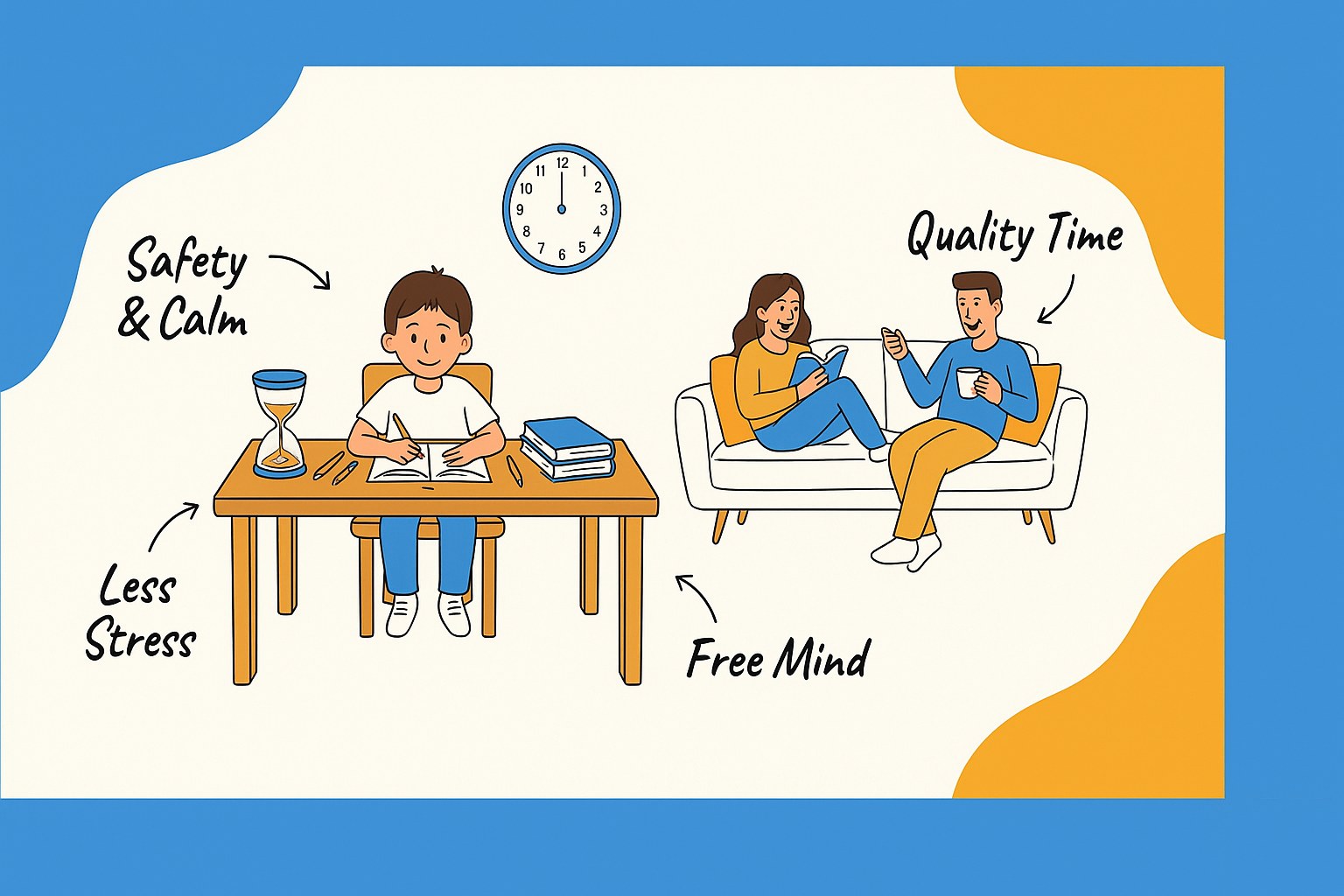
🔁 Regularity reassures your child
Habits create a real sense of safety. Your child knows exactly what to expect each evening. That eases the anxiety of the unknown after school.
When the time is set, the pushback fades on its own. The brain gets itself ready for the effort. It’s a steady framework for healthy daily emotional growth.
Calm settles in. The peace lasts.
🧠 The brain loves automatic habits
Procedural memory is a precious ally. Automatic habits free up mental energy. The more you repeat, the less energy it takes a young pupil to get started.
Understanding how the brain learns helps you offer the right study support.
The energy saved for new learning is real. The effort goes into the actual work, not into getting going. It’s a clever way to learn.
😌 Less frazzle for parents
No more exhausting negotiations. No more arguing for hours. The rule finally replaces the power struggle.
The return to family calm feels good. Evenings become gentler for everyone. You skip the shouting and the pointless stress.
A good homework routine helps you get back quality time together. Once the work is done, it’s playtime.
🪑 Setting up a desk corner that helps focus
But willpower isn’t enough if the surroundings sabotage your child’s efforts. The workspace should be a little haven for thinking.
🧘 A quiet space with no visual distractions
Spotting what breaks concentration comes first. Screens and toys should stay out of sight. Eyes shouldn’t wander towards pointless temptations.
Suggesting alternatives like the library is a smart move. It’s a neutral, quiet place. Sometimes, changing rooms helps mark the switch. The studious mood comes naturally there.
Pupils are often distracted by digital devices. That directly affects their final marks.
✏️ The right supplies always ready
Listing the must-have supplies makes life easier. Pens, rubber and ruler should be within reach. That way you avoid stopping to hunt for a tool.
A simple drawer set-up changes everything. Each item has its own spot. A tidy desk fosters a tidy, calm mind.
A good homework routine includes this basic kit:
- Sharpened pencils
- Scrap paper
- Dictionary or quick-reference guide
- Water bottle
💡 Why good light and comfort matter
Choosing the right light source is key. A desk lamp prevents eye strain. Natural light is ideal if the desk is well placed.
Matching the seat to your child’s size keeps them comfortable. Feet should touch the floor or a footrest. Good posture supports attention over time.
A few cushions can be a handy trick. Physical comfort stops the fidgeting.
⏰ Managing time with visual tools and breaks
Once the space is sorted, there’s still time to tame — that slippery idea that runs through young fingers.
👶 Matching session length to age
Setting realistic durations is essential. A primary-school child often runs out of steam after twenty minutes. You need to respect that natural rhythm to stay effective.
Attention is limited in little ones. Pushing beyond their limits breeds resentment. Better to have short but focused, productive sessions.
Older children need adjusting too. They build stamina but still need clear milestones. Two to three hours is plenty by the final year of secondary school.
⏳ Using timers or sand timers
Making time visible changes everything. A sand timer physically shows the minutes ticking away. That helps your child see where they are in a task.
| Tool | Main benefit | Best for |
|---|---|---|
| Time Timer | Shows time left at a glance | All ages |
| Classic sand timer | Fun and playful | Nursery and primary |
| Sequence magnets | Order of tasks | Organised children |
Magnets are brilliant. They lay out the steps visually.
🏃 Building in active breaks to move
Adding movement restarts the engine. Jumping or stretching gets the blood flowing. The brain needs oxygen to process new information.
Suggesting breathing helps enormously. A few deep breaths calm the nervous system. It’s a simple ritual for letting go of built-up pressure.
Don’t forget hydration either. A glass of water is often enough to give a fresh boost.
🤗 Being supportive without too much pressure
Beyond pure organisation, it’s your outlook and your attitude that give your child the will to keep going.
👏 Praising the effort your child puts in
Encouraging perseverance really helps. The final mark matters far less than the work put in each evening. Celebrate the fact that they didn’t give up on a tricky instruction.
Building self-esteem is essential. Specific compliments land better than vague cheers. Point out neat handwriting or clear reasoning in an exercise.
Self-confidence is a vital quality for pupils to keep going in their learning.
🧘 Staying a model of calm and patience
Sharing anti-stress tips changes everything. Take a deep breath before stepping in if you feel yourself getting annoyed. Your calm is contagious and reassures your child when they doubt themselves.
Defusing conflict takes tact. If emotions spill over, take an immediate break. No one ever thinks clearly under the grip of anger or built-up tiredness.
Keeping in touch with school helps a lot. Smooth communication with teachers prevents misunderstandings. Knowing what they expect lets you fine-tune your homework routine.
🤝 Supporting independence without doing it for them
Asking open questions sparks thinking. Guide their path without handing over the answer. Your child should stay the main player in their own work so they keep improving.
Deciding how involved to be takes flexibility. Stay close to reassure, then gradually step back. Independence is built little by little, step by step, at each child’s own pace.
Encouraging them to explain out loud confirms what they’ve learnt. Putting a tricky instruction into their own words proves they truly understand it.
✅ Tricks to beat procrastination and get organised
To stop homework becoming an endless chore, there are concrete tools to turn intention into action.
📜 Creating a homework charter together
Involving your child is the key. Talk through the house rules together. When they help make the decision, they respect the framework better.
Writing a visual agreement helps enormously. Pin it up in the desk corner. Everyone signs to commit officially. That gives weight to the promises made in front of the family.
Giving the pupil responsibility is rewarding. They become the master of their own daily wins.
🧩 Breaking long projects into small steps
Learning to break things down changes everything. A big project is scary and freezing. Split it into small tasks that are quick to finish.
Using lists is very effective. Ticking a box brings instant satisfaction. It’s a powerful engine to keep the effort going.
Prioritising by urgency is clever. Start with the hardest thing while the mind is fresh.
🚀 Setting up start-up rituals
Symbolic gestures are soothing. Tidying the desk marks the start of the session. It’s a clear signal sent to the brain.
Some calm music can help. A light background sound helps some children shut out the world. The glass-of-water ritual works well too.
Preparing the transition is useful. You gently leave the world of play for the world of work.
🎯 Adapting the method to your child’s needs
Finally, remember that no method is one-size-fits-all. Closely watching your own child is your best ally.
🌙 Taking each child’s body clock into account
Spot the peaks of focus. Some children work best right after school. Others need a long wind-down first.
Respect basic needs. Sleep and a snack directly affect concentration. Never underestimate the impact of good food.
Adjust around hobbies. The routine should stay flexible to fit in sport. A timetable that’s too rigid quickly wears everyone out.
💻 Using digital tools as a helpful extra
Choose the right tools. Educational apps can bring a tricky lesson to life. They make learning more interactive and sometimes more fun.
Set strict rules. Screens should only be used for precise research. Keep an eye on browsing to avoid distractions.
Teach them to credit their sources. It’s a basic way to respect other people’s work. It also helps avoid accidental plagiarism.
🆘 Knowing when to seek outside support
Spot the lasting signs. If there are tears every single time, something is wrong. Trouble concentrating can hide deeper difficulties.
Know when to hand over. A tutor can ease the parent-child relationship. Sometimes, a fresh pair of eyes unlocks a situation.
Many schools offer supervised homework support. It’s a valuable help for lightening the homework routine.
Ready to transform the evening ritual? By setting up a quiet corner and building a smart homework routine, you give your child a safe, reassuring framework. Try the timer tomorrow for short sessions: family calm and your young pupil’s independence can’t wait. Here’s to peaceful evenings! ✨
❓ FAQ
⏰ How much time should my child spend on homework, by age?
The length should really match their school level to stay effective without exhausting our little ones. For the first years of primary school, aim for a short 10 to 30-minute session, focused on reading or writing. Towards the end of primary, you can gently move to 20 to 40 minutes to encourage independence.
At secondary school, the pace picks up a little: count on around 45 minutes in the first year, then between 45 minutes and an hour in the following years. The idea is to keep a steady daily rhythm rather than cramming everything into the weekend, which frees up time for family rest.
🪑 How do I set up a desk corner that really helps focus?
The secret is to create a little haven with no temptations. Keep screens and toys out of sight so the eyes don’t wander. The desk should be well lit, ideally with a dedicated lamp or near a window, and the supplies (pens, rubber, ruler) should be ready to use to avoid pointless back-and-forth.
Feel free to add a few cushions for comfort, or even suggest the local library as an alternative if home is too lively. The main thing is that your child feels good, whether sitting at their desk or sometimes even on the floor if that’s their preference for the moment.
⏳ What are the best tricks to help my child manage their time?
To make time concrete, nothing beats visual tools! A monthly calendar pinned up in the kitchen or bedroom helps you picture big deadlines like presentations. The school diary stays the number-one ally for spreading the workload over several days and avoiding last-minute stress.
You can also use a sand timer or a “Time Timer” to mark out the work sessions. Breaking big projects into small “SMART” missions (Specific, Measurable, Achievable, Realistic, Time-bound) lets your child cross off their wins one by one. It’s so rewarding for them to watch the list shrink!
😣 What should I do if homework becomes a source of conflict or stress?
Take a deep breath! Our job is to support without too much pressure. Praise the effort and the perseverance rather than the perfect mark. If tension rises, take an immediate break: a glass of water, a few stretches or some deep breathing often work wonders to ease the pressure.
If the difficulties persist despite your smiles and patience, don’t hesitate to contact the teacher. There are also options like supervised homework support at school or hiring an outside tutor to ease the parent-child relationship. Sometimes, handing over leads to much gentler evenings.
🌐 How do I supervise internet use for school research?
Digital tools are great, but they call for a few ground rules. We explain to our children why it matters to credit their sources to avoid plagiarism, and we stay alert to what they post. Screens should serve a precise search, not become a constant distraction.
To protect our little web explorers, setting up family safety controls and using parental-control software is an excellent starting point. And to keep the connection, switch everything off during meals! It’s the perfect time to chat about what they learnt or imagined during the day.
