
Explaining what a black hole is to kids can feel like a real brain-teaser when the curious questions start flying. This guide breaks space down for little explorers, turning these dark objects into an adventure that’s easy to grasp and fun to follow. You’ll uncover the secrets of these cosmic vacuum cleaners, from the silly idea of spaghettification all the way to incredible photos of the invisible. 🕳️
- A simple definition of a black hole for kids
- The dramatic birth of these cosmic objects
- The two main kinds of black holes
- The strange effects on matter and time
- How to observe the invisible in space
- Answers to common questions about the dangers
🕳️ A simple definition of a black hole for kids
After gazing up at the stars, we often wonder what hides in the darkest corners of the sky, where black holes rule.
💪 A patch of space with an enormous force
A black hole is a precise point in the universe. It isn’t an empty hole. It’s a very compact, one-of-a-kind cosmic object.
Gravity pulls everything down. A ball you throw falls back because of the Earth. Now imagine that force multiplied by millions. That’s what’s happening out there.
The strength is incredible. Nothing can fight against this invisible grip. Get too close and you’re stuck for good.
🌀 The cosmic vacuum cleaner comparison
Picture a giant vacuum cleaner in space. The black hole sucks in everything that drifts within reach. It’s a bit like dust at home.
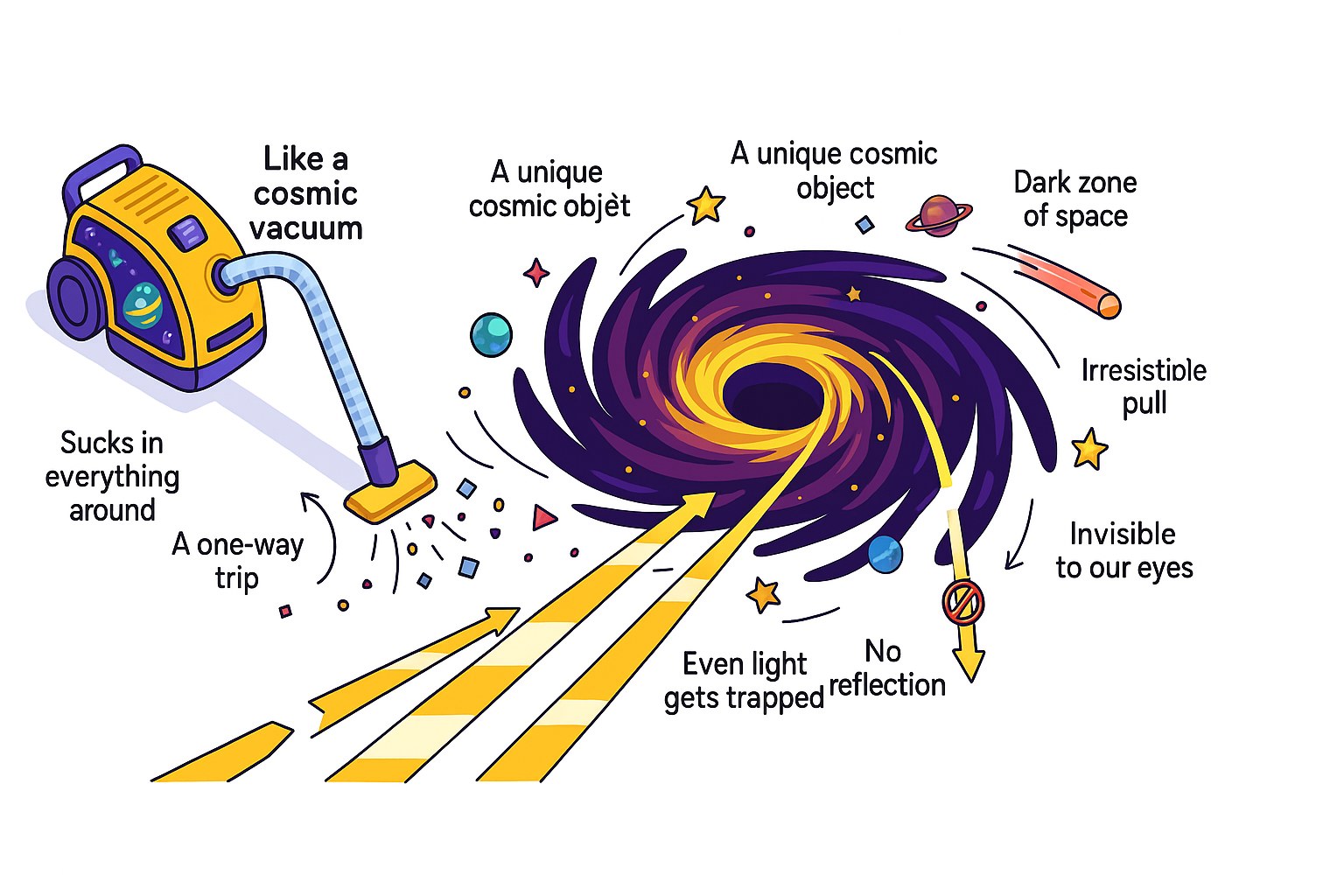
But watch out, there’s one big difference. A vacuum cleaner doesn’t pick its targets. Anything that comes close falls in, with no exceptions.
Once it’s caught, it’s all over. The object can never turn back. It’s a one-way trip with no possible return to the outside.
🔦 Why light never escapes from it
Light is the fastest thing there is. Yet even at that wild speed, it stays trapped. The extreme gravity keeps it from escaping.
That’s why the object is black. No light bounces back to our eyes. A total absence of reflection creates this darkness.
We can’t see the black hole directly. We can only guess where it sits in the sky. It simply hides the stars right behind it.
💥 The dramatic birth of these cosmic objects
To understand where these space monsters come from, you have to watch the spectacular final days of the biggest stars in our galaxy.
⭐ The life cycle of a giant star
A massive star is impressive in size. It’s far bigger than our little Sun. For millions of years, it shines brightly as it burns through all its inner fuel.
One day, it inevitably runs out of energy. With no fuel left, the star can no longer hold up its own weight. It then begins a deep, irreversible transformation.
The final imbalance sets in all at once. The bright force that held it together switches off. Gravity wins the battle and crushes the star in on itself with phenomenal power.
💥 The spectacular supernova explosion
The explosion flings the outer layers out with great violence. It’s one of the brightest events in the universe. You can’t miss this dazzling show of light.
Clouds of colourful gas spread out in every direction. These leftover scraps of matter act like building blocks. Later on, they’ll make new planets or other distant stars.
The core meets a drastic fate. While the outside scatters, the centre goes through a violent collapse. This is where its destiny is sealed for good.
A supernova is an explosion so powerful that it can briefly shine brighter than an entire galaxy made of billions of stars.
⬇️ The final collapse of the star’s heart
The core is squeezed completely. Imagine a whole mountain shrunk down to a grain of sand. That tiny point becomes incredibly heavy and dense in an instant.
The matter grows so tightly packed that it punches a hole in space. A bottomless pit forms. This is the official birth of what we call a black hole.
The giant star is now nothing but a minuscule dot. Yet this remnant holds a terrifying pull. So what is a black hole? Space explained for kids starts with this very mystery.
🔢 The two main kinds of black holes
Not all black holes are alike, because their size and origin vary enormously depending on where they sit in the vastness of the cosmos.
🌟 The stellar kind, born from a single star
Stellar black holes are the most common. They’re born from the death of a single massive star. You’ll find them scattered all over distant galaxies.
They often weigh between ten and twenty times as much as our Sun. Yet they’re far smaller in actual size. That’s quite a concentration of matter!
They’re hard to spot because they sit alone. Astronomers have to watch for stars that seem to dance on their own around the emptiness. It’s real detective work.
🌌 The supermassive giants at the heart of galaxies
Supermassive black holes are the kings of the universe. They weigh millions, even billions of times as much as our little Sun. It’s a number that can make your head spin.
They live at the exact centre of galaxies. They act like giant anchors that keep the whole system turning steadily. Without them, it would probably be chaos up there.
Our own galaxy has one of these giants at its core. It’s called Sagittarius A*, and it quietly watches over our patch of space. You can learn more about these supermassive black holes at the heart of galaxies through resources from the ESA.
🤝 When two black holes meet and merge
Sometimes two black holes drift close and spin around each other. They end up crashing together in a collision of staggering violence. It’s an invisible yet powerful event.
This crash makes space tremble like a stone tossed into water. These ripples, called gravitational waves, travel a very long way to reach our detectors here on Earth. We’ve been listening to them since 2015.
The two objects merge into a single, even bigger one. That’s how some black holes turn into true giants. There’s strength in unity, even in space!
⏰ The strange effects on matter and time
Getting close to a black hole isn’t just dangerous — it’s also an experience that breaks all the usual rules.
🍝 The curious phenomenon of spaghettification
Gravity there is so brutal that it pulls on your body unevenly. If you fall in feet first, your feet feel a much stronger pull than your head. That creates an instant stretch.
Now imagine your body stretching out like modelling clay. You’d turn into a kind of thin, very long noodle. It’s a real physical effect caused by this utterly wild gravitational power.
In the end, the stretching becomes too much for matter to bear. The object eventually snaps. It then breaks into countless tiny scattered atomic pieces.
Spaghettification is the process where an object is stretched by extreme tidal forces until it looks like a long, thin thread.
🚀 Escape velocity explained simply
To leave a planet, you have to race off at top speed. This is what we call escape velocity. Our rockets have to reach this threshold to soar up towards the stars.
On our ground, you need to travel at 11 kilometres per second. That’s an impressive speed. Yet our current engines handle this technical challenge just fine to leave the atmosphere.
But out there, you’d have to go faster than light to break free. Since that’s physically impossible, no one can escape. So what is a black hole? Space explained for kids shows just how final this trap really is.
⏳ Time slowing down near the edge
Strong gravity doesn’t only warp the matter we can see. It also slows down time itself. The seconds turn sticky and stretch out in a very surprising way for anyone watching from outside.
An astronaut near the edge would see their own watch tick along normally. Yet to friends far away, they would seem frozen. It would look as if they’d stopped moving for all eternity.
A few minutes spent out there could match whole years back on Earth. It’s a real machine for travelling into the distant future. The time gap is simply dizzying.
🔭 How to observe the invisible in space
Since they let no light escape, scientists have become real detectives hunting down these hidden objects.
✨ Studying the movement of nearby stars
Astronomers sometimes notice suns spinning very fast around a central point where there’s absolutely nothing to see.
By working out the speed of these stars, we can tell an extremely heavy object is pulling on them. That’s the proof that a black hole is hiding there.
It’s like watching leaves swirl around. You can’t see the wind, but you know an invisible current is at work.
💡 The light from matter falling in
Before vanishing, the gas spins very fast around the black hole. It rubs and heats up until it becomes incredibly bright and hot.
This superheated matter gives off X-rays that our telescopes pick up. This draws a glowing ring.
The black hole gives itself away with this show of light just before it devours everything within reach.
| Method | Observation | Evidence |
|---|---|---|
| Stellar movement | Stars orbiting an emptiness. | A giant invisible mass. |
| X-rays | Very hot gas. | Matter being pulled in. |
| Gravitational waves | Ripples in space. | A massive collision. |
📷 The story of the first photo in 2019
In 2019, researchers linked up telescopes all around the Earth. They built a giant camera the size of our planet.
The image shows an orange ring surrounding a black centre. It isn’t the black hole itself, but its shadow cast onto the burning gas.
This photo proves our theories are right. From now on, the invisible has become something real for everyone.
⚠️ Answers to common questions about the dangers
Despite their reputation as space predators, black holes stir up as much fear as genuine curiosity in young and old alike.
🌍 Is the Earth safe from these objects?
Rest assured, no black hole threatens our daily lives. Space is vast and we’re well protected. None of these giants sits anywhere near the solar system.
What’s more, our Sun will never become a black hole. It’s far too small for that. When it dies, it will simply turn into a calm white dwarf.
The closest one is still thousands of light-years away. So there’s no risk of our blue planet being sucked in. We can sleep soundly.
🚪 Why you can’t get back out once you’re in
It’s an absolute rule: the passage is one-way only. Once you cross the line, turning back is impossible. Not even the most advanced technology could change that.
And yet these objects aren’t eternal. They lose tiny scraps of energy through a slow radiation. They eventually fade away after billions of years of existence.
The great mystery remains wide open about the bottom of the hole. Science still can’t describe this exact spot. That’s where matter ends its secret journey.
- Gravity too strong: the pull is so great that nothing escapes.
- Escape velocity: it’s higher than the speed of light.
- Warped space: space-time is completely twisted at that spot.
⏱️ The theories about time travel
Some scientists imagine that these objects are doorways. They might let us reach far-off places. It’s an idea that sparks the dreams of today’s researchers.
People talk about wormholes as shortcuts through space. You’d go in one side and pop out somewhere else in an instant. It’s a bit like taking a magic tunnel.
But watch out, this only exists in films. In real life, no one has ever seen a way out. So what is a black hole? Space explained for kids stays, for now, a theoretical adventure.
These cosmic vacuum cleaners, born from giant stars, capture everything with their gravity, even light. To explore more of space explained for kids, look up at the sky: these supermassive mysteries shape the future of our galaxies. The space adventure is only just beginning, so keep your head in the stars!
🎬 Watch the video
❓ FAQ
🕳️ What exactly is a black hole in space?
Despite what its name suggests, a black hole isn’t a big empty void. Picture instead a giant star at the end of its life that has crumpled in on itself to become a tiny, incredibly heavy and dense marble. It’s a compact celestial object with a pull so powerful that nothing can escape it.
To make sense of it, think of it as a point of no return in the universe. Its gravity is so strong that it captures everything that drifts too close, a bit like a giant magnet you could never pull away from once you’ve touched it.
🔒 Why do people say light stays trapped in black holes?
Light is the fastest thing in the whole universe, yet even it is no match for a black hole. To escape the gravity of such an object, you’d have to travel even faster than light, which is simply impossible under the laws of physics.
Since no light can bounce back to us or escape, the object looks completely black and invisible to us. That’s why we can’t photograph them directly with an ordinary camera, because they give off no reflection at all.
🌀 Is a black hole like a giant vacuum cleaner?
It’s a picture we often use to explain things to kids, but watch out — a black hole doesn’t roam through space “swallowing” everything it finds. It only pulls in what comes really close to it, beyond a boundary called the event horizon.
If our Sun were swapped for a black hole of the same mass, the Earth would keep orbiting around it quite happily without being devoured. So there’s no active “suction” — just a very intense pull of gravity for any reckless objects that wander too close.
🍝 What is the “spaghetti” effect scientists talk about?
It’s a funny name for a phenomenon that’s a little less so: spaghettification! If an object fell into a black hole feet first, gravity would pull far harder on its feet than on its head. It would stretch out more and more until it looked like a long, thin noodle.
This stretching comes from extreme tidal forces. In the end, the object breaks into tiny atomic pieces. It’s one of the strangest and most striking effects of gravity on matter.
🌎 Could the Earth ever be swallowed by a black hole?
No need to panic, we’re perfectly safe on our lovely blue planet. Space is vast and the nearest black hole sits thousands of light-years away. There’s no chance one of these monsters will drop by for a surprise visit.
On top of that, our Sun is far too small to turn into a black hole at the end of its life. It will become a white dwarf, a kind of peaceful little star. So we can sleep soundly and keep admiring the stars without any worry.
⏰ Can you really travel through time using black holes?
It’s a fascinating idea that science-fiction writers love! In theory, the extreme gravity of a black hole slows time down. A few minutes spent near the edge could match years back on Earth. So in a way, it’s a machine for travelling into the future.
Some even imagine they could be “wormholes”, a kind of magic tunnel to other places in the universe. But watch out — for now, this stays a great mystery and no one has ever spotted a way out on the other side!
