
Explaining the order of the 8 planets of the solar system to your kids can sometimes feel like a never-ending puzzle. This handy guide lifts the lid on what makes each world special, from scorching rocks to giant balls of gas, so it all sticks without any effort. You’ll pick up simple memory tricks and surprising facts about our corner of space, ready to shine at your next stargazing session. 🪐
- Everything you need to know about the solar system’s planets
- Mercury, the little rock right next to the Sun
- Venus, the scorching twin and its volcanoes
- Earth, our lovely blue home
- Mars, the red planet that fuels our dreams
- Jupiter, the biggest of the gas giants
- Saturn, the queen of the icy rings
- Uranus, the slightly tilted ice giant
- Neptune, the blue pearl with record-breaking winds
- Why Pluto is no longer a classic planet
- Asteroids and comets, our other neighbours in space
- How to remember the order of the planets with ease
🪐 Everything you need to know about the solar system’s planets
Space seems endless and mysterious. Yet our neighbourhood is neatly arranged around one brilliant conductor: the Sun, which keeps every world in its place with an invisible pull.
☀️ The Sun at the centre of our neighbourhood
The Sun is a yellow dwarf star sitting right in the middle. Its huge mass makes up 99% of the whole system. It’s the warm heart of our cosmic home.
We live on the Orion Arm. It’s a small spiral structure of the Milky Way. Our system follows its galactic orbit there.
The Sun’s gravity runs everything. It guides the endless ballet of the eight planets. Nothing escapes its protective hold.
⚖️ The difference between rocky worlds and giants
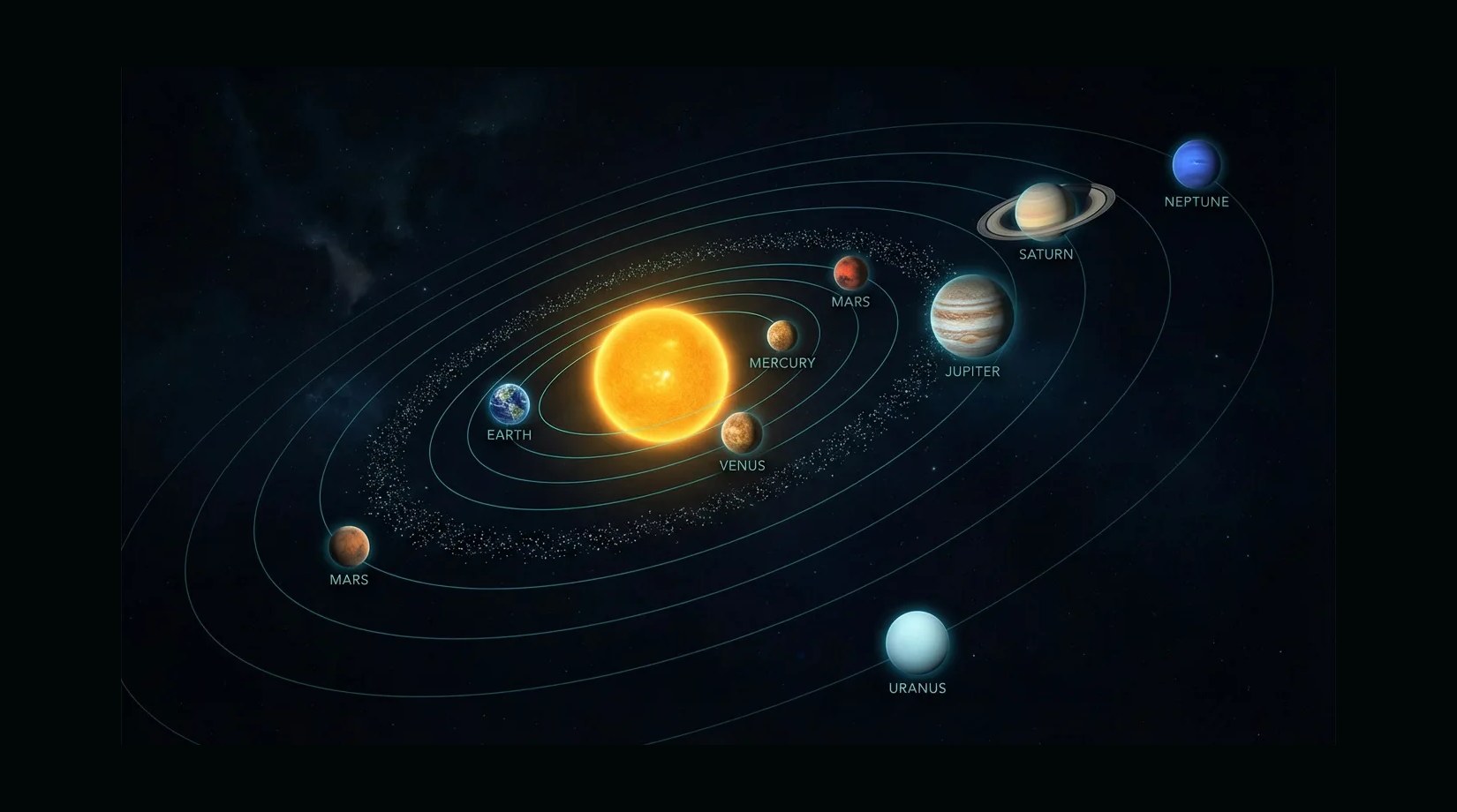
Four terrestrial planets orbit close to the Sun. Mercury, Venus, Earth and Mars all have rocky surfaces. They often hide a dense metal core deep inside.
Further out, beyond the asteroid belt, the giants rule. These worlds of gas or ice are vast and freezing cold.
✨ The birth of our cosmic world
It all starts with a solar nebula. A huge cloud of gas collapsed. The dust then began to swirl around.
This was 4.5 billion years ago. Planetesimals clumped together. Those crashes finally formed the worlds we know today.
☿️ Mercury, the little rock right next to the Sun
Now that the scene is set, let’s begin our journey at the first stop, the one closest to the Sun’s fire: shy little Mercury.
🌑 A surface scarred by craters
Mercury looks a lot like our own Moon, covered in countless craters. It’s a small, very compact ball of rock. It’s barely 1.5 times the size of our natural satellite. Its outline really is tiny.
This planet has no moons at all. Sitting so close to the Sun is a real problem. The Sun’s gravity would stop it from holding onto any satellite for long. So it travels all alone.
🌡️ Extreme temperatures with no atmosphere
With no atmosphere, it can’t hold onto any of the heat it gets. Without air, the sky stays pitch black. You can see the stars even in broad daylight. It’s a world of silence.
The swing in temperature here is brutal. It climbs to 430°C during the day. At night, the thermometer drops to -180°C.
Its enormous iron core takes up a huge amount of space. That’s why it’s so dense. It’s a little heavyweight of space.
♀️ Venus, the scorching twin and its volcanoes
Mercury may be the closest, but it isn’t the hottest; that title goes to Venus, a true inferno hidden under a layer of cloud.
🔥 A stifling greenhouse atmosphere
The greenhouse effect here breaks every record. The temperature stays stuck at 470°C. The thick atmosphere of CO2 works like a deadly heat trap.
The pressure at ground level is simply colossal. It matches what you’d feel 900 metres under the ocean. It’s a truly crushing planet for any visitor.
🔄 An unusual backwards spin
Venus has what’s called a retrograde spin. So, oddly enough, the Sun rises in the west there. It’s a really striking exception among the eight planets.
Its volcanic activity is especially intense too. Its surface is completely covered in domes and vast lava flows.
And this planet always travels solo. Just like Mercury, Venus has no natural satellite at all.
🌍 Earth, our lovely blue home
Let’s leave these furnaces behind and find a little freshness on the only known haven of peace: our very own planet.
💧 Liquid water and breathable air
Our stop sits in exactly the right spot. The temperature here stays mild. That lucky break lets water flow freely.
Earth is the only planet in the solar system inside the habitable zone, where water can exist as a liquid.
The air we breathe is a precious mix. It’s mostly nitrogen and oxygen. This blend of gases works like a shield. It blocks the most dangerous of the Sun’s rays.
🌕 The Moon, our protective satellite
The Moon isn’t just there to look pretty. It steadies the tilt of the Earth. Without that big lump of rock, our axis would wobble too much. The climate would then become completely wild and unpredictable.
It also keeps the oceans moving. Its pull draws the water towards it. This natural mechanism is what creates the daily rhythm of the tides along our coasts.
Beneath our feet, the core is busy too. It generates a powerful magnetic field. This invisible shield protects us nicely from the constant battering of the solar wind.
🔴 Mars, the red planet that fuels our dreams
Right after us comes Mars, a rusty desert that could well be humankind’s next great leap.
🟥 A colour that comes from iron oxide
Its orange tint comes from the ferrihydrite in its soil. That’s a very particular kind of iron oxide. You’ll also find Olympus Mons there. This giant volcano is the tallest in the solar system.
The polar caps mark the ends of the globe. They’re made of water ice and frozen carbon dioxide. Their size changes with the Martian seasons.
🛰️ Its two little moons and the exploration
Phobos and Deimos orbit around the planet. These two moons look like big lumps of rock. They’re probably asteroids captured by gravity.
The Curiosity and Perseverance rovers roam the ground. They study the sediments with great care. Their mission is to track down traces of ancient life.
River networks still mark the desert landscape. Water once flowed here in great quantities. That was several billion years ago.
🟠 Jupiter, the biggest of the gas giants
Let’s cross the asteroid belt to meet the real heavyweight of the family: colossal Jupiter.
🌀 An imposing mass and mighty storms
This planet smashes every record for size. It’s more massive than all the other planets put together. Its presence completely dominates our patch of space. It’s a true gassy ogre.
What stands out most is its Great Red Spot. This giant whirlwind spins without ever stopping. It’s been raging for at least three centuries. It’s a permanent, jaw-dropping storm.
🌙 Its four famous natural satellites
Jupiter keeps a very lively crowd around it. The best known are its four Galilean moons. These are Io, Europa, Ganymede and Callisto. Each one is a unique, fascinating geological world.
Here’s what makes these moons so special:
- Io the volcanic
- Europa and its hidden ocean
- Ganymede the giant
- Callisto the cratered
The celestial ballet doesn’t stop there. We now count close to a hundred of them. Together, the eight planets reveal all their wonderful variety here.
🪐 Saturn, the queen of the icy rings
A little further out, Saturn puts on the most beautiful show in the solar system with its glittering rings of ice.
💍 A spectacular ring system
Its rings are made of billions of pure ice particles. They form a huge disc 300,000 km wide. These bits of debris shine brightly in the empty dark of space. It’s a truly one-of-a-kind sight.
This gas giant has a surprisingly low density. It’s actually lighter than water. If you found an ocean big enough, it would float like a cork.
🌙 Titan and the many moons
Titan is a fascinating moon with a very thick atmosphere. It’s home to strange lakes of liquid methane. It’s the only known satellite with that kind of surface.
Tiny Enceladus is full of surprises too. It shoots out powerful geysers of icy water. These jets feed straight into one of the planet’s rings.
When it comes to size, Saturn is a real heavyweight. It weighs about 95 times as much as Earth. Even so, it stays smaller than its neighbour Jupiter.
🔵 Uranus, the slightly tilted ice giant
As we head deeper into the icy reaches, we come across Uranus, a planet that does nothing like the others.
🔄 A one-of-a-kind tilt
This planet has an incredible tilt of 98 degrees. It literally rolls along its orbit. It doesn’t spin like a normal spinning top. Its axis stays almost parallel to its path.
This sideways tip leads to truly extreme seasons. Each pole is plunged into total darkness. That darkness lasts 42 years. Then constant light takes over.
💙 A blue tint thanks to methane
Its lovely turquoise coat comes from the methane in its atmosphere. This gas soaks up all the red light. It reflects only the blue shades. That’s its very recognisable visual signature.
The cold here is absolutely biting. Its atmosphere is among the iciest of all. The temperatures are truly extreme by our standards.
We know of 27 fascinating moons around it. Their names come from the works of Shakespeare. It’s a small poetic touch out in space. You’ll find Miranda and Ariel among them.
💙 Neptune, the blue pearl with record-breaking winds
Our planetary journey ends with Neptune, a dark and stormy sentinel lost on the very edge of the void.
❄️ Extreme distance and the cold
Neptune hides 4.5 billion kilometres from the Sun. It really is the end of the world. The average temperature here is close to -220°C. An icy chill reigns out there.
Time flows differently on this giant. It takes 165 years to complete a single lap. It’s an incredibly long journey around the Sun. One Neptunian year lasts a whole lifetime.
🌬️ Storms and violent winds
Out here, the weather doesn’t mess about. Supersonic winds top 2,000 km/h. They’re the fastest of all eight planets. It’s pure, wild power.
Triton is its largest natural satellite. It’s a rather odd one. It orbits in the opposite direction to the planet’s spin. That’s unique behaviour in our neighbourhood.
Its make-up is much like Uranus. It’s an ice giant. It’s rich in water and ammonia. Its blue colour comes from the methane in its atmosphere.
🥶 Why Pluto is no longer a classic planet
You can’t talk about the planets without bringing up the case of Pluto, that former ninth member that caused so much fuss.
🪐 Its new status as a dwarf planet
In 2006, the International Astronomical Union made its decision. Pluto lost its title as a classic planet. It failed to clear its orbit. It shares its space with far too many crowding neighbours.
Three rules now define a planet. It must orbit the Sun. It must be properly round. And finally, it must rule its orbital path alone.
Pluto is still a little world of ice. It does have five moons all the same.
🔭 The hunt for a ninth planet
Researchers are now tracking down Planet Nine. Strange gravitational tugs hint that it’s there. A very massive body may be hiding on the edge of the solar system.
Other icy worlds exist out there. Eris and Haumea come to mind. They’re dwarf planets that escort Pluto in the shadows.
Space is huge. Our list is far from finished.
☄️ Asteroids and comets, our other neighbours in space
Beyond the eight main worlds, space teems with fascinating debris, left over from the birth of our system.
🪨 The main belt and the Kuiper belt
The main belt sits between Mars and Jupiter. It gathers millions of rocky bodies. It’s a transition zone between the rocky planets and the gas ones. You mostly find metal-rich asteroids there.
| Zone | Location | Make-up | Notable object |
|---|---|---|---|
| Main belt | Mars/Jupiter | Rock | Ceres |
| Kuiper belt | Beyond Neptune | Ice | Pluto |
The Trojan asteroids are very curious too. They share Jupiter’s orbit at stable points.
Why bother with them? They’re fossils of the early solar system.
☄️ Comets from the Oort cloud
Comets are often described as dirty snowballs. They travel from the distant Oort cloud. This spherical store surrounds our whole planetary system.
Their look changes near the Sun. The ice turns to gas and releases dust. This forms a glowing trail called a tail or coma.
Their path is sometimes enormous. Some only come back to see us every few thousand years.
🧠 How to remember the order of the planets with ease
To finish, here are a few handy tricks so you never stumble again when someone asks you to list the planets.
🎵 Fun memory sentences
Learning becomes a game with the sentence: “My Very Easy Method Just Speeds Up Naming.” Each first letter helps you remember a name. It’s a simple, effective trick.
Here’s the exact order to remember so you can shine in company:
- Mercury
- Venus
- Earth
- Mars
- Jupiter
- Saturn
- Uranus
- Neptune
Picture the sizes. Jupiter is a big watermelon. Earth is more like a little pea.
🚀 Human exploration and space probes
The famous Voyager probes explored the gas giants before heading off into the distance. They’re now leaving our system after decades of service. These machines are our faraway eyes.
The solar wind flows everywhere. This stream of charged particles bathes all the space between the planets.
The future looks thrilling. The robots are quietly paving the way for the next human explorers.
Getting to grips with the eight planets of our solar system becomes child’s play thanks to our handy memory tricks. Between rocky worlds and gas giants, this trip through space offers a fascinating show to share as a family from tonight. Keep your head in the stars, because exploring our wonderful cosmic neighbourhood is only just beginning! 🌟
❓ FAQ
🪐 What is the exact order of the planets in our solar system?
To never get it wrong, just start from the Sun and move out towards the cold of space. The official order is: Mercury, Venus, Earth, Mars, Jupiter, Saturn, Uranus and finally Neptune.
A little tip to help kids remember it all? Use the magic sentence: “My Very Easy Method Just Speeds Up Naming”. Each first letter stands for a planet — it’s foolproof!
❓ Why is Pluto no longer considered a planet?
Since 2006, astronomers have changed the rules of the game. To be a “real” planet, a body must be round, orbit the Sun, and above all have tidied up its own orbit. Sadly, Pluto shares its path with too many other little icy objects.
Don’t worry though — it hasn’t disappeared! It simply belongs to a new category: dwarf planets. It’s a fascinating world of ice that still has five little moons.
🔥 Which is the hottest planet in our neighbourhood?
You might think it’s Mercury, since it sits so close to the Sun’s fire — but that’s a mistake! The prize for heat goes to Venus. Thanks to a colossal greenhouse effect from its thick CO2 atmosphere, the temperature stays at a constant 470°C.
It’s a true inferno, where the ground pressure is as crushing as being 900 metres under the ocean. We’re much better off on our lovely Earth, aren’t we?
⚖️ What are the main differences between rocky and gas planets?
The solar system is a bit like a big family split into two groups. The terrestrial planets (Mercury, Venus, Earth, Mars) are small, dense and made of rock and metal. They sit right next to the Sun.
Further out, beyond the asteroid belt, you find the gas giants like Jupiter and Saturn. They’re huge, far less dense and made mostly of hydrogen and helium. They don’t even have a solid surface you could stand on!
🌙 How many moons does the planet Jupiter have?
Jupiter is a real mother hen with a very big family! We now know of close to a hundred moons around it. The most famous are its four Galilean moons: Io the volcanic, Europa and its hidden ocean, Ganymede the giant and Callisto the cratered.
It’s the most massive planet in our system — heavier, in fact, than all the other planets put together. Its gravity is so strong that it pulls in and holds onto all these natural satellites.
