
Space for Kids: A Complete Guide to the Universe
From the Moon to black holes — discover the whole universe with your child, sorted by age (3–11). No telescope required. 🚀
🌌 Space is the biggest, most exciting playground there is — and your child already has a front-row seat every single night. From the friendly Moon that quietly changes shape to the giant planets wheeling around the Sun, the universe is bursting with wonders that turn curious kids into little explorers. This complete guide gathers everything you need to discover space together, carefully sorted by age so you always know exactly where to begin. ✨ Whether you have a wide-eyed 3-year-old who just wants to wave at the Moon or a question-machine 11-year-old who wants to know what’s inside a black hole, there’s a door into the cosmos waiting for you right here — no rocket, no expensive telescope, and no science degree required.
- What is space, really?
- Stargazing for little ones (ages 3-5)
- Our cosmic neighbourhood (ages 6-8)
- Mind-blowing deep space (ages 9-11)
- How humans explore space
- Exploring space as a family
- All our space guides
- Space questions kids ask
🌌 What is space, really?
Space is everything that lies beyond the thin blanket of air wrapped around our planet. It officially begins about 100 kilometres above our heads — a line called the Kármán line — and from there it stretches out further than anyone can truly picture: past the Moon, past the Sun, past billions upon billions of stars. It is mostly a vast, silent emptiness, sprinkled with glowing stars, drifting planets, icy comets and slowly spinning galaxies.
The numbers are almost impossible to imagine, and that’s exactly what makes them fun for kids. The Moon is roughly 384,000 kilometres away — already so far that a car driving non-stop would take months to get there. The Sun is 400 times further still. And the nearest star beyond the Sun is so distant that its light, the fastest thing in the universe, takes more than four years to reach us. When your child looks up, they are quite literally seeing into the past. 🔭
The best part for families is that you don’t need a spaceship to start exploring. A clear night sky is your first and best telescope. Every twinkling point up there is a real object, often unimaginably far away, sending its light on a journey of years just to land in your child’s eyes. Helping a child grasp that one simple idea — that the night sky is a window onto the entire universe — is the spark that makes every other space adventure suddenly click into place.
The rest of this guide is organised by age, because a 4-year-old and a 10-year-old wonder about completely different things. Pick the section that fits your child today, and come back to the others as they grow. 🚀
🌙 Stargazing for little ones (ages 3-5)
For the youngest explorers, space is all about what they can see with their own eyes. Forget long words and complicated science — at this age it’s about pointing at the sky, naming what you spot, and sharing a feeling of wonder. The three perfect places to begin are the Moon, the stars and, if you’re lucky, a shooting star.
🌝 The Moon: a slow game of peekaboo
The Moon is the ideal first object for tiny astronomers because it changes a little every single night, like a slow and magical game of hide-and-seek. Watching it grow from a thin silver smile into a bright round circle and back again teaches patience, observation and the comfort of a repeating rhythm. Our gentle guide to the phases of the Moon turns all of this into a cosy bedtime ritual, complete with biscuit games and simple drawings that make the lunar cycle stick in a small head without a single difficult word.
⭐ Stars: tiny lights that twinkle
Stars come next, and to a small child a star is simply a tiny light that sparkles — which is a beautiful place to start. Counting them, spotting the brightest one, or making up names together costs nothing and delights everyone. When they inevitably ask “but why do they shine?”, you’ll find a warm, picture-friendly answer in our explanation of why stars sparkle in the night sky, written specially to be read aloud.
🌠 Shooting stars: make a wish
And on a lucky, patient evening, you might both catch a sudden streak of light zipping across the dark: the pure magic of a shooting star. It’s the perfect excuse to make a wish, gasp together, and plant the seed of a lifelong love of looking up. At this age the goal isn’t facts at all — it’s feelings: awe, curiosity, and the simple joy of noticing the sky side by side.
🪐 Our cosmic neighbourhood (ages 6-8)
Around the start of school, children grow hungry for how things actually work. This is the golden age to introduce our cosmic home: the solar system, a busy family of planets all looping around one dazzling star. Suddenly the random lights in the sky become a place with a map — and your child loves having the key.
☀️ The big picture: our solar system
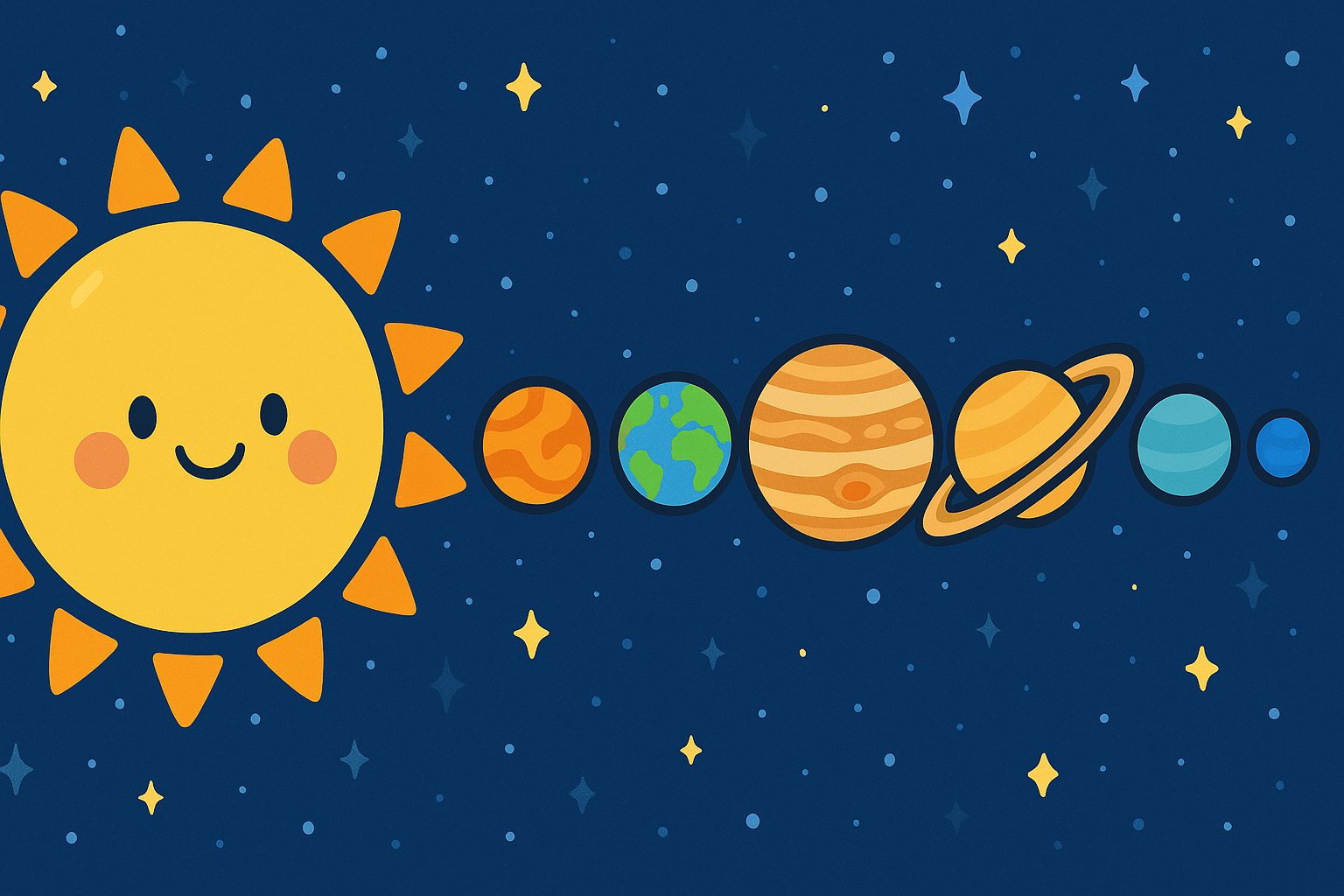
The best starting point is always the big picture. Our friendly overview of the solar system explained for kids shows how the Sun sits like a campfire at the centre while everything else circles around it, held by an invisible force called gravity. Once a child pictures that, the whole sky reorganises itself in their mind.
🌍 Meet the eight planets
From there, zoom into the planets themselves. Discover all eight planets in their correct order, from scorching little Mercury right out to icy, faraway Neptune, complete with the kind of easy memory tricks your child will proudly show off at the dinner table. Learning the order is a confidence-builder: it’s a “grown-up” fact they can fully master.
🔥 The Sun and our red neighbour Mars
Two members of the family deserve their own spotlight. The first is the star that makes life itself possible: learn why the Sun shines so fiercely, how it turns hydrogen into light, and why it warms our whole planet from 150 million kilometres away. The second is the rusty world every future astronaut dreams of visiting — say hello to Mars, the red planet, with its record-breaking volcanoes, planet-wide dust storms and brave little robot explorers. By the end of this stage, a 6-to-8-year-old can name the planets, point to the Sun’s place in the sky, and explain why Earth sits in just the right spot for life. That’s real, lasting science. 🌟
🕳️ Mind-blowing deep space (ages 9-11)
Older children are finally ready for the truly jaw-dropping stuff — the ideas that bend your brain and feel almost like magic, except every word of it is completely real. This is where space stops being merely pretty and becomes genuinely astonishing, the kind of knowledge that makes a 10-year-old feel like they’ve been let in on the universe’s biggest secrets.
💍 Saturn and its impossible rings
Start with the undisputed showpiece of the solar system: find out why Saturn wears its famous rings, made not of solid hoops but of billions of tumbling chunks of ice and rock, some as small as a grain of sugar and some as big as a house. It’s the perfect bridge between the familiar planets and the stranger, wilder physics waiting just ahead.
🌑 Black holes: the universe’s greatest mystery
Then take the plunge into the most mysterious object in existence. Our clear, careful guide to what a black hole really is explains how a giant dying star can collapse into a point so dense that not even light can escape its pull — and why, very reassuringly, every black hole is thousands of light-years away, far too distant to ever bother our cosy corner of space. These are exactly the topics that spark “wait, that can’t be true!” debates over dinner, and that spirited disbelief is the very best fuel for a curious mind. Beyond black holes lie galaxies, each one a swirling city of hundreds of billions of stars, and our own — the Milky Way — is just one of trillions. The universe, it turns out, is always bigger than you think. 🌌
🛰️ How humans explore space
If we can’t easily travel to space ourselves, how do we know so much about it? That question fascinates children of every age, and the answer is a story of clever machines and brave people.
It begins with telescopes, giant eyes on the ground and in orbit that gather faint, ancient light and reveal planets, rings and distant galaxies our own eyes could never catch. Then come rockets, which burn enormous amounts of fuel to push hard enough to escape Earth’s gravity — the same gravity that keeps the Moon circling us and the planets circling the Sun.
To explore worlds too dangerous or too far for people, we send robot explorers. Rovers like the ones rolling across the surface of Mars drill into rocks, sniff the air and beam home photos from a planet no human has ever set foot on. And of course there are astronauts, who train for years to live and work in the weightless silence of space, floating aboard space stations far above our heads. Together, these tools have turned the night sky from a mystery into a place we are slowly, wonderfully getting to know — and your child could be part of the next chapter. 🚀
🔭 Exploring space as a family
You really don’t need expensive gear to raise a stargazer. A handful of simple habits do far more than any gadget ever could:
- Get away from city lights. A dark garden, a quiet park or a short country drive reveals ten times more stars. Light pollution is the single biggest enemy of a beautiful night sky.
- Let your eyes adjust. Stay outside for 15-20 minutes without glancing at a phone, and faint stars will slowly bloom into view as if by magic.
- Keep a sky notebook. Drawing the Moon’s shape each evening or jotting down which planets you spotted builds real observation skills — and becomes a treasured keepsake.
- Follow the seasons. The night sky slowly turns through the year, so there’s always something new to find. Winter evenings are famous for their brilliant, easy-to-spot constellations, while summer offers warm nights perfect for spotting the Milky Way.
- Answer every “why” with a story. Children remember space best when it’s wrapped in wonder rather than dry facts. Every guide on this page is written to be read aloud and enjoyed together.
The most powerful tool of all isn’t a telescope — it’s your shared attention. Ten quiet minutes under the stars, side by side, pointing and wondering together, is a memory your child will carry for the rest of their life. 🌟
📚 All our space guides
Here is the full collection, ready to explore in any order you like. Bookmark this page and work through the guides together as your little astronaut grows from waving at the Moon to debating black holes.
- 🌙 The phases of the Moon, explained for kids
- ⭐ Why do stars shine at night?
- 🌠 What is a shooting star?
- 🪐 The solar system explained to kids
- 🌍 The 8 planets of the solar system
- ☀️ Why the Sun shines
- 🔴 Mars, the red planet
- 💍 Why Saturn has rings
- 🕳️ What is a black hole?
❓ Space questions kids ask
🚀 At what age can I start teaching my child about space?
You can start as young as 2 or 3, simply by pointing at the Moon and naming it. Toddlers don’t need science — they need wonder. Around ages 6-8, children are ready to understand how the solar system works, and by 9-11 they can grasp bigger ideas like black holes and galaxies. This guide is sorted by age so you always have an entry point that fits exactly where your child is right now.
🌙 Why does the Moon change shape?
The Moon doesn’t really change — it’s always the same round ball of rock. What changes is how much of its sunlit side we can see from Earth as it travels around us over about 29 days. Our guide to the Moon’s phases explains it with simple games and tricks that kids love.
⭐ What is the difference between a star and a planet?
A star, like our Sun, is a giant ball of hot gas that makes its own light and heat. A planet, like Earth or Mars, is a cooler, solid or gassy world that doesn’t shine on its own — it only reflects sunlight. That’s why true stars twinkle, while planets glow with a steadier light.
🪐 How many planets are there in the solar system?
There are eight planets orbiting the Sun: Mercury, Venus, Earth, Mars, Jupiter, Saturn, Uranus and Neptune. Pluto was reclassified as a “dwarf planet” back in 2006. You can meet them all in our guide to the eight planets in order.
🕳️ Are black holes dangerous to Earth?
Not at all! Black holes are real and incredibly powerful, but the nearest ones are thousands of light-years away — far too distant to affect us in any way. Our black hole guide for kids explains why they’re fascinating rather than frightening.
🔭 Do I need a telescope to explore space with my kids?
No. Your eyes are the perfect first instrument. The Moon, the brightest planets, shooting stars and thousands of stars are all visible with no equipment at all — you just need a dark sky and a little patience. A telescope is a lovely later step, never a starting requirement.
☀️ Why is the Sun so important for life on Earth?
The Sun gives our planet the light and warmth that every living thing depends on, from the plants that make our food to the comfortable temperatures that keep water liquid. Discover how the Sun makes its energy and why we’re so lucky to orbit it at just the right distance.
✨ Keep exploring the universe together
Space is the gift that keeps on giving: every clear night is a brand-new lesson, and every “why?” is a door swinging open onto the next adventure. Pick one guide above, head outside after dark, and start your family’s journey through the cosmos tonight. 🌌 The universe is waiting — and your little explorer is more ready than you think.
