
Explaining the phases of the Moon to kids can feel like an impossible mission when the questions start flying at bedtime. This guide breaks down how our satellite seems to change shape thanks to the light of the Sun, turning that nighttime mystery into a simple observation game. You’ll discover foolproof memory tricks and tasty hands-on activities so the lunar cycle finally holds no more secrets. 🌙
- Why does the Moon seem to change shape?
- The 4 steps to follow the lunar cycle
- Understanding how the Moon moves
- 3 tricks to recognise the phases easily
- Fun activities with biscuits or dough
- Sleep and eclipses: answers for curious kids
🌙 Why does the Moon seem to change shape?
Have you ever glanced up at the sky in the evening and noticed that our nightly neighbour never looks quite the same as the night before? That shift in shape is actually just a fascinating optical illusion.
☀️ The role of the Sun’s light
The Moon is a dark world. It makes no light of its own. It simply reflects the light of our star.
Picture a huge mirror hanging in the sky. The Sun always lights up one half of the Moon. That bright side is the part we’re trying to see. Its position changes, but the light source stays the same.
Without the Sun, the Moon would be invisible. It’s all a game of shadows.
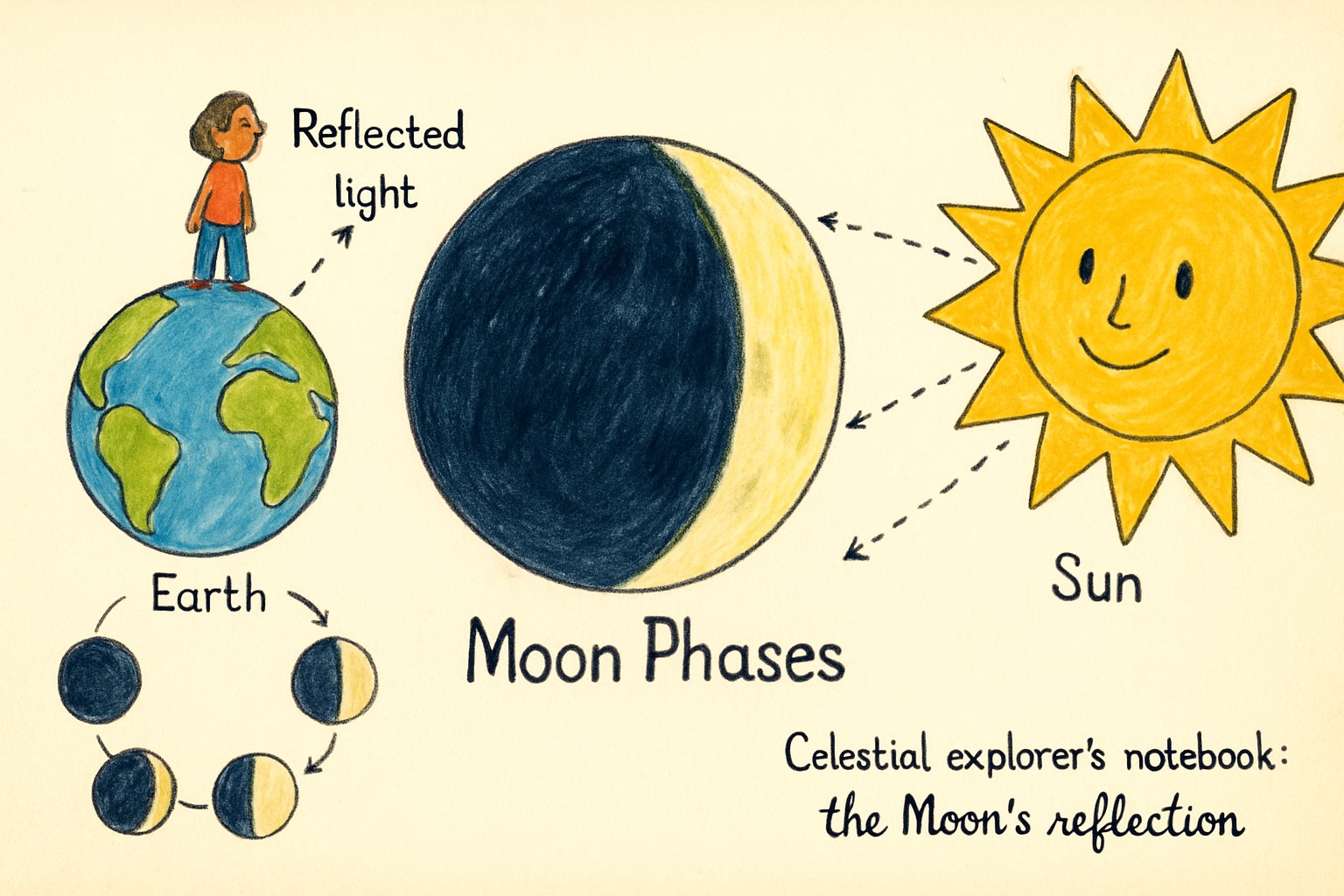
👁️ It’s all about your point of view
The Moon stays the same unchanging ball of rock. It never really shrinks. It’s our viewpoint from the ground that keeps shifting.
Think of a tennis ball in the dark. A torch stands in for the Sun. Depending on where you stand, you see either a crescent or a full circle.
The Moon doesn’t change shape — our eyes simply catch a different slice of its sunlit side each night.
⭐ The difference between the Moon and the stars
Stars are faraway balls of fire. They shine with their own nuclear energy. The Moon is much closer and completely cold.
It’s a travelling companion. It orbits around us. Reflected light is the exact scientific term for this.
The planets work just like the Moon. They bounce back the Sun’s light too.
Explaining the phases of the Moon to kids helps them see that this 29.5-day cycle is a steady dance between the Earth and the sky.
🌗 The 4 steps to follow the lunar cycle
Now that we understand where the light comes from, let’s see how this show breaks down into four key moments across the nights.
🌑 The new moon and the first crescent
The new moon kicks things off. The Moon slips right between us and the Sun. Its bright side faces away from us, so it stays invisible.
Then a thin thread of light appears. People often call this first crescent the Moon’s smile. It’s the signal that the waxing phase has begun. The light gains a little more ground each evening.
The sky looks empty for a short moment. Then the magic happens all over again.
🌓 The first quarter and the gibbous moon
The first quarter draws a perfect half-circle. It looks like a capital letter D in the sky. The Moon is now half filled with sunlight.
Next comes the gibbous moon. It’s bigger than a plain quarter but not quite round yet. It shows up very early, sometimes even in broad daylight.
| Phase | What it looks like | When to watch |
|---|---|---|
| New Moon | Invisible dark disc | Daytime |
| First Quarter | Half moon (a D shape) | Afternoon and evening |
| Full Moon | A full bright circle | All night long |
| Last Quarter | Half moon (a backwards D) | Late night and morning |
🌕 The full moon and the fade-out
The full moon is the grand finale. The whole visible side is flooded with sunlight. It shines like a guardian lighthouse in the dark night.
Then the waning phase takes over. The disc starts to nibble away at its edges. We reach the last quarter before everything gently fades.
The loop is complete in four weeks. The cycle starts again, tirelessly, to our endless delight.
🔄 Understanding how the Moon moves
This dance of light isn’t down to chance — it comes from a precise journey the Moon makes around our planet.
📅 How long one full lunation lasts
The lunar cycle lasts about 29 and a half days. This is what we officially call a lunation. That stretch of time matches our usual calendar months almost exactly.
Our 30-day months come from this. People long ago used the Moon as a natural clock. It made counting time very easy. It’s a shared marker for all of humankind.
The lunar calendar is still useful. It sets the rhythm for many cultures even today.
🌍 The journey around the Earth
The orbit is the Moon’s invisible path. It circles the Earth without ever stopping. An unseen force keeps it neatly in place.
We always see the same face. The Moon spins on itself at exactly the same speed as its journey. It’s a perfect, natural match-up — genuinely surprising.
To picture all this more clearly, you can join a hands-on science workshop. Nothing beats doing it yourself to learn.
☀️ The line-up of Sun, Earth and Moon
Picture these three bodies in space, always shifting into a new alignment. Their changing positions create the different phases. It’s a never-ending movement through the empty vastness of space.
The Earth spins on its axis too. That’s why the Moon rises and sets. The scenery changes, but the players stay the same.
Space is a giant clock where every cog, from the Earth to the Moon, plays its part with perfect timing.
💡 3 tricks to recognise the phases easily
Now that the theory is sorted, here are a few pro tips to spot the current phase in the blink of an eye.
🔤 The secret of the letters p and d
Just imagine a vertical line drawn against the crescent moon. That made-up stroke turns the shape in the sky into a letter kids know well.
If you make a “p”, it’s the first quarter. P for “premier” — the French word for first — makes it easy to recall. If you make a “d”, it’s the last quarter, and the Moon is about to vanish soon.
This memory trick is foolproof. Kids love it and remember it for good.
🌙 Watch the lit side of the crescent
Look at which side of the Moon is shining most. If it’s the right, the Moon is growing. If it’s the left, it’s slowly shrinking again.
Keep in mind that the Moon can be a bit of a trickster. When it forms a “C”, it isn’t growing. It’s on its way out, heading towards the dark new moon.
Here’s a quick visual recap so you never get it wrong:
- Right side lit = waxing (growing)
- Left side lit = waning (shrinking)
- A C shape = it’s on its way out
📆 Keep a homemade moon calendar
We love the idea of keeping a little observation notebook. Each evening, you draw the shape you spotted. It’s a brilliant habit for becoming an expert.
Learn to predict the next full moon. You count the days since the last quarter. Soon you’ll be able to read the future.
Watching regularly builds a stronger bond with nature. It’s a calm moment before heading off to sleep.
🍪 Fun activities with biscuits or dough
To make these ideas feel real, there’s nothing like getting hands-on with some playful little workshops.
🍪 The biscuit game for sweet tooths
Grab some round chocolate sandwich biscuits. Carefully twist the two halves apart. The white cream stands for the Sun’s light.
Scrape the cream away to copy the phases. You make neat crescents and quarters. Then you line up the biscuits on the table. It’s a delicious timeline you can gobble up.
Learning while eating works a treat. It’s every little astronomer’s favourite activity.
🟤 Mould the Moon out of modelling clay
Roll two balls of different sizes. The big one is the Earth and the small one is the Moon. Use different colours so they’re easier to tell apart.
Use a desk lamp to stand in for the Sun. Move the Moon around the Earth. Watch how the shadows really shift.
Here’s the kit you’ll need for this workshop:
- Blue and grey modelling clay
- A torch
- A steady stand for the Earth
📓 Draw a nighttime observation diary
Print some empty circles on a sheet of paper. Each evening, your child colours in the part they can see. It’s a visual record of how steady they’ve been.
Add stickers for the cloudy evenings. You can also note the local weather. Compare the drawings at the end of the month.
This diary becomes a treasured keepsake. It shows how their understanding of space has grown.
😴 Sleep and eclipses: answers for curious kids
Let’s wrap up this tour by answering the questions that so often puzzle kids at bedtime.
👶 How the Moon affects children
The myth of restless sleep comes up a lot. Some children do feel more wound up on those evenings. The light of the full moon really is very bright.
Even so, there’s nothing magical about it. It’s simply an unusual brightness creeping into the bedroom. Drawing the curtains is often enough to settle everyone down. Natural cycles hold no hidden powers.
Reassure little ones about these legends. The Moon is still a kind friend to them.
🌚 The wonder of lunar eclipses
It’s a rare moment when everything lines up perfectly. The Earth passes exactly between the Sun and the Moon. It then casts its shadow onto the Moon’s surface.
The Moon turns a red or coppery colour. That’s the Earth’s atmosphere bending the sunlight. It’s a gorgeous sight, completely safe to watch.
You can uncover the secrets of eclipses at dedicated workshops. It’s a great way to learn while having fun.
🔭 Watch the night sky as a family
It’s best to get away from city lights to see clearly. A garden or a dark park is ideal. Light pollution hides the most beautiful details in the sky.
Learn to spot the planets, which stay steady. They don’t twinkle like the faraway stars. It’s a first taste of real astronomy for little ones.
Encourage children’s natural curiosity. The universe is a limitless playground for their imagination.
The Moon is a magic mirror that reflects the Sun without ever changing shape. By following its 29-day cycle, from the thin crescent to the full glow, the sky turns into a playground. Watch it tonight with your kids and unlock the mysteries of the night sky! 🌟
❓ FAQ
🌙 Why does the Moon change shape in the sky?
In truth, the Moon always keeps its shape as a ball of rock. What changes is simply the sunlit part we can see from the Earth. As it circles around us, our viewpoint shifts every night.
It’s a bit like a ball you move around a lamp. Depending on where you stand, you see either a small crescent of light, half the ball, or the whole ball shining brightly.
⏳ How long does a full cycle of the Moon last?
A whole lunar cycle, which scientists call a lunation, lasts about 29.5 days. That’s why our months are usually 30 or 31 days long — people long ago used the Moon as a natural clock.
Over those four weeks, the Moon goes through eight distinct phases. It starts off invisible at the new moon, grows to the full moon, then slowly shrinks until it vanishes again and starts a fresh lap.
🔍 How can you tell whether the Moon is growing or shrinking?
There’s a magic trick with the letters “p” and “d”. If you imagine a vertical line against the crescent and it makes a “p”, it’s the first quarter, so the Moon is growing. If it makes a “d”, it’s the last quarter, so the Moon is shrinking.
Another handy tip is to look at which side is lit. If the light is on the right, the Moon is waxing. If the light is on the left, it’s waning. Watch out — the Moon can be a bit playful and seem to fool us when it forms a “C”!
🌖 What exactly is a gibbous moon?
The word “gibbous” might sound odd, but it simply describes a Moon that’s more than half full without being quite round yet. It looks like an almost complete disc, with one side still nibbled away by shadow.
You meet it twice during the cycle: just before the full moon (when it’s waxing) and just after (when it’s waning). It’s a very bright phase you can sometimes catch even in broad daylight.
🔴 Why does the Moon sometimes turn completely red?
This striking sight happens during a lunar eclipse. It occurs when the Earth sits exactly between the Sun and the Moon. Our planet then casts its shadow onto its little natural satellite.
The red colour comes from the Earth’s atmosphere, which bends the Sun’s light towards the Moon. It’s a gorgeous sight to enjoy as a family, and unlike solar eclipses, there’s no danger to your eyes.
😴 Does the full moon really keep children awake?
Many parents notice their children are more restless on those evenings. Scientifically, there’s no hidden magic power, but the light of the full moon is very bright and can slip through the curtains.
This unusual brightness in the bedroom can disturb little sleepers. A good thick curtain is usually enough to bring back the calm. The Moon stays a kind neighbour watching over our nights.
