
Explaining why stars shine at night without tying yourself in knots is a real parenting challenge. This guide cracks the secret of these balls of gas that turn hydrogen into light thanks to incredible heat. You’ll discover how that glowing journey crosses space to make your little stargazers’ eyes sparkle. ✨
- The Sun is a star like any other
- Nuclear fusion makes the light
- The force of gravity and pressure
- The long journey of starlight
- Why stars twinkle but planets don’t
- The end of a star’s life
☀️ The Sun is a star like any other
By day, our sky is ruled by one dazzling light, but did you know it’s simply one star among billions of others? When you look up at night, you’re actually seeing the very same galactic family, just from much farther away.
🎈 A big ball of gas in the sky
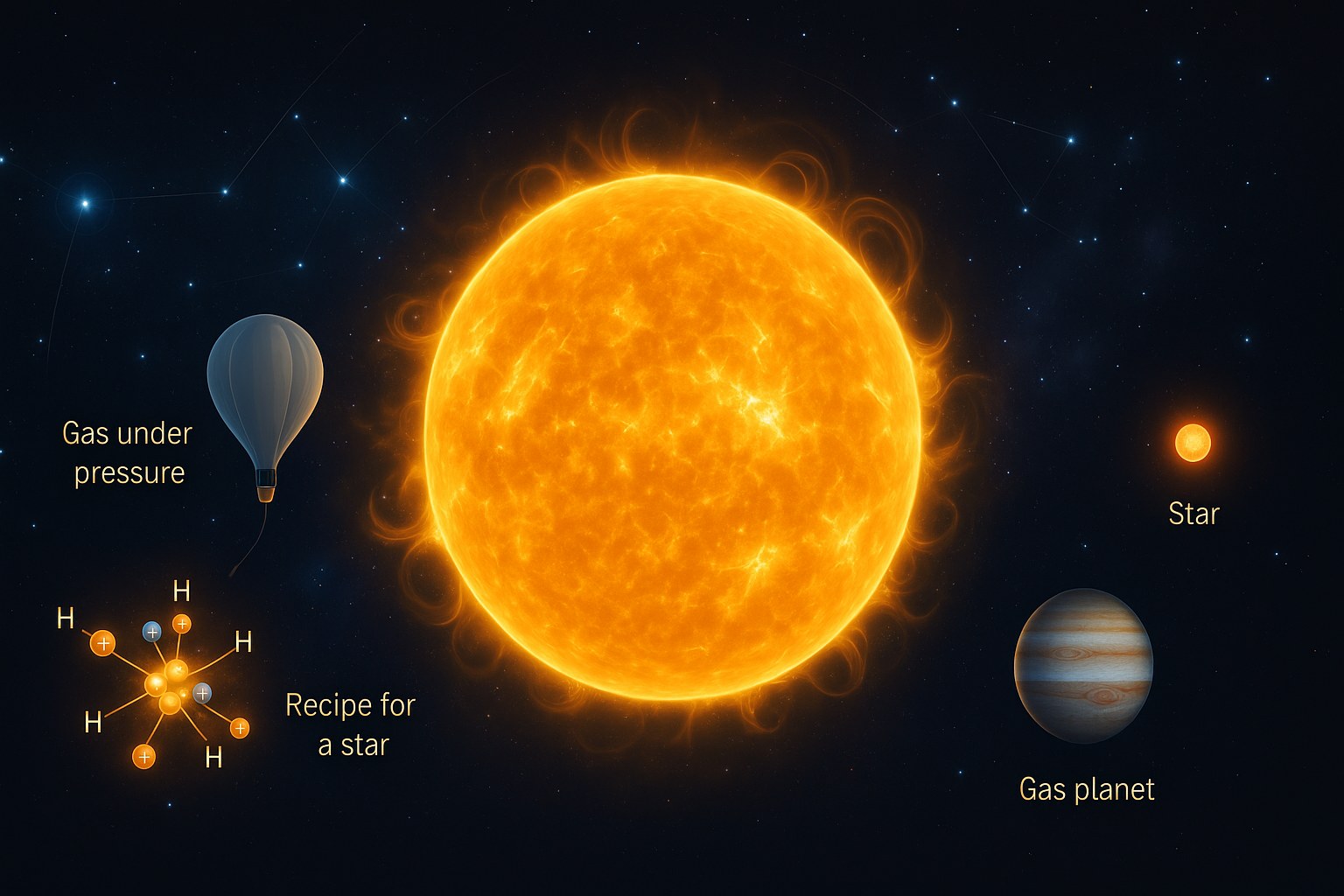
Stars aren’t solid objects. They’re giant balls of gas. They simply float in the emptiness of space. You couldn’t walk on one the way you walk on the ground here on Earth.
It’s a bit like a big balloon. The gas inside pushes out in every direction, very hard. That’s what holds the perfectly round shape. It’s a light structure, but a truly enormous one.
There’s no rock up there. Unlike asteroids, everything flows. And everything inside that ball is blazing hot, too.
☀️ Why the Sun looks bigger
The Sun looks huge to us because it’s so close. The other stars are incredibly far away. It’s a simple optical illusion in space, nothing more.
Think of a small torch and a lighthouse. The nearby torch can dazzle you more than a faraway lighthouse. The real size doesn’t decide how bright something looks. It all comes down to perspective.
In fact, some stars are far, far bigger.
🧪 A star’s secret recipe
Hydrogen makes up most of the mix. Helium fills out the rest of this cosmic recipe. These are the building blocks of the whole universe.
This gassy make-up is what lets a star create such intense heat. And that’s what explains why stars shine at night, in a way kids can picture.
A gas planet like Jupiter doesn’t have enough mass. So it stays cold and dark. A star holds enough matter to switch itself on.
⚛️ Nuclear fusion makes the light
Now that we know the ingredients, let’s see how this giant space kitchen cooks up the glow that reaches us.
⚛️ Turning hydrogen into helium
Deep in the star’s core, hydrogen nuclei smash into each other. In the end, they stick together. That creates a new element called helium. It’s an incredibly powerful process.
This joining releases an unbelievable amount of force. We call it nuclear fusion. It’s the engine that drives every single star.
This reaction is exactly why stars shine. That’s how matter becomes light.
🔥 A truly extreme heat
We’re talking millions of degrees at the centre. It’s an unimaginable furnace. Nothing can survive that kind of heat.
It’s hotter than millions of ovens all switched on at once. This energy stops the star from freezing. Space is cold, but the core burns.
Nuclear fusion is the only known process that can explain a star’s energy and its very long life.
⚡ The energy that escapes towards us
That intense heat eventually radiates out. It escapes from the surface as rays. And that’s what our eyes finally catch.
A star shines in every direction at once. It showers the emptiness with tiny particles of light. This light travels for years. In the end, it reaches our little planet.
Light is never instant. It travels for a long time.
⬇️ The force of gravity and pressure
For that light to burst out, the matter first has to be seriously squeezed by forces that are invisible but absolutely colossal.
👶 The birth of baby stars
It all begins inside vast, dark nebulae. Gravity acts like a giant magnet. It pulls the grains of gas together.
The cloud shrinks in on itself. It grows denser and denser. A burning core starts to form. That’s the beginning of a star’s life.
- Gas gathers together
- Intense squeezing
- Nuclear ignition
🚲 The bicycle pump trick
When you pump up a tyre, the nozzle gets warm. That’s because you’re squashing the air really hard. Pressure always creates heat.
Out in space, gravity squashes the atoms. It packs them tightly against one another. That squeezing pushes the temperature up. And that’s what finally sparks the shine.
The harder you press, the more it burns. That’s the law of thermodynamics.
⚖️ Keeping the balance so it doesn’t blow up
Gravity wants to crush everything inwards. The pressure from fusion pushes outwards. It’s a never-ending tug of war.
Thanks to this balance, the star stays round. It doesn’t collapse in on itself. And it doesn’t suddenly blow up, either.
If the fuel runs out, gravity wins. The star then changes shape completely.
🚀 The long journey of starlight
Once it’s made, this light sets off on an epic trip across the void, crossing distances too big for the human mind to grasp.
💛 Escaping the heart of the star
The centre is a real maze. The photons bounce around endlessly in every direction. They take thousands of years to get out. The path is one long zigzag.
It’s a prison of dense gas. Once they reach the edge, it’s freedom. The light finally races off into the void. It leaves its first prison behind.
| Stage of the journey | Estimated time | Obstacle in the way |
|---|---|---|
| Core to surface | Thousands of years | Dense gas and collisions |
| Surface to Earth (the Sun) | 8 minutes | The emptiness of space |
| Surface to Earth (Proxima) | 4 years | Vast distances |
🌌 Crossing the emptiness of space
Light is always in a huge hurry. It races along at 300,000 kilometres per second. Nothing goes faster. It holds the record for speed.
Kilometres are too small a measure out here. So we use the light-year instead. That’s the distance light covers in a whole year. Space is one big, quiet emptiness. The rays travel through it with no real trouble.
Nothing can slow them down. There’s no air to hold the rays back.
👁️ Reaching our eyes at last
The journey is nearly over. The light passes the neighbouring planets. At last it meets our blue atmosphere. This is the end of the trip.
So why do stars shine at night, in a way kids can picture? The Sun hides everything by day. Its brightness floods our sky. We have to wait for Earth’s shadow. Only then do those faraway points become visible again.
Our eyes do the rest. Our pupils catch these very old messages.
✨ Why stars twinkle but planets don’t
The light may travel smoothly through the void, but its arrival on Earth has one last bumpy little dance in store.
🌍 The effect of Earth’s atmosphere
Imagine the air is a thick soup. The atmosphere is made of shifting layers. Warm air and cold air move about constantly. That creates turbulence you can’t see, but that’s very real. It’s a bit like looking through a flame.
The light gets bent by all this constant movement. It shifts direction ever so slightly, every single second. And that’s exactly what creates the twinkling effect.
It’s these waves of air that make the rays dance before they reach our eyes. The light wobbles a little on its way down through the sky.
🪐 A point of light versus a planet’s disc
A star is just a single point. It sits so far away that it takes up no visual space at all. Only one ray of light reaches us. So the tiniest disturbance is enough to make it wobble.
Planets are much closer to us. A planet looks like a little round disc. It sends thousands of rays at once. If one ray wobbles, the others make up for it. So the overall image stays fixed and steady.
Here’s what to remember to tell them apart:
- Star = fragile point
- Planet = solid disc
- Atmosphere = restless filter
📍 Position in the sky and brightness
Watch the stars low down near the horizon. Down there, the twinkling is very strong. There’s a lot more air to pass through. The light has to fight against a thicker layer.
Look instead at the stars high up in the sky. They seem calmer and noticeably sharper. The air up there is thinner and less turbulent. It’s the secret amateur astronomers use to see clearly.
A calm sky helps a lot, too. The weather is your best ally.
💫 The end of a star’s life
Like any powerful engine, stars eventually use up all their fuel and then begin a spectacular transformation.
⛽ When the fuel starts to run low
Hydrogen isn’t an endless supply. After billions of years, the star inevitably runs out of puff. The nuclear engine inside slows down little by little.
The star’s appearance then changes completely. Its colour often turns darker or shifts towards red. That’s the sign of old age. Every single star will go out one day.
The Sun should keep shining for more than 4 billion years.
🔴 Red giants and white dwarfs
The star then begins one last, impressive swelling. It turns into a huge red giant. It may even swallow up planets that are too close as it grows in this messy way.
After swelling up, it loses its outer layers. All that’s left is a small, very dense core. This core slowly cools in total darkness. That’s exactly the fate waiting for our own Sun.
The white dwarf left behind is tiny. Its size shrinks right down to the minimum.
💥 The grand finale: supernovas
The most massive stars end as a supernova. It’s the most violent explosion known in the universe. It can light up whole galaxies for a brief moment.
The flung-out debris creates new clouds of gas. Later on, they’ll go into making future planets. In fact, we’re all made of stardust. It’s an endless cycle.
Sometimes, what’s left collapses into a black hole. It’s a mysterious object that devours everything in its path.
These balls of gas turn hydrogen into light thanks to nuclear fusion. That journey of energy gives us a sparkling show through the atmosphere. Head outside soon and look up at the sky with your children to admire this stellar engine before the clouds hide these astronomy treasures. Your future little astronauts will never forget this night-time magic.
❓ FAQ
🌙 Why do stars only shine when it’s dark?
Stars actually shine all the time, even in the middle of the afternoon! It’s simply that our Sun’s light is so strong that it hides them. Imagine trying to see the glow of a tiny candle right next to a huge floodlight: it’s impossible.
As soon as the Earth turns and we end up in the shadow (night-time), the Sun stops dazzling us. That’s the moment our eyes can finally catch the fragile light of the other stars, which has been travelling through space for years.
💡 Where does the light that makes stars shine come from?
Stars are like giant energy factories. Inside, it’s so hot (millions of degrees!) that the little bits of gas called hydrogen bump into each other and stick together to become helium. We call this process nuclear fusion.
This magical collision releases an incredible amount of heat and light. That energy then crosses the whole star to escape into space and reach us. That’s why they shine like little lighthouses in the dark.
✨ Do stars really twinkle in the sky?
It’s a little magic trick performed by our air! Out in space, stars have a steady, calm light. But to reach our back garden, their light has to cross the Earth’s atmosphere, which is full of warm air and cold air moving about non-stop.
These movements of the air bend the star’s thin ray of light, a bit like looking at a pebble at the bottom of a rippling river. That’s what gives us the pretty twinkle we so love to watch.
🪐 What’s the difference between a star and a planet?
It comes down to the inner “engine”. A star is a giant ball of gas that makes its own light through nuclear fusion. It’s self-sufficient and shines on its own, like a lamp switched on.
A planet, on the other hand, is much smaller and makes no light at all. If we see it in the sky, it’s only because it reflects the light of its star, a bit like a mirror. On top of that, planets barely twinkle, because they’re closer to us.
💫 Can stars go out one day?
Yes, stars aren’t eternal, but don’t worry, they live a very long time! They shine for as long as they have hydrogen to transform. When they run out of fuel, they change shape: some swell up to become red giants, then end up as little white dwarfs.
The biggest stars sometimes end their lives with a spectacular explosion called a supernova. Our Sun, though, is still in great shape and should keep lighting us for around 4 billion years. There’s still plenty of time for lovely naps in the sun!
