
Explaining to your kids why the Sun shines — without falling back on magic or a giant torch — is a real challenge for any parent. This article unpacks the mystery of nuclear fusion, the natural engine that has been turning hydrogen into light for billions of years at the heart of our star. You’ll discover how colossal pressure and a heat of 15 million degrees create the vital energy that warms our days and helps the plants in your garden grow. ☀️
- Why the Sun shines thanks to fusion
- Gravity and pressure do all the work
- E=mc² — the recipe for its energy
- Light’s journey from the core to the surface
- Why the Sun isn’t a campfire
- How long will our star last?
☀️ Why the Sun shines thanks to fusion
We often picture the Sun as a huge campfire floating in empty space. But it isn’t ordinary burning at all — it’s an atomic engine that’s far more powerful.
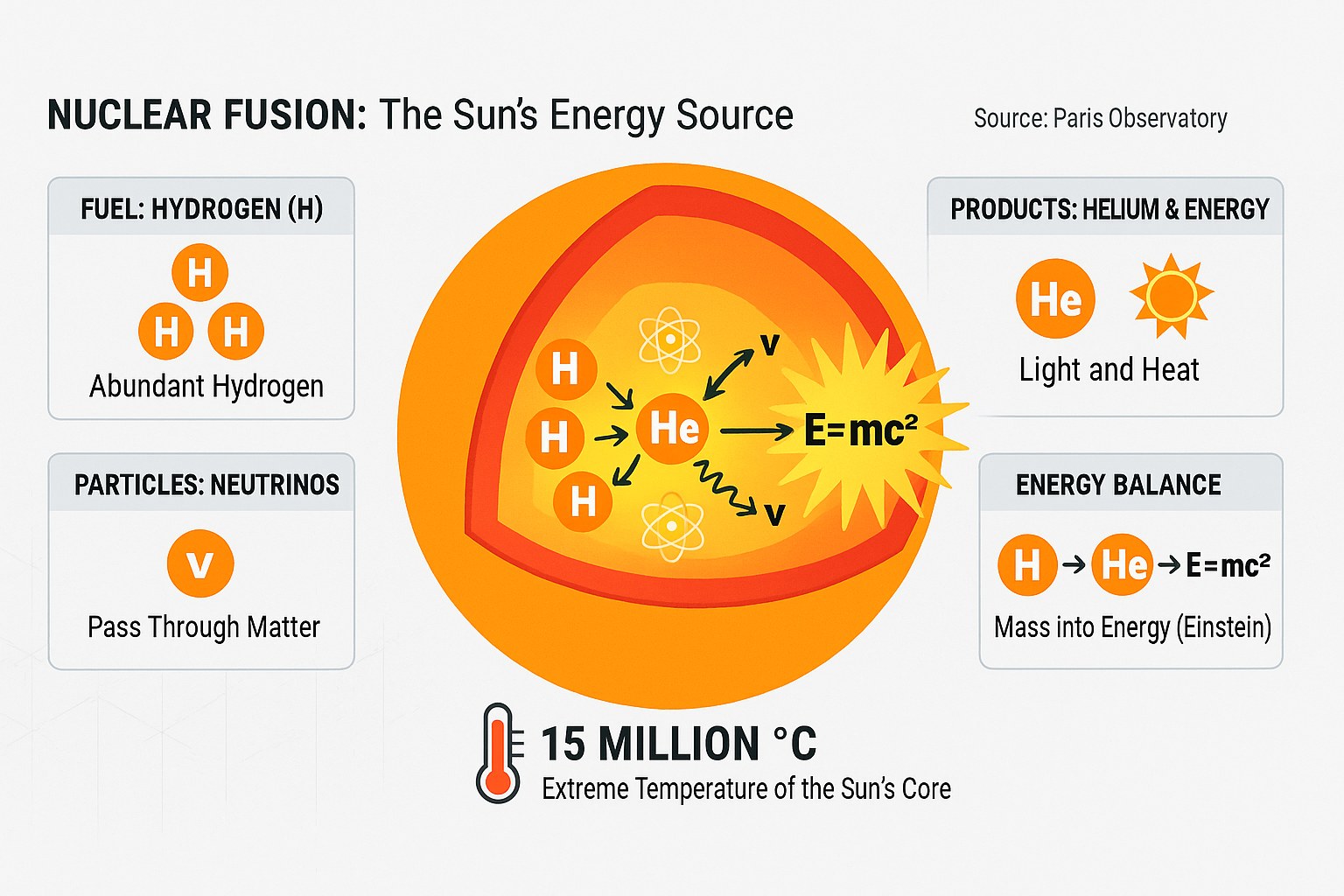
🎈 Turning hydrogen into helium
At the centre of the star, the heat is so fierce that hydrogen nuclei smash into one another. In the end they join together to make helium. This fusion process releases an astonishing amount of energy.
Every single second, 600 million tonnes of hydrogen vanish. That lost mass is turned into light. It’s a beam of pure brightness that nothing can stop on its way out.
This cycle has stayed steady for billions of years. It’s what gives us all the Sun’s warmth.
👻 The part neutrinos play in the reaction
Neutrinos are true ghost particles. They are born at the exact moment nuclei fuse deep inside the Sun. They’re a direct signature of what’s happening at its core.
These particles pass straight through any matter without ever slowing down. They escape the Sun the instant they’re born. Then they race off into space at a staggering speed.
Scientists hunt them down with huge detectors here on Earth. These measurements prove that the Sun’s engine is still running perfectly today.
🌡️ The blistering heat of the Sun’s core
Inside, the thermometer reads about 15 million degrees. That’s a striking contrast with the 6,000 degrees measured at the surface. This furnace is essential to life.
That temperature is what breaks down the natural barrier between atoms. Without all this frantic jostling, the nuclei could never fuse. The reaction would simply grind to a halt.
The Sun’s heat is generated by the gas inside it being squeezed together under its own gravity.
🔽 Gravity and pressure do all the work
You might think the heat does everything, but without a colossal force to hold that furnace together, nothing would stay standing. This is where the physics gets truly impressive.
⚖️ The balance between force and heat
Hydrostatic balance is a perfect set of scales. Gravity is forever trying to crush everything towards the centre. Pushing the other way, the inner pressure shoves hard towards the outside.
This endless tug-of-war keeps the Sun from collapsing. It’s a vital battle of forces. Without it, our star would be nothing more than a distant memory.
This steady state has lasted for billions of years. It’s the secret behind the Sun’s long life — the very staying power that lets us be here today.
🔽 An intense squeeze at the star’s centre
Gravity squeezes the gas at the heart of the star. This pressure is absolutely staggering. It’s hundreds of billions of times greater than our own.
That squeeze forces the hydrogen nuclei to fuse. They have no choice left but to join up. And that’s how light finally bursts out.
Imagine the pressure of Earth’s atmosphere multiplied beyond all limits. The number is simply too big for the human mind to grasp. That’s why the Sun blazes away with such fierce intensity.
🪨 Density unlike anything we know
The core is thirteen times denser than lead. And yet the Sun is still a ball of ionised gas. This special state has a name: plasma.
In all that chaos, atoms lose their electrons. They’re stripped completely bare and crash into each other non-stop. In such a crowded space, there’s no way for them to dodge one another.
This matter is one of a kind. It’s like nothing we know on Earth. It’s a world all its own.
⚛️ E=mc² — the recipe for its energy
Moving on from the mechanics of forces to Einstein’s famous equation helps us see exactly where this light comes from.
⚡ Turning mass into pure energy
The helium that forms weighs a little less than the hydrogen it started from. That difference in mass doesn’t vanish by magic. It simply changes form and becomes something else.
The formula E=mc² explains how weight is turned into radiation. A tiny scrap of matter produces a gigantic burst of energy. That’s the key to understanding why the Sun shines.
Nothing is truly lost during fusion. The loss of mass comes to exactly 0.7% during the process.
📉 An everyday way to picture the lost mass
Think of it like a slightly unusual cooking recipe. If you mix four ingredients together, the finished cake weighs less than the total you started with. Pretty surprising, isn’t it?
In fact, the missing part flew off as heat. That’s the sheer efficiency of how stars work. The Sun wastes nothing — it turns everything into something brilliant.
And yet nothing truly disappears into the void. It all becomes that essential light that brightens and warms us every single day.
🔢 The wild numbers behind the hydrogen it burns
The Sun burns around 600 million tonnes of hydrogen every second. That’s a colossal rate that’s frankly dizzying. It’s hard to imagine a scale that big.
| Measurement | Solar value |
|---|---|
| Mass burned per second | 600 million tonnes |
| Energy produced (watts) | 4×10^26 W |
| Current age | 4.6 billion years |
| Core temperature | 15 million K |
But don’t worry — our star is nowhere near running dry. Its reserves are still enormous despite this furious pace. We’ve got plenty of bright days ahead of us.
💡 Light’s journey from the core to the surface
Now let’s follow the path of this freshly made energy as it tries to break out of its solar prison.
🌀 Crossing the radiative and convective zones
In the radiative zone, photons bounce endlessly off the dense matter. This invisible maze keeps them trapped. They take thousands of years to finally cross this thick layer.
Next, the energy enters the convective zone. Here the matter bubbles like water in a saucepan to carry the heat upwards. Great blobs of hot plasma rise to the surface, let go of their energy, then sink back down.
The journey is gruelling. The energy fights to reach the open air at last.
💡 How gamma rays become light
The energy first appears as deadly gamma rays at the centre of the star. As they climb towards the outside, these photons lose their original power. Bit by bit, they change.
This gradual shift turns them into visible light and infrared. It’s exactly this that makes the Sun look yellow to our eyes. Without it, we’d see nothing at all.
The light finally reaches the photosphere, the star’s “surface”. This is where the rays at last leap off into the emptiness of space.
⏱️ How long it takes to light our way
The light we see today is actually very old. It took more than 100,000 years to escape the Sun. That’s a serious test of patience for a single ray.
After that come the final eight minutes of travel through space. That’s how long it takes to cross the 150 million kilometres to reach us. All for that dazzling grand finale.
Here’s a quick recap of the whole expedition:
- The core (creation)
- Radiative zone (wandering)
- Convective zone (transport)
- Photosphere (departure)
🔥 Why the Sun isn’t a campfire
Let’s drop the picture of a great crackling blaze in the void. To understand what’s going on up there, we need to shift our perspective and step away from the everyday goings-on here on Earth.
🚫 No oxygen at all in space
On Earth, a flame needs oxygen. Without that gas, burning is impossible. And space is an almost total vacuum.
So the Sun isn’t burning in any chemical way. There’s no real flame anywhere in our solar system. It’s a completely different physical process.
The brightness comes from the gas being squeezed together. It’s gravity itself that sets off this intense pressure.
🧪 Chemistry versus nuclear physics
Chemistry simply rearranges molecules. Nuclear fusion, on the other hand, transforms the atomic nuclei themselves. This process is millions of times more efficient.
The Sun doesn’t use a single match. Its own gigantic mass is enough. Gravity then naturally sparks this constant inner reaction.
The nuclear part changes everything. It’s a phenomenal kind of power.
🧲 What magnetic activity and flares do
Sometimes you can spot dark patches. Giant loops of plasma rise up too. These are signs of very intense magnetic activity.
Flares create bright flashes of light. They happen when magnetic fields twist and snap. The energy released is sudden and massive.
So why does the Sun shine? Here’s a simple way to put it:
Stars shine because of the heat at their surface, made of ionised gas at extreme temperatures.
⏳ How long will our star last?
Let’s finish by taking a look at our star’s future and what its glow means for our survival.
📊 Its current age and the stable main sequence
The Sun is right at the halfway point of its life. Today it has 4.6 billion years on the clock. This stretch of its life is marked by remarkable stability.
This calm, mature phase gives off a steady glow. That’s a real stroke of luck for us. It’s what allowed life to develop on our little blue planet long ago.
This calm comes from a perfect balance between the forces inside it. Nothing seems able to upset this reassuring rhythm. We can rest easy about this daily cycle.
⛽ The fuel reserves for the future
The fuel reserves are reckoned to last around 5 billion years. Even so, the hydrogen will run out one day. The supply will inevitably be used up.
The Sun will then begin turning into a red giant. It will swell up dramatically into space. In the end it will swallow the nearest planets, like Mercury and Venus.
But let’s not panic just yet. We’ve still got an enormous amount of time ahead. This is clearly nothing to worry about for the generations to come.
🌱 Why this radiation matters for life
The way plants photosynthesise depends directly on the fusion energy they receive. Without that steady flow, everything stops. The world’s whole food chain would collapse.
The Sun also keeps temperatures on Earth mild and liveable. It acts like a giant thermostat, completely free for all of humankind. It’s thanks to the Sun that water stays liquid — and that it keeps us warm.
We depend on it completely. We are, quite literally, the children of nuclear fusion.
The Sun shines thanks to nuclear fusion turning hydrogen into helium under colossal pressure. This atomic engine keeps us alive for another 5 billion years to come. The sooner we grasp how lucky we are, the better we can protect our beautiful planet — because we are the precious children of this light.
❓ FAQ
⚛️ Why can we say the Sun shines thanks to nuclear fusion?
The Sun isn’t a big ball of fire like you might imagine, because there’s no oxygen in space to keep a flame going. In reality, it shines thanks to nuclear fusion: in its core, the heat and pressure are so strong that hydrogen nuclei fuse together to become helium.
This process turns a small part of the mass into an absolutely gigantic amount of energy. It’s this energy, made at the centre of the star, that eventually reaches us as light and heat after a very long journey.
🌡️ How hot is the Sun’s core for this reaction to happen?
For atoms to agree to fuse, you need a truly supercharged setting! At the centre of the Sun, the temperature climbs to about 15 million degrees. It’s this extreme heat, paired with colossal pressure, that overcomes the atoms’ natural resistance.
For comparison, the surface we see is “only” around 6,000 degrees. So it’s deep down in the star that the real heat engine lighting our way every day is hidden.
💡 Is it true that light takes thousands of years to escape the Sun?
It’s absolutely true, and pretty fascinating. The particles of light, called photons, are born in the Sun’s core but they don’t escape easily. They bounce around endlessly off the tightly packed atoms in the radiative zone, a bit like a giant pinball machine.
This chaotic journey can last more than 100,000 years, and even up to two million years depending on the route. Once they finally reach the surface, the photons take just eight short minutes to cross the emptiness of space and warm our faces.
⏳ Is the Sun about to go out any time soon?
No need to worry about our future grandchildren — the Sun is currently in the prime of its life. It has been shining for 4.6 billion years and it still has enough hydrogen reserves to keep going for around another 5 billion years.
It’s in a very stable phase that scientists call the “main sequence”. The balance between the gravity squeezing it inward and the pressure of fusion pushing it outward is perfect, guaranteeing us steady light for a very long time to come.
👻 What are these “ghost particles” called neutrinos?
Neutrinos are tiny particles made at the same time as light during nuclear fusion. We call them “ghosts” because they pass through almost everything, including the Earth and us, without ever stopping or bumping into a thing.
Unlike light, which takes thousands of years to leave the Sun, neutrinos escape instantly. By studying them here on Earth, researchers can confirm in real time that the Sun’s core is still working properly.
