
Ever tried to explain to your kids why Saturn has rings without tripping over your words? This guide explores the origin of those icy ornaments — born from a shattered moon or ancient space debris — to finally satisfy your little one’s boundless curiosity. You’ll uncover the secret behind their shimmer, along with the rain of crystals that means this show is doomed to vanish one day. 🪐
- Saturn’s rings and their surprising make-up
- The story of a discovery that shook astronomy
- How they form and the Roche limit
- The architecture of the rings and their guardians
- The debate over their age and coming disappearance
- The neighbourhood and what comes next
🪐 Saturn’s rings and their surprising make-up
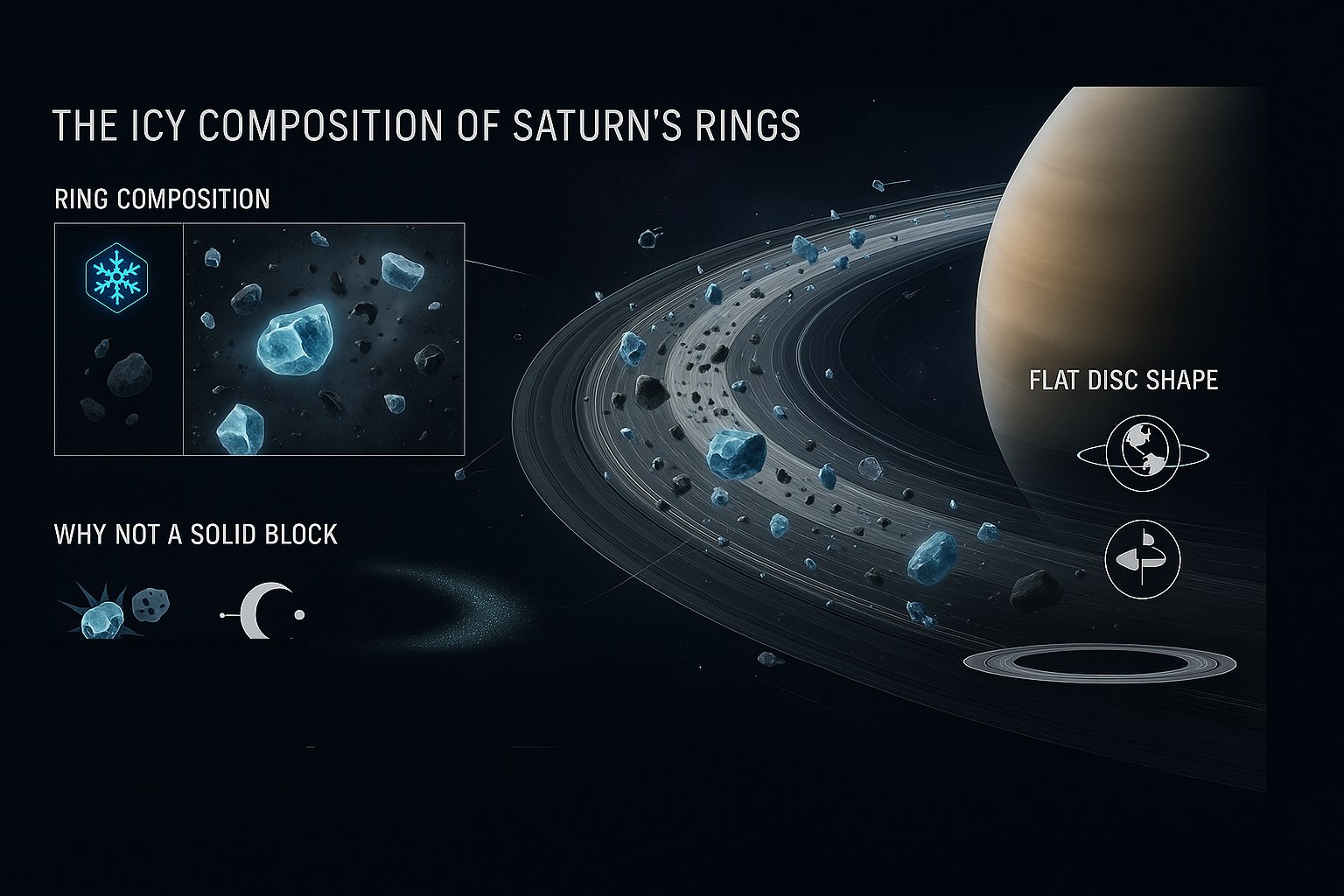
It’s easy to forget that this shining disc isn’t a solid plate at all. What we admire from our own back garden is actually a vast cloud of icy rubble, forever on the move.
❄️ A mix of ice and space dust
These structures are over 99% pure water ice. That’s exactly why they shine so brightly. The Sun’s light bounces off them with truly remarkable intensity.
You’ll also find a little dark dust mixed in. These rocky bits are very much in the minority. Even so, these tiny impurities are enough to give certain parts of the rings a faint tint.
The size of the pieces varies enormously. Some are tiny specks of dust. Others are blocks several metres across.
🧊 Why isn’t it one solid block?
The secret lies in endless collisions. The fragments knock into each other without a moment’s pause. This stops the pieces from merging into a single rigid mass.
Gravity plays a big part too. At this distance, Saturn pulls far too hard. The debris simply can’t clump together into one body.
That smooth look is just an optical illusion. The huge distance hides all the gaps. It’s the way the light reflects as a whole that creates this seamless surface.
💿 The physics behind this flat disc shape
Collisions between particles cancel out any up-and-down motion. The material ends up settling into the equatorial plane. It’s pure orbital mechanics.
The planet’s fast spin helps a lot. Centrifugal force dictates this flattened shape. That’s what gives Saturn its instantly recognisable silhouette.
This disc is astonishingly thin. It stretches 400,000 km wide. Yet its thickness often comes to no more than a few tens of metres.
🔭 The story of a discovery that shook astronomy
Looking up at the sky holds some real surprises. Why does Saturn have rings? That question puzzled scientists for centuries, turning every observation into a genuine technical challenge for astronomers the world over.
📜 From Galileo’s confusion to Huygens’ calculations
In 1610, Galileo looked at Saturn through his crude telescope. He thought he saw ears or moons stuck to the planet. The image just wasn’t sharp enough for him.
Christiaan Huygens put this right in 1655. With a better telescope, he finally made out a thin, flat ring. He explained that this disc surrounds the planet without ever touching it.
The tools improved over the centuries. Experts began to spot fascinating details. They noticed in particular the dark gaps separating the different discs of dust and ice.
🛰️ What the Cassini mission revealed
The Cassini probe completely changed how we see this giant. For thirteen years, it explored the system from the inside. Its data swept away plenty of old assumptions.
The “Grand Finale” was unforgettable. Diving between the planet and its rings, the probe measured their mass. We now put it at 1.54 × 10^19 kg.
The high-definition snapshots are stunning. They reveal complex structures that look like waves. These were completely invisible from our usual telescopes here on Earth.
🔭 Watching the show with a simple telescope
You can enjoy this spectacle from home. Opposition is the ideal time to look. That’s when Saturn comes closest to our own planet.
You don’t need professional gear to get started. A powerful pair of binoculars or a small telescope will do. You can already make out the rings’ unmistakable shape.
The tilt matters a lot too. Depending on the year, the rings face us head-on or edge-on. That completely transforms the view during your evenings outside.
⚙️ How they form and the Roche limit
Now let’s look at the invisible laws of gravity that govern how these structures are born and survive.
🌊 How tidal forces act on moons
The Roche limit marks an invisible boundary. Below this precise distance, Saturn’s gravity becomes a real monster. It mercilessly rips apart any moon that ventures too close.
The break-up happens when a body drifts too near. Tidal forces stretch the object out. They end up overpowering its own inner cohesion, shattering it completely.
One theory points to a lost moon. These rings may be the remains of an ancient giant satellite. Saturn would have ground it up millions of years ago.
🪨 Debris that refuses to come together
Here, accretion is completely impossible. In this turbulent zone, the particles crash into each other non-stop. They can never gather to form new, stable little moons.
The forces at work fight a constant duel. Saturn’s pull always wins. It easily overwhelms the feeble mutual gravity of the small icy fragments.
The idea of the early nebula lingers on. Some of the material may date back to the birth of the solar system. Why Saturn has rings remains a thrilling mystery.
💨 How Saturn’s gassy nature plays a part
Saturn’s fast spin is impressive. It turns on itself in just 10 hours. This flattens the planet at the poles and directly steadies the ring disc.
The magnetic field plays its part too. The fine specks of dust are very sensitive to it. They respond to the electromagnetic forces of this remarkable gas giant.
The whole system stays steady this way. The gassy surroundings and the enormous mass hold the fragile balance of this spectacular system in place.
🛡️ The architecture of the rings and their guardians
Let’s explore how this colossal disc is organised inside, and the forces that keep it in order.
📐 Making sense of the A, B and C divisions
Saturn has three main structures. Ring B shines intensely because it’s so dense. The A and C zones, by contrast, look noticeably thinner and more see-through.
The famous Cassini Division splits the rings. This wide gap comes from precise gravitational resonances. The moon Mimas pushes the particles back inwards.
The amount of material varies a great deal. Each section has its own opacity. That’s what creates this striking visual contrast around the gas giant.
🌙 The tireless work of the shepherd moons
Pan and Daphnis act as the cleaning crew. These tiny moons travel through the empty gaps. They sweep up the dust to keep their own paths perfectly clear.
Their presence keeps the edges crisp and clean. Without these little shepherds, the rings would spread out everywhere. They would eventually fade away completely into the emptiness of space.
Their passage creates astonishing ripples. Real waves of ice rise up. The show along the edge of the gaps is truly breathtaking.
🌀 The mystery of the spokes and the seasons
Dark patches called “spokes” sometimes appear. They look like the spokes of a bicycle wheel. These fleeting marks stretch out radially across the icy surface.
This phenomenon follows the rhythm of the seasons. We see them mostly during Saturn’s equinoxes. That happens roughly every fifteen Earth years.
Magnetism then lifts the charged dust. The particles hover above the main plane. Why Saturn has such ever-changing rings is still a fascinating question.
⏳ The debate over their age and coming disappearance
Let’s ask how long this celestial jewel will last: has it always been there, and for how much longer?
🌌 Were they born with the solar system?
Two main theories go head to head. Some experts believe these structures are ancient. Others point instead to a recent, violent event.
The purity argument is a striking one. Ice this white suggests the rings are young — around 100 million years old. On a cosmic scale, that’s almost yesterday.
Yet studies from 2024 add some nuance. A self-cleaning mechanism could keep very old material looking bright. So rings as old as the solar system itself remain a real possibility.
🌧️ The phenomenon of ring rain
It all comes down to electric charge. The Sun’s UV rays charge up the grains of ice. They then become sensitive to the powerful magnetic field.
This interaction triggers a fall of material. A genuine rain of ice literally pours into the atmosphere. This drainage slowly eats away at the rings from the inside.
The loss of mass is staggering. The equivalent of an Olympic swimming pool of ice vanishes every half hour. It’s a steady, jaw-dropping flow.
⏰ When will Saturn finally lose it all?
The forecasts for their disappearance are now clearer. At the current pace, the rings could vanish within 100 to 300 million years. This coming disappearance of the rings seems unavoidable.
Still, we should soften that picture of a complete end. There are internal recycling mechanisms at work. Fresh debris could also extend the life of this complex system.
On an astronomical scale, it’s the blink of an eye. We’re incredibly lucky to witness this one-of-a-kind setting. Let’s make the most of it while it’s still here.
🚀 The neighbourhood and what comes next
Having admired these icy discs, it’s time to widen our view towards the neighbouring moons and the next steps in human exploration.
🌕 Titan and Enceladus, two influential neighbours
Enceladus plays a major role. Its ice geysers fling material out into space. This feeds the E ring directly, the largest of them all.
Titan exerts a pull too. This giant moon has an impressive mass. It disturbs the orbits of the small particles around it.
The system is incredibly rich. There are more than 140 moons to count. They all take part in a truly intricate celestial ballet.
🔄 The 29-year cycle and the tilt
Sometimes the rings seem to disappear. Every 15 years, they turn edge-on towards us. They then become invisible from Earth.
It all depends on the planet’s tilt. Its 27-degree angle shifts with its position. That completely changes our usual view.
The full cycle lasts 29 years. So astronomers get to enjoy a variety of perspectives. It’s a show that keeps renewing itself.
🚀 Upcoming missions to crack the mysteries
New projects are finally taking shape. The Dragonfly mission to Titan is on the way. It marks the next step in this distant exploration.
Even so, questions remain unanswered. The exact origin of the rings is still hazy. We need measurements taken directly on the spot.
Scientific interest in Saturn runs deep. It’s an exceptional natural laboratory. It helps us understand how planets are born.
These icy ornaments, born from broken moons or ancient dust, are a fleeting treasure. Go and see why Saturn has rings before they fade away in a few million years. Get your telescope ready and take in this unique celestial ballet while it still lights up our starry nights.
❓ FAQ
🧪 What exactly are Saturn’s rings made of?
Despite how they might look from afar, they aren’t solid discs at all. They’re made of a multitude of fragments of pure water ice, over 99% of it. These pieces vary enormously in size, from a simple speck of dust to rocky blocks several metres across.
You’ll also find a tiny amount of dark dust and rocky debris. It’s this mix — and above all the brightness of the ice — that gives the rings the special glow we admire through our telescopes.
✨ Where do these rings come from?
It’s a big debate among scientists! One theory suggests that an ancient giant moon drifted too close to Saturn. It would then have been torn apart by the planet’s tidal forces. Another idea is that they’re leftovers from the original disc of material that formed Saturn billions of years ago.
More recent research even points to a massive collision between two moons around 400 to 500 million years ago. That crash would have sent out a cascade of debris, which then flattened into the setting we know today.
📅 How old are Saturn’s rings really?
The question still divides the experts. Some think they’re very young, around 100 million years old, because the ice is still so clean and bright. If the rings had been there since the birth of the solar system, space dust would surely have darkened them by now.
However, other studies suggest they could be far older. A constant recycling mechanism might let the ice keep its “fresh” look, even after billions of years.
📏 Why do the rings stay so flat and thin?
It comes down to physics and collisions. The particles keep crashing into each other, which eventually cancels out their up-and-down motion. All the material then lines up on a single plane, a bit like a pizza base that flattens out as you spin it.
The centrifugal force from Saturn’s fast spin helps keep this disc shape too. For all its enormous width, the thickness is tiny: in places, it’s no more than 10 to 40 metres!
⚠️ Is it true that Saturn’s rings are going to disappear?
Sadly, yes — this show won’t last forever. The Sun’s UV rays and tiny micrometeorites give the grains of ice an electric charge. They’re then pulled in by the planet’s magnetic field and end up falling into its atmosphere. This is what we call ring rain.
Saturn is thought to lose a staggering amount of ice every second. At this rate, the rings could vanish completely within 100 to 300 million years. So we’re very lucky to be able to watch them today!
👀 Why do the rings sometimes seem to disappear?
It’s a little magic trick of astronomy! Roughly every 15 years, Saturn tilts so that we see the rings exactly edge-on. Since they’re extremely thin, they become almost invisible from Earth for a short while.
This effect is purely visual and down to our viewing angle. It’s a unique chance for astronomers to study the small moons or the fainter structures surrounding the gas giant.
