
Wondering whether your little one is ready for what comes next after their first year of school? 🌱 This guide walks you through everything your child should know by the end of their first preschool year, from talking to becoming more independent, so you can feel reassured without any pressure. You’ll discover how they learn to stand on their own two feet by using “I”, how they tame numbers up to three, and how they handle their first books with the pride of a big kid.
- The preschool path to talking and communicating
- Gently getting to know books and early writing
- Moving and creating to express themselves freely
- Discovering numbers and shapes without pressure
- Finding their place in space and time
- Growing up through life in a group
🗣️ The preschool path to talking and communicating
After a first day back that’s often full of big emotions, the first major task of preschool is, without a doubt, language, the true foundation of every other kind of learning.
💬 Daring to speak up and chat with others
School first encourages children to speak freely. Your child learns to express themselves within a small group. This is an essential step toward breaking through that early shyness in front of classmates.
Saying what they need becomes an everyday priority. Children learn to make themselves understood by grown-ups and by other children. Circle time gives them the perfect setting. There, they learn to listen to others before sharing their own point of view.
Talking then becomes a way to share. Your child takes an active part in group life.
🙋 Using the word “I” to stand up for themselves
Moving away from “he” or from using their own first name marks a real psychological step. Your child finally sees themselves as a separate person. This shift to “I” shapes their thinking and their personality.
Building short but correct sentences gets a little better every day. The teacher gently guides this budding grammar. Picking up the basic building blocks of language happens naturally through constant imitation.
Talking about themselves becomes a pleasure. Your child shares their experiences with newfound confidence and more precise words.
👂 Understanding and following simple instructions
Listening to a grown-up calls for a new, sustained kind of attention. Your child has to take in what they hear and then act on it. It’s a tricky exercise, and it’s practised in every activity throughout the day.
Carrying out a specific action shows they’ve truly understood. Your child learns to turn an instruction into a real, concrete movement. Repeating the instruction in their own words helps them remember it. It’s a sign of mental independence that school values enormously from age three onward.
Following instructions keeps classroom life running smoothly. Your child feels proud when they get it right.
📖 Gently getting to know books and early writing
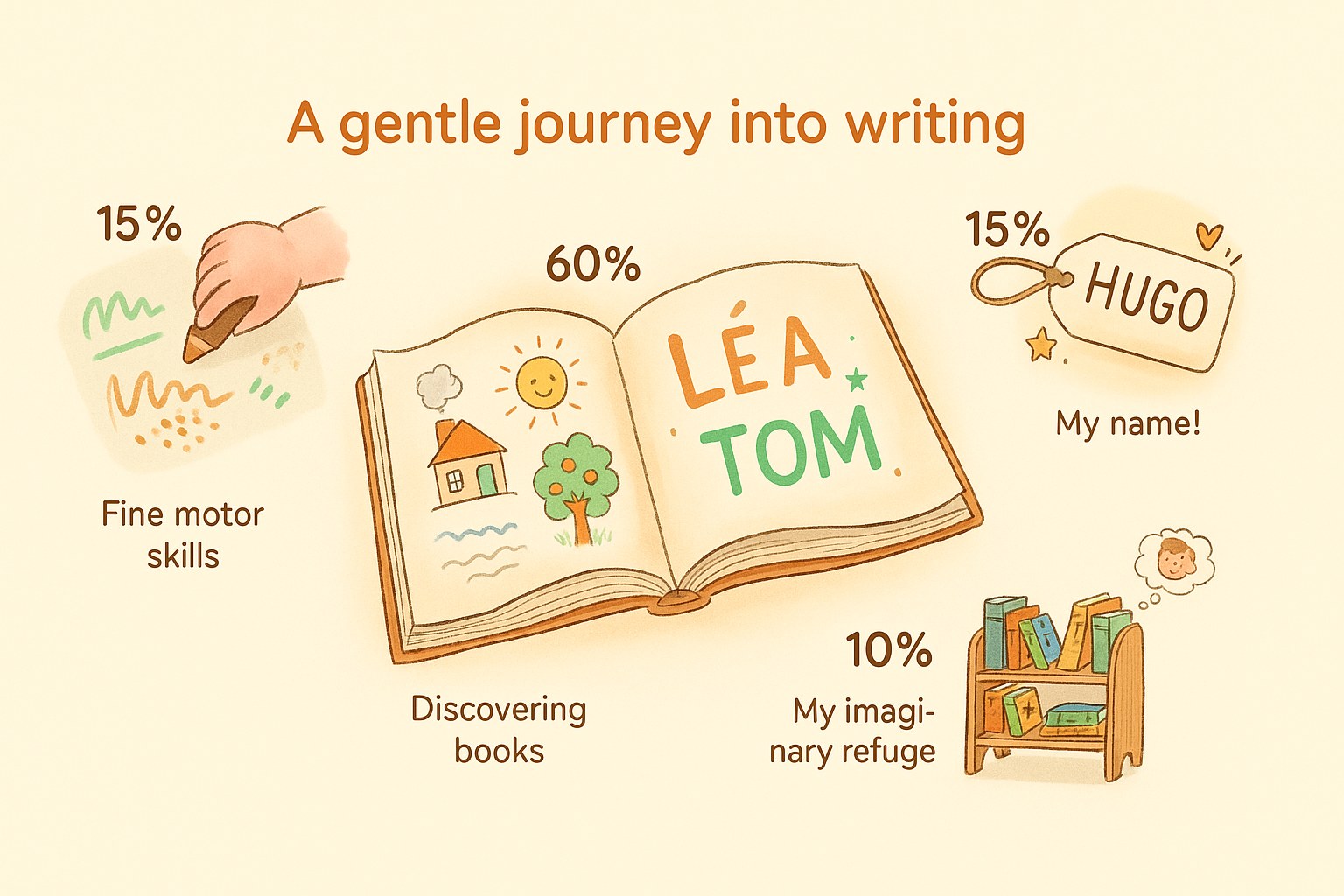
If speaking is the engine, writing is the destination your child is just beginning to travel toward, first by handling the book itself, then by tracing their very first marks.
📚 Discovering the book as an object and what it’s for
Handling a book takes a gentle touch. Your child learns to turn the pages without tearing them. This physical contact with paper is the first step toward written culture.
A book is different from a screen because it stays still. Your child spots which way the reading goes, from left to right. The pictures support the story, but it’s the text that carries the message. Understanding this pairing is key to becoming a future, attentive reader.
The classroom book corner becomes a little refuge. Your child explores imaginary worlds there all on their own, which only confirms how important reading picture books is from the very youngest age.

🔤 Recognising their own name in capital letters
The name label is the main marker of who they are. Your child has to find it among their friends’ labels. This whole-word visual recognition comes before the close-up study of the individual letters in their name.
Telling letters apart from numbers is a real brain workout. Your child looks closely at the shapes, the lines and the curves. Remembering the order of the characters takes time and plenty of playful repetition.
Seeing their name written everywhere makes your child feel valued. They begin to understand that writing is there to name things and to make a space their own.
✏️ Building the fine motor skills for drawing
Holding a paintbrush properly takes strength. Your child builds up the muscles in their fingers through all sorts of exercises. The pincer grip between thumb and index finger gradually falls into place, morning after morning.
Making deliberate marks is a real motor achievement. Your child draws dots, waves or loops. The eye now guides the hand with a precision that sharpens month after month.
Drawing expresses what words keep hidden. It’s an essential bit of creative freedom, just like preparing for the movements of handwriting. Everything your child should know by the end of this first preschool year is rooted in this joy of leaving a mark.
🎨 Moving and creating to express themselves freely
The mind never travels alone; the body and artistic creativity are the essential engines of all-round development in preschool.
🤸 Mastering their body in space
Climbing and crawling work every muscle. Your child discovers their physical limits in complete safety. Movement courses turn the gym into a playground for adventure.
Balancing on a tricycle takes coordination. Your child pedals while steering their little machine. Running and jumping become smooth, controlled actions. These physical feats build self-confidence and a sense of their own body.
Moving is a vital need at this age. Physical activity releases all that pent-up tension.
💃 Joining in circle games and group play
Group games come with simple rules. Your child learns to wait their turn patiently. It’s a first taste of group strategy and mutual respect.
A ring game means getting your steps in sync. Everyone holds hands to make a perfect circle. Acting things out with the body lets children express feelings without using words. Dancing together creates a strong, joyful sense of belonging within the class.
Music guides the group’s movements. Your child keeps to the beat.
- Motor coordination: getting the arms and legs to move together.
- Listening to the musical beat: matching their steps to the rhythm of the song.
- Respecting other people’s space: learning not to bump into classmates.
- Remembering the words: holding on to the rhymes and vocabulary of the nursery songs.
🎵 Exploring sounds and arts and crafts
Singing or whispering lets children explore their own voice. Your child discovers the different levels of loud and soft. These voice games train the ear to better pick up the sounds of spoken language.
Working with modelling clay builds strength. Children make shapes, balls and little sausages. Clapping their hands keeps time with songs and helps them discover the sounds the body can make.
Arts and crafts are a place to experiment. Your child mixes colours and textures for a one-of-a-kind result.
🔢 Discovering numbers and shapes without pressure
After exploring movement and creativity, your child begins to make sense of their surroundings by discovering their first maths tools.
🔟 Counting and working out small quantities
The counting rhyme is recited like a song. Your child climbs up to ten with delight. It’s a spoken base they need before they can grasp the real idea of quantity.
Linking a number to actual objects is crucial. Your child counts out small collections of up to three. Using their fingers helps them picture the value of the number they’ve just said. This hands-on practice keeps things from becoming too abstract too soon.
Counting becomes an everyday game. You count the cups or the coats together to encourage this grasp of early maths tools.
🔷 Naming basic geometric shapes
The circle, the square and the triangle pop up everywhere. Your child learns to name them precisely. This visual recognition shapes how they see the world around them every day.
Sorting objects by colour is great fun. Your child sorts the blocks by specific rules. Puzzles and shape-sorting games build patience and spatial logic.
Touching the edges helps with remembering. Your child runs a finger along the sides to really feel the shape.
⚖️ Comparing sizes and spotting patterns
Telling big from small is instinctive. Your child compares the size and weight of toys. These ideas about size are picked up through hands-on play and watching closely.
Copying a pattern takes concentration. You alternate a blue cap and a red one. Using everyday objects makes these ideas stick. Your child comes to understand that logic runs through the world right around them.
Patterns prepare the way for reasoning. It’s gentle, effective brain training and part of everything your child should know by the end of this first preschool year.
| Maths idea | Hands-on activity | Goal |
|---|---|---|
| Counting | Counting the fruit | Count up to 3 |
| Shapes | Sorting the blocks | Name circle, square, triangle |
| Sizes | Comparing the cuddly toys | Tell small from big |
| Patterns | Sequences of caps | Copy a pattern |
🕐 Finding their place in space and time
Beyond numbers, your child needs to learn how to place themselves within a sense of time and space in order to feel safe.
📅 Understanding the rhythm of the school day
The day is marked out by key moments. Your child tells morning apart from the afternoon. This sense of time is hugely reassuring for children who lose their familiar home routines.
Sequence pictures help them put events in order. Your child tells you what they did first. Classroom rituals let them anticipate what’s coming next. This predictability eases anxiety and helps them get more involved.
Time becomes something real. Your child waits their turn calmly.
🧭 Placing objects with words about space
Using “on” or “under” takes practice. Your child puts objects in place following clear instructions. This vocabulary about space is essential for finding their way and making sense of their surroundings.
Moving around the school helps them spot familiar places. You name the canteen, the playground or the play area. Naming the parts of the body also helps them place themselves.
Being precise avoids mix-ups. Your child proudly describes where they put their cuddly toy.
🔍 Observing living things and materials
Respecting animals and plants is learned early. Your child watches a seed grow with real wonder. This early awareness of living things nurtures a natural empathy toward nature.
Playing with sand or water wakes up the senses. Your child puts words to how different materials feel. They discover wet, dry, rough and smooth. These experiences are the first steps in a scientific approach.
Exploring the world is an adventure. Every discovery deepens their understanding of what’s real.
👫 Growing up through life in a group
Finally, preschool is the perfect place for your child to learn how to become an independent pupil within a social group.
💪 Becoming more independent day by day
Getting dressed alone is a daily victory. Your child learns to do up their coat or put their shoes away. These small acts build their independence and personal pride.
Managing personal hygiene becomes second nature. Your child goes to the toilet without any help. Succeeding at simple tasks builds solid self-confidence. Independence is built patiently, through repetition.
Your child feels capable and responsible. They no longer need a grown-up for everything.
👩🏫 Understanding what grown-ups do at school
The teaching assistant is a pillar of emotional support. They help your child with their physical and practical needs. It’s a reassuring figure who perfectly rounds out the teacher’s work.
The dialogue between school and family keeps the approach consistent. Parents and teacher talk about the progress being made. Following shared rules protects the group. Your child understands that each grown-up has a specific job to do.
Grown-ups working together makes children feel safe. Your child grows up in a stable, caring environment.
Emotional security is the essential foundation on which all of a child’s future learning at preschool rests.
😌 Managing emotions and rest time
Naming their feelings helps them grow. Your child puts words to their morning sadness or joy. Coping better with goodbyes calls for plenty of gentle support.
Naptime is a moment of physical recovery. It lets the brain process everything it has taken in. Accepting this rest is essential for staying focused during activities.
A well-rested child learns far better. Sleep locks in what they’ve learned and soothes the nervous tension of the day. Everything your child should know by the end of this first preschool year also runs through learning about feelings and relationships.
Your child is about to round off this stage in style! They now know how to stand up for themselves with “I”, they recognise their own name and they’re taming their first numbers with pride. Gently get ready for the new school year by celebrating their progress. This solid grounding at the end of the first preschool year calmly opens the door to the next stage.
❓ FAQ
👶 What language skills should you expect from a 3-year-old?
By the end of the first preschool year, your little one should be able to express themselves so they’re understood and to use the word “I” to stand up for themselves. School encourages spontaneous speaking, whether that’s saying what they need or sharing a little story with friends and grown-ups.
When it comes to understanding, they should be able to listen to a short story attentively and answer a few simple questions. They also start to memorise nursery rhymes and songs to recite or sing them proudly in front of the group.
📖 How do children discover reading and writing in their first preschool year?
Don’t worry, we’re not talking about reading the newspaper yet! Your child first learns to handle a book with care and to recognise their own name written in capital letters. It’s a wonderfully proud moment when they spot their own letters.
For writing, it all comes down to fine motor skills. Your child practises holding their pencil properly to leave deliberate marks: dots, lines or circles. They also learn to tell letters apart from numbers or plain drawings, which lays the groundwork for the alphabetic principle.
🧮 What maths skills do the youngest children pick up?
They approach numbers gently and through play. By the end of the year, a child in their first preschool year can usually recite the counting rhyme up to 10. They also begin to count small quantities, often up to 3, using their fingers or real objects.
The programme also includes discovering basic geometric shapes such as the circle, square and triangle. Your child has fun sorting objects, doing simple puzzles or following patterns, like alternating two bead colours on a necklace.
🗺️ How does a child learn to find their place in time and space?
Getting their bearings in the day is a major bit of learning that reassures children a great deal. They learn to tell morning, afternoon and rest time apart. They also start to use precise words about space, such as “on”, “under”, “in front of” or “behind”, to place objects or move around the school.
Exploring the world also means observing living things. Your curious little one learns to name the parts of their body and discovers the cycle of nature, like a seed sprouting or caring for the little animals in the school garden.
🌟 What progress should a child make in independence and group life?
Becoming “a big kid” is, above all, about growing more independent day to day. We expect a child to be able to get dressed almost on their own (doing up a coat is a real challenge!) and to manage their hygiene needs more independently. This self-confidence is the driving force behind all their future learning.
In a group, they learn to follow simple rules, wait their turn and recognise their feelings. Coping with the morning goodbye and accepting naptime are key steps so they feel calm and ready to learn alongside others.
