
Do your kids constantly beg for the tablet when all you want is a peaceful family meal? 😊 Finding the right daily balance with screens can sometimes feel like a real challenge, especially when our own notifications pull us away from what matters. This article offers age-by-age guidance and practical tips to protect your children’s sleep and development while keeping everyone calm. Discover how to set up battery-free rituals and turn technology into a creative tool that strengthens family bonds instead of breaking them apart.
- Guidance for every stage of growth
- The body and mind under blue light
- Four simple rules to bring back calm
- Our own habits under our children’s gaze
- Fun without any batteries
- Safe internet and quality content
📊 Guidance for every stage of growth
Now that we’ve set the scene for our digital everyday life, let’s look at how to adapt our habits to our children’s age so they can truly thrive.
👶 Before age 3: put real interaction first
Babies have fundamental sensory and motor needs. Their brain builds itself solidly by handling real objects. Moving and exploring their surroundings is the absolute priority during this critical phase of development.
Eye contact and direct spoken exchange are irreplaceable. Language truly takes root in the give-and-take of conversation. The passive stimuli from videos can never replace the warmth of a familiar voice.
Early exposure increases the risk of speech delay. Time spent in front of a screen steals precious moments from social interaction. Vocabulary growth and a child’s understanding of the world often suffer as a result.
It’s best to keep children away from screens before age 3, as health experts recommend. This protects their natural curiosity and awakening to the world.
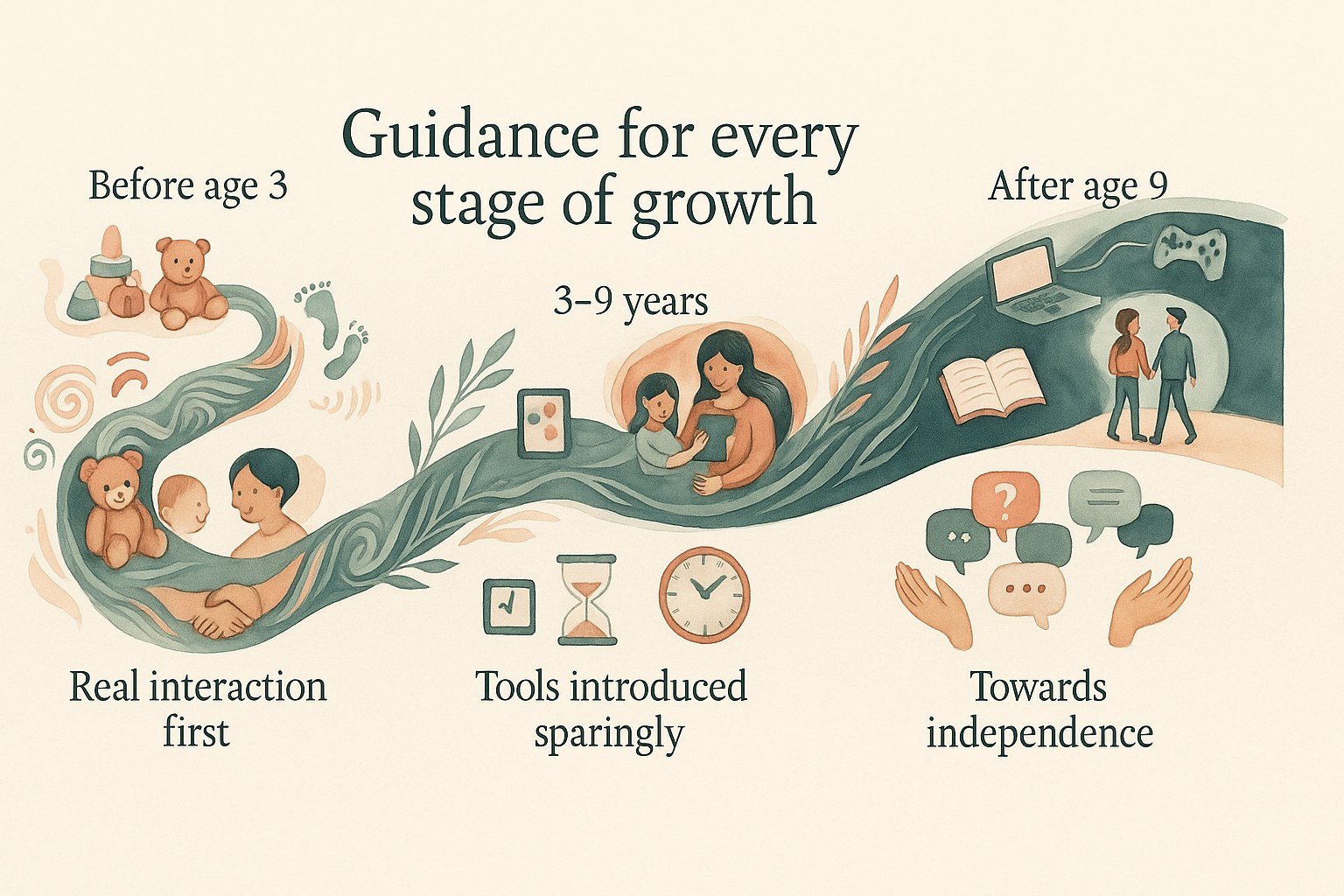
📱 From 3 to 9: introduce tools sparingly
A clear age-based logic guides every new freedom. As children gain independence, firm parental supervision remains necessary. This prevents slip-ups and protects their fragile emotional balance.
Short sessions of 15 to 20 minutes are plenty. Ideally, sit next to them to talk about what’s on the screen. This turns a solitary activity into a genuinely enriching exchange.
Content must be filtered with great care. Choose slow, calm programmes. Frantic, fast-cut editing should be avoided so it respects their natural pace of understanding.
- No screens before age 6.
- Time-limited sessions.
- Calm cartoons only.
💻 After age 9: guide them towards digital independence
The arrival of social media calls for special vigilance. Pre-teens’ curiosity soars, but their maturity is still fragile. They are often defenceless against the sometimes harsh interactions found online.
Negotiating gaming-time quotas avoids many conflicts. A clear agreement always works better than a daily battle. Sticking to the schedule also builds their sense of responsibility.
Keeping a space open to talk about what they discover is essential. Ask them what they liked or learned on the web. It’s a lovely way to stay involved in their online world.
💙 The body and mind under blue light
Understanding the impact of digital tools is a first step, but we also need to look closely at what happens physically in the glow of those bright screens.
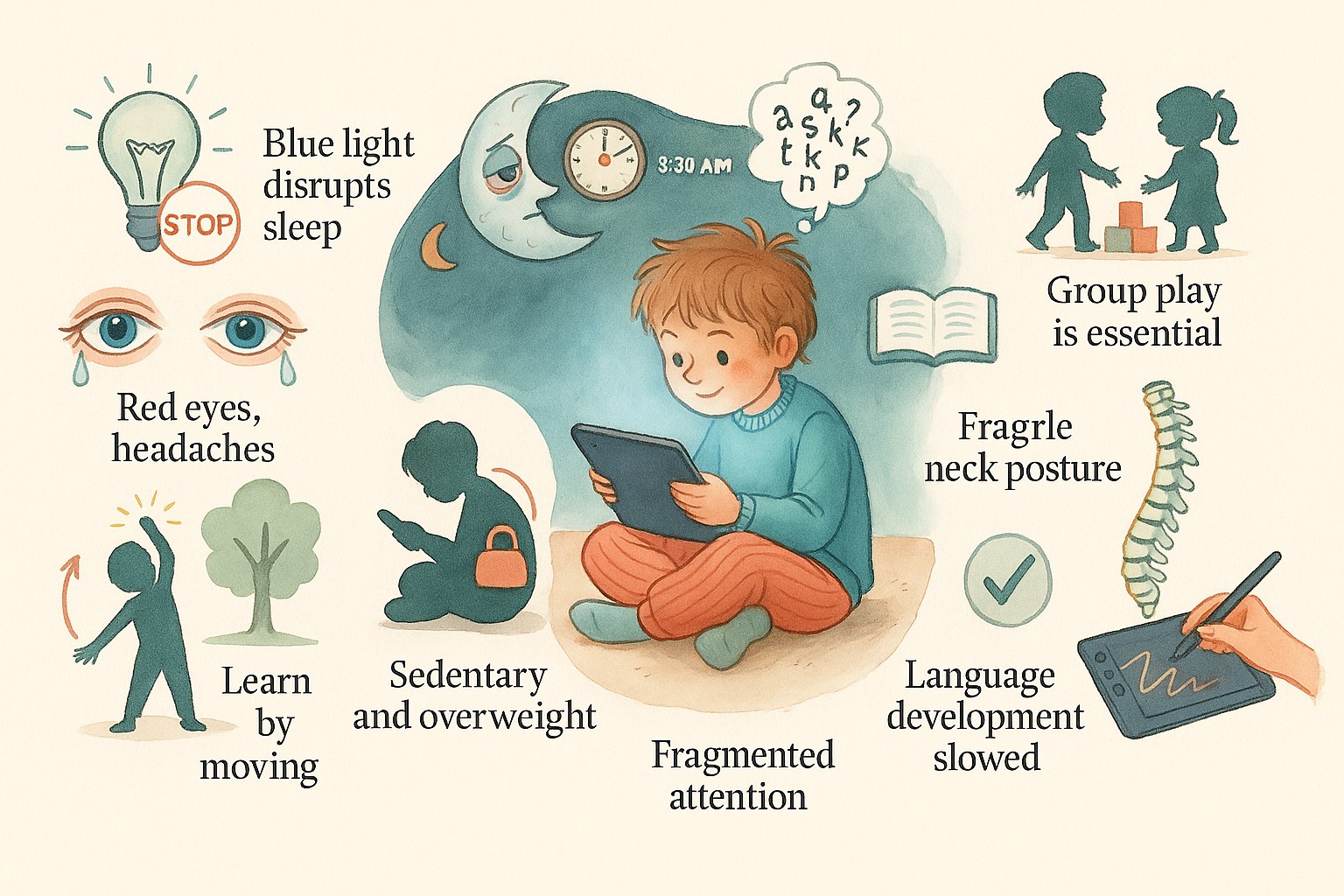
😴 Sleep and eyesight: the risks of eye strain
Blue light blocks the release of melatonin. This wavelength disrupts the sleep hormone. The brain then thinks it’s broad daylight in the evening.
Falling asleep becomes a struggle. A child exposed to screens before bed will find it hard to drift off. Their rest will often be restless and far less restorative.
Watch out for red eyes or tingling. Frequent headaches signal visual fatigue. You should then quickly cut back on screen time.
Research on children’s eyesight confirms how strongly screen light can affect their sleep.
🏃 A sedentary lifestyle and its effects on physical health
Excess weight threatens children who sit too much. Time spent sitting with a tablet replaces sport. This inactivity quickly becomes harmful to their health.
Think about regular active breaks. Every twenty minutes, the child should stand up. They can stretch and look into the distance to give their body a rest.
The “head-down” posture tires the neck. These early tensions need to be offset by movement. Outdoor play remains the best solution.
🧠 Attention and language: the developmental challenges
Fast-paced content fragments attention. The brain gets used to instant rewards. Long school tasks then become boring and difficult.
There’s a difference between consuming and creating. Watching videos stays passive. Drawing or coding on a tablet engages the mind far more.
Group games build empathy. Nothing replaces real-life friends. That’s where children learn to handle their emotions.
The context of use, such as the television on during meals, affects language development more than screen time alone.
Finding the right balance with screens for your family takes patience. But every small step counts for their wellbeing.
🧘 Four simple rules to bring back calm
To counter these physical and mental effects, there are concrete methods you can apply starting tomorrow in your home.
🪜 The four-step method to structure the day
This approach rests on four protective pillars. Avoid screens in the morning, during meals, in the bedroom and just before bedtime to protect the body clock.
A calm morning preserves the focused attention school learning needs. At the table, the absence of noisy distractions encourages conversation and naturally enriches the vocabulary of the youngest family members.
The bedroom should stay a sanctuary for rest. Screens and blue light have no place there if you want to guarantee quality sleep.
| Rule | When | Expected benefit |
|---|---|---|
| No screens | Morning | Better focus |
| No screens | Meals | Talking and sharing |
| No screens | Bedroom | Protected sleep |
| No screens | Evening | Falling asleep faster |
📜 Set up a family agreement to fix the limits
Writing the rules together with the children changes everything. By taking part in setting the limits, they feel heard and respected, which makes the boundaries far easier to accept.
You need to set clear consequences if the time is exceeded. This agreement should be fair and mutual, asking parents too to put their phones down to set a good example.
Posting this document on the fridge gives a permanent visual reminder. It avoids endless negotiations and lets everyone rely on a stable framework everyone has agreed to.
😤 Handle the frustration when it’s time to put the device down
Anticipating the end of the session is a small but effective secret. Warn the child five minutes before stopping so they can finish their game without a sudden, jarring cut-off.
Using a visual timer or a simple sand-timer helps a lot. Seeing the time run out for real helps the youngest understand that the end is near, making the transition gentler.
Offering an immediate, joyful alternative works wonders. A little game, a cuddle or a story redirects their attention and eases the emotional tension of giving up the device.
🔍 Our own habits under our children’s gaze
These rules count for nothing if we, the grown-ups, can’t put down our own phones to look our children in the eye.
📱 Technoference: when the smartphone steals our attention
Parental technoference happens when our notifications interrupt our exchanges. This creates a feeling of emotional insecurity in the child. Their needs then come second to the screen.
Watch the little ones closely. A child ignored for an email often gets fidgety. They become loud to demand the attention they rightly deserve. It’s an exhausting vicious circle.
Identify moments of complete disconnection. Put the device in another room when coming home from school. Be fully present for bath time or play.
National statistics confirm the major influence of parental habits on young children.
👨👩👧 Lead by example to encourage good habits
Being consistent is the foundation. If you ban the phone at the table but check your own, the child sees the unfairness. The rule then loses all its credibility.
Apply these no-connection zones to yourself. Show that you can do without technology. Reading a book or cooking proves that pleasure exists beyond the pixels.
Value this quality presence. Explain why you’re putting your device down. Enjoying time with your child is far more precious than any video or fleeting notification.
🎨 Turn passive use into a creative activity
Move from spectator to creator. Use the tablet to edit a family film. Record an audio story together to finally make the tool useful and educational.
Explore drawing or music apps. Technology becomes a medium for artistic expression. This sparks the imagination instead of numbing it with endless scrolling.
Learn a new skill together. The web can be a guide for gardening. Then carry out real projects in the physical world.
🎲 Fun without any batteries
Once the screens are off, a world of possibilities opens up to have fun and strengthen family bonds in an authentic way.
😊 Family rituals to unplug with a smile
Set up a weekly board-game night. It’s the perfect chance to laugh, compete in a friendly way and chat about everything with no electronic distractions.
Launch group craft projects. Building a cardboard fort or painting a mural creates lasting memories. It builds the pride of making something with your own hands.
Celebrate the simple moments of everyday life. A walk in the woods or a cooking session is enough to fill up everyone’s emotional tank.
- Card games
- Cooking workshops
- Gardening
- Reading aloud
🚗 Keep kids busy on car trips without a tablet
Rediscover classic observation games. Counting red cars or spotting shapes in the clouds keeps the mind busy. The child stays connected to the landscape.
Use the power of audio stories. Told tales fire the imagination without tiring the eyes. This lets children travel in their minds while staying calm and attentive during the journey.
Sing together or play guessing games. These spoken-word moments build closeness. They turn a potentially long trip into a fun, joyful time of sharing.
🎲 Rediscover the joy of free play and boredom
Stand up for the virtues of boredom. It’s in these empty moments that a child draws on their own resources. They then invent stories and stir up their deepest creativity.
Leave room for free play. With no instructions or goals, the child explores their surroundings and tests their limits. They build their independence in complete freedom, far from constant digital prompts.
Encourage reading for pleasure. A good book carries the mind far further than any screen. It also soothes a nervous system worn out by blue light.
Boredom is the fertile ground of imagination; don’t try to fill it every time with a screen.
🛡️ Safe internet and quality content
Despite all these alternatives, technology is still part of life, so let’s learn to make it safe so it never becomes a danger.
🎬 Choose educational, age-appropriate programmes
Look for official quality labels. Favour apps with no intrusive advertising. Choose content approved by childcare or education professionals to ensure healthy learning.
Always check the age ratings. Content rating logos or the indications in app stores are valuable guides. They help you avoid exposing your little ones to completely unsuitable content.
Prefer slow, narrative content. Avoid videos with frantic editing. These formats over-stimulate the brain without adding anything useful to a child’s understanding.
🛡️ Prevent the risks of the web and bullying
Raise awareness of the dangers of social media. Explain early that any post stays online. Remind them that the anonymity behind a screen never fully protects anyone, nor from others.
Teach them how to react to a shock. The child must know they can come to you without fear. If they see a violent image or a hurtful message, stay their first safe haven.
Keep the conversation open every day. Talk regularly about online interactions. This helps you spot the signs of bullying or distress before the situation becomes serious.
The first phone deserves careful thought. Check the official recommendations on the right age before deciding.
⚙️ Set up protection tools effectively
Install parental safety filters. These tools block inappropriate sites and limit bad encounters. They’re an essential first technical barrier, though not enough on their own.
Use the built-in time limits. Most tablets allow an automatic, scheduled shut-off. This helps everyone respect the rules without you having to play police officer.
Technology doesn’t replace the human touch. Your supervision and your conversations remain the best protection against problems. Nothing beats an attentive presence.
Here are a few essential settings to put in place:
- Parental controls turned on
- Time limits
- Web filtering
- Shared history
For peaceful days, remember the four-step rule, favour real play before age 3 and lead by example. By limiting notifications, you protect your little ones’ sleep and attention. Finding the right balance with screens as a family means offering a bright future to their imagination.
❓ FAQ
👶 At what age can a child watch screens for the first time?
For toddlers’ wellbeing, it’s strongly advised to wait until age 3 before any exposure. Before that age, their brain mainly needs real human interaction, handling objects and moving around to build itself well. Too-early exposure could sadly slow down language acquisition and motor development.
In fact, health experts stress the importance of no exposure before age 3 to protect the critical stages of growth. So favour floor play and shared eye contact, far richer than any cartoon!
😴 How does tablet light affect our little ones’ sleep?
The blue light from screens is a little troublemaker: it blocks the release of melatonin, the hormone that tells the body it’s time to sleep. For a child’s brain, this light mimics broad daylight, which delays falling asleep and makes sleep much more restless and less restorative.
Experts therefore suggest switching off screens at least two hours before bedtime. Replacing the tablet with a little reading or an audio story helps prepare the nervous system for rest and avoids eye strain or headaches the next morning.
🪜 What is the four-step method for managing screen time?
It’s a wonderfully simple golden rule for bringing calm back home. It rests on four key screen-free moments: not in the morning before school, not during meals, not in the bedroom and not before sleep. This helps protect time for learning, socialising and rest.
By keeping these moments sacred, you stop images from invading the family space. It’s a great way to structure a child’s day without constant negotiation, while encouraging better focus.
📱 Why is it important to limit our own phone use in front of them?
Our children are true little mirrors. If we spend our time on notifications, they’ll naturally want to do the same. What’s more, what we call “technoference” — when the smartphone cuts off a conversation — can create a feeling of emotional insecurity in the child, who feels less important than the device.
Putting your phone down the moment your child seeks your attention is the finest gift you can give. By leading by example and respecting the screen-free zones ourselves, we give credibility to the household rules and strengthen our bond of closeness.
🛡️ How can we protect older children from the dangers of the internet and social media?
The key is dialogue and anticipation. It’s essential to explain to children that anything posted online stays there forever and can become public. You can also set up parental controls and safety filters, while keeping an eye on browsing history in a shared way to guide them with kindness.
You also need to reassure them: if they come across an image that shocks them or have an unpleasant interaction, they must be able to tell you without fear of punishment. It’s that trust that remains their best protection against cyberbullying or unsuitable content.
