
Bringing the Montessori method into your home can feel daunting when you’re juggling meals and toys scattered everywhere. This practical guide offers simple ways to turn your home into a space for independence without turning your living room into a strict classroom. You’ll learn how to spot your child’s sensitive periods 🌱 and set up each room with everyday objects that gently encourage their natural curiosity.
- The right mindset for Montessori at home
- Arranging rooms to free up movement
- Building independence through daily tasks
- Do you need expensive materials to succeed?
- Spotting sensitive periods and handling emotions
- A smooth daily routine with several children
🧘 The right mindset for Montessori at home
Bringing Montessori into your home starts with shifting your own outlook as a parent, long before you move the furniture. It isn’t simply a list of activities, but a genuine philosophy of presence.
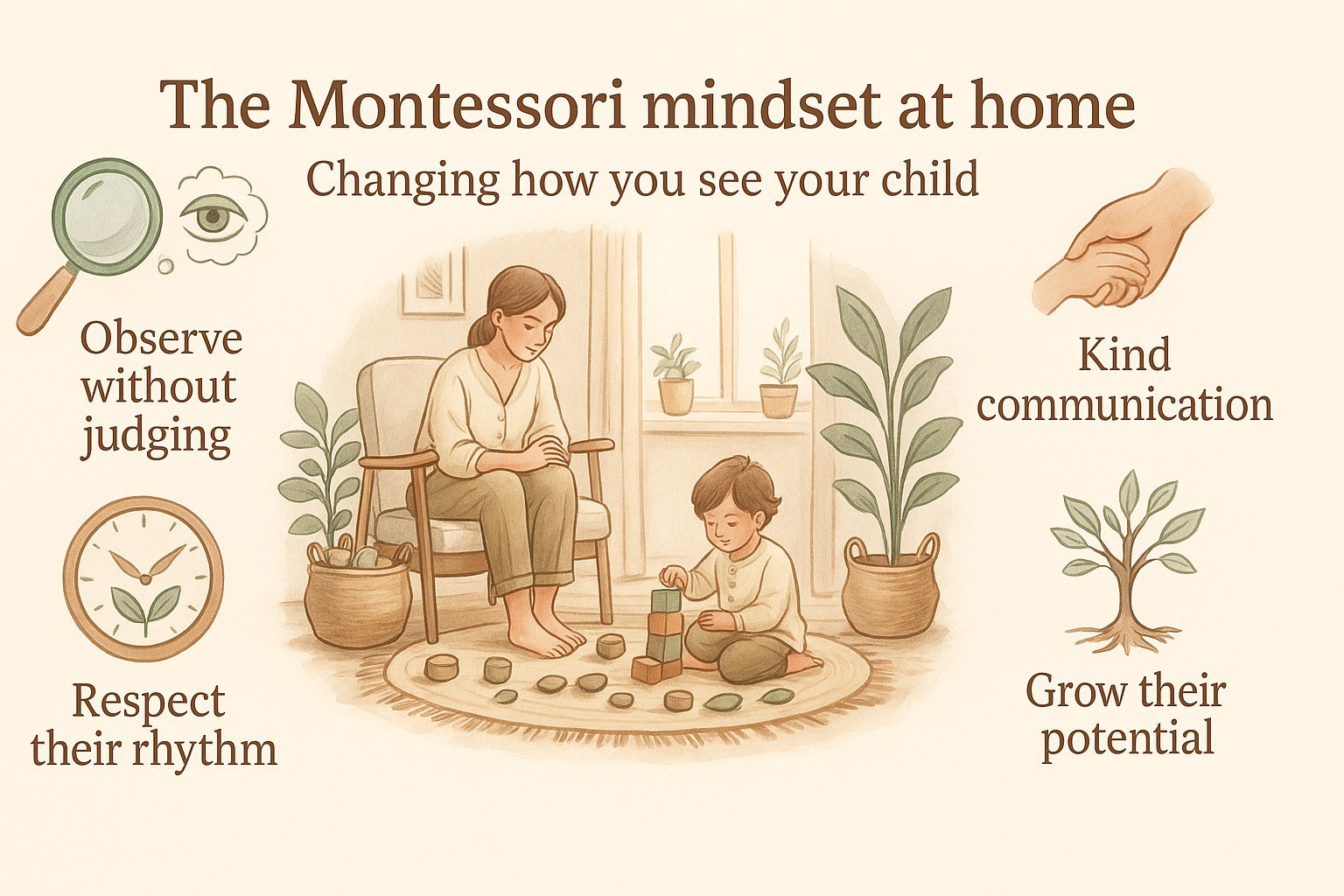
👀 Watch your child without always stepping in
Take the time to sit and watch your child act on their own. Notice what holds their attention, without breaking the moment with praise. Quiet observation reveals what they’re really capable of.
Then adjust the surroundings to match what you’ve seen. If your child climbs everywhere, they’re craving movement. If they line objects up, they’re going through a phase of order. Tune your offerings to their real needs.
Observation is the key. It saves you from suggesting activities that are pointless or too tricky.
💗 Practise kindness and gentle communication
Use “I” to express your own limits. Say “I’m tired of this noise” instead of shouting. This sets a reassuring boundary for everyone.
Meet emotional storms with great calm. Empathy helps your child move through frustration without feeling judged or punished.
Mutual respect sits at the heart of this approach, helping create a peaceful atmosphere.
The overall mission of this approach is to help children develop their full potential by focusing on their moral, behavioural and emotional growth.
Montessori associations around the world support these principles, championing this gentle approach to human development.
🌙 Respect their body clock and waking rhythms
Every child has their own inner clock. Don’t push a skill just because the neighbour’s child can do it. Slowing down helps things sink in deeply.
Follow their needs for sleep and physical activity. A tired child can’t concentrate on a fine-motor task.
Treasure the small everyday discoveries. An ant walking by matters as much as a puzzle. Give them time to explore these details without rushing.
🏡 Arranging rooms to free up movement
Now that your mindset is ready, let’s look at how to turn your home into a safe, child-friendly place to explore.
🛏️ Transform the bedroom with a floor bed
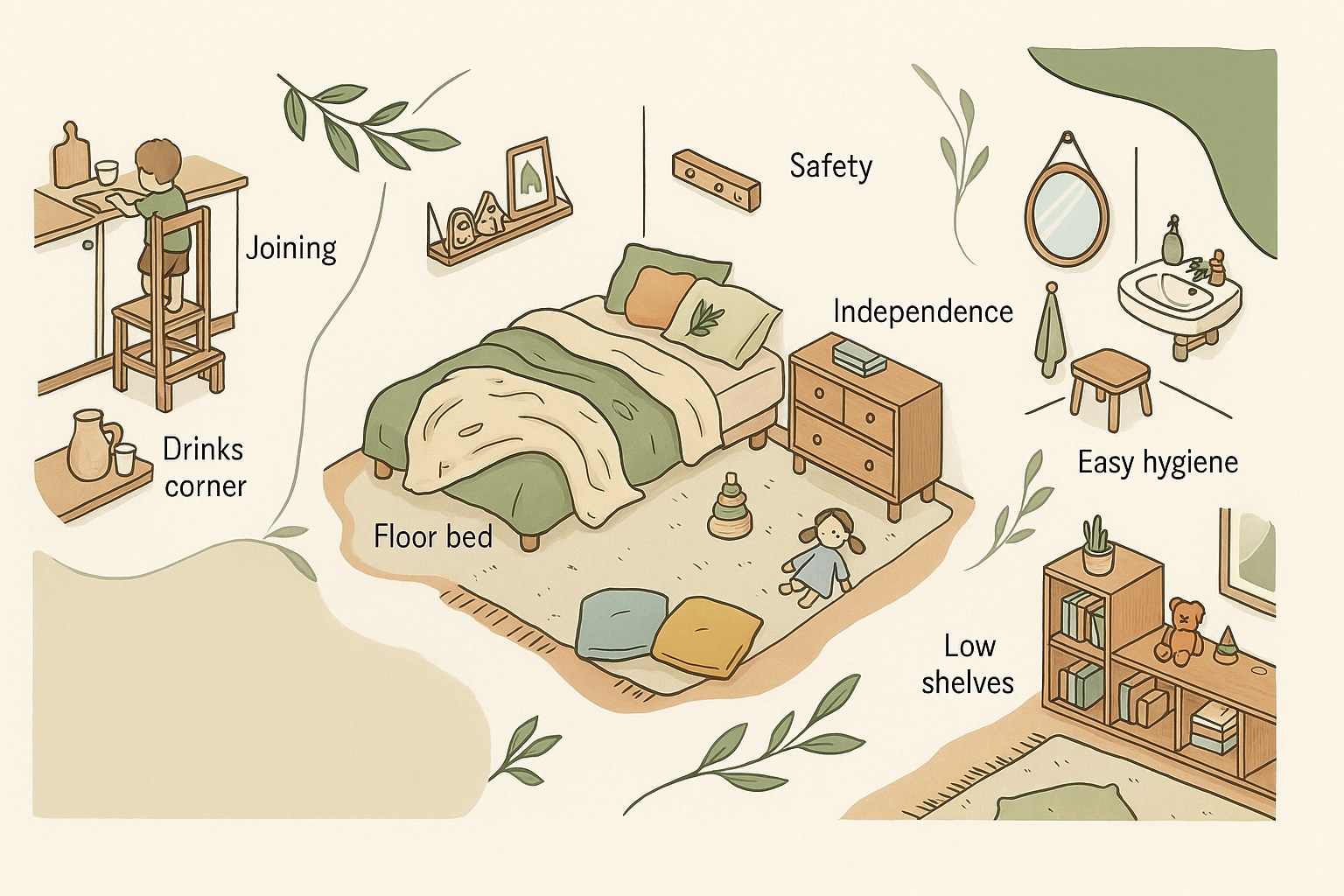
A floor bed is a wonderful alternative to a cot with bars. Your child can get up on their own as soon as they wake. This encourages early independence and respects their natural cycle. Make the room safe by fixing furniture to the wall to prevent accidents.
Set up the wardrobe at their height. Offer two clothing choices to make decisions easier. This is how they learn to dress themselves.
A tidy space helps everyone stay calm. Don’t crowd the bedroom with toys they don’t need.
🍽️ Adapt the kitchen and bathroom for little ones
A learning tower is a brilliant tool in the kitchen. It brings your child safely up to your height. They can then watch and join in with the cooking.
In the bathroom, put up a small mirror. Keep their soap and toothbrush within easy reach.
Create a drinks corner they can reach. A small jug of water and a glass let them serve themselves. This cuts down on interruptions and boosts their sense of being capable.
📐 Make the most of small shared spaces
You don’t need a mansion to bring Montessori into your home. Use low shelves in a corner of the living room. Mark out activity zones with small individual rugs to give the space structure.
Choose quality over quantity. Too many objects create confusion. Tuck the extras away and rotate them regularly.
| Room | Key setup | Benefit for the child |
|---|---|---|
| Bedroom | Floor bed | Freedom of movement |
| Kitchen | Learning tower | Joining in and helping |
| Bathroom | Step stool | Independent hygiene |
| Living room | Low shelves | Easy access to toys |
🤲 Building independence through daily tasks
Once the space is ready, your child can practise the everyday tasks of real life and become truly independent.
👕 Make dressing and self-care easier
Choose simple clothes, such as trousers with an elastic waist. Avoid tricky buttons at first. The goal is for your child to succeed at their first attempts without getting discouraged.
A child-height mirror is a must. It lets them see whether they’ve washed their face properly or brushed their hair.
Praise every effort, even an imperfect one. If they put their shoes on the wrong feet, don’t correct it straight away. Let them feel the discomfort so they adjust next time.
🍳 Get your child involved in preparing meals
Give them real tools that fit their hands. A small round-tipped knife lets them slice a banana. They’ll feel proud to contribute to the family meal.
Setting the table is a great activity. Show them where to place the plate and cutlery. It works on fine motor skills and a sense of order. It’s also a moment of sharing for the family.
Pouring ingredients from one container to another develops precision. It’s a fundamental building block of the Montessori approach at home.
🧹 Learn to tidy up with logic and joy
Use baskets or themed trays. Every item should have a clear, logical place. Your child then finds their bearings easily and tidies up with more pleasure.
Lead by example, every time. Put one activity away before bringing out another. Repeating the ritual builds a natural, lasting habit.
Here are a few tips for keeping order:
- A place for every object
- Use clear baskets
- Tidy up before switching activities
- Value visual order
💰 Do you need expensive materials to succeed?
Many people think Montessori means a big budget, but the reality is far more affordable and creative.
🥄 Favour real, everyday objects
Use real ceramic or glass crockery. Its weight and fragility teach your child to handle objects with care. Plastic gives no real feedback.
Repurpose everyday objects. A shoebox can become a shape-sorting box. Fabric scraps offer varied textures for sensory awakening. Nature, too, is an endless source of free, beautiful material.
Authenticity beats marketing. A child often prefers your keys to a toy version.
🎨 Create homemade activity trays
Make sorting workshops with seeds or colourful buttons. Use muffin tins as containers. It’s a cheap, effective way to build concentration.
Design dressing frames from old clothes. Salvage zips or large buttons for practice.
The Montessori approach at home draws on the founding work of Maria Montessori. Her book sets out just how vital learning through direct experience really is.
🎲 Choose toys by age group
For 0–18 months, go for mobiles and grasping balls. These objects stimulate sight and coordination. Stick to simple shapes and contrasting colours.
Between 18 and 36 months, introduce practical life. Sweeping or washing windows fascinate children.
For 3–6 year-olds, favour more complex puzzles and language. This is the ideal time to explore sandpaper letters. Offer activities that feed their growing curiosity.
💗 Spotting sensitive periods and handling emotions
Understanding the materials is one thing, but knowing when to offer them based on inner development is another.
📈 Identify the major stages of development
The sensitive period for order often shows up as a need for strict routine. Your child may get upset if an object is moved. Watch out for these telling signs.
The language phase is an explosion of words. Read plenty of stories and name each thing precisely. Don’t water down your vocabulary needlessly. Children absorb everything with startling ease during this particular period.
Anticipate needs to avoid tension. A spotted phase is an opportunity seized.
🧠 Protect moments of deep concentration
When a child is absorbed, don’t interrupt. Even a “well done” can burst their bubble of concentration. Let them follow their inner process all the way through, with no distractions at all.
Switch off the television and background music. A calm setting supports sustained attention and quality work.
Maria Montessori believed the aim of education is to raise responsible, independent and adaptable adults for an ever-changing world.
💡 Turn mistakes into learning opportunities
Montessori materials are often self-correcting. If water overflows the glass, the child sees the mistake on their own. They don’t need your judgement to understand and adjust.
Take the drama out of everyday clumsiness. If a pot breaks, clear it up together calmly. A slip-up then becomes just one step in learning.
Value the journey rather than the final result. What matters is the effort made and repeating the gesture. That’s how self-confidence is built to last.
👨👩👧👦 A smooth daily routine with several children
Applying these principles on your own is a challenge, but weaving them into a household of siblings calls for even finer organisation.
📅 Set up a balanced typical day
Alternate quiet activities with times to let off steam. A steady routine reassures your child and limits conflict. Fold household chores in as cheerful family rituals.
Plan gentle transitions between each high point. A little song or dimmed lights ease the return to calm. This avoids meltdowns at mealtime or bedtime. Consistency is your best ally for a peaceful home.
The schedule should stay flexible. Adapt it to your children’s energy each day.
👫 Bring siblings into the dynamic
Encourage older ones to help the little ones. It reinforces their own mastery and develops empathy. Helping each other becomes a core value in your everyday Montessori home.
Respect everyone’s work. You don’t touch someone else’s activity without their clear, prior agreement.
Set up calm zones for precision activities. If one child needs silence, they should be able to slip away. This teaches everyone to respect others’ needs and space.
🌟 Move from a classic framework to guided freedom
Don’t try to change everything overnight. Introduce one new rule or piece of furniture a week. Give your child time to take in each change to their surroundings.
Explain the new freedoms and their limits clearly. Freedom without a framework is just chaos. Safety always comes first.
Here’s how to bring Montessori into your home for calmer parenting:
- Gradual changes
- Clear explanations of the rules
- Safety first
- Adjusting to your child’s reactions
Bringing Montessori into your home transforms everyday life through kind observation, an adapted environment and respect for sensitive periods. Offer this guided freedom now to nurture your child’s independence and confidence. Together, let’s calmly prepare for their flourishing future, one small step at a time. 🌟
❓ FAQ
💰 How can I start Montessori at home without breaking the bank?
There’s no need to empty your bank account to transform your home. The key is to favour real, everyday objects: a small glass carafe, real crockery or kitchen tools sized for your child. Plastic gives no real feedback, whereas ceramic teaches delicate handling.
You can also create your own workshops with whatever you have to hand. Seeds for sorting, old clothes for practising zips, or shoeboxes turned into shape-sorting boxes all work beautifully. Authenticity and nature are your best free allies.
👨👩👧 What is the parent’s real role in this approach?
The parent isn’t a directive teacher, but a kind guide and a discreet observer. Your job is to prepare a safe, adapted environment, then step back and let your child explore. Observing without judgement helps you understand their real needs and waking phases without interrupting them.
It’s about embodying the values of respect and patience. By showing gestures precisely and calmly, you help your child become independent. You step in only when there’s danger or when your child asks for help, so you protect their precious moments of deep concentration.
🏡 How do I set up my home to encourage my child’s independence?
The idea is to bring the world down to their height. In the bedroom, a floor bed lets your child get up and lie down on their own. In the kitchen, a learning tower lets them join in with meals safely. Low shelves and wall-fixed furniture round out this setup nicely.
Think too about the small everyday details: a child-height mirror in the bathroom, a low coat hook or a reachable drinks corner with a small jug. A tidy, ordered space helps your child find their bearings and build their sense of being capable without depending on the adult.
😡 Why does my child have tantrums, and how does Montessori help?
Maria Montessori explained that “tantrums” are often the expression of an unmet need tied to a sensitive period, such as an intense need for order or movement. If the environment or the adult blocks this natural need, the child shows their frustration sharply. Understanding these phases helps you anticipate tension.
Managing emotions also relies on kind communication and active listening. By using “I” to express your limits and meeting emotional storms with empathy, you create a reassuring framework. Mistakes are seen as a normal step in learning, which eases the pressure and builds self-confidence.
👨👩👧👦 Can you apply Montessori with several children of different ages?
It’s perfectly possible and even very rewarding! The trick is to set up a steady routine that alternates between calm activities and time to let off steam. Encouraging the older ones to help the younger ones reinforces their own mastery and develops empathy among siblings.
It’s important to set clear rules, such as respecting others’ work: you don’t touch a brother’s or sister’s activity without their agreement. Setting up calm zones lets everyone slip away if they need silence, teaching the whole family to respect each person’s needs and space.
