
Explaining where everyday objects come from can sometimes feel like a never-ending puzzle for parents. 💡 This article shares the inventions that changed the world, explained to children, turning their curious questions into real moments of togetherness. You’ll discover how ideas born from frozen mistakes or simple circus games ended up leaving a lasting mark on history.
- The ice lolly, a child’s invention
- The trampoline, inspired by circus nets
- Braille, reading with your fingers
- Earmuffs, to protect your ears from the cold
- Turning household objects into toys
- Olivia Hallisey’s fast Ebola test
- Eliott Sarrey’s self-driving garden robot
- Maya Penn’s eco-friendly fashion
- Abraham Keita’s fight for children’s rights
- A guide to succeeding with your own inventions
🍦 The ice lolly, a child’s invention
Let’s start with a treat everyone knows, born from a simple bit of forgetfulness on an icy California night.
🥤 The tale of the drink left out on the porch
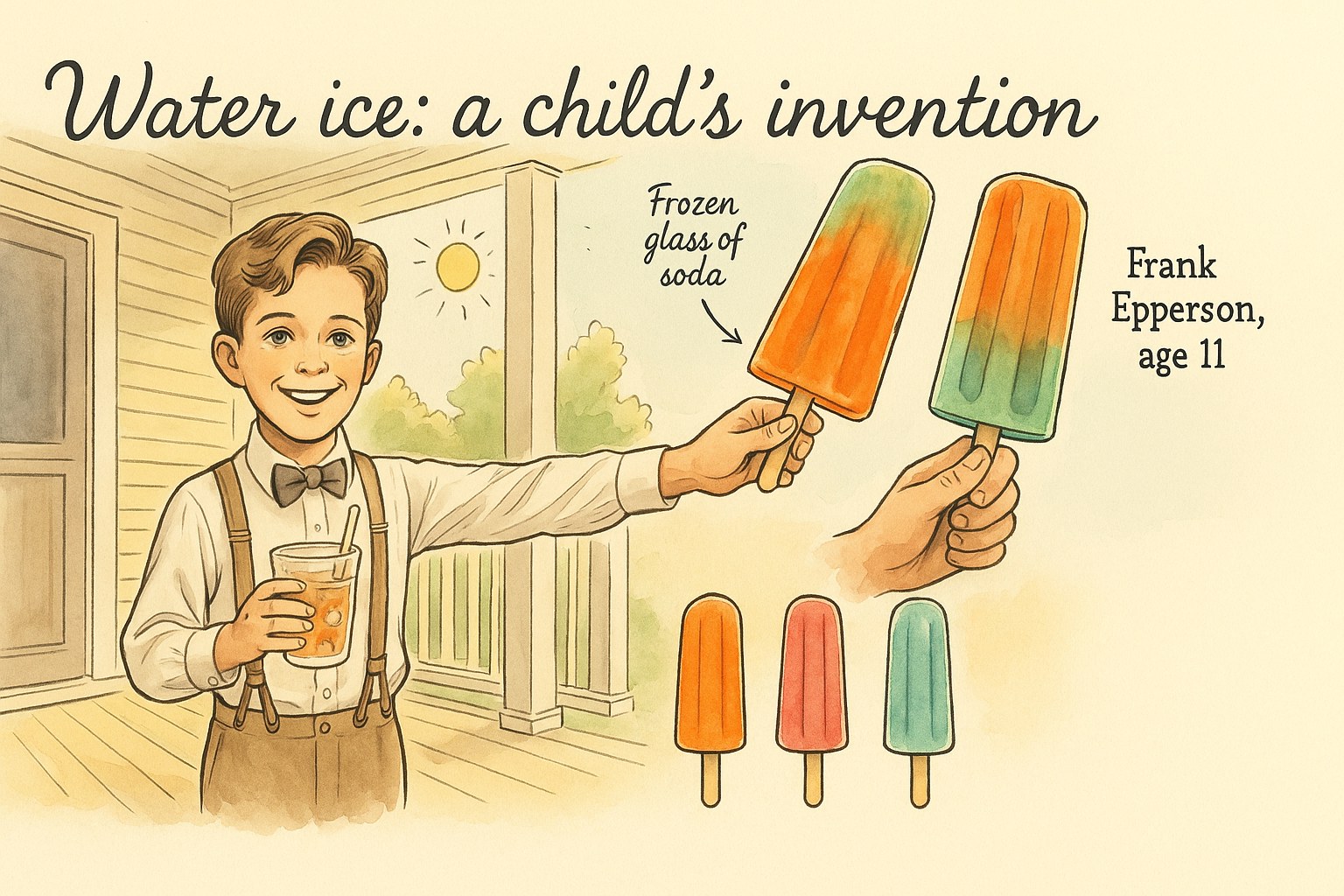
In 1905, young Frank Epperson, aged 11, mixes water and soda powder. He forgets his glass out on the porch. That night, the frost changes everything.
The next day, he discovers a frozen surprise. The stick he used for stirring is stuck inside the block. He has just invented the ice lolly without knowing it.
Frank tastes his creation. He instantly loves this new kind of frozen dessert.
🍦 The frozen treat that conquered the planet
It’s only twenty years later that Frank files his patent. He calls his invention the Popsicle. The success is dazzling. The whole world quickly adopts this simple but refreshing summer treat.
Today, billions of lollies are sold every year. It’s proof that a careless mistake can become an empire.
Imagination doesn’t wait for adulthood. Frank is the perfect example from history.
🤸 The trampoline, inspired by circus nets
If the ice lolly was born from forgetfulness, other iconic objects come from careful observation, as was the case under a big top.
🎪 Watching the acrobats during their shows
George Nissen loved watching the trapeze artists at the circus. He noticed most of all how they dropped into the net. That final bounce seemed to him the most fun part.
At just 16, he imagines a machine that could stretch out that jump. His goal is to practise acrobatics at home. The idea slowly grows and he draws his first plans.
🔧 Building the first prototype in a garage
In his garage, George collects scrap metal and inner tubes for the springiness. The first prototype is noisy but it works. He then tests his first somersaults on this stretched canvas.
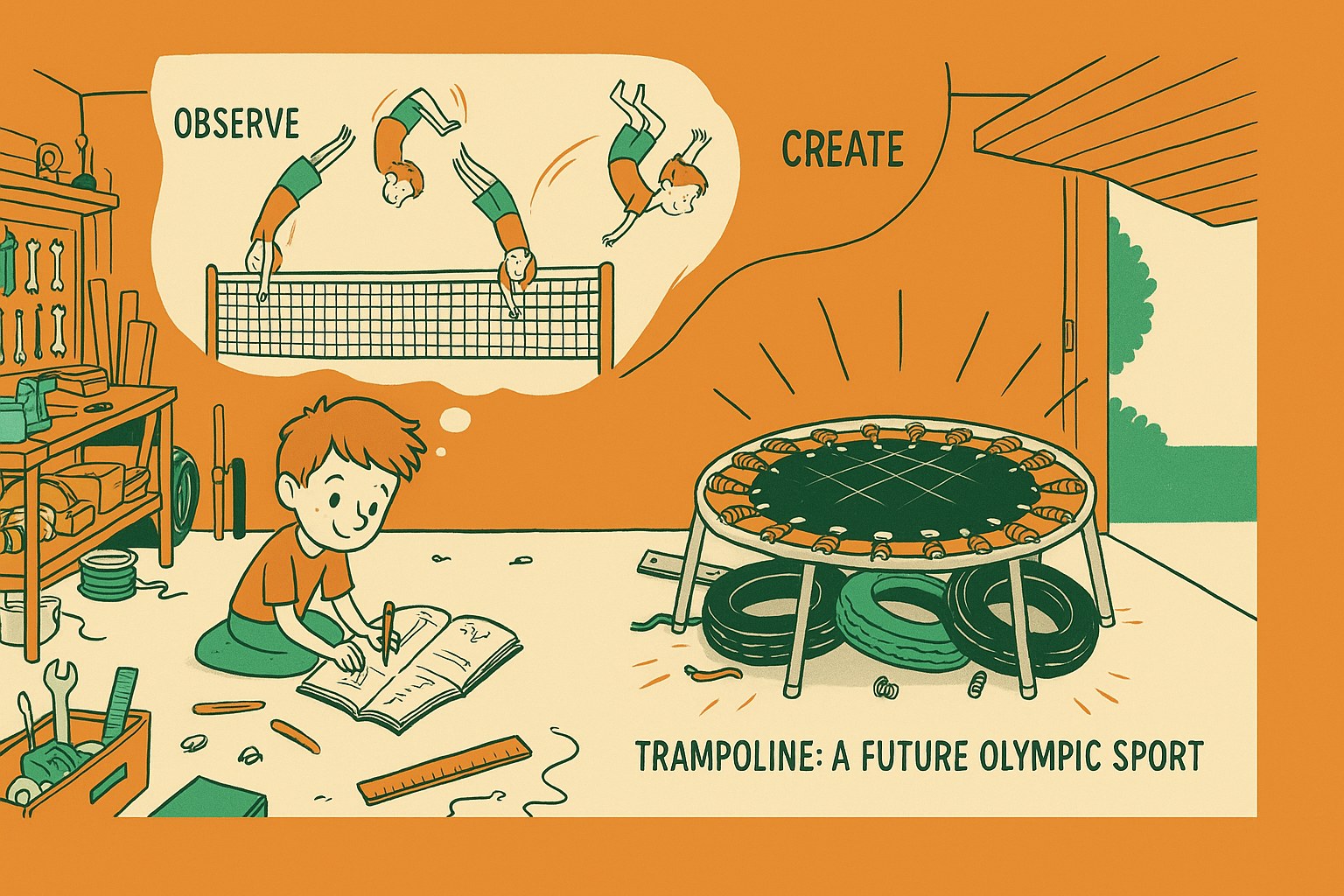
His invention has become an Olympic discipline at the Sydney Games. Millions of children now jump in his footsteps in their gardens.
George Nissen’s invention shows how a simple children’s game can lastingly transform world sport.
As you discover the inventions that changed the world, explained to children, you realise that George Nissen’s ingenuity paid off. It’s a wonderful lesson in perseverance for our little curious minds.
🤲 Braille, reading with your fingers
Beyond entertainment, young genius sometimes takes on far deeper challenges, like access to culture for everyone.
🪖 Adapting a military code for blind people
Louis Braille loses his sight in an accident at a very young age. At school, books are rare and heavy. He then discovers a secret military code.
This “night reading” system is too complex for him. At 15, he decides to simplify it radically. He wants an alphabet his fingers can understand quickly.
He works tirelessly on his styluses. His determination finally pays off.
⠿ A simple method to read with six dots
His system is based on a cell of six raised dots. Each combination stands for a precise letter or number. Blind people can finally read and write on their own. It’s a major humanitarian revolution born in a student’s bedroom.
- The 6 basic dots
- Reading by touch
- Literacy for all
- Independence for visually impaired people
You can discover these inventions that changed the world, explained to children, in dedicated books.
🎧 Earmuffs, to protect your ears from the cold
Sometimes, an invention simply comes from a bit of physical discomfort during an ordinary winter activity.
⛸️ A solution against the freeze while skating
Chester Greenwood is 15 and loves skating. But the cold of Maine is unbearable for him. His ears turn red and painful very quickly.
Woollen hats itch him far too often. So he makes two circles out of wire. He asks for help to cover these metal rings.
His idea is simple but tremendously effective. The first prototype is ready for the ice.
🧵 His grandmother’s help to sew on the fur
His grandmother sews beaver fur onto the frame. Chester wears his “ear protectors” on his next outing. His friends mock him at first, then grow very envious. They all want the same protection against the icy wind.
He opens a factory in his hometown. Chester becomes a successful businessman before he comes of age.
The patent is filed in 1877. Winter will never be the same again.
🧸 Turning household objects into toys
Ingenuity doesn’t always lead to a factory; it also lies in the art of seeing the hidden potential of lifeless objects.
📦 Using cardboard boxes to create whole worlds
A plain packing box is a treasure. For a child, it’s an unconquerable castle. Or maybe an ultra-fast racing car.
This ability to repurpose things is fundamental. It trains the brain to solve problems. The child doesn’t see rubbish, but an opportunity.
Creativity turns everyday life into an adventure. It all starts with a different way of looking.
🚀 Turning empty bottles into space rockets
Plastic bottles become rocket engines. A few pieces of tape are all you need for lift-off. This creative recycling is the basis of the inventive spirit. We should encourage these short-lived but essential builds for the mind.
Imagination is the inventor’s first laboratory, where ordinary objects take on an extraordinary dimension.
To invent is first of all to dare to imagine the impossible. Children do it naturally.
🧪 Olivia Hallisey’s fast Ebola test
Let’s leave the world of toys for that of cutting-edge science, where a high-school student took on a global epidemic.
❤️ An invention to save lives without electricity
In 2014, Ebola devastates several African countries. Olivia Hallisey, 16, wants to help the sick. She looks for a fast, simple way to detect the disease.
Existing tests are expensive and need to be kept cold. Olivia invents a card made of tissue paper. It works without electricity and is easy to carry anywhere.
Her solution is both brilliant and cheap. It changes the game in the field.
📰 A low-cost device inspired by the news
The test gives a result in thirty minutes. That’s a vital time saving for isolating patients. Olivia proves that young people can respond to health crises. Her project won first prize at the Google Science Fair.
| Criterion | Classic test | Olivia’s test |
|---|---|---|
| Cost | Around 1,000 dollars | Around 25 dollars |
| Time to result | Up to 12 hours | Under 30 minutes |
| Electricity needed | Yes (refrigeration) | None |
| Storage | Cold chain required | Room temperature |
This success reminds us how essential global health efforts are. Well done, Olivia.
🤖 Eliott Sarrey’s self-driving garden robot
Technology can also put itself at the service of nature, as this young inventor shows.
🤖 Automating vegetable-patch chores with a robot
Eliott Sarrey is only 14 when he creates Bot2Karot. This little robot looks after your vegetable patch all by itself. It can hoe the soil and water the shoots.
The user controls everything from a simple mobile app. It’s like a video game, but in real life. The robot can even replant seedlings without help.
Gardening becomes accessible to those who are short on time. Eliott has really understood the future.
🏆 The journey of a young creator at the Google Science Fair
Eliott is the first French winner. His robot won over the jury with its practical usefulness. Today he keeps improving his machine to sell it. His journey inspires many young teenagers who are passionate about robotics.
There are even projects using artificial intelligence for learning to help pupils build such technical skills.
Perseverance is the key to his dazzling success. He never gave up on his idea.
👗 Maya Penn’s eco-friendly fashion
Early entrepreneurship isn’t limited to robots; it also touches our way of dressing.
♻️ Making clothes from recycled fabrics
Maya Penn launches her business at the age of eight. She creates Maya’s Ideas with a very clear vision. She uses only recycled and organic fabrics.
For her, fashion shouldn’t destroy the planet. Her dyes are natural and respect the local environment. She makes unique, very colourful accessories.
Her style quickly wins over international magazines. She becomes an eco icon.
💝 Giving part of the profits to charity
Maya isn’t only out to make a profit. She gives 10% of her profits to charities. She supports environmental projects and global causes.
She’s a truly committed business leader despite her young age. Here are her priorities:
- Using organic materials
- Textile recycling
- Charitable donations
- Raising eco awareness
She proves that passion and positive impact can go together. An example for her whole generation.
✊ Abraham Keita’s fight for children’s rights
Sometimes an invention isn’t an object, but a new way of carrying a message of justice.
📣 A voice against injustice in Liberia
Abraham Keita starts his activism at the age of nine. In Liberia, he speaks out against violence towards children. His words are direct and touch hearts.
He organises peaceful marches to demand more justice. He challenges his country’s leaders without any fear. His courage impresses international observers.
He becomes the voice of a youth that is often forgotten. His strength lies in his sincerity.
🕊️ Winning the International Children’s Peace Prize
In 2015, he receives the International Children’s Peace Prize. This award recognises his relentless fight to protect childhood. He keeps travelling to raise awareness around the world. Abraham shows that young people can change the law.
He joins the circle of young inventors and activists who are deeply committed. His journey inspires many families across the planet.
His victory belongs to all oppressed children. An immense hope for the future.
💡 A guide to succeeding with your own inventions
After discovering these incredible journeys, you might be wondering how to take action yourself.
📜 Filing a patent and protecting early ideas
A young person can absolutely protect their invention legally. Parents have to sign the necessary paperwork. It’s a crucial step to avoid having ideas stolen.
To go further, you can read a good guide on how patents work. It explains the steps clearly.
🔧 Turning a project into a prototype and accepting failure
First make a simple version with recycled objects. Don’t be afraid of mistakes at the start. Failure is simply a normal step towards final success.
Test your object several times in real conditions. Note down every problem you run into so you can improve it.
🧠 The difference between a child’s intuition and adult technique
A child imagines without limits or useless mental barriers. An adult brings the technical rigour to make the dream real. The collaboration between the two is often the key.
Listen to the wildest ideas of the youngest. They often hide tomorrow’s solution.
These young inventors prove that boldness doesn’t wait for the years to pass. By watching the world with curiosity, your children might just imagine the next great innovation. Encourage their ideas starting today: the future belongs to them, and every little discovery can become a great revolution tomorrow!
❓ FAQ
🍦 Who had the brilliant idea for the ice lolly?
It was an 11-year-old boy, Frank Epperson, who invented this treat purely by accident in 1905. He had left a mix of soda and water with a stick on his porch during a frosty night in California.
The next day, he found his drink turned into an ice block around the stick. He first called his invention the “Epsicle” before his own children later suggested the name “Popsicle”.
🤸 How was the very first trampoline born?
The trampoline was dreamed up by George Nissen, a young 16-year-old gymnast fascinated by circus acrobats. Watching the trapeze artists bounce in their safety nets, he wanted to create a tool to stretch out that fun jump.
With his coach’s help, he rigged up a prototype in his garage using an iron frame and inner tubes for the springiness. His invention even became an official discipline at the Olympic Games.
⠿ Why does Braille use only six dots?
Louis Braille designed this system at the age of 15 to simplify a military code that was too complex. He chose a cell of six raised dots because it lets the fingers quickly read each letter or number without having to move the hand.
Thanks to this clever layout, blind and visually impaired people could access reading, writing and even music completely on their own. It’s a real humanitarian revolution born from the determination of a young student.
🎧 Where do the earmuffs we wear in winter come from?
We owe this protection against the cold to Chester Greenwood, a 15-year-old teenager from Maine. In 1873, while he was skating, he could no longer stand having frozen ears but found woollen hats too itchy.
He made a wire frame and asked his grandmother to sew beaver fur onto it. His idea was such a hit that he opened a factory and filed his patent as early as 1877.
🧪 Are there medical tests invented by teenagers?
Yes, that’s the case with the fast Ebola test created by Olivia Hallisey at just 16. Struck by the 2014 epidemic, she developed a tissue-paper device, no bigger than a credit card.
Unlike classic tests, her invention needs no electricity or refrigeration and gives a result in under 30 minutes. This brilliant project actually won first prize at the Google Science Fair.
🤖 Can a robot really look after a vegetable patch all by itself?
It’s entirely possible thanks to the invention of Eliott Sarrey, a young 14-year-old from France. His robot, called Bot2Karot, is able to hoe the soil, water the plants and even replant them without any human help.
The user steers the robot directly from an app on their phone, turning gardening into a simple, connected activity. Eliott was the first French winner at the Google Science Fair.
👗 How can a child create an eco-friendly fashion brand?
Maya Penn launched her company “Maya’s Ideas” at just 8 years old. Passionate about the environment, she makes clothes and accessories only from recycled fabrics and natural, non-toxic dyes.
On top of her eco commitment, she gives 10% of her profits to charities. She proves to the youngest that you can live from your passion while having a positive impact on the planet.
📜 Is a young person allowed to protect their own inventions?
Absolutely — a child or teenager can definitely protect their ideas legally. It’s the parents who sign the official documents to file a patent in their child’s name.
It’s an essential step to secure an early creation. It lets you turn a simple intuition into a real project, while learning the basics of intellectual property from a young age.
