
Does your little one burst into tears because their banana was cut the wrong way, leaving you feeling completely helpless in the face of the storm? 🌈 This gentle guide helps you understand how to handle your child’s emotions by decoding the reactions of a brain that is still very much under construction. You’ll discover concrete tips for validating their feelings and turning meltdowns into moments of connection, while staying the calm lighthouse they need.
- Why little brains overheat so fast
- Weathering the storm without getting struck
- Helping your child put feelings into words
- Handling a meltdown in public with calm
- Staying the lighthouse in the middle of the storm
- Adapting to life stages and ages
🧠 Why little brains overheat so fast
Once we’ve set the stage for kindness, it’s essential to dive into the biological machinery that drives our children’s reactions so we can stop seeing them as personal attacks.

🧠 Brain immaturity before age 7
The prefrontal cortex is still very much under construction. Yet this is the area that manages reason and calm. Before the age of seven, this wiring simply can’t put the brakes on impulses. So the child experiences their storms with no biological filter at all.
Under stress, the connection between the upper and lower brain snaps. Logic then becomes completely out of reach. In short, there’s no point trying to reason with a little one in the middle of a meltdown.
They are biologically unable to calm down on their own. They need the adult’s nervous system to find their inner balance again.
⚖️ The difference between feeling and behaviour
Emotion is an involuntary physiological reaction. The action that follows is something else. While anger is always legitimate, hitting or biting remains unacceptable behaviour that needs to be set straight.
Validating the feeling lets the child feel safe. Emotions are essential adaptive processes for their development. They then feel understood.
You can say “I understand your frustration” while still stopping the action. This is the cornerstone of modern emotional education.
🔬 What neuroscience tells us about meltdowns
The amygdala acts like a fire alarm. It takes control of the body instantly. The upper brain goes offline, making any discussion pointless in that moment.
Warm support works better than punishment, which raises cortisol. Punishing a brain in distress only deepens its sense of insecurity. The parent must put out the fire with their presence. Maturity simply takes time.
Connection repairs. A stressed brain cannot learn.
⛈️ Weathering the storm without getting struck
Understanding the biology is a first step, but how do you turn this theory into a soothing presence during moments of high tension?
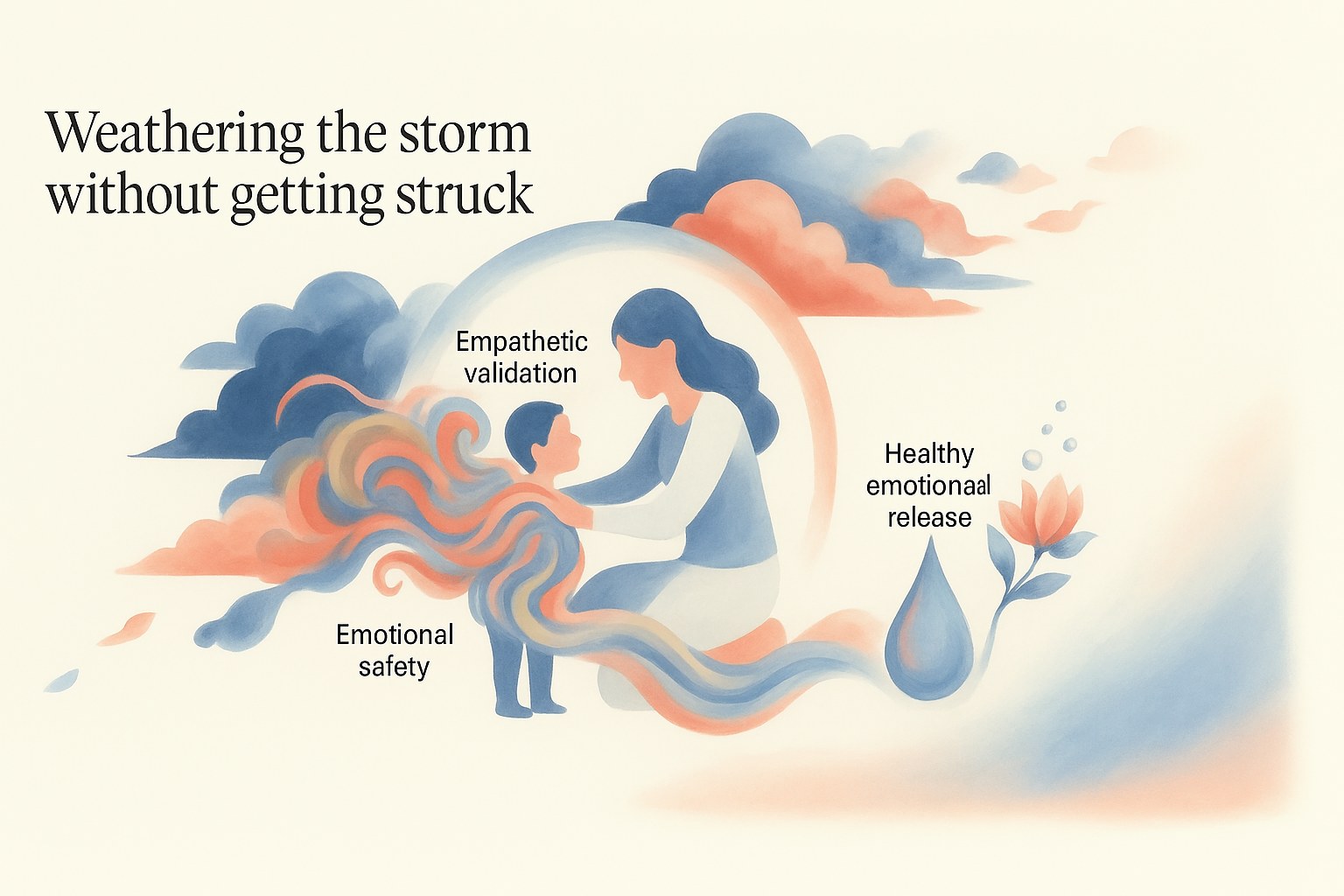
🤗 The importance of empathetic validation
Unconditional acceptance means receiving the emotional message without judgement. Denying an emotion, like saying “it’s nothing”, invalidates the child’s experience. This often makes the meltdown more intense.
Validation strengthens emotional security and self-confidence. The child learns that their feelings are normal.
The influence of those around a child is crucial for developing emotional adjustment skills and social adaptation.
By naming what the child is going through, we help them make sense of their experience. This is the beginning of assisted emotional regulation.
💧 The idea of emotional release
End-of-day tears are often a release of accumulated stress. School or daycare demands enormous self-control. Once back home, the cup finally overflows.
Tears contain stress hormones that it’s healthy to let out. A quiet presence is often enough to soothe. There’s no need to look for an immediate solution. What matters is letting the release happen.
Welcoming these tears without getting annoyed is a gift. Calm always returns after the rain.
🛡️ The need for safety and attachment
Meltdowns often hide basic needs like tiredness or hunger. Physical contact triggers oxytocin, the well-being hormone. A genuine hug can make cortisol drop instantly. It’s a powerful tool.
Secure attachment lets a child explore and come back to their home base. There’s actually a strong link when it comes to the impact of the family’s emotional climate on a child’s development.
The adult’s body acts as an external regulator. By staying calm, you offer a solid anchor to help handle your child’s emotions with kindness every day.
💬 Helping your child put feelings into words
Once the storm has passed, it’s the perfect moment to fill your child’s toolbox and give them ways to express themselves differently.
🍼 Building an emotional vocabulary from the cradle
Moving beyond the binary “happy or unhappy” takes active learning. Use precise adjectives like disappointed, worried or frustrated. The richer the vocabulary, the more nuanced the expression.
Here are a few practical supports:
- Emotion wheels to picture how strong a feeling is.
- Picture cards for little ones who don’t talk yet.
- Using “I” statements to express a clear need without blaming.
Naming is already the start of taming. This is how a child gains emotional independence.
📖 Playful supports and themed reading
Emotion plushies let children express feelings in a concrete way. The child can show their mood without having to speak. It’s a reassuring way to open up a conversation.
Stories create the distance children need. By talking about the character, the child processes their own fears. Reading then becomes a moment of closeness and learning.
Play takes the drama out of tricky everyday situations. With little ones, messages land best through fun.
🎭 Acting it out and role-play
Re-enacting a difficult scene with figurines helps a child understand what happened. Switching roles develops empathy in a playful way. The child sees the situation from another angle. This encourages creative problem-solving for next time.
Play lets children test reactions with no real risk. It’s an extraordinary social experimentation lab. The adult gently guides without imposing a rigid moral.
These moments strengthen the bond and mutual understanding. Laughing together is also a great way to regulate emotions.
🛒 Handling a meltdown in public with calm
If your tools work well at home, the challenge gets trickier under other people’s gaze, calling for a specific strategy to stay on course.
💬 Key phrases to ease distress
At the emotional peak, go for short, punchy phrases. Avoid “why” questions that demand too much thinking. Prefer affirming your presence: “I’m here, everything’s okay”.
Keep the tone of your voice low and calm. This signals to the child’s brain that there’s no immediate danger. Sometimes physical closeness is enough.
The goal is to bring back safety before trying to teach. You can talk through the incident later, once things are calm.
🔍 Telling a real emotion from a need for independence
Work out whether the meltdown is deep distress or self-assertion. The word “tantrum” is often unhelpful because it assumes an intent to do harm. It’s usually just clumsiness.
Offering limited choices gives the child back some power. “Do you want to put your shoes on now or in two minutes?”. This steers attention away from a head-on conflict. The child feels like an actor in the decision rather than forced.
Manipulation doesn’t exist in a toddler. They’re simply trying to meet a need.
🧘 Mindfulness and breathing for little ones
Introduce your child to breathing through simple images like blowing on an imaginary candle. Heart coherence can be learned through play from a very young age. Body grounding helps step out of mental turmoil. It’s a precious skill for the whole of life.
| Technique | Playful description | Ideal age |
|---|---|---|
| The candle | Gently blow on an imaginary flame without putting it out. | From age 3 |
| The balloon | Puff up your tummy like a big colourful balloon. | From age 2 |
| Inner weather | Spot whether it’s sunny or stormy inside your heart. | From age 4 |
| The butterfly hug | Tap your shoulders with crossed arms to calm down. | Any age |
Practising these exercises outside of meltdowns makes them easier to use when the moment comes. The brain turns the reflex into an automatic habit.
🕯️ Staying the lighthouse in the middle of the storm
To support your child effectively, you first need to know how to navigate your own inner waters without sinking.
👨👩👧 The parent as a model of regulation
Mirror neurons mean a child mirrors your state onto themselves. If you shout, their stress automatically rises. Your calm is their best remedy.
Putting your own emotions into words sets the example to follow. “I feel tired, I need some quiet”. This normalises having a range of feelings, including difficult ones.
Emotional education happens above all through watching the adult’s behaviour. Be the change you want to see in them.
🎯 Managing your own internal triggers
Spotting what makes us lose patience is crucial for anticipating it. Is it noise, tiredness or a feeling of helplessness? Knowing yourself better helps you react better.
Use the pause technique before acting on impulse. Take three deep breaths if you need to. Accepting your own limits prevents parental anger from exploding. There’s no shame in stepping away for a few moments to clear your head.
A rested parent is a more empathetic parent. Take care of yourself for them.
🏡 Creating a safe space at home
Set up a calm corner with cushions and books. It’s not a place of punishment, but a place to recharge by choice. Predictable routines hugely reassure the limbic brain. They offer a stable framework where the child can relax.
Value free expression within a defined, safe framework. The child must know they can say anything without fear of being rejected. Home becomes a refuge.
Structure brings the emotional freedom needed for healthy development. It’s the bedrock of mutual trust.
📈 Adapting to life stages and ages
Finally, emotional support isn’t fixed and must evolve at the pace of a child’s growth to stay relevant.
📊 How techniques evolve from 2 to 10
Adapt your level of language to the child’s maturity. With a little one, favour physical contact and simple words. For older children, move gradually to the verbal.
Give an older child responsibility for their own emotional management. Ask them what they need to calm down. They then become a partner in their own regulation.
Around age 7, the child crosses a major milestone. They move into the stage of concrete operations, which changes how they see the world.
➡️ Supporting major transitions
Prepare changes like starting school or moving house well in advance. Use non-violent communication to defuse simmering conflicts. Anticipation dramatically reduces stress spikes.
For handling your child’s emotions with kindness, here are a few concrete ideas during these stages:
- Validate the child’s concerns without brushing them aside.
- Offer belly-breathing techniques.
- Show unreserved confidence in their abilities.
Every new thing is an emotional challenge. Your support is the bridge to success.
💖 Teaching empathy every day
Point out other people’s emotions in real life or in films. Encourage genuine repair after a conflict, without forcing a meaningless apology. Cultivating kindness towards oneself matters just as much. Empathy is learned through everyday example.
In fact, it helps to keep this definition in mind:
“Emotional regulation covers the internal and external processes that allow a person to function in an adaptive way.”
An empathetic child will become a more balanced, socially integrated adult. It’s an investment in their future.
Supporting your little one’s inner weather means validating their feelings, naming emotions and staying a calm lighthouse in the face of the storm. By understanding their brain immaturity, you turn every meltdown into a lasting bond. Act with patience starting today: your kindness calmly builds the balanced adult of tomorrow.
❓ FAQ
💥 Why does my child explode so fast over a tiny thing?
It’s a matter of wiring! Before age 7, our little ones’ brains are still very much under construction. The prefrontal cortex, which manages reason and calm, isn’t mature enough to put the brakes on the impulses of the amygdala, their inner alarm.
When emotion rises, the connection between the upper and lower brain literally snaps. The child goes through a biological storm with no filter. It’s not bad will — they are simply unable to reason with themselves at this stage of their development.
🤔 How do I tell the difference between an emotion and a tantrum?
The word “tantrum” is often a bit strong because it implies an intent to do harm, whereas a toddler is simply trying to meet a need or assert their independence. An emotion is an involuntary physiological reaction and is always legitimate.
It’s the behaviour that may be unacceptable. You can validate the anger (the emotion) while staying firm on the ban on hitting (the action). Welcoming the feeling without judgement lets the child feel safe enough to learn to self-regulate.
😢 Is it normal for my child to cry for no obvious reason at the end of the day?
This is what’s called an emotional release. A day at daycare or school demands huge self-control. Once back in their safe cocoon with you, the cup finally overflows to let out the accumulated stress.
These tears contain stress hormones like cortisol. Letting them out is very healthy. A quiet presence, a hug or simply being there is often enough. Calm always returns naturally.
🧰 What simple tools can help a child name what they feel?
Moving beyond a simple “I’m fine” or “I’m not fine” changes everything. You can use playful supports like an emotion wheel or picture cards for the youngest. This makes feelings concrete and less overwhelming.
Enriching their vocabulary with words like “frustrated”, “disappointed” or “worried” helps them tame their storms. Role-play with figurines is also great for re-enacting a tricky scene and testing new solutions while having fun.
🛒 How do I stay calm when a meltdown erupts in the middle of the supermarket?
The secret is to stay the lighthouse in the storm. Since the child’s mirror neurons match onto you, your calm is their best remedy. Use short phrases like “I’m here” and lower the tone of your voice.
The goal is to bring back immediate safety before trying to teach a lesson. You can also offer a limited choice (“Shall we finish the shopping now or in two minutes?”) to give back a sense of control and steer attention away from the conflict.
👶 At what age does a child really start to manage their emotions alone?
Emotional maturity is a long road that continues into early adulthood, around age 25! However, between 5 and 8, a key milestone happens with the development of strategic memory and better brain connection.
From around age 7, the child begins to use more complex memory and concentration strategies. But even at this age, they still often need your support so they don’t get overwhelmed by an overload of information or stress.
