
Do your children pepper you with questions about the Tyrannosaurus rex while you struggle to recall its real secrets? 🦖 This guide lifts the lid on the king of the dinosaurs to help you tell fact from fiction — sorting the movie myths from the latest scientific discoveries. You’ll find out why this tyrant lizard had an unbeatable bite, and whether its little arms really were as useless as people say.
- Portrait of a Cretaceous giant
- An anatomy built for power
- The busy life of a great theropod
- A diet under debate
- These famous skeletons that speak to us
- The T. rex: cinema versus reality
🦖 Portrait of a Cretaceous giant
After decades of cinematic fantasy, it’s time to come back to the plain facts and paint a portrait of prehistory’s biggest icon.
👑 Where the name Tyrannosaurus rex comes from
The name comes from the Greek “tyrannos” for tyrant and “sauros” for lizard, finished off with the Latin “rex”. Henry Fairfield Osborn chose this name in 1905. It literally means the king of the tyrant lizards.
This fearsome carnivore sits at the very top of the Tyrannosauridae family. Despite its fame, the genus holds just one officially recognised species. It’s a unique case of biological and historical dominance.
To this day it remains the most iconic dinosaur in history. Its kingly stature has crossed the ages without ageing a day.
🤔 One species or several?
In 2022, a study shook up the certainties by proposing three species: Rex, Imperator and Regina. The idea rested on differences in how sturdy the thigh bones were. Some thought they could see several separate lineages.
Yet most experts reject this split. They point to a lack of precise geological evidence. For them, these physical variations are simply natural within a single population of dinosaurs.
So the name T. rex remains the only scientific reference. The king keeps his crown intact.
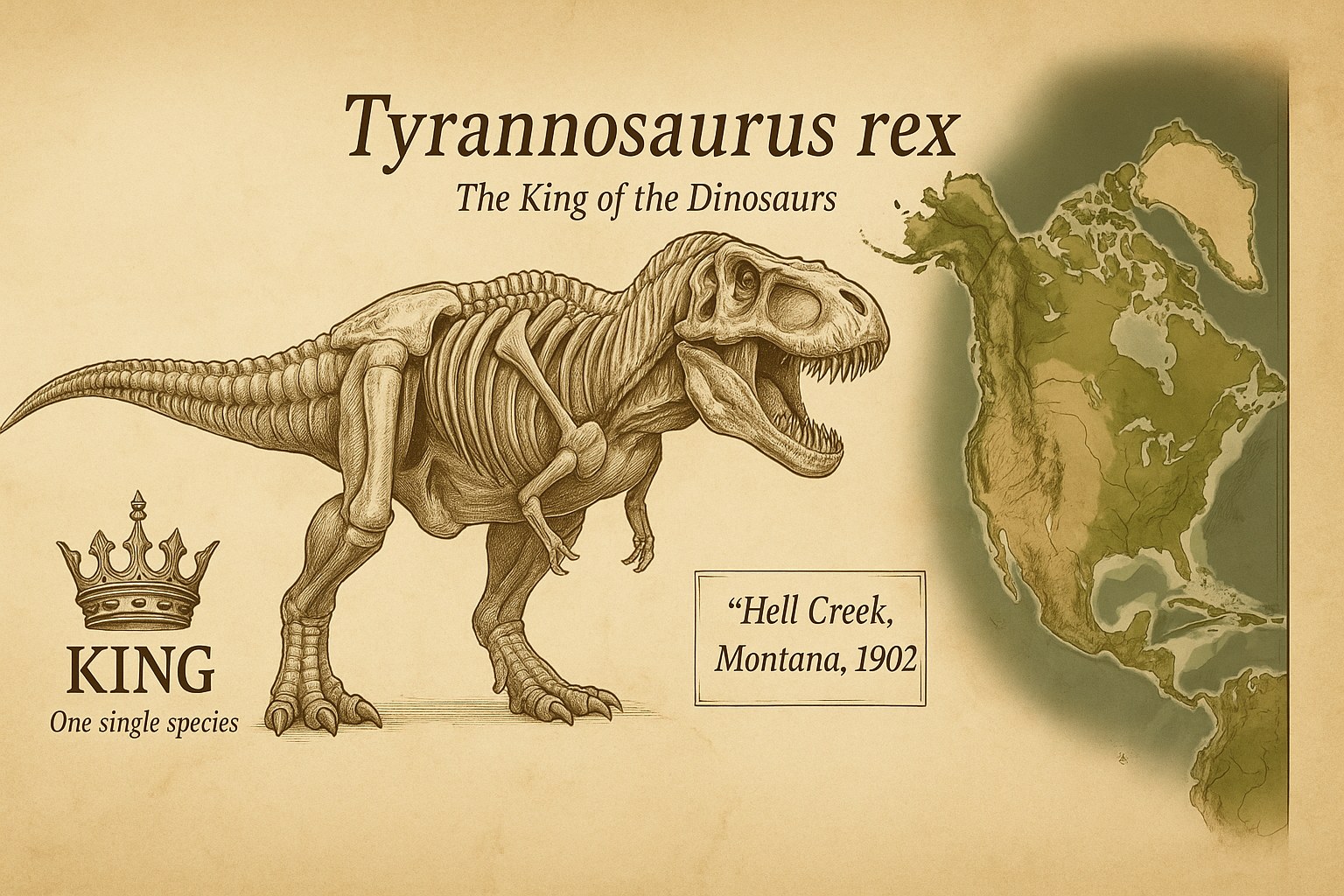
🗺️ Its stomping ground in North America
The Tyrannosaurus rex roamed Laramidia, a giant island continent. This land stretched from Alaska all the way to Mexico. The climate there was subtropical, humid and dotted with green plains.
Researchers dig mostly in the Hell Creek Formation to find its traces. It was in Montana, in 1902, that the very first specimen was unearthed. A truly rich area for fossil treasures.
The first Tyrannosaurus rex skeleton was discovered in 1902 in Hell Creek, Montana, by the palaeontologist Barnum Brown.
Thanks to Barnum Brown’s find, we know far more about the most iconic dinosaur in history. It was a key moment for modern palaeontology.
💪 An anatomy built for power
But beyond its grand name, it’s the physical build that commanded respect and dread among the creatures of its time.
📏 Measurements that make your head spin
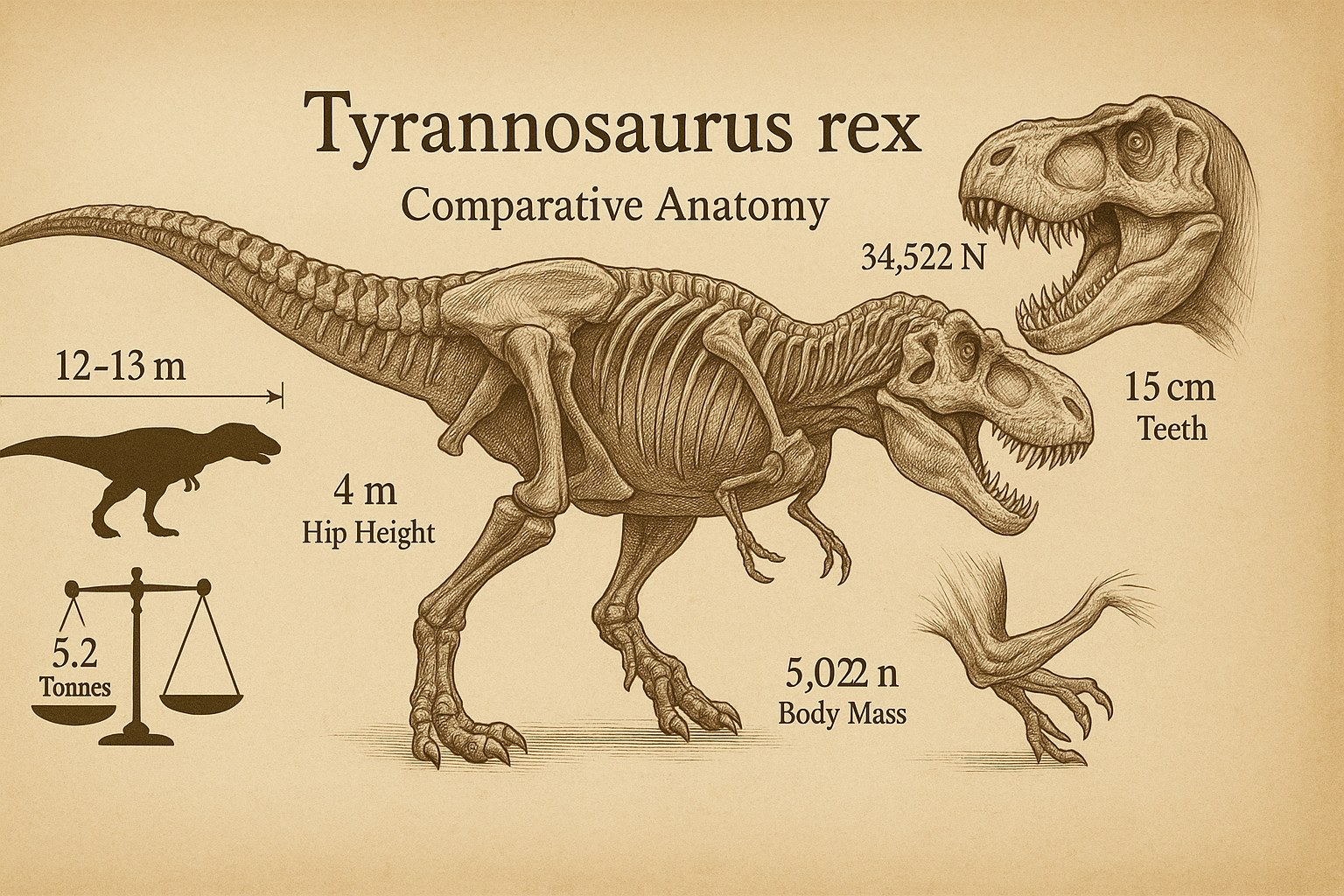
The Tyrannosaurus rex boasted dizzying dimensions. It reached 12 to 13 metres long. Its hips towered 4 metres high.
Its sheer bulk is impressive. Scientists put the average body mass of an adult at 5.2 tonnes. That’s a colossal weight for a two-legged animal.
Its frame outclassed that of other giant theropods. It was far more massive. Its robust skeleton made it a predator without equal.
🦷 A jaw that could crush bone
Its bite was phenomenal. It delivered a record force of 34,522 newtons. Nothing could withstand that kind of crushing pressure.
Its teeth looked like big serrated bananas. They measured 15 centimetres long. This shape handled extreme pressure without ever snapping.
These teeth pulverised the bones of its prey. Even armoured herbivores eventually gave way. Its jaw was a real biological war machine.
| Feature | Estimated value | Biological impact |
|---|---|---|
| Bite force (N) | 34,522 to 57,000 | Crushing bone |
| Tooth pressure (MPa) | Up to 2,974 | Deep puncturing |
| Skull length (m) | 1.53 | Mechanical leverage |
| Number of teeth | About 60 | Gripping and slicing |
💪 The puzzle of its tiny arms
Its one-metre arms look minuscule. Yet they held powerful muscles. Their sharp claws came in handy during close-quarters fights.
What these limbs were for is still debated. A help with mating, or a prop to get back on its feet? They may have shrunk to avoid accidental bites.
In short, these arms weren’t useless leftovers. They were specialised tools. They rounded off its hunter’s toolkit perfectly.
🏃 The busy life of a great theropod
Understanding its shape is one thing, but picturing its daily life and biological growth plunges us right into the heart of modern science.
🥚 Fast growth from egg to adult
The T. rex’s growth curve follows an S shape. As a teenager, this giant packed on around 600 kg a year. It was a genuine metabolic explosion.
It reached adulthood at about 18 or 20 years old. Its lifespan stayed short. It rarely topped 28 years, according to studies of its bone growth rings.
This intense life is typical of large predators. The pace was relentless in this ecosystem.
🌡️ Warm-blooded or cold-blooded?
The idea of mesothermy seems the most likely. The T. rex was neither a sluggish lizard nor a hyperactive mammal. It was an efficient in-between.
Analyses confirm a direct evolutionary link between this dinosaur and birds. Fossil proteins back up this close biological kinship. Studying its tissues reveals striking similarities.
Its imposing size kept its temperature steady. Thermal inertia played a big part.
🪶 Feathers or scales on its back?
Some skin impressions show clear scales. Yet its ancestors had feathers. Youngsters may have worn partial fuzz.
The theory of fleshy lips is gaining ground. Unlike crocodiles, it probably needed to protect its enamel. That kept its teeth safe from drying out.
Its appearance was less reptilian than expected. Here are a few key features of its portrait:
- Evidence of scales on the belly and tail
- A theory of feathers on the back for display
- Likely fleshy lips to protect the enamel
The Tyrannosaurus rex still surprises us with its biological complexity.
🍖 A diet under debate
This exceptional biological machine had just one goal: to fuel an energy-hungry metabolism with a steady diet of meat.
🦴 Fearsome hunter or simple scavenger?
The debate is settled. A 3.75 cm tooth found embedded in a hadrosaur’s vertebrae proves an attack on a living animal. It’s direct proof that the T. rex was an active predator.
Even so, it stayed an opportunist. Why turn down a fresh carcass? Eating without a fight avoided needless injuries.
This double role was clever. Hunting and cleaning up the ecosystem helped it thrive for millions of years.
🐢 A rather limited top speed
Forget chases at 50 km/h. The biomechanical simulations are clear. Its top speed capped out between 20 and 25 km/h.
Its bones couldn’t have taken the impact of a flat-out sprint. So it relied on ambush instead. Its long legs mainly allowed a very efficient fast walk.
It had no reason to be a sprinter. It just had to be faster than its massive prey.
🦕 Life among the triceratops
The menu was made up of Triceratops and Edmontosaurus. These herbivores had natural armour. So every hunt became a deadly, risky fight.
Danger also came from its own kind. Tooth marks on fossils prove cannibalism. They probably fought over territory or the leftovers of a meal.
Violence was the rule in the Maastrichtian. Survival demanded constant vigilance.
The location of the wound on the hadrosaur’s tail points to a pursuit strategy meant to pin down the prey.
🦴 These famous skeletons that speak to us
Everything we know today comes from a few exceptional individuals whose bones have travelled through the ages to tell us their story.
⭐ The stars Sue, Stan and Trix
Sue is the most complete specimen ever found. Its skeleton led to major breakthroughs in understanding the genus’s physiology. It’s a real goldmine.
Stan is famous for its perfect skull, while Trix is the European elder. These specimens are the world ambassadors of palaeontology. They fascinate young and old alike.
Fewer than 100 specimens have been found. So every new discovery is absolutely priceless for science and our knowledge.
🪨 Scars carved in stone
The holes in Sue’s jaw intrigue many people. According to some studies, they’re combat wounds rather than a disease. These marks reveal trauma caused by particularly violent fights within the species.
This giant’s body bore other marks too. We can see broken ribs, fused vertebrae and healed infections. A T. rex’s life was a string of physical injuries.
These wounds prove an incredible resilience. This giant survived even after brutal blows.
🔬 Unexpected traces of soft tissue
Mary Schweitzer made a revolutionary discovery. Blood vessels and collagen were found inside a fossilised thigh bone. It was utterly unthinkable for a fossil of that age.
These proteins let us compare the T. rex with today’s animals. They biologically confirm that birds are the direct descendants of theropod dinosaurs. The kinship with the ostrich became obvious.
Fossilisation can preserve far more than stone. Nature still has plenty of surprises in store for us.
🎬 The T. rex: cinema versus reality
Despite all this scientific evidence, the image of the T. rex stays inseparable from its overwhelming presence on the big screen.
🎬 The classic mistakes in films
Forget the idea that it could only see moving targets. In reality, the T. rex had excellent binocular vision. It was even sharper than a modern eagle’s.
Its movie roar is also a myth. It probably produced low-frequency infrasounds. These sounds were felt in the body more than they were heard.
Its posture wasn’t upright like Godzilla. The predator stood horizontally. Its tail then acted as an essential counterbalance.
⚔️ Up against Spinosaurus and Giganotosaurus
In terms of size, Spinosaurus was admittedly longer. Yet the T. rex was far more massive. Its bite was also far more devastating than its rivals’.
It would surely win a duel, thanks to its intelligence. Its brain was large for a dinosaur. Its highly developed sense of smell also gave it a clear tactical edge in the field.
In short, it remains the most finely tuned land predator. It’s a true natural war machine.
🏛️ Why it’s still the museum star
The Tyrannosaurus rex embodies raw power. It also stands for the mystery of extinction. That has fascinated children and researchers alike for a century.
According to the records, its first appearances date back to 1918. Ever since, it has become the ultimate ambassador of science. Its popularity never fades in the galleries.
- Appearances in King Kong and Fantasia
- A central role in the Jurassic Park franchise
- A permanent fixture in natural history museums
Around 2.5 billion of these kings once walked the Earth. They left an indelible mark on our collective imagination for ever.
This fearsome tyrant lizard king remains the absolute icon of the Cretaceous, thanks to its crushing bite and its captivating look. Go and explore the museums soon to admire its impressive skeletons, before new discoveries shake up what we know all over again. What a joy to imagine this giant ruling our ancient world!
❓ FAQ
👑 Why does the Tyrannosaurus carry this “king” name?
We owe this majestic name to the palaeontologist Henry Fairfield Osborn, in 1905. He combined the Greek “tyrannos” (tyrant) and “sauros” (lizard) with the Latin word “rex”, which simply means “king”. It’s a perfect way to describe this giant that ruled its world with absolute power.
The name calls to mind the animal’s imposing stature and fearsome strength. Even today, the T. rex remains the most iconic dinosaur in history, a true sovereign in the imagination of young and old.
🦖 Are there really several species of T. rex?
This is a question that caused quite a stir in the scientific world recently! In 2022, a study suggested splitting the species into three: the Rex, the Imperator and the Regina, based on how sturdy their thigh bones were. However, most experts preferred to keep our good old Tyrannosaurus rex as the one and only valid species.
For now, the evidence isn’t considered strong enough to rewrite the textbooks. So the differences seen between skeletons are taken to be simply natural variations within a single family — a bit like us!
🗺️ Where and when was this giant first discovered?
The very first Tyrannosaurus rex skeleton was discovered in 1902 in Hell Creek, Montana, by the famous fossil hunter Barnum Brown. It was a memorable expedition, where they had to use dynamite to free the bones from the sandstone rock before winter arrived.
At the time, Brown shipped no fewer than 15,000 pounds of bones to New York. This specimen lived around 68 to 66 million years ago, at the very end of the Cretaceous, in a region called Laramidia that today matches the western part of North America.
🦷 How strong was its jaw, really?
Hold on tight, because it’s impressive: its bite force is estimated at around 34,522 newtons! That’s an absolute record for a land animal. Its teeth, which look like big serrated 15-centimetre bananas, had no trouble pulverising the bones of even the toughest prey.
This incredible mechanical power let it eat absolutely anything it wanted. Whether it was a well-armoured Triceratops or a carcass found along the way, nothing could resist its steel jaws.
💪 What were its arms for, so small compared with its body?
This is the little mystery that often amuses children! Despite being around a metre long, these arms were very muscular and had two clawed fingers. Researchers think they could grip prey during a close fight, or even help the dinosaur get back up after a nap.
Another theory suggests their arms shrank over the course of evolution to avoid being bitten by accident by other T. rex during shared meals. So they weren’t useless — they were rather highly specialised tools.
🏃 Was the T. rex a fast hunter or a scavenger?
In fact, it wore both hats! Direct evidence, like a tooth found in a healed hadrosaur vertebra, proves it was an active and very violent predator. But like any good opportunist, it wouldn’t snub a fresh carcass for an effortless meal.
As for speed, forget the frantic chases of the films. Its joints didn’t let it go past 20 or 25 km/h. But with its size, a simple fast walk was more than enough to catch up with its favourite prey.
🪶 Is it true that the Tyrannosaurus had feathers?
It’s a very serious theory! While the skin impressions found on adults show mostly scales, it’s very likely that the babies and youngsters had a fuzz of feathers to stay warm. As they grew, they would have lost part of this prehistoric coat.
It’s also thought to have had fleshy lips to hide its teeth and protect the enamel from drying out. We’re a long way from the image of the bare, roaring lizard we so often see on television!
🧠 Was the T. rex a clever animal?
Opinions differ a little, but studies of its brain show surprising abilities. Some theories compare its intelligence to that of a baboon, while others put it closer to a crocodile. Either way, it had an exceptional sense of smell and binocular vision.
Its eyesight was even sharper than a modern eagle’s! Between its keen nose and its sharp senses, it was a very well-adapted animal, capable of elaborate hunting strategies.
