
It’s hard to imagine that some of nature’s treasures measure less than a centimetre and slip completely past our eyes during family walks. This article presents the smallest animals in the world: records and fact sheets to finally put a name to these tiny creatures, from Madame Berthe’s mouse lemur to the minuscule 8-millimetre frog. 🔬 You’ll discover detailed sheets on creatures with record-breaking metabolisms, like the Etruscan shrew, whose heart beats at a crazy speed to keep its little life going.
- Why the smallest animals impress us
- The Paedophryne amauensis frog and its 8 millimetres
- The Etruscan shrew, or life at full speed
- The crab and the dwarf wasps with invisible records
- The pistol shrimp and the bee hummingbird
- Madame Berthe’s mouse lemur, our mini cousin
- How do these tiny beings survive every day?
🔬 Why the smallest animals impress us
We’re often fascinated by nature’s giants, but the true feats of evolution sometimes hide in the infinitely small. These tiny, almost invisible creatures push the limits of what’s possible with an ingenuity that commands admiration.
🔍 The challenge of spotting these tiny beings
Tracking down a species just a few millimetres long is a real headache for biologists. Their natural camouflage and absolute discretion make them almost impossible to detect.
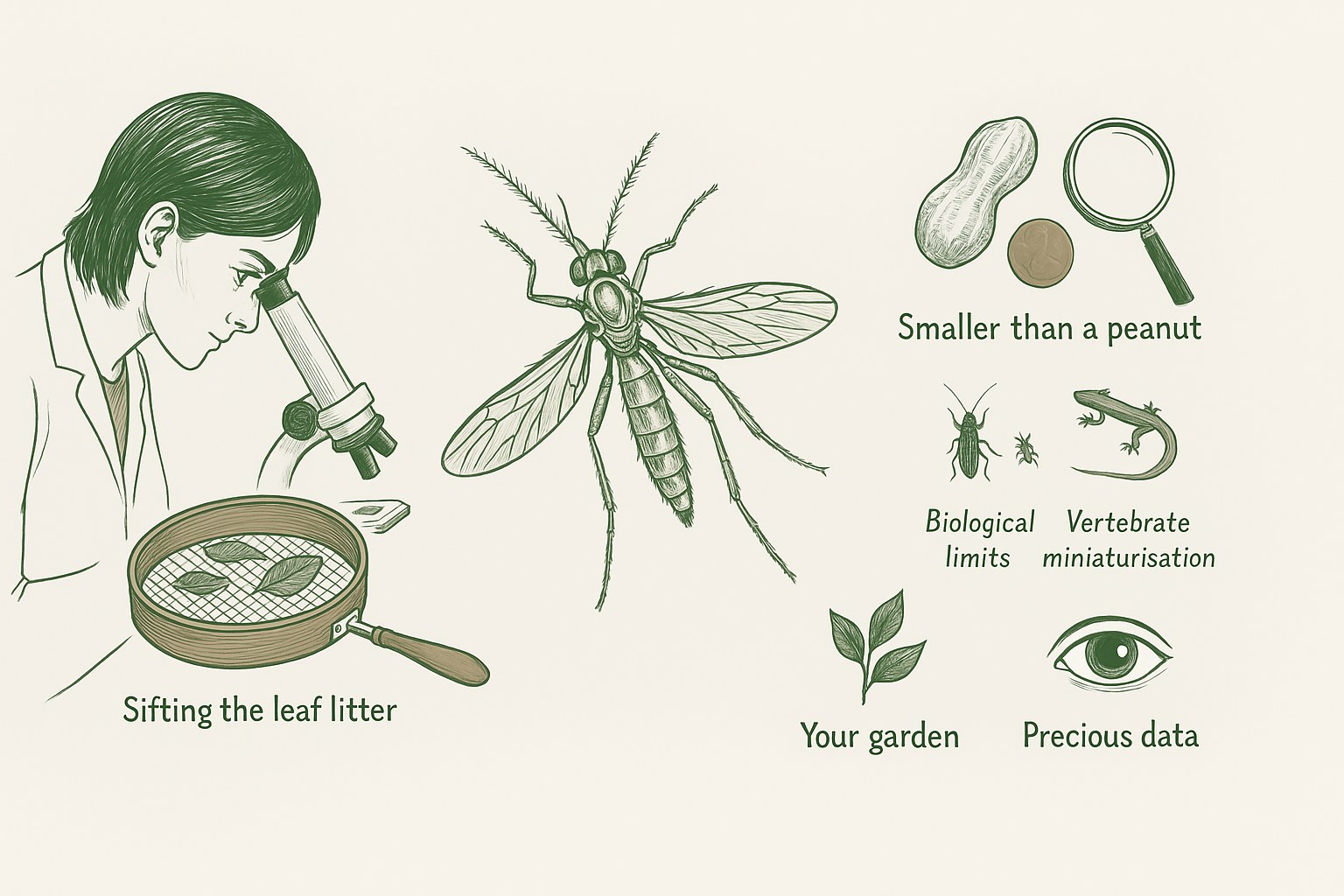
Scientists use precise techniques, such as carefully sifting through the forest floor litter. Even so, many species probably remain to be discovered in those carpets of leaves.
Science moves forward thanks to endless patience. Each new identification of a tiny being feels like a little technological miracle.
📏 A scale of size that’s hard to picture
To picture these records, imagine a creature smaller than a peanut or a coin. That’s the case for the Paedophryne amauensis frog, which measures only 8 millimetres.
Fitting a working skeleton and vital organs into such a tiny space is a major biological challenge. Miniaturisation in vertebrates is fascinating.
These dimensions brush against the physical limits of life. It’s sometimes hard to believe that such beings breathe and move about.
Exploring the smallest animals in the world helps us better understand how fragile our ecosystem is.
👀 The importance of citizen observation
The role of nature lovers is precious. Amateurs provide essential data on areas often overlooked by the big international scientific expeditions.
Tools like the Biodiversity Atlas make this work easier. A single sharp photo can help researchers record very discreet and little-known species.
Sometimes you just have to look carefully beneath your feet. The richness of biodiversity often begins in your own garden.
🐸 The Paedophryne amauensis frog and its 8 millimetres
Now that we’ve seen why these animals fascinate us, let’s take a closer look at the absolute star of miniature vertebrates, a frog that redefines the meaning of small.
🏆 A record-breaking vertebrate in Papua New Guinea
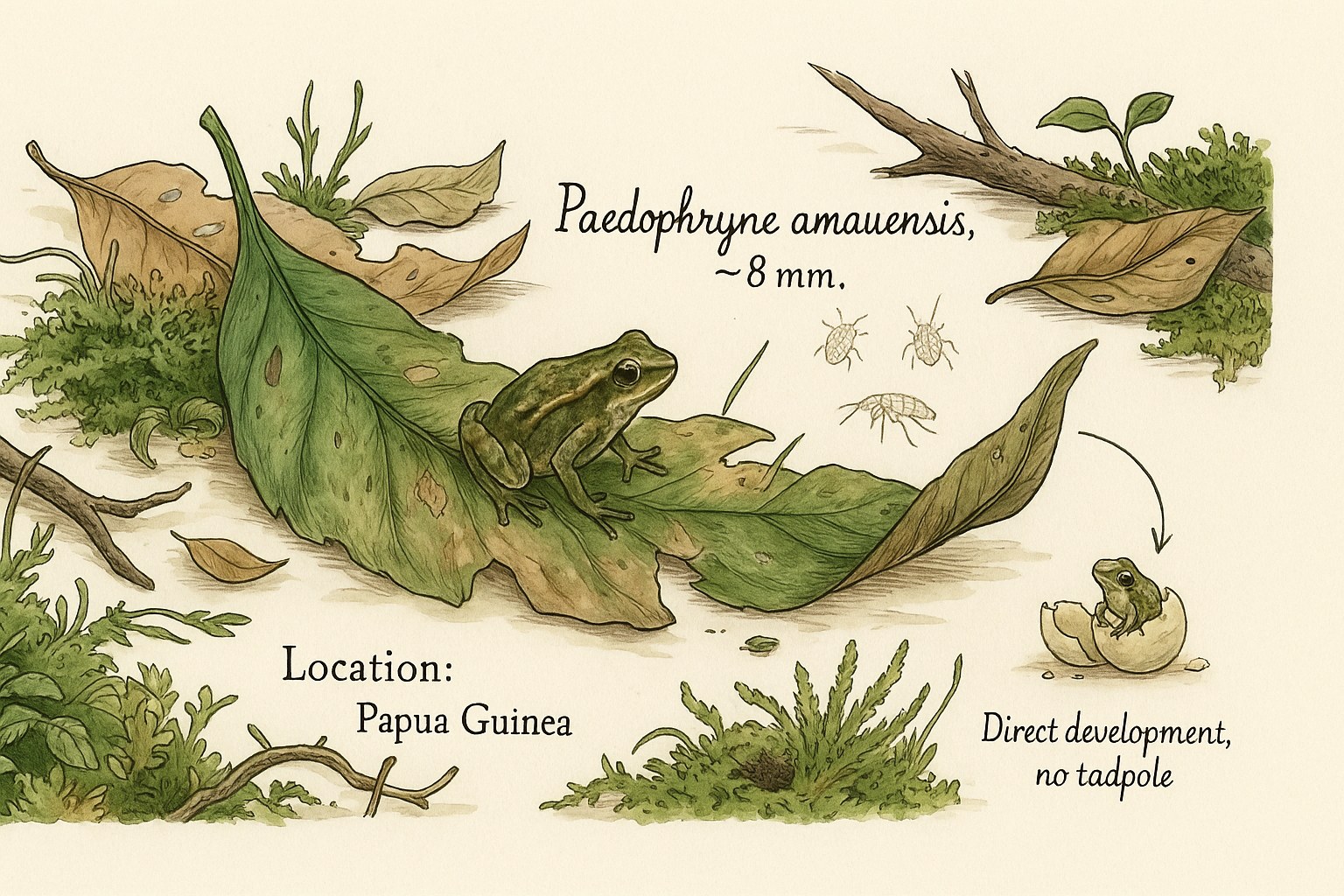
Paedophryne amauensis is a tiny creature. It measures only 7.7 millimetres on average. This little animal hides in dead leaves. It is especially fond of the humid forests of Papua New Guinea.
These amphibians are the smallest known tetrapods. They beat every size record among vertebrates. They are a true treasure of the world’s biodiversity.
🐜 A diet of mites
Its food is just as miniature. It hunts tiny prey such as mites.
Its size is a strategic advantage. It reaches ecological niches that are out of reach. Other predators can’t follow it there.
Its metabolism is finely tuned. Eating little is enough to keep it going. It stays incredibly active despite its size.
🐸 Born without going through the tadpole stage
Its life cycle is rather surprising. The egg hatches straight into a fully formed frog. There is no aquatic larval stage. No need to look for a pond to grow up.
It’s a truly brilliant natural adaptation. The species colonises the forest floor easily. It no longer depends on water sources at all.
🐭 The Etruscan shrew, or life at full speed
If the frog stands out for its discretion, the world’s smallest mammal makes up for its size with boundless energy and a frantic pace.
❤️ A little heart that beats very hard
The Etruscan shrew’s heart rate is simply staggering. When it’s active, its little heart tops 1,000 beats per minute. It’s an absolutely extraordinary physical performance.
This high rate meets a vital need. The smaller an animal is, the faster it loses its body heat.
You could compare this internal engine to that of a racing car. It’s a biological machine perfectly tuned for survival.
🍽️ A constant hunger to stay in shape
Its food needs are just as impressive. This shrew has to eat twice its own weight every day. If it goes without food for a few hours, it simply risks dying right away.
The Etruscan shrew lives on a knife’s edge, its metabolism demanding an almost non-stop search for food to survive.
🐭 The habits of this discreet shrew
This tiny creature with its pointed snout looks like a miniature cuddly toy. It weighs barely 1.8 grams day to day. It’s an absolute featherweight in nature.
You mostly find this little mammal around the Mediterranean. Its range, however, stretches as far as distant Asia.
This creature prefers to live at night. It then uses its long whiskers to hunt its prey in the deepest darkness.
🦀 The crab and the dwarf wasps with invisible records
Let’s leave the vertebrates behind and enter the realm of the infinitely small, where insects and crustaceans defy the laws of visibility.
🦀 A crab smaller than a grain of sand
The record for the smallest crustacean is impressive. Some crabs measure less than 0.1 millimetre. That’s a tiny size. You almost can’t see them without a powerful microscope.
Studying these creatures in the sea remains tricky. They often hide very well. You find them in the gaps in the sand. Corals also serve as a discreet refuge.
🐝 Dwarf wasps with funny names
Have you heard of Kikiki huna and Tinkerbella nana? These wasps measure about 0.2 millimetre. That’s a minuscule size. They are even smaller than some organisms made of a single cell.
Their anatomy is surprising. They have feathery wings. It’s a clever adaptation. It lets them swim through air that has become very thick for them.
- Kikiki huna: 0.15 to 0.19 mm, discovered in Hawaii.
- Tinkerbella nana: 0.25 mm, discovered in Costa Rica.
- Dicopomorpha echmepterygis: 0.13 mm (male), an egg parasite.
🔬 Life in the infinitely small
Living at this scale brings physical constraints. The air becomes as thick as syrup. Flight then changes its nature completely. It calls for specific movements that cost a lot of energy.
The diversity of small organisms is nonetheless immense. There are countless tiny creatures, like roundworms, that help us understand this hidden world. These species are everywhere but stay invisible to our eyes.
🦐 The pistol shrimp and the bee hummingbird
Size isn’t everything, and these two examples prove that a small build can hide either firepower or extraordinary agility.
🪙 A bird no heavier than a coin
The bee hummingbird, from Cuba, is tiny. It weighs less than 2 grams. It’s a true flying jewel with iridescent feathers.
Its nest is really tiny. It’s the size of half a walnut shell.
Its wings beat so fast. They’re a visual blur to the human eye.
🔊 The deafening noise of a little shrimp
The pistol shrimp has an incredible mechanism. It snaps its claw so fast that it creates a cavitation bubble. The sound it makes tops 200 decibels. That’s a feat for a five-centimetre crustacean.
This fearsome shockwave stuns its prey instantly. It’s one of the loudest sounds in the ocean.
💪 Physical abilities that surprise
| Species | Weight/Size | Special record | Habitat |
|---|---|---|---|
| Bee hummingbird | 1.6 g / 5 cm | Smallest bird | Cuba |
| Pistol shrimp | 5 cm | Sound of 200+ dB | Oceans |
| Etruscan shrew | 1.8 g / 8 cm | Smallest mammal | Mediterranean basin |
| Paedophryne amauensis | 8 mm | Smallest vertebrate | Papua New Guinea |
The hummingbird’s hovering flight is impressive. This effort demands colossal energy every day.
These small organisms are fascinating. They are masterpieces of natural engineering.
🐒 Madame Berthe’s mouse lemur, our mini cousin
Among mammals, one group touches us especially: the primates, whose smallest member fits in the palm of a hand.
🦍 The difference between a mammal and a primate
The mouse lemur is a real primate. Its grasping hands prove it well. Its big front-facing eyes help its vision. It’s a miniature lemur from Madagascar.
It differs from other small mammals. Its brain is more complex than a shrew’s. This proportion is quite astonishing. It’s a feature unique to primates.
🌙 A nightlife in the forests of Madagascar
This little being lives alone. It comes alive at night in Kirindy. It looks for fruit and insects. Its menu is quite varied.
Its reddish tail is essential. It works like a balancing pole. So it moves with agility.
It stays utterly discreet. Watching it without special equipment is impossible. It’s a real challenge for researchers.
⚠️ A little lemur in great danger
Its survival is now under threat. Deforestation shrinks its vital habitat. The IUCN classes it as critically endangered. Its future looks bleak.
The loss of Madame Berthe’s mouse lemur would be an irreparable loss for our understanding of primate evolution.
It weighs only 30 grams. The smallest animals in the world remind us how fragile it is. Protecting its forest is now urgent.
🌿 How do these tiny beings survive every day?
To round off this overview, let’s understand how these tiny creatures manage to hold their own.
🧬 Surprising biological adaptations
Survival calls for ingenuity. Some make huge leaps to escape. Others rely on a powerful venom despite their tiny size.
Their reproduction is often lightning-fast. That’s the secret to making up for losses and keeping the population stable.
Camouflage remains a major asset. Blending completely into the scenery is their most effective protection.
🏠 The question of keeping them as pets
It’s tempting to want to adopt these miniature beings. Yet they remain wild and extremely fragile. They thrive in nature, far from jars or narrow cages.
Ethics should guide our choices. Catching these species weakens ecosystems that are already on borrowed time. It’s better to watch them with respect and from a distance.
🌍 Protecting habitats to save these species
These animals play a vital ecological role. They are pillars of the food chain. Without them, the forest’s fragile balance ends up collapsing.
The resilience of life is fascinating, but it has its limits. Every species counts for biodiversity.
Citizen action makes the difference. Actively supporting nature reserves helps to protect the smallest animals in the world effectively.
From the tiny 8-millimetre frog to the Etruscan shrew’s speed records, these little beings prove that size does not dictate strength. Protecting their habitats is becoming urgent to preserve this fascinating biodiversity. Keep your eyes open on your walks: nature’s show often hides in the infinitely small.
❓ FAQ
🐸 What is the smallest vertebrate animal recorded to date?
The record for the world’s smallest vertebrate belongs to a tiny frog called Paedophryne amauensis. Discovered in the rainforests of Papua New Guinea, it measures only 7.7 to 8 millimetres on average. Simply put, it’s so small it could sit on the tip of your little finger!
🐭 Which mammal holds the record for the smallest size?
It’s the Etruscan shrew, a small shrew weighing only between 1 and 3 grams. Despite its featherweight, it’s a real live wire: its heart can beat up to 1,400 times a minute. It has to eat the equivalent of twice its weight every day to keep up the pace.
🐒 Are there miniature primates that fit in your hand?
Yes, and it’s Madame Berthe’s mouse lemur that holds this title. This little lemur from Madagascar measures about 9 centimetres and weighs 30 grams. Sadly, this “mini cousin” is now critically endangered because of the deforestation shrinking its natural habitat in the Kirindy forest.
🐦 What is the smallest and lightest bird in the world?
It’s the bee hummingbird, from Cuba, that takes the prize. Weighing less than 2 grams, it’s no heavier than a small coin. Its iridescent feathers and its nest the size of half a walnut shell make it a true marvel of nature, almost unreal to watch.
🦐 How does the pistol shrimp use its small size as a weapon?
The pistol shrimp, although it measures only 3 to 5 centimetres, has an asymmetrical claw able to create a cavitation bubble. By snapping its claw, it generates a shockwave and a deafening sound of 220 decibels. It’s a fearsome technique for stunning its prey in the blink of an eye.
🐛 What are the tiniest insects known to science?
The insect world holds records invisible to the naked eye, like the dwarf wasps Kikiki huna and Tinkerbella nana. They measure about 0.25 millimetre, which makes them smaller than some single-celled organisms. At this scale, the air becomes as thick as syrup for them!
🌍 How can we help protect these very discreet species?
The protection of these little beings comes first and foremost from preserving their natural habitat. You can also take part in initiatives like the Biodiversity Atlas by sharing your own observations. Watching where you put your feet and supporting nature reserves are lovely gestures for these champions of discretion.
